Distinguish material tin from a tin of food, then learn the familiar compounds and idioms.
Material, container, contents
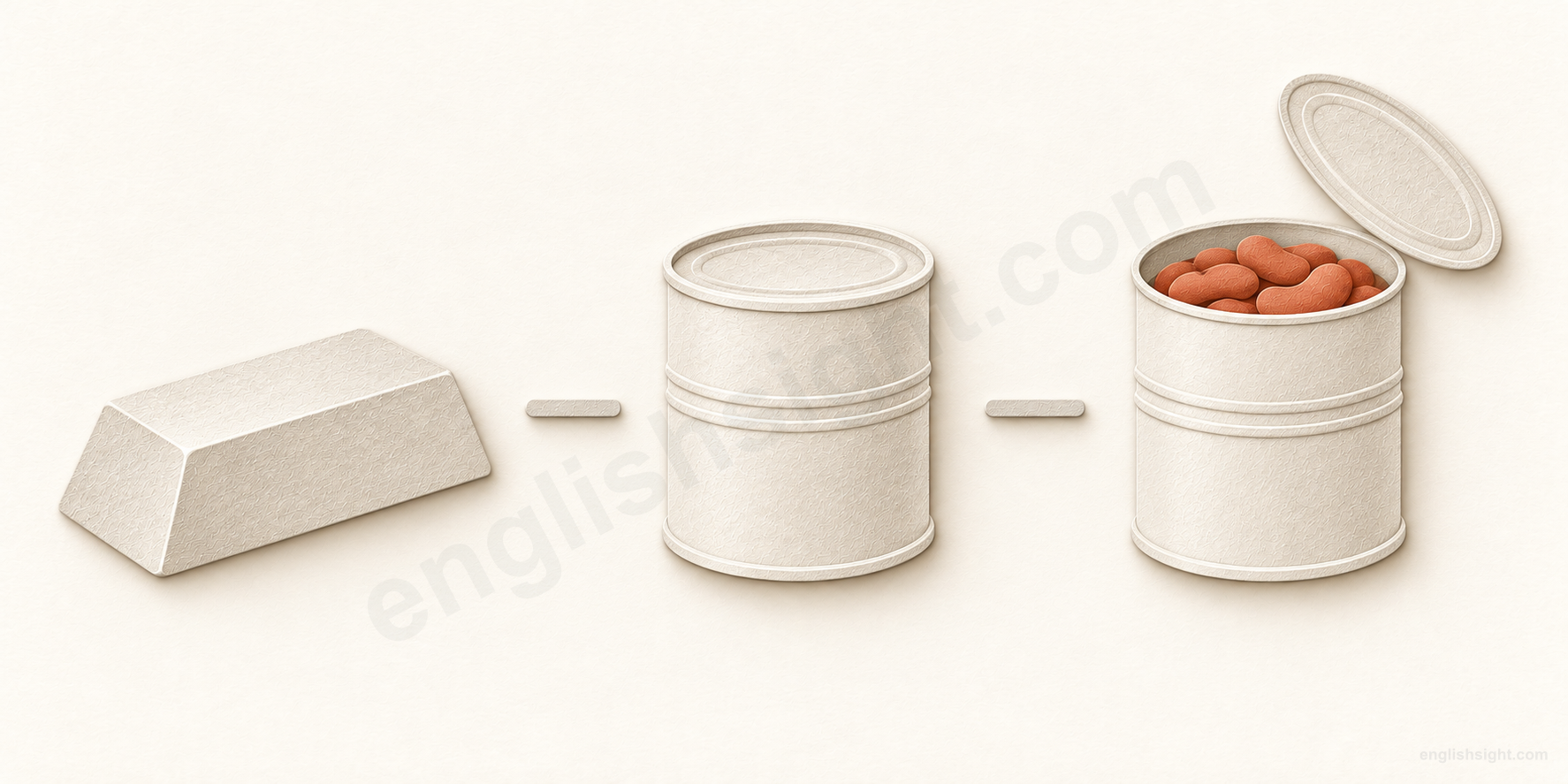
From material to container to contents
Tin: the metal
tin
A tin of beans: the container and its contents
A tin: a metal container
Material, container, contents: related uses, not manufacturing stages or a guarantee of pure tin.
Tin names a metal; in everyday use it also names metal containers and their contents.
The connecting lines show related uses of a word, not a manufacturing process. A modern tin need not be made entirely of metallic tin. Idioms are separate established branches.
Tin names a metal, but everyday English also uses it for metal containers and the amounts inside them. Grammar and context tell you which meaning matters.
This lesson uses that material–object–contents connection as a teaching model. Fixed expressions have their own meanings, and no single picture is shared by every English speaker.
01
The metal and familiar material names
First distinguish a substance from a named product. A familiar name does not always identify the exact metal used.
01
tin; some tin; a piece of tin; made of tin
made of tin
refer to the metal as a material
Situation
You identify a sample of metal.
What the expression identifies
You name its substance rather than count objects.
Material tin is uncountable; a tin is a container.
Tin /tɪn/ names the element with symbol Sn. It is a soft, pale, silvery metal used in mixtures with other metals and in protective coatings.
Use some tin, a piece of tin, or made of tin for the substance. Two tins normally means two containers. In a tin mine, tin tells us what is extracted; the mine itself is not made of tin.
In a sentence
The small ornament is made of tin.
Watch the difference Do not use a tin to mean an unspecified amount of the metal.
02
tin + noun: tin roof / box / can
a tin roof / a tin can
recognize tin in names for thin metal objects
Situation
Someone describes a metal roof or food container.
What the expression identifies
You recognize the product without assuming it is pure tin.
A material word can become an established product description.
Tin comes before another noun in tin roof, tin box, and tin can. In these familiar names, it can refer to sheet metal or tinplate rather than an object made entirely of the element.
Collins explicitly includes corrugated or galvanized iron under the roof use. Merriam-Webster allows metal containers made of other metals. The word alone therefore does not establish the exact composition of a roof or can.
In a sentence
Rain drummed on the tin roof of the shed.
Watch the difference Do not treat tin as a general synonym for every metal in every setting.
03
some tinfoil; a sheet of tin foil; wrap something in foil
tinfoil / tin foil
name thin metal wrapping
Situation
You need to cover a dish.
What the expression identifies
You ask for foil rather than a rigid container.
The everyday name need not mean foil made from the element tin.
Tinfoil, also written tin foil, is thin metal sheet used for wrapping or covering. It is uncountable: some tinfoil, a sheet of tinfoil, or wrap something in tinfoil.
Modern household foil is commonly aluminum, called aluminium in British spelling. Foil or aluminium/aluminum foil makes that material clearer. This is a related product name, not the countable container sense of tin.
In a sentence
I covered the dish with a sheet of tinfoil.
Watch the difference Say a sheet of tinfoil, not a tinfoil, when counting pieces.
02
Containers, contents, and kitchen tools
In British English, tin covers several everyday containers. Read the following noun or the situation to identify the kind.
04
a tin of + food; open / empty a tin; a tin can
a tin of beans
name a sealed food container
Situation
You are shopping for food that keeps in a sealed container.
What the expression identifies
You request a particular packaged product.
Tin is countable here; of introduces what is inside.
In British English, a tin of beans names a sealed metal package of food. Open the tin refers to the container; eat the beans refers to its contents.
American English usually says a can of beans. Can is also used in British English. Tin can is a longer container name; neither expression guarantees that the whole container is pure tin.
In a sentence
Could you buy a tin of chickpeas for tonight?
Watch the difference Use of in a tin of beans; a bean tin describes a kind of container instead.
05
number + tin(s) of + contents; a paint tin
two tins of tomatoes / a tin of paint
measure an amount by its container
Situation
A recipe or decorating job needs a certain amount.
What the expression identifies
You count container-sized quantities.
Tins can count packages or the amounts they hold.
Add two tins of tomatoes means add the tomatoes contained in two tins, not add the metal. Use the plural tins after two. The exact amount depends on the package size.
The same container-to-contents relationship works with paint: We used a tin of paint. British English also calls the lidded paint container a paint tin; American English normally uses paint can. A paint tin is not a baking pan.
In a sentence
The sauce needs two tins of chopped tomatoes.
Watch the difference One tin is not a universal weight or volume; check the size if precision matters.
06
a biscuit / cookie tin; keep something in a tin
a biscuit tin / an airtight tin
name a reusable lidded metal box
Situation
You want somewhere to keep biscuits or small objects.
What the expression identifies
You put them in a container with a lid.
Storage tins need not be sealed food cans or cylinders.
A biscuit tin or cookie tin is a lidded metal container for storage. An empty biscuit tin is still that kind of container even when it holds buttons. A tin of biscuits focuses on the contents.
Store something in a tin identifies location; put it into a tin describes placement. Airtight means that the closed container keeps air out. Cake tin can mean a storage tin or, in British recipes, a baking container: context matters.
In a sentence
She keeps spare buttons in an old biscuit tin.
Watch the difference A tin can be rectangular; do not define every tin as a cylinder.
07
a cake / loaf / baking tin; grease / line a tin
a cake tin / a loaf tin
name a metal container used for baking
Situation
You have prepared cake mixture.
What the expression identifies
You choose the container it will bake in.
The first noun identifies the baking purpose, not the current contents.
In British recipes, a cake tin or loaf tin is the container in which you bake a cake or loaf. It can be empty when you grease or line it. American English usually uses cake pan or loaf pan.
The regional difference is a useful guide, not a ban on American tin: muffin tin and pie tin also occur in American English. Unlike a sealed food tin, a baking tin is used open during baking.
In a sentence
Line the loaf tin before adding the mixture.
Watch the difference A tin of cake describes contents; a cake tin names the container or its intended use.
08
a tin opener; open a tin with a tin opener
a tin opener
name the tool for opening food tins
Situation
A food tin has no easy-open lid.
What the expression identifies
You ask for the opening tool.
Tin modifies opener by naming what it opens.
A tin opener is a kitchen tool used to open food tins. The standard American equivalent is can opener, which is also used in Britain.
The compound names the function of the tool, not its material. Compare a tin box, where tin describes a material or established metal-container type. Learn the relationship expressed by each compound.
In a sentence
Where is the tin opener? I need to open the soup.
Watch the difference The tool is an opener; it is not itself another food tin.
03
Preserving food and coating metal
The verb has two different object relationships: put food into a container, or put a coating onto metal.
09
tinned + food; tin + food; food is tinned
tinned tomatoes / tin food
describe or carry out food preservation in tins
Situation
Food is packed into sealed containers.
What the expression identifies
It is described as tinned food.
Food goes into a tin; the food is not coated with the metal.
Tinned tomatoes and tinned fish are foods preserved in cans. Tinned is especially British; canned is the ordinary American choice and is also used in Britain.
The transitive verb tin means package or preserve food in tins: The factory tins the fish. Its forms are tins, tinned, tinning, with double n in the last two. In everyday shopping, the adjective is often the useful form.
In a sentence
We used tinned peaches because fresh ones were unavailable.
Watch the difference Tinned fish means fish preserved in a tin, not fish covered in metallic tin.
10
tin + metal / surface; a tinned surface; tinning
tin a metal surface
apply a layer of tin or tin alloy
Situation
A metal surface has no such coating.
What the expression identifies
A thin layer is applied to it.
Here the object receives a coating rather than being put into a food container.
In metalwork, tin is a transitive verb for coating a surface with tin or a tin alloy. A surface can be tinned, and tinning names the process.
In soldering, tinning can specifically mean applying a thin layer of solder to prepare a surface. This technical sense helps distinguish tinned metal from tinned food; it is recognition vocabulary here, not an instruction in metalworking.
In a sentence
The manufacturer tins the metal surface before assembly.
Watch the difference Read the object: tin fish and tin a metal surface describe different operations.
04
Fixed expressions beyond the kitchen
These expressions use established figurative meanings. Learn the whole phrase and its tone rather than predicting it from a metal container.
11
(it) does (exactly) what it says on the tin
does what it says on the tin
work as the description promises
Situation
You try a product with a straightforward claim.
What the expression identifies
You find that it delivers the promised function.
The imagined label stands for the description or promise.
This informal expression is especially associated with British English. It can praise something for performing the function its description leads you to expect, without suggesting extra features.
The subject need not be a physical product in a tin: software or a service can do what it says on the tin. Exactly strengthens the match. The whole expression is established; tin alone does not mean promise.
In a sentence
This timer does exactly what it says on the tin: it rings when the time is up.
Watch the difference The expression does not imply that the item is luxurious or unusually advanced.
12
be like a cat on a hot tin roof
like a cat on a hot tin roof
describe visible nervousness or agitation
Situation
Someone is worried while waiting for an important event.
What the expression identifies
They seem unable to relax.
The cat image suggests restless discomfort; the person is not literally on a roof.
Be like a cat on a hot tin roof describes being very nervous or agitated. The comparison is vivid and informal rather than a neutral description of temperature.
The whole phrase carries the feeling. Hot tin by itself simply describes hot metal; it does not independently mean nervous. British English also has like a cat on hot bricks.
In a sentence
Waiting for the interview, I was like a cat on a hot tin roof.
Watch the difference Use the comparison for anxiety or agitation, not merely because someone feels physically hot.
13
have a tin ear; have a tin ear for + noun
have a tin ear for something
lack a good feel for sound or a sensitive response
Situation
A person misses musical differences or the effect of words.
What the expression identifies
You criticize their lack of sensitivity.
The expression is a judgment about perception or sensitivity.
Have a tin ear can mean having little ability to appreciate music or hear its qualities well. Have a tin ear for dialogue can criticize a writer whose speech sounds unnatural.
The expression also extends to insensitivity to other people’s concerns. This is a critical idiom, not a medical description of hearing. For introduces the area: a tin ear for music or for the audience’s mood.
In a sentence
The writer has a tin ear for dialogue; every character sounds the same.
Watch the difference Do not use this idiom as a neutral way to say someone is deaf.
14
a (little) tin god; behave like a little tin god
a little tin god
criticize someone who acts excessively important and powerful
Situation
A person with limited authority demands unquestioning obedience.
What the expression identifies
Others object to their inflated self-importance.
Tin contributes a disparaging comparison rather than a material description.
Calling someone a tin god, often a little tin god, criticizes a bossy or pompous person who behaves as though their authority cannot be questioned.
Another recorded use refers to someone given undeserved reverence. The shared criticism is inflated status. This is a strong, potentially insulting description, so it is more useful to recognize than to use casually about someone.
In a sentence
The new supervisor acts like a little tin god and refuses to hear suggestions.
Watch the difference Little does not describe physical size here, and tin god is not praise.
15
something puts the (tin) lid on + plans / hopes / things
put the tin lid on something
be the final setback that ruins a plan
Situation
Several problems have already damaged your plans.
What the expression identifies
One more event makes success impossible.
The final event closes off the remaining hope.
Put the tin lid on something, also put the lid on something, is a British informal expression for a final event that makes plans or hopes fail. The event itself can be the subject.
This is different from keeping a lid on something, which can mean controlling it or keeping it secret. The added word tin belongs to this established expression; a literal tin lid is simply a metal cover.
In a sentence
The cancelled train put the tin lid on our plans for a day at the coast.
Watch the difference Do not confuse the final-setback idiom with keeping something under control.
Read the noun, the object, and the whole phrase
Countability changes meaning
As a material, tin is uncountable. The plural tins refers to containers or container-sized quantities. In two tins of soup, tins is plural while soup remains a mass noun.
Regional choices are guides
British food tin usually corresponds to American can; a British baking tin usually corresponds to an American pan. Cookie tin, muffin tin, and pie tin show why tin is not absent from American English.
A label is not a chemical analysis
Tin can, tin roof, and tinfoil are established everyday names. They do not always specify the exact material. The diagram explains a naming connection, not a rule for inferring composition.
Forms and limits
The noun plural is tins. The verb forms are tin, tins, tinned, tinning; it can take an object and occur in the passive. No productive particle-verb family or special causative pattern is needed here. Technical metalworking details, historical slang, specialist compounds, and capitalized TIN are outside this lesson.
Choose the meaning in context
Use the situation and grammar to decide what tin contributes.
1. You are naming the metal in a small sample. Which phrase names the substance?
2. A recipe says “Add two tins of tomatoes.” What should go into the sauce?
3. In a British recipe, you must grease a cake tin before pouring in the mixture. What is it?
4. A workshop says a metal surface has been tinned. Which meaning fits?
5. A simple app “does exactly what it says on the tin.” What is the speaker saying?
Sources and teaching notes
Dictionary entries support the uses and regional notes below. The explanations, examples, and naming diagram were created for this lesson; the diagram is a teaching interpretation.
The diagram is a teaching model, not a picture shared by every native speaker.