Use tired for needing rest, tired of for lost patience or interest, and tired ideas for lost freshness.
Less energy, interest, or freshness
Less energy, interest, or freshness
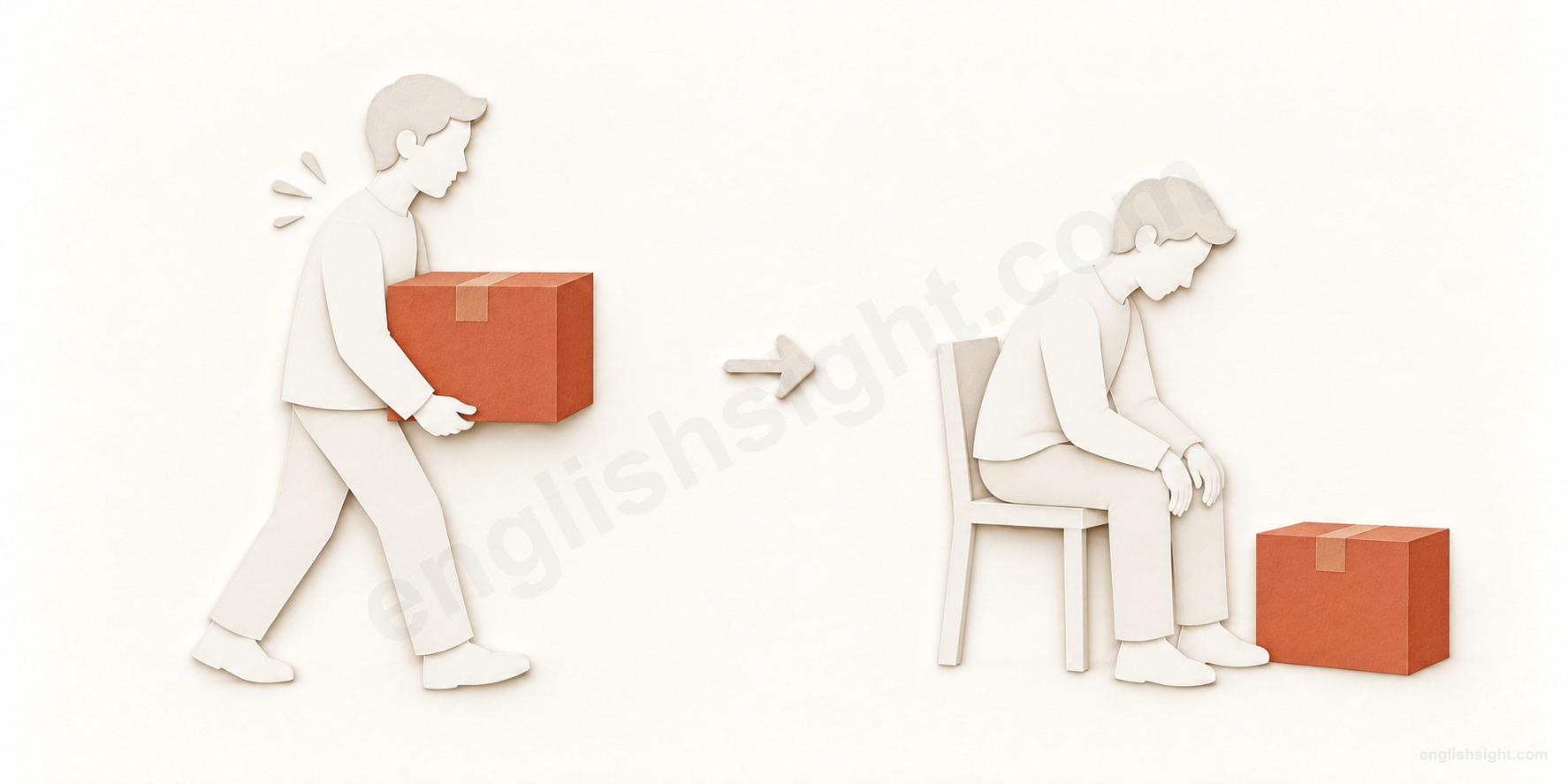
The person carries a box with effort.
tired
The same person sits beside the box with head and shoulders lowered.
After the effort, their energy is low.
Tired names a need for rest; pausing is one possible response.
Tired describes needing rest. In tired of, someone has had enough of an experience; with ideas or worn surroundings, tired describes a loss of freshness.
The picture shows one physical example: the same person works, then pauses with a drooping posture. Tired names the condition, not a required action or a promise that rest follows. The other branches need their own context.
After effort or too little rest, you may be tired. When a repeated experience becomes unwelcome, you may be tired of it. The words around tired help you tell these situations apart.
A tired joke does not need sleep: it has been used too often. These connections are useful teaching comparisons, not a rule for inventing meanings or a picture shared by every English speaker.
01
Needing rest
Describe a person’s condition, the part that needs a break, the cause, and how that condition limits an activity.
01
be / feel / look / get + tired; a tired + person
be / feel / look / get tired
need rest, feel that need, show it, or begin to need it
Situation
You have been busy since early morning.
What the speaker means
You describe your low energy.
The linking verb tells us how the tired condition is presented.
I am tired states the condition. I feel tired reports your experience; You look tired comments on someone’s appearance. Get tired describes a change, so I get tired quickly is about how soon fatigue begins.
Tired can also come before a noun: a tired parent. It is an adjective here. In I was tired yesterday, was carries the past tense; tired itself does not mean past time.
For degree, say a little tired, very tired, or more tired than yesterday. Tired need not mean completely exhausted.
Example in context
I’m tired, so I’ll finish the washing-up tomorrow.
Keep the distinction Say I am tired or I feel tired, not I tired when describing your present condition.
02
tired + body part; body part + be tired; physically / mentally tired
tired eyes / mentally tired
describe fatigue in a body part or from mental effort
Situation
You have read and concentrated for several hours.
What the speaker means
Your eyes need a break, and concentrating feels difficult.
Tired is not limited to whole-body effort or immediate sleepiness.
My eyes are tired and tired feet name the part that feels overworked. The person may still be alert; a body part can need rest without the whole person being ready to sleep.
Physically tired emphasizes bodily fatigue; mentally tired emphasizes the effort of thinking or concentrating. You can be both at once.
Sleepy focuses on being ready to fall asleep. After a demanding discussion, you might be mentally tired but not sleepy. The meanings overlap without being identical.
Example in context
My eyes are tired, but I’m not sleepy yet.
Keep the distinction Tired eyes do not mean that the eyes themselves can go to sleep independently.
03
tired from + noun / -ing; tired after + noun / -ing
tired from / tired after
identify what caused fatigue or when it is felt
Situation
You carry furniture up several flights of stairs.
What the speaker means
Your muscles need rest because of that effort.
From points to a cause; after places the fatigue after an event.
Tired from carrying boxes connects the fatigue to the effort. From can take a noun or an -ing form: tired from the journey; tired from walking. After can likewise introduce the earlier event or activity.
I’m tired after work gives a time relationship and often suggests that work was tiring. From makes the cause more explicit. Neither preposition means that you dislike the activity.
Compare tired from cooking with tired of cooking. The first describes fatigue caused by cooking; the second normally says you have had enough of cooking. Someone could feel both, but the phrases highlight different things.
Example in context
We’re tired from carrying the furniture upstairs.
Keep the distinction Do not choose of merely to name the cause of physical fatigue; from or after usually expresses that intention more clearly.
04
too tired to + verb; too tired for + noun; so tired that + clause
too tired to…
have too little energy for an action
Situation
You consider cooking, but you can hardly keep going.
What the speaker means
You decide that cooking is beyond your energy at present.
Too connects the degree of fatigue with an action that is difficult or prevented.
Too tired to cook says the tiredness exceeds what is compatible with cooking in this situation. To cook supplies the action; it is not a purpose such as becoming tired in order to cook.
Too tired for a walk uses a noun phrase instead. So tired that I fell asleep gives an actual consequence in a full clause. Very tired simply gives a high degree without specifying either result.
Not too tired to help removes the stated barrier: I still have enough energy to help. It does not necessarily mean I feel fresh.
Example in context
I’m too tired to cook tonight; let’s have something simple.
Keep the distinction Use too tired to cook, not too tired for cook. With for, use a noun phrase such as a long walk.
05
be / feel tired out; be dead tired / dog-tired; tire + person + out
tired out / dead tired / dog-tired
emphasize a strong need for rest
Situation
A long day of moving house is finally over.
What the speaker means
You emphasize how exhausted you feel.
These familiar combinations intensify tiredness rather than add a new kind of activity.
I’m tired out means I am very tired. Compare The move tired me out: tire is now a verb, with me as its object. With a pronoun, put it before out: It tired me out, not It tired out me.
Dead tired and dog-tired are informal ways to say very tired. Dead is an intensifier here, not a statement about death; dog-tired does not require a dog in the scene.
Use these expressions with care about tone: I’m dog-tired is conversational. Very tired is a neutral choice. Dog-tired usually follows a linking verb rather than coming before a noun.
Example in context
By the time we unpacked the last box, we were tired out.
Keep the distinction Tired out describes the resulting condition; tired me out describes what caused someone’s fatigue.
02
Having had enough
With of, tired often concerns interest or patience. Repetition may make a person want something to stop.
06
be / get / grow tired of + noun / pronoun / -ing; tired of + person + -ing
be / get tired of…
have or develop a wish for an experience to stop or change
Situation
The same song plays repeatedly.
What the speaker means
You no longer want to hear it.
Of introduces the person, thing, or activity that has become unwelcome.
Tired of the song describes boredom or irritation, not a claim that listening has exhausted your muscles. You may want variety or want the experience to end.
After of, use a noun, pronoun, or -ing form: tired of it; tired of waiting. To name someone else’s behavior, use tired of people interrupting. The person experiencing the feeling is the subject; the source of the feeling follows of.
Get or grow tired of marks a developing reaction. I never get tired of this view expresses continuing enjoyment: repeated experience does not spoil it for me. This is ordinary negation of the tired-of pattern.
Example in context
I’m getting tired of hearing the same song every morning.
Keep the distinction For the activity, say tired of waiting, not tired of wait or tired to wait.
07
be sick and tired of + noun / -ing
be sick and tired of…
express strong irritation and impatience
Situation
People repeatedly leave dirty cups on your desk.
What the speaker means
You complain firmly and want them to stop.
The whole fixed expression strengthens the complaint.
Sick and tired of is an emphatic, informal way of saying you have had enough. Sick does not normally report a physical illness in this expression.
The same of-complement patterns apply: sick and tired of the mess; sick and tired of cleaning up. The expression can sound angry, so a request such as Please clear your cups away is often gentler.
Plain I’m tired without of normally describes fatigue. Adding and another adjective does not always create an idiom: tired and hungry can simply describe two conditions.
Example in context
I’m sick and tired of finding dirty cups on my desk.
Keep the distinction Do not interpret sick and tired of as a medical diagnosis or use it as a neutral, mild request.
03
Losing freshness
Things can be tired through overuse or wear. This is an evaluation, not literal human fatigue.
08
a tired (old) + joke / excuse / idea; the same tired old + plural noun
the same tired old excuses
criticize ideas or expressions as overused and uninteresting
Situation
You hear an excuse that has been offered many times.
What the speaker means
You dismiss it as lacking anything fresh or convincing.
The excuse is tired; the person is tired of hearing it.
A tired joke, a tired cliché, or tired excuses have been repeated so much that they feel stale. This use often comes before the noun and conveys criticism.
Old reinforces familiarity in tired old excuses. It need not mean the speaker knows their exact age. A long-established idea is not necessarily tired; tired adds a negative judgment about its freshness.
Compare His excuses are tired with I’m tired of his excuses. One evaluates the excuses; the other reports my reaction. Either can be true without the other being stated.
Example in context
The advert relies on the same tired old jokes about age.
Keep the distinction A tired joke is not necessarily a tiring joke: tired means overused here, while tiring means causing fatigue.
describe something as worn and in need of refreshing
Situation
A room has faded curtains and scuffed furniture.
What the speaker means
You judge its appearance as worn rather than fresh.
Physical wear gives an object or place a tired appearance.
A tired interior or a room that looks tired can describe surroundings that show age or heavy use. Tired-looking makes the reference to appearance explicit.
This extends the idea of lost freshness to a physical setting. The room is not sleepy; it may need cleaning, repairs, or redecoration. The word alone does not tell you which change is needed.
The worn-room use differs from a tired joke: the room shows physical wear, while the joke has become stale through repetition. Both are contextual evaluations, not literal fatigue.
Example in context
Fresh paint brightened the tired-looking waiting room.
Keep the distinction A tired room comments on its worn appearance; a tiring room would need a context explaining how it makes people tired.
Let the grammar identify what is tired
Tired and tiring
The climb was tiring; the walkers were tired. Tiring describes what causes fatigue, while tired usually describes who experiences it. The endings do not simply mean present versus past. A tired-looking person can be someone you are looking at right now.
Adjective and verb
Tired is also the past tense and past participle of tire: The journey tired me. In I am very tired, it functions as an adjective. Tire someone out is a verb pattern; be tired of is an adjective with a prepositional complement, not a separable phrasal verb.
Scope and tone
This lesson covers ordinary fatigue, tired of, emphatic combinations, stale expressions, and worn surroundings. The British euphemism tired and emotional can mean slightly drunk in an appropriate context; it is not a general synonym for needing rest. Specialized tired meaning fitted with tires, and separate lessons on tiredness or tiredly, are outside this scope.
Choose the intended meaning
Look at the cause, the complement, and who or what the adjective describes.
1. You enjoyed gardening, but the physical work left you needing rest. Which sentence says that most clearly?
2. A long journey made you need rest. Complete: The journey was ___, and I was ___.
3. You have too little energy to continue working. Which sentence expresses that limit?
4. A speaker tells a tired old joke. What does tired describe here?
5. Someone says, “I never get tired of watching the sea.” What do they mean?
Sources and teaching notes
The sources below support the meanings and usage distinctions. Explanations, examples, and the visual teaching comparison were created for this lesson.
The picture illustrates one connection; English speakers need not share a single mental image.