From a body part to footwear, readiness, and familiar social expressions.
A distinct part at the foot’s front
A distinct part at the foot’s front
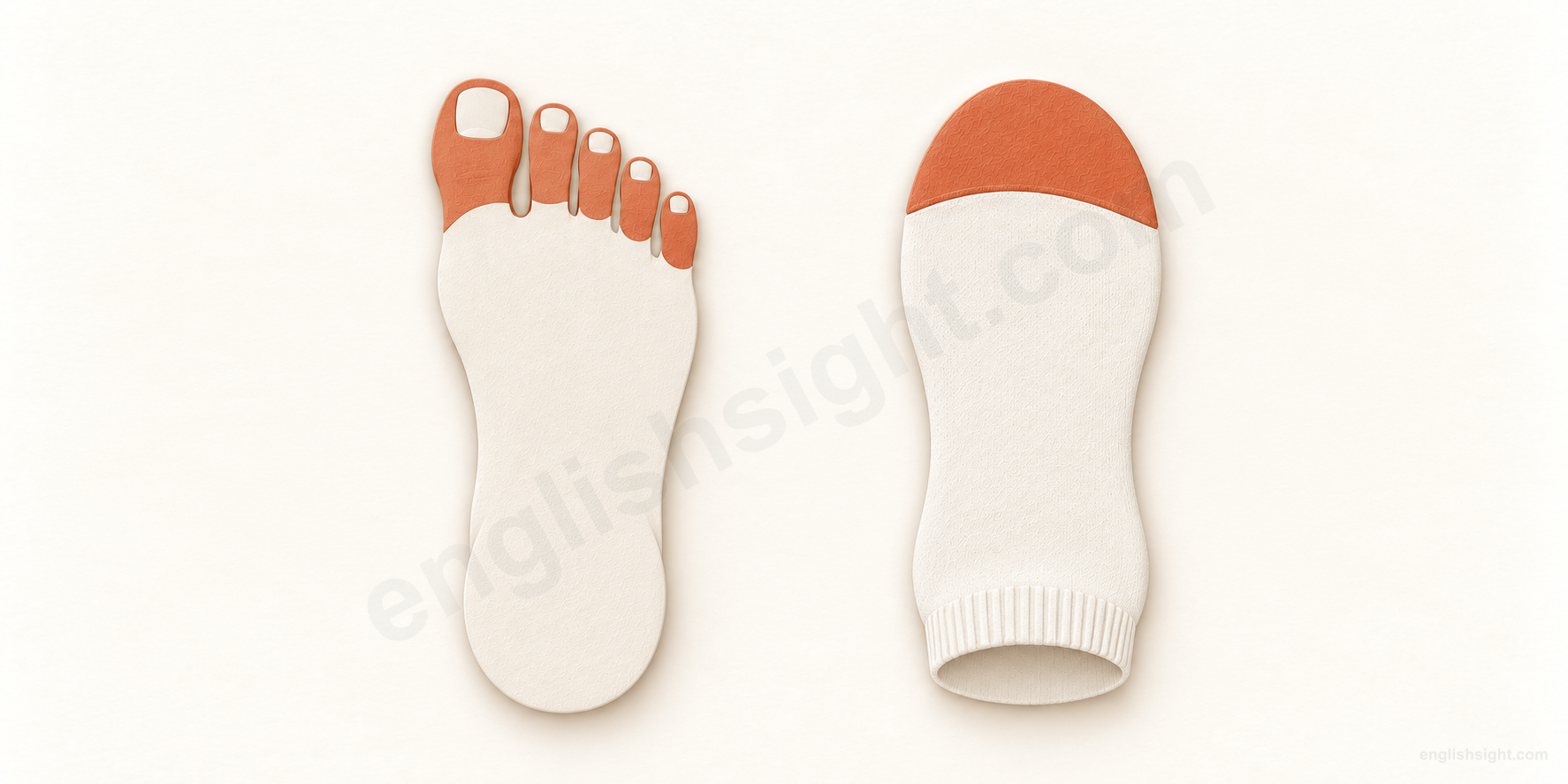
The foot has five separate projecting parts at its front.
toe
Each body part is a toe; the sock's covering section is also called its toe.
The sock covers these parts at its closed front end.
A toe is one part of the foot; a sock's toe is the section that covers the toes.
A toe is an individual projecting part at the front of a foot; the toe of footwear is the corresponding covering section.
The sketch locates the body part. Idioms about alertness, interference, obedience, and trial have established meanings that must be learned with their wording.
A toe is one of the separate parts projecting from the front of a foot. English also uses toe for the corresponding front of a shoe or sock, and in established expressions such as on your toes and toe the line.
The physical picture gives you a starting point. It cannot predict every fixed expression, and it is not a claim that every English speaker has the same mental image.
01
The body part, its covering, and physical actions
Start with the separate parts at the front of a foot. Ordinary action verbs and descriptions specify what happens to them.
01
a / one + toe; possessive + (big / little) toe; plural toes
a toe / toes
one of the separate parts at the front of a foot
Situation
You look at the front of a bare foot.
What it means
You identify one small projecting part.
A toe is part of a foot, not the whole foot.
Toe is a countable noun: one toe, two toes. Use a possessive to identify whose body part it is: my toe, her toes. Big toe names the large inner toe; little toe names the small outer one. Finger normally refers to a digit of the hand.
Animals and birds can have toes too; the word does not imply that every species has five. The diagram highlights the projecting parts of one human foot. It is a concrete starting point, not a rule for interpreting every idiom.
In a sentence
My little toe is cold, but the rest of my foot is warm.
Watch the difference The plural is toes. Feet is the plural of foot, not of toe.
02
stub + possessive + toe + on + object; step / tread on + possessive + toe(s)
stub your toe / step on a toe
hurt a toe by striking it or putting weight on it
Situation
Your bare toe meets the edge of a box.
What it means
The collision hurts.
The verb tells you what happens to the toe.
Stub your toe on something describes accidentally knocking it against a hard object. In I stubbed my toe on a box, I is the person, my toe is the affected body part, and on a box identifies what it hit. Toe itself does not mean injury.
Step on someone’s toe can be completely literal, as when a dancer puts a foot on another dancer’s toe. Hurt my toe is broader: it does not tell us whether there was a collision. The plural toes is also natural when several toes are affected.
In a sentence
I stubbed my big toe on a box beside the bed.
Watch the difference Use on for the object struck: stubbed my toe on the box. A figurative use of step on someone’s toes is taught separately.
03
wiggle / tap + possessive + toes; stand on + possessive + toes
wiggle your toes / stand on your toes
move the toes or raise the heels to reach higher
Situation
Both heels are down.
What it means
The heels lift while the front of each foot stays down.
On your toes can describe an actual body position.
Wiggle your toes means move them with small repeated movements. Tap your toes describes repeated light contacts, often in time with music. These are ordinary verb-and-object combinations; toe names the body part and the verb supplies the action.
Stand on your toes or on the tips of your toes describes a raised-heel position. The everyday wording does not require a ballet dancer’s fully pointed position. Compare the figurative be on your toes, meaning be mentally ready rather than physically higher.
In a sentence
I stood on my toes to see over the wall.
Watch the difference The body position and the alertness idiom share wording; use the situation to distinguish them.
04
touch + possessive + toes; can + subject + touch their toes?
touch your toes
bend down and reach the ends of your feet
Situation
You are standing upright.
What it means
You bend forward and reach toward your toes.
The usual exercise keeps the legs straight.
In an exercise instruction, touch your toes normally asks you to bend forward and reach your toes with your hands while keeping your legs straight. Your toes are the target; touch describes the contact. The phrase can also have an ordinary literal meaning in another situation.
Can you touch your toes? asks about the ability to make that movement, not whether you can feel sensations in your feet. Compare I can feel my toes, where feel concerns sensation. Nothing in the noun toe alone specifies an exercise.
In a sentence
During the stretch, Mia bent forward to touch her toes.
Watch the difference Touch your toes is not the same as walk on your toes. Read the action verb.
05
the toe of + a shoe / boot / sock; shoes with + adjective + toes
the toe of a shoe / sock
the part of footwear that covers the toes
Situation
A shoe has a front, sides, and a heel.
What it means
You inspect the front part around the toes.
The body-part name also identifies its covering.
The toe of a shoe, boot, or sock is its front section where the toes go. A hole in the toe of a sock is a hole in the fabric, not an injury to the wearer. With a pair, the plural toes can refer to the two front sections.
Compare a pointed toe and a round toe when describing shoe shape. Here pointed and round describe the shoe’s design. This is a conventional extension from the body part to the corresponding part of clothing; it does not mean the entire shoe.
In a sentence
There is a hole in the toe of my left sock.
Watch the difference Ask whether the sentence concerns a body part or the shoe or sock covering it.
06
open-toed + footwear; number + -toed + animal
open-toed / three-toed
describe footwear or the toes an animal has
Situation
You need to describe a sandal or an animal.
What it means
A compound adjective specifies a toe-related feature.
Read the first part of the compound.
Open-toed sandals leave the wearer’s toes exposed. Three-toed describes an animal with three toes, as in a three-toed sloth. The ending -toed participates in adjectives; it does not mean that sandals are living things with toes.
Use the hyphen in these compounds before a noun: open-toed sandals. Compare the toe of a sandal, a noun phrase naming its front section. A compound adjective describes a feature, whereas the noun toe identifies a part.
In a sentence
We bought open-toed sandals for the summer.
Watch the difference Open-toed is an adjective. The -ed here is not a claim that somebody performed the verb toe.
07
toe + object (+ direction phrase); toed; toeing
toe a ball
touch or kick something with the toes or front of the foot
Situation
A ball is within reach of the front of your foot.
What it means
You give it a small push with that part.
As a verb, toe specifies the part used for contact.
In a sporting description, toe can be a transitive verb meaning touch or kick with the toe. The person is the subject and the contacted thing is the object. She toed the ball toward me identifies the part used for contact; toe itself does not specify how gently or forcefully she kicked it. In this scene she gives it a small nudge, while pushed or kicked would be broader descriptions.
The forms are toe, toes, toed, toed, toeing. Keep the e in toeing. This physical verb is less central to everyday use than the noun. Learn toe the line separately: the established obedience meaning cannot be worked out simply as kicking a line.
In a sentence
She toed the ball toward me without getting up.
Watch the difference Toe is not tow. Tow a car means pull it with another vehicle; the two words sound the same.
02
Describing the whole body
A fixed expression uses the head and toe as endpoints to describe someone all over.
08
(from) head to toe; be dressed / covered + from head to toe
from head to toe
over the whole body
Situation
You look at someone’s clothes or condition.
What it means
You describe the person all over.
The two endpoints stand for the entire body.
From head to toe describes the full extent of a person’s body, often with dressed, covered, or wet. It does not describe travel from the head down to one particular toe. The singular toe belongs to the fixed expression.
From head to foot and from top to toe are alternatives. Compare a head-to-toe examination: before a noun, the hyphenated expression acts as a compound modifier meaning an examination of the whole body. The endpoints give a useful memory link, not a general formula for new idioms.
In a sentence
After the storm, we were wet from head to toe.
Watch the difference Keep singular toe in this expression: from head to toe, not from head to toes.
03
Staying ready and trying cautiously
These familiar expressions refer to attention and limited involvement. Their full wording matters.
09
be / stay on + possessive + toes; keep + person + on + their toes
be on your toes / keep someone on their toes
be alert, or make someone stay ready to respond
Situation
A task may change without warning.
What it means
You pay close attention and prepare to react.
Readiness is mental here; no heel lifting is required.
Be or stay on your toes describes being alert. Keep someone on their toes says what creates or maintains that readiness: a demanding job, an unpredictable situation, or someone who asks unexpected questions. The person after keep is the one who must stay ready.
The image of a person poised to move can help remember this idiom, but the expression has an established figurative meaning. Compare stand on your toes to reach a shelf: that sentence can describe only a physical position. Match the possessive to the person: keeps me on my toes, keeps us on our toes.
In a sentence
The children’s unexpected questions keep me on my toes.
Watch the difference Use on, not at: on my toes. The expression does not necessarily mean anxious or frightened.
10
dip a toe in / into + activity or field; dip your toes into + activity
dip a toe into something
try an activity cautiously before committing more
Situation
You are unsure whether an activity suits you.
What it means
You make a small trial rather than a full commitment.
Limited contact becomes a model for a cautious first step.
Dipping a toe into water can literally test its temperature. Figuratively, dip a toe in or into something means begin cautiously to see how it goes. Dip your toes into something and dip a toe in the water are familiar variants.
The complement can name a field or activity: dip a toe into online selling. The expression suggests a limited trial; it does not promise success or a later full commitment. Toe remains a noun inside a larger idiom, not a new verb meaning try.
In a sentence
We dipped a toe into online selling with a small weekend sale.
Watch the difference Into marks the activity entered. Do not substitute an arbitrary body part and expect the idiom to keep its meaning.
04
Responsibilities, rules, and direct opposition
Toe appears in established expressions for how people act toward one another or an authority.
11
step / tread on + person’s / possessive + toes
step on someone’s toes / tread on someone’s toes
offend or annoy someone, especially by interfering in their affairs
Situation
A colleague is responsible for a task.
What it means
You interfere and risk upsetting them.
Physical intrusion supplies a memory link for a social boundary.
Figuratively, stepping on someone’s toes means offending or annoying them, especially by interfering with a responsibility they consider theirs. Taking over a colleague’s plan without asking can do this even when you mean to help. You may also tread on someone’s toes by criticizing how they do their work. No physical contact is involved.
Step on someone’s toes is the usual North American wording; tread on someone’s toes is especially British. These are fixed expressions with toe as a noun. Compare the literal accident during a dance: context determines whether physical pain or social offense is intended.
In a sentence
I offered to help, but I didn’t want to step on the team leader’s toes.
Watch the difference The idiom often concerns responsibility, not every accidental inconvenience. Keep the plural toes.
12
toe the line; toe the party line; refuse to toe the line
toe the line / toe the party line
follow the behavior or position required by authority
Situation
An authority expects a particular course of action.
What it means
Someone follows that expectation, perhaps unwillingly.
Toe is a verb in this fixed expression.
Toe the line means comply with what an authority expects. Toe the party line specifically concerns following a political party’s or organization’s official position. A person can do this without privately agreeing, so the expression does not necessarily describe sincere belief.
Here the whole noun phrase the line is the object of toe. It is not a separable phrasal verb: there is no particle to move. The spelling is toe the line, not tow the line. A literal sporting use, toe a starting line, means position your toes at that line. This supplies a memory link for a required boundary, but it does not prove the idiom’s history.
In a sentence
The committee expected every member to toe the party line in public.
Watch the difference Do not replace the fixed expression with toe a line when you mean obey expectations.
13
go toe to toe with + opponent; a toe-to-toe + contest
go toe to toe with someone
confront or compete with someone directly
Situation
Two sides face a difficult contest.
What it means
One side meets the other in direct opposition.
The expression stresses confrontation, not ordinary cooperation.
Go toe to toe with someone means compete, argue, or fight directly and forcefully. Collins marks it mainly US. It can describe a business challenging a larger rival, not just two fighters standing close together.
The opponent follows with. In a toe-to-toe contest, the hyphenated form modifies contest. The closeness of opponents gives a memory link, but success or equality in size is not guaranteed: a small team can go toe to toe with a larger one and still lose.
In a sentence
Our small team went toe to toe with the champions until the final minute.
Watch the difference Toe to toe does not mean side by side in friendly cooperation.
05
Embarrassment and resistance
These expressions evoke bodily reactions but can describe feelings or decisions without visible movement.
14
make + possessive + toes + curl; a toe-curling + noun
make someone’s toes curl
cause strong embarrassment or discomfort
Situation
You hear an awkward public remark.
What it means
You feel intensely embarrassed.
This is an idiomatic reaction, not an anatomical requirement.
Make someone’s toes curl can describe a reaction of embarrassment or discomfort. The person whose toes are mentioned is the one having the reaction. In The speech made my toes curl, the speech causes my embarrassment; it need not produce visible toe movement.
The related informal adjective toe-curling describes something painfully embarrassing, as in a toe-curling apology. Compare curl your toes, which can simply describe an intentional physical movement. This lesson focuses on the embarrassment use, not every emotional or pleasurable use found in broader contexts.
In a sentence
His rude joke at the meeting made my toes curl.
Watch the difference After make, use curl without to: made my toes curl, not made my toes to curl.
15
dig + possessive + toes / heels + in
dig your toes in
refuse to give way or change your decision
Situation
Someone asks you to accept a change.
What it means
You become determined not to accept it.
The whole expression conveys stubborn resistance.
Dig your toes in means refuse to do something or change your mind. Dig your heels in is an alternative. The image of pressing against the ground can help you remember resistance, but no literal digging is required.
The possessive identifies the person resisting: she dug her toes in, we dug our toes in. Do not confuse this with dip a toe in, which describes cautious participation. Dig and dip sound and look similar but create very different expressions.
In a sentence
When we suggested moving the meeting, Ben dug his toes in and refused.
Watch the difference Dig your toes in means resist; dip a toe in means try cautiously.
Keep the body part and the full expression distinct
Toe, foot, finger, and tow
A toe belongs to a foot; a finger normally belongs to a hand. Toe and tow are homophones: toe names the body part or occurs as a verb, while tow means pull a vehicle or object along. Spell the obedience expression toe the line.
Grammar depends on the expression
Toe is usually a countable noun, with plural toes. Physical toe is also a transitive verb; forms include toed and toeing. The -toed in open-toed is adjectival. In most idioms here, toe is a noun inside a larger pattern; toe the line uses it as a verb. These expressions are not all phrasal verbs.
Coverage and visual boundary
This selection covers everyday body and footwear uses and established expressions useful for general reading and conversation. Specialist golf, machinery, carpentry, and vehicle-alignment senses are not expanded. The drawing locates a part of the foot; it cannot predict the meanings of all expressions containing toe.
Choose from the whole situation
Use the action, the surrounding words, and the context to decide what toe means.
1. There is a hole in the toe of a sock. What has a hole?
2. A demanding job keeps Jo on her toes. What does this normally mean?
3. You want to try photography cautiously before buying expensive equipment. Which phrase fits?
4. You do not want to interfere with a colleague’s responsibilities. Which expression fits?
5. An organization demands that its members support its official position. Which spelling fits?
Sources and teaching notes
The linked dictionary entries support the uses and forms. Explanations, examples, and the visual model are original teaching material; memory links are not claims about word origins.
The diagram helps locate the body part; it is not a mental picture shared by every English speaker.