Use tomorrow to locate the next day, make plans, and look toward the future.
Today is the reference; tomorrow is next
Today is the reference; tomorrow is next
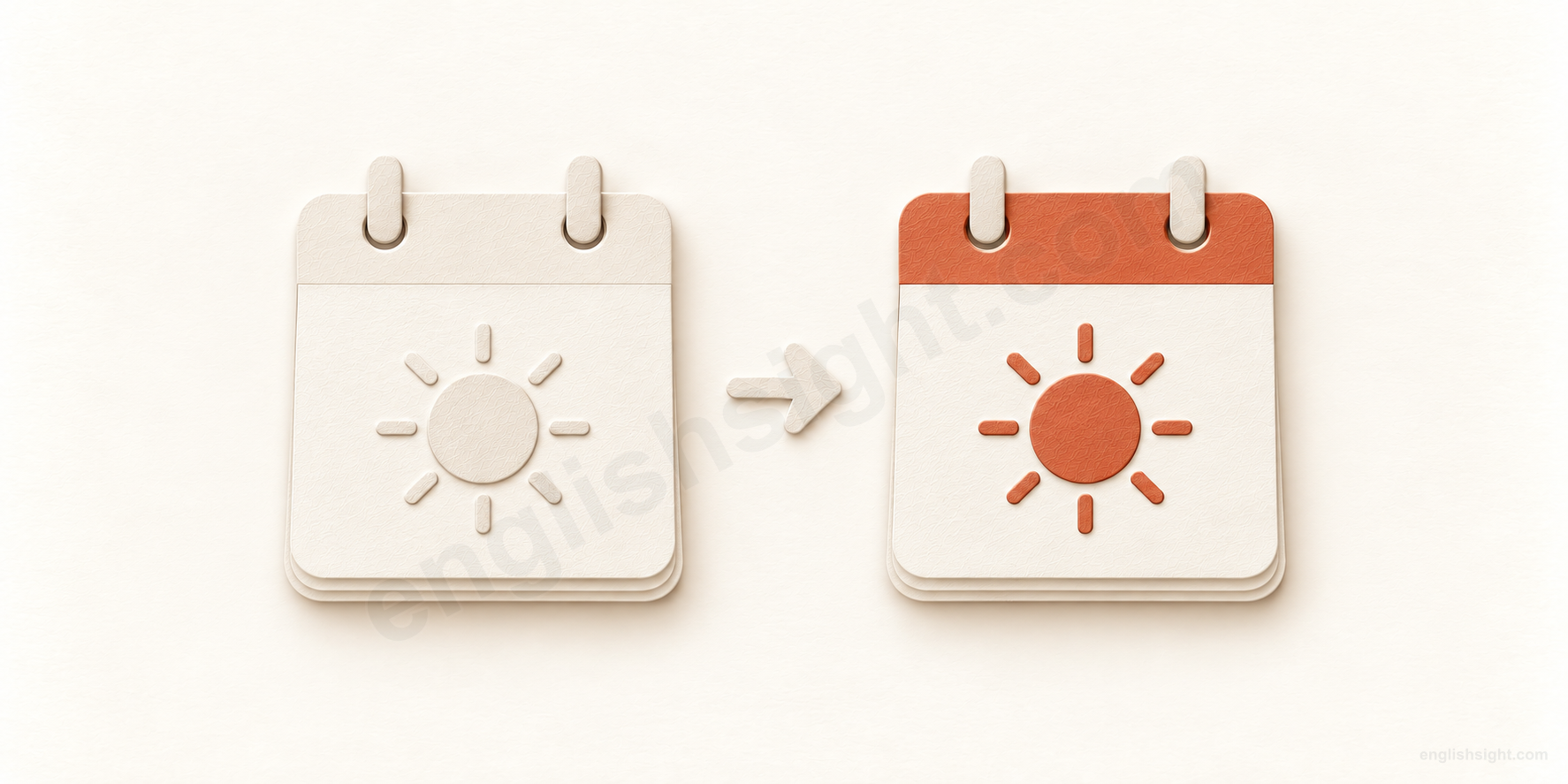
The ivory calendar page on the left represents today.
tomorrow
The page with orange accents on the right represents tomorrow.
Count one calendar day forward.
Tomorrow is the next calendar day after today.
With today as the reference, tomorrow points to the next calendar day.
This relation is about calendar days, not a measured twenty-four-hour delay. Broader future meanings and fixed sayings need their own context.
Tomorrow usually points to the day immediately after today. That simple reference helps with goodbyes, appointments, deadlines, and plans.
The next-day meaning also supports a broader idea of the future. Fixed expressions add their own meanings, so a calendar sketch cannot explain every phrase by itself.
01
Locate the next day
Start with today as the reference. Then choose whether to say when something happens, name the day, or connect something with it.
01
verb / clause + tomorrow; tomorrow + clause
See you tomorrow.
place an event on the day after today
Situation / reference
Today is Friday.
Time / intended meaning
The planned meeting is on Saturday.
Tomorrow answers when, relative to today.
In I’ll call tomorrow, tomorrow tells you when the call will happen. See you tomorrow is a friendly shortened goodbye when you expect to meet again the next day.
Use tomorrow directly, without on: We leave tomorrow. It can also come first: Tomorrow, we leave. A next calendar day is not necessarily exactly twenty-four hours away: at ten tonight, tomorrow morning is only a few hours away.
In a sentence
“Shall we meet again?” “Yes, see you tomorrow.”
Watch the difference Say tomorrow, not on tomorrow or in tomorrow, for the ordinary time expression.
02
tomorrow + morning / afternoon / evening / night; tomorrow at + time
tomorrow morning / afternoon / evening / night
choose a part of the next day
Situation / reference
You need a more precise meeting time.
Time / intended meaning
The meeting will be in the morning of the next day.
The second word narrows the part of the day.
Tomorrow morning means the morning of the next day; tomorrow afternoon, evening, and night work similarly. Early tomorrow and late tomorrow describe timing within that day.
Say tomorrow at nine or at nine tomorrow for a clock time. Tomorrow night is the night associated with the next day; tonight belongs to the current day.
In a sentence
We can check the seedlings tomorrow morning at nine.
Watch the difference The ordinary compact phrase is tomorrow morning; no in the is needed between the two words.
03
tomorrow + be + description; be + tomorrow + description?
Tomorrow is Monday.
treat the next day as the topic
Situation / reference
Today is Sunday.
Time / intended meaning
You identify the next day as Monday.
Tomorrow can name the day as a noun.
Tomorrow is Monday tells us something about the next day. Is tomorrow a holiday? asks about that day. Here tomorrow is the subject, rather than an extra expression telling us when an action happens.
Use tomorrow without a or the for the ordinary next-day meaning. Its reference moves with today: something called tomorrow on Sunday is called today on Monday.
In a sentence
Is tomorrow a school day or a holiday?
Watch the difference Tomorrow is normally uncountable in the literal day meaning; a tomorrow is not the usual way to schedule a day.
04
tomorrow’s + noun
tomorrow’s meeting
connect an event or thing with the next day
Situation / reference
You are reviewing the agenda today.
Time / intended meaning
It belongs to a meeting scheduled for the next day.
The apostrophe-s connects the day with the noun.
Tomorrow’s meeting means the meeting taking place tomorrow. Tomorrow’s weather and tomorrow’s newspaper similarly refer to what is associated with that day.
The ending ’s is a possessive form here, not is. Compare Tomorrow’s busy, where ’s can mean is. The words that follow show which structure you have.
In a sentence
Please read the agenda before tomorrow’s meeting.
Watch the difference Write tomorrow’s meeting with an apostrophe; tomorrows is a plural form with a different use.
05
present continuous / present simple / will / be going to + verb … tomorrow
We’re meeting tomorrow.
choose a verb form for a future event
Situation / reference
You have arranged a visit.
Time / intended meaning
You tell someone about that arrangement.
Tomorrow supplies the time; the verb form supplies the kind of future statement.
We’re meeting tomorrow presents an arrangement. The ferry leaves tomorrow presents a timetable. I’ll help tomorrow can be a promise; I’m going to clean tomorrow presents an intention.
Tomorrow does not force will into every sentence. For a future condition, say If it rains tomorrow, we’ll stay inside. The if-clause normally uses a present form even though tomorrow is future.
In a sentence
We’re meeting the guide tomorrow, and the bus leaves at eight.
Watch the difference Do not automatically replace We’re meeting tomorrow with a will form; the choice can change the emphasis.
02
Arrange, finish, wait, or begin
Tomorrow names the same day in these patterns. The preposition tells you whether it is a deadline, a waiting point, an intended date, or a starting point.
06
finish / send / be ready + by tomorrow
by tomorrow
set the latest acceptable time
Situation / reference
A report is unfinished.
Time / intended meaning
It must be ready no later than the agreed point tomorrow.
By introduces a deadline, not a required waiting period.
Finish it by tomorrow allows earlier completion. Tomorrow identifies the day; by adds the latest-time meaning.
A day alone may leave the exact cutoff unclear. For a real deadline, agree on by nine tomorrow morning or by the end of tomorrow. In I’ll finish tomorrow, the work is placed tomorrow rather than simply before a limit.
In a sentence
Please send the figures by ten tomorrow morning.
Watch the difference By tomorrow is not the same as until tomorrow: a deadline does not tell you to continue an activity up to that time.
07
stay / wait / leave something + until tomorrow; not + verb + until tomorrow
until / till tomorrow; not until tomorrow
continue a situation, or delay an event, to the next day
Situation / reference
You cannot get a repair today.
Time / intended meaning
You wait, and the repair can happen tomorrow.
Until marks how long a situation lasts or when a delayed event can begin.
We’ll stay until tomorrow means the stay continues up to tomorrow. I won’t leave until tomorrow means leaving will not happen before tomorrow. Till is also common, especially informally.
Let’s leave it until tomorrow suggests postponing the task. In contrast, Finish it by tomorrow sets a completion deadline. The continuing situation in wait until tomorrow is waiting, not finishing.
In a sentence
The mechanic won’t be available until tomorrow, so we’ll wait.
Watch the difference Use until for continuation or delay, not as a direct substitute for by with a completion deadline.
08
book / arrange / prepare + something + for tomorrow
for tomorrow
name an intended date or occasion
Situation / reference
You book a table today.
Time / intended meaning
You intend to use it on the next day.
For connects an arrangement or preparation with its intended day.
Book a table for tomorrow identifies the booking’s intended day. Prepare lunch for tomorrow means the lunch is intended to be eaten then; you may prepare it today.
Compare I booked it yesterday for tomorrow: yesterday tells us when you made the booking; for tomorrow tells us when you intend to use it. A meeting scheduled for tomorrow likewise takes place tomorrow.
In a sentence
I’ve booked a table for tomorrow evening.
Watch the difference For tomorrow does not necessarily mean the booking or preparation happens tomorrow.
09
from tomorrow (on), + clause; starting tomorrow, + clause
from tomorrow (on)
start a continuing situation on the next day
Situation / reference
A shop currently opens late.
Time / intended meaning
Its earlier opening hours begin tomorrow.
From marks a starting point; on can emphasize continuation afterward.
From tomorrow, the shop will open at seven introduces a new arrangement beginning on the next day. From tomorrow on makes the onward continuation explicit.
Starting tomorrow is another clear way to announce this. Tomorrow alone could describe just one occasion; from tomorrow looks at the start of a period or repeated practice.
In a sentence
From tomorrow on, we’ll use the side entrance.
Watch the difference From tomorrow names a start, not a completion deadline or just a reservation date.
03
Count onward from today
These expressions locate a later day precisely. One is broadly used; the week patterns have regional preferences.
10
verb + the day after tomorrow
the day after tomorrow
locate the day two calendar days ahead
Situation / reference
Today is Monday.
Time / intended meaning
You choose Wednesday, after Tuesday.
Tomorrow is one day ahead; the day after it is two days ahead.
If today is Monday, tomorrow is Tuesday and the day after tomorrow is Wednesday. The whole phrase tells you when the event happens.
Keep the article in the day after tomorrow. You can add a day part: the day after tomorrow morning. In a message someone may read later, a date can be clearer than a relative expression.
In a sentence
The replacement part should arrive the day after tomorrow.
Watch the difference The day after tomorrow is not tomorrow; count two calendar steps from today.
11
a week tomorrow; tomorrow week; a week from tomorrow
a week tomorrow / tomorrow week
locate the day seven days after tomorrow
Situation / reference
Today is Monday.
Time / intended meaning
You mean Tuesday of next week, eight days from today.
Count a week from tomorrow, rather than a week from today.
A week tomorrow and tomorrow week are especially associated with British English. They mean seven days after tomorrow. A week from tomorrow is also used, including in North American English.
These expressions are useful to recognize, but an explicit date avoids regional confusion. If today is Monday, a week tomorrow is the following Tuesday, not the coming Tuesday.
In a sentence
The course starts a week from tomorrow.
Watch the difference Do not confuse a week tomorrow with a week today, which counts seven days from today.
04
Look beyond the next day
In discussions of hopes, change, and coming generations, tomorrow can stand for the future rather than a date on the calendar.
12
the + noun + of tomorrow; tomorrow’s + noun; a better tomorrow
the world of tomorrow; a better tomorrow
speak about future life rather than the next date
Situation / reference
People discuss changes over the coming years.
Time / intended meaning
They consider future life or future generations.
The next day becomes a way of looking toward what lies ahead.
In the world of tomorrow, tomorrow names the future. The engineers of tomorrow can mean people who will become engineers in years to come. Tomorrow’s cities has a similar forward-looking use.
A better tomorrow means a better future, not simply a pleasant following day. In more expressive writing, tomorrows can mean future days or possible futures. This broader use supports forms that are unusual in literal appointment-making.
Collins also records the broader use as an adverb: technology may change tomorrow can mean at a future time, depending on context. In an ordinary appointment, assume the next day unless the context clearly suggests a wider future.
In a sentence
We’re helping young people build a better tomorrow.
Watch the difference Context decides whether tomorrow is a calendar day or a broader future; the word does not always mean the very next date.
05
Learn the whole expression
These established sayings use tomorrow to talk about consequences, short-lived things, hope, or promises. Their full meanings need context.
13
do something + like / as if there’s no tomorrow
like / as if there’s no tomorrow
do something intensely or without regard for later consequences
Situation / reference
Someone has just been paid.
Time / intended meaning
They spend freely without seeming concerned about later needs.
The whole comparison removes concern for a future afterward.
Spending like there’s no tomorrow suggests spending a great deal, often carelessly. With other activities the expression can emphasize intensity or doing a lot.
This is expressive, informal wording. It normally does not predict the end of the world. Like and as if introduce the comparison; tomorrow stands for a later time when consequences might matter.
In a sentence
He bought new gadgets like there was no tomorrow.
Watch the difference Do not interpret the idiom as a literal statement that the next day will not exist.
14
be here today, gone tomorrow
here today, gone tomorrow
describe something that does not last
Situation / reference
A fashion suddenly becomes popular.
Time / intended meaning
Its popularity may disappear quickly.
Today and tomorrow contrast a present appearance with quick disappearance.
Here today, gone tomorrow describes short-lived things such as fashions, money, or popularity. The two days can be figurative: the point is brief duration.
The saying often suggests that something is unreliable or disappointing. It is not necessarily a promise that it will disappear on the very next calendar day.
In a sentence
Online fashions can be here today, gone tomorrow.
Watch the difference Gone describes disappearance; the expression does not merely say that something will travel tomorrow.
15
tomorrow is another day
Tomorrow is another day.
offer hope after a bad experience
Situation / reference
Today’s attempt has gone badly.
Time / intended meaning
You look ahead to another chance.
A new day becomes an opportunity to begin again.
After a disappointment, Tomorrow is another day can encourage someone to try again or stop judging the future by one bad day.
This established saying expresses hope, not certainty that a problem will disappear. Use it with care when someone needs practical help rather than a quick encouraging remark.
In a sentence
“The practice went badly.” “Rest tonight. Tomorrow is another day.”
Watch the difference The saying offers encouragement; it does not guarantee success tomorrow.
16
a promise of jam tomorrow; offer / promise jam tomorrow
jam tomorrow
criticize promised rewards that never arrive
Situation / reference
People are promised future benefits again and again.
Time / intended meaning
The benefits are still not delivered.
Tomorrow stands for a future reward endlessly postponed.
Jam tomorrow is a British informal expression for good things promised for the future that never materialize. It is useful to recognize in discussion of public promises or workplace rewards.
The jam is figurative: a desirable benefit. This skeptical meaning belongs to the fixed expression, not to tomorrow whenever it refers to the future.
In a sentence
The workers wanted a pay rise now, not more jam tomorrow.
Watch the difference This regional idiom is not a neutral way to describe any genuine future plan.
Keep the reference and the construction clear
Tomorrow moves with today
If someone writes “I’ll call tomorrow” on Monday, they mean Tuesday. If you read the message on Wednesday, do not silently reinterpret that promise as Thursday. In a later report, the next day or the following day can preserve the original date; tomorrow may remain if it still matches the speaker’s current reference.
A calendar day is not a duration
Tomorrow is the next calendar day. In twenty-four hours measures a duration from now. They may point to different times. When an exact appointment or deadline matters, add a date, time, and relevant time zone.
Spelling, sound, and word classes
Spell tomorrow with one m and two r’s. Stress the second syllable: British /təˈmɒrəʊ/, American /təˈmɑːroʊ/ or /təˈmɔːroʊ/. Learner’s dictionaries usually present an adverb and a noun; some dictionary traditions also label uses before a day-part noun adjectival. The usable patterns remain tomorrow morning and tomorrow’s meeting. This word has no ordinary verb inflections, passive, causative, or phrasal-verb family.
A future, not a forecast
A better tomorrow and tomorrow’s leaders can refer to years ahead. The broad future is an extension of looking beyond today, but the idioms must be learned as expressions. This lesson does not assign a single mental image to all English speakers.
Choose the time and meaning
Use the day reference and the whole construction to decide.
1. Today is Thursday. You say, “See you tomorrow.” Which day do you mean?
2. The file must arrive no later than nine the next morning. Earlier delivery is fine. Which request fits?
3. You reserve a table today to use the next evening. Which sentence clearly distinguishes the two times?
4. A visit is already arranged for the next day. Which sentence naturally presents the arrangement?
5. A school hopes to help children create “a better tomorrow.” What does tomorrow mean here?
6. A friend says, “She’s spending like there’s no tomorrow.” What is the likely point?
Sources and teaching notes
The dictionary and grammar sources below support the usage distinctions. Explanations and examples are original; the calendar relationship is a teaching model.
The diagram shows the next-day relationship as a learning aid.