Connect the body part with language, ways of speaking, and familiar expressions.
The organ and its connections
The organ and its connections
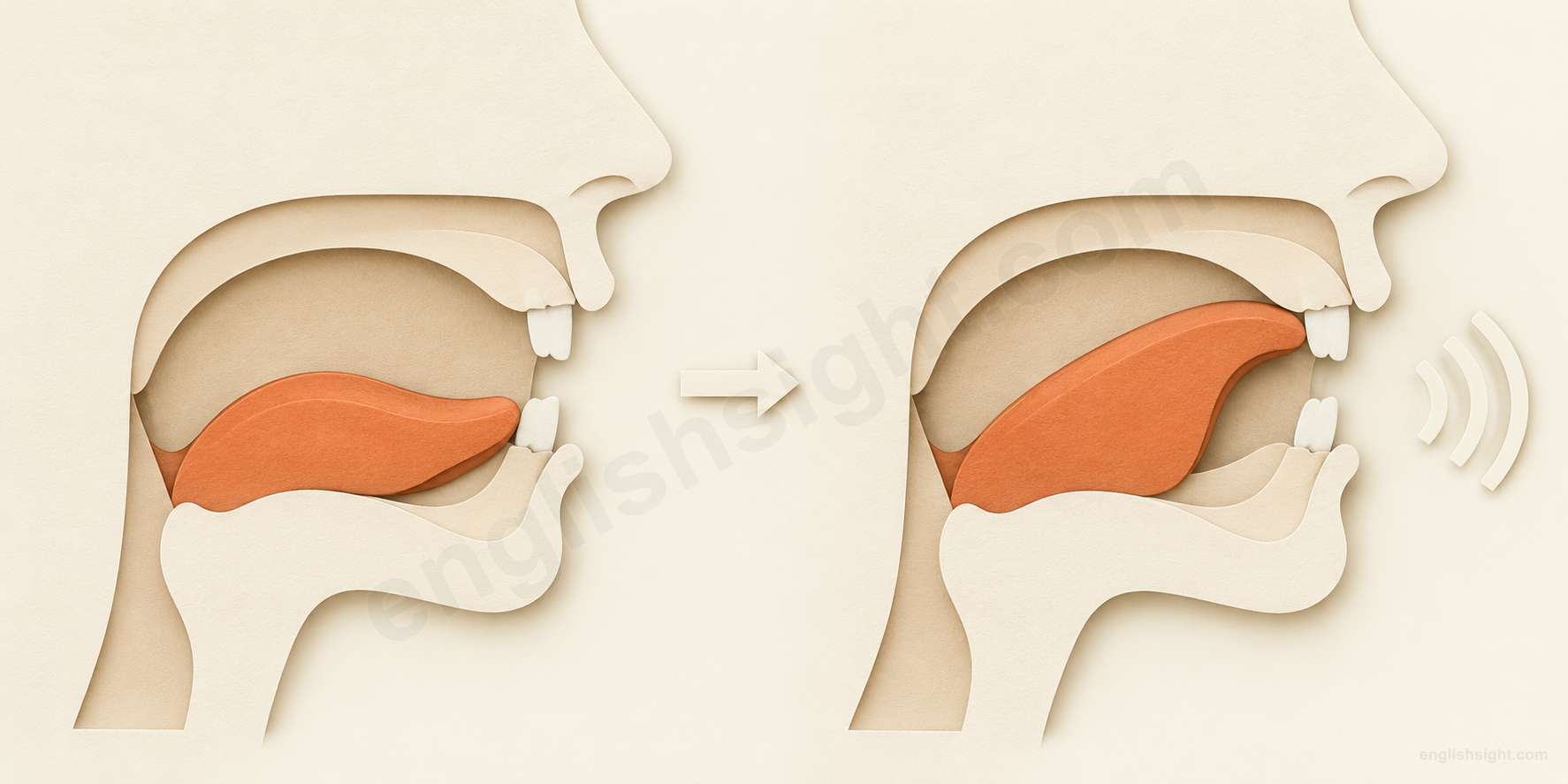
The tongue lies low inside the mouth.
tongue
The tongue tip is raised near the upper front teeth; curved marks represent speech.
Its position changes as it helps shape speech sounds.
The tongue moves to help shape speech sounds; the sound marks represent speaking, not sound made by the tongue alone.
A tongue is a movable organ inside the mouth. Its role in speech connects it with language and ways of speaking; its shape motivates some names for projecting parts.
The sketch focuses on the physical organ helping shape speech. Idioms such as on the tip of your tongue and tongue-in-cheek have established meanings that require their own explanations.
A tongue moves inside the mouth and helps with food and speech. English also uses tongue to talk about a language or a person’s manner of speaking. Other objects receive the name because of a projecting shape.
These connections are a teaching model, not a promise that every phrase can be guessed. Learn fixed expressions in their situations; English speakers do not all visualize one shared picture.
01
The organ and bodily actions
Start with the physical tongue. Verbs and context tell you what it does.
01
possessive + tongue; the tip of + possessive + tongue
your tongue
the movable organ inside your mouth
Situation
A person has food or speech sounds to manage.
What is meant
The tongue moves inside the mouth.
The body part supports eating, tasting, and speech.
Tongue names a physical part of a person or animal. It is normally countable: one tongue, two tongues. Use a possessive when identifying whose body part you mean.
The noun is pronounced /tʌŋ/: one syllable, ending with the sound at the end of sing. Do not pronounce a separate g or an extra syllable from the spelling ue.
Example
I burned my tongue on the hot soup.
Watch the difference Mouth is the whole opening and surrounding space; tongue is one organ inside it.
02
stick / poke / put + possessive + tongue + out; stick out + possessive + tongue
stick your tongue out
extend your tongue beyond your lips
Situation
A child looks at the camera.
What is meant
The tongue projects out of the mouth.
Out gives the direction; the tongue remains attached.
Stick out your tongue and stick your tongue out describe the same bodily action. At someone identifies a target; in that situation the gesture can be rude or teasing.
Context matters: a clinician may ask someone to put their tongue out for an examination. The action itself does not always express an insult.
Example
The child stuck her tongue out at the camera.
Watch the difference This is a combination with the verb stick, not a phrasal verb formed from tongue.
03
click + possessive + tongue; run + possessive + tongue + over + surface
click your tongue
make a short clicking sound with your tongue
Situation
A person reacts to an unwelcome delay.
What is meant
A brief click expresses the reaction.
The verb names a sound-producing action.
Click your tongue describes a mouth sound. Depending on context it can attract attention or express disapproval; the words alone do not tell you the intention.
Compare run your tongue over your lips: here run describes moving the tongue across a surface, with no clicking sound required.
Example
Mara clicked her tongue when she saw the broken plate.
Watch the difference Clicking is not the same as sticking the tongue out at someone.
04
beef / ox tongue; a slice of tongue
beef tongue
an animal’s tongue prepared as food
Situation
A diner reads a menu.
What is meant
Tongue names an ingredient or dish.
The food use can be uncountable.
Beef tongue identifies the animal source. In a sandwich or a serving, tongue can be a food substance: some tongue, a slice of tongue.
A whole tongue can still be counted. The change in countability comes from treating it as a whole organ or as food, not from a new plural form.
Example
The café serves beef tongue with mustard.
Watch the difference A tongue sandwich refers to its filling; it does not describe the shape of the bread.
02
From the organ to language
A body part involved in speech can name a language in established expressions.
05
possessive + mother / native tongue; speak in a foreign tongue
mother tongue / native tongue
a language learned as a young child
Situation
You describe the language you first spoke.
What is meant
Tongue refers to a language rather than anatomy.
The speaking organ can stand for language.
Mother tongue means first language; native tongue is a familiar related expression. Mother does not restrict the meaning to a language spoken only by your mother.
Tongue on its own meaning language often sounds formal or literary: a foreign tongue, speak in another tongue. Language is the neutral choice in ordinary questions such as Which languages do you speak?
Example
She writes in English, but her mother tongue is Polish.
Watch the difference Do not use tongue as a general replacement for every meaning of language, such as a programming language.
03
How freely, politely, or persuasively someone speaks
These expressions evaluate speech or control it. Read each complete expression and its tone.
06
have a sharp tongue; be sharp-tongued; keep a civil tongue in your head
have a sharp tongue
often say critical or unkind things
Situation
Someone repeatedly makes cutting remarks.
What is meant
Others describe their way of speaking.
Sharp evaluates words, not the organ’s physical edge.
A sharp tongue is a habit or ability of speaking critically. The adjective sharp-tongued can describe the person directly.
It does not merely mean speaking loudly or clearly. Keep a civil tongue in your head is a formal reprimand meaning speak politely; civil describes the manner of speech.
Example
Our neighbour has a sharp tongue, especially when she is tired.
Watch the difference A sharp tongue and a clear voice describe different qualities.
07
have a silver tongue; a silver-tongued + speaker
have a silver tongue
be skilled at persuading people through speech
Situation
A speaker presents an idea attractively.
What is meant
Listeners are persuaded by the delivery.
Silver suggests persuasive speech, not a physical material.
A silver tongue is a formal expression for persuasive speaking ability. Silver-tongued is the related adjective: a silver-tongued speaker.
The description can admire eloquence or suggest suspicion of smooth persuasion. It does not guarantee that the speaker is honest, correct, or successful every time.
Example
With her silver tongue, she persuaded us to give the plan another chance.
Watch the difference This is an established expression; changing silver to an arbitrary metal will not preserve the meaning.
08
speak with (a) forked tongue
speak with (a) forked tongue
lie or deliberately mislead people
Situation
A speaker makes promises that hide their real intentions.
What is meant
A listener accuses them of being dishonest.
The established expression evaluates honesty, not pronunciation.
Speak with forked tongue and speak with a forked tongue both mean speak dishonestly or deliberately mislead. Learn the expression as a whole. It is a strong accusation, so consider its effect on the listener.
This is different from a silver tongue: persuasive speech is not necessarily dishonest. Nor is it a slip of the tongue, which is an unintended mistake. The meaning belongs to the idiom; no literal split tongue is required.
Example
You promised to protect the park, but approved the building work. You speak with forked tongue.
Watch the difference Do not use this expression merely because someone pronounces a word badly or changes an opinion honestly.
09
hold + possessive + tongue
hold your tongue
remain silent instead of giving your opinion
Situation
You have an objection.
What is meant
You choose not to voice it.
The silence is controlled rather than caused by forgetting.
Hold your tongue means refrain from speaking, often when an opinion would be unwelcome or badly timed. Held is the past form: I held my tongue.
Oxford marks this expression old-fashioned. As an order, Hold your tongue! sounds stern; Please let me finish is more suitable when politely managing a conversation.
Example
I disagreed with the joke, but I held my tongue during the speech.
Watch the difference The idiom does not instruct you to grip your tongue with your hand.
10
bite + possessive + tongue; bit + possessive + tongue
bite your tongue
stop yourself saying something inappropriate
Situation
A reply is about to come out.
What is meant
You suppress it to avoid trouble.
The idiom highlights restraint at the point of speaking.
Bite your tongue commonly describes stopping an unwelcome remark. It overlaps with hold your tongue, but often makes the suppressed impulse especially clear.
The same words can be literal: I bit my tongue while eating describes an injury. In the idiom, no physical bite is required; the surrounding situation decides the reading.
Example
I nearly corrected him in front of everyone, but I bit my tongue.
Watch the difference Bite has past tense bit; do not write I bited my tongue.
11
watch + possessive + tongue / mouth
watch your tongue
be careful not to speak offensively
Situation
Someone makes a rude remark.
What is meant
Another person warns them about their words.
Watch means monitor your speech here.
Watch your tongue! is a warning to control what you say, especially to avoid insults. Watch your mouth! is a related expression.
The imperative can sound angry or authoritative. It asks for care or restraint; it does not always demand complete silence, as Hold your tongue! does.
Example
“Watch your tongue,” the coach said after the insult.
Watch the difference The listener is not being asked to look at their tongue.
12
have + a loose tongue
have a loose tongue
talk too much or too freely, especially about private matters
Situation
A person knows confidential details.
What is meant
They tend to reveal more than they should.
Loose describes a lack of control over speech.
Have a loose tongue criticizes excessive or indiscreet talk, especially revealing private information. It need not refer to a particular secret; the criticism is that the person fails to control what they say.
The article belongs to the noun phrase: a loose tongue. This describes a tendency; a single accidental wrong word is more naturally called a slip of the tongue.
Example
Don’t tell Paul about the surprise; he has a loose tongue.
Watch the difference Enjoying conversation is not itself a fault; a loose tongue criticizes a lack of discretion or restraint.
13
something + loosens + someone’s tongue
loosen someone’s tongue
make someone speak more freely
Situation
A guest says very little.
What is meant
A change in the situation encourages more talk.
Something affects how freely a person speaks.
Loosen someone’s tongue describes a cause and a change in speech. The cause may be a person, an experience, or the atmosphere.
Unlike have a loose tongue, it need not describe a lasting fault. A welcoming setting can loosen a quiet guest’s tongue without causing any secret to be revealed.
Example
The friendly welcome loosened the new guest’s tongue.
Watch the difference Loosen is the verb; loose is the adjective in a loose tongue.
14
set tongues wagging; tongues are wagging
set tongues wagging
cause gossip about people’s private affairs
Situation
An unexplained event attracts attention.
What is meant
People begin speculating about it.
Plural tongues stands for the people doing the talking.
Set tongues wagging describes causing gossip. Tongues are wagging describes the gossip already happening.
The expression is informal and often appears in stories about relationships, departures, or surprising public behaviour. It does not mean every report is true.
Example
Their sudden departure set tongues wagging in the village.
Watch the difference This is more specific than starting an ordinary factual discussion.
15
give someone a tongue-lashing; get a tongue-lashing; give someone the rough side / edge of your tongue
give someone a tongue-lashing
criticize someone angrily and severely
Situation
Someone has behaved badly.
What is meant
They receive an angry verbal rebuke.
Lashing is figurative punishment through words.
A tongue-lashing is an informal countable noun for a severe scolding. Give names the person delivering it; get or receive names the person being scolded.
The compound names one event, whereas have a sharp tongue describes a way of speaking. Neither expression requires physical violence.
Give someone the rough side of your tongue, also the rough edge of your tongue, likewise means speak harshly to them about something they have done wrong. For example: She gave me the rough side of her tongue for missing the meeting. The possessive identifies the person doing the scolding.
Example
The manager gave us a tongue-lashing for leaving the door unlocked.
Watch the difference Ordinary constructive feedback is not necessarily a tongue-lashing.
04
Finding, pronouncing, and interpreting words
Forgetting, making a mistake, being nervous, and joking are different situations. Choose the expression that matches.
16
a word / name + be on the tip of + possessive + tongue
on the tip of your tongue
known but temporarily impossible to recall
Situation
You recognize an actor’s face.
What is meant
The name feels close, but you cannot retrieve it.
The familiar word is unavailable at this moment.
The idiom describes a word or name you feel you know but cannot remember right now. It does not refer to food resting on the literal tip of the tongue.
Keep the full pattern: on the tip of my tongue. Contrast a slip of the tongue, where you actually say the wrong thing.
Example
Her surname is on the tip of my tongue, but I can’t remember it.
Watch the difference This is not a general expression for a word you have never learned.
17
a slip of the tongue; make a slip of the tongue
a slip of the tongue
an unintended mistake in speaking
Situation
You intend to say Friday.
What is meant
You say Thursday instead.
The error happens in speech, rather than in memory alone.
A slip of the tongue is something said by mistake, such as the wrong date or name. It can be corrected immediately.
The ordinary pattern uses a slip and the tongue. A slip of the pen is the writing counterpart. This expression describes an error; it does not by itself mean a deliberate lie.
Example
I said Thursday instead of Friday—a slip of the tongue.
Watch the difference Do not confuse it with slip off the tongue, which can describe easy pronunciation.
18
get + possessive + tongue + around / round + word or phrase
get your tongue around a word
manage to pronounce a difficult word
Situation
A learner meets an unfamiliar name.
What is meant
They try to form its sounds successfully.
The difficulty is saying the word, not understanding its meaning.
Get your tongue around something, or round something, means manage its pronunciation. It is often used with can’t or have trouble.
The object is a word, name, or phrase, rather than an idea in general. If you understand a theory, say understand it; the tongue expression concerns producing its sounds.
Example
I can’t get my tongue around the name of this station yet.
Watch the difference Getting your head around something concerns understanding; getting your tongue around it concerns pronunciation.
19
a name / phrase + roll / slip / trip off the tongue
roll off the tongue
be easy or natural to pronounce
Situation
You test a possible product name aloud.
What is meant
Its sounds fit together easily.
The name is the subject of this expression.
A name or phrase rolls off the tongue when it is easy to say. Slip off the tongue and trip off the tongue are established variants.
Compare I can’t get my tongue around it, where the speaker is the subject and has difficulty. Easy pronunciation does not guarantee that the name is memorable or that everyone likes it.
Example
The shorter name rolls off the tongue more easily.
Watch the difference Off is part of this fixed expression; it does not mean a physical object is falling.
20
be / get + tongue-tied
be tongue-tied
struggle to speak because of shyness or nerves
Situation
A nervous visitor is introduced.
What is meant
They struggle to find words.
This adjective describes a speaking difficulty caused by emotion.
Be tongue-tied describes being unable to speak freely because you feel shy or nervous. Get tongue-tied emphasizes entering that state.
This everyday figurative adjective does not diagnose a physical condition. It differs from having a word on the tip of your tongue: the problem need not be forgetting one known word.
Example
I get tongue-tied when I speak in front of a large audience.
Watch the difference Write the adjective with a hyphen; it is not the past tense of a verb tongue-tie in this pattern.
21
Has the cat got your tongue?; Cat got your tongue?
Cat got your tongue?
ask why someone is unexpectedly silent
Situation
You ask a question and receive no reply.
What is meant
You comment on the person’s silence.
This is an informal remark, not a real question about an animal.
Has the cat got your tongue? and the shortened Cat got your tongue? address someone who is expected to speak but stays silent.
The remark can sound teasing or impatient. It is particularly associated with talking to children; Why are you so quiet? is a more direct question without the teasing image.
Example
“You’re very quiet today. Cat got your tongue?”
Watch the difference The expression may embarrass a nervous person; it is not a neutral greeting.
22
find + possessive + tongue / voice
find your tongue
become able or willing to speak
Situation
Surprise leaves a person silent.
What is meant
They recover enough to say something.
Find describes a return or emergence of speech.
Find your tongue means become able to speak or express yourself. Find your voice is a related expression; neither requires finding a lost body part.
It can describe getting over surprise or hesitation. It does not mean finding a forgotten language, and it is not interchangeable with every literal use of find.
Example
After a long pause, she found her tongue and thanked the visitors.
Watch the difference The missing thing in this image is the ability or confidence to speak, not vocabulary on a list.
23
a tongue-twister; practise / say a tongue-twister
a tongue-twister
a word or phrase that is difficult to say correctly
Situation
A teacher chooses a tricky sequence of sounds.
What is meant
Learners practise saying it clearly.
The difficulty lies in the sound sequence.
A tongue-twister is a countable noun for an expression difficult to say, especially quickly. It may repeat or alternate similar sounds.
It is a kind of language exercise or playful challenge, not a literal tool for twisting an organ. A tongue-twister can make an otherwise confident speaker stumble.
Example
We used a tongue-twister to practise the difference between two sounds.
Watch the difference A tongue-twister is the difficult expression; tongue-tied describes a person’s difficulty speaking from nerves.
24
a tongue-in-cheek + remark; say something with tongue in cheek
tongue-in-cheek
joking rather than completely serious
Situation
A writer exaggerates a tiny achievement.
What is meant
Readers are meant to recognize the humour.
The attitude belongs to the whole established expression.
A tongue-in-cheek remark sounds as though it could be serious but is intended humorously. With your tongue in your cheek and with tongue in cheek are related idiomatic phrases.
Use hyphens in the adjective before a noun: a tongue-in-cheek apology. You do not have to push your tongue into your cheek while making the remark.
Example
Her claim to be the world’s slowest runner was tongue-in-cheek.
Watch the difference Do not confuse tongue-in-cheek humour with a slip of the tongue: the humour is intended.
05
Projecting parts and specialized uses
Some physical parts are called tongues by shape. A specialist verb also names an action of the organ.
25
the tongue of a shoe / boot; a shoe’s tongue
the tongue of a shoe
the flap underneath the laces
Situation
You loosen the laces of a boot.
What is meant
You straighten the flap under them.
A tongue-like shape gives this shoe part its name.
A shoe’s tongue lies under its laces and covers part of the top of the foot. Here tongue is countable: the tongues of both boots.
This use depends on a conventional name for a projecting flap. It is related to shape and position, not to speaking or tasting.
Example
The tongue of my boot was folded under the laces.
Watch the difference Laces are the cords; the tongue is the flap beneath them.
26
a tongue of + flame / fire / land
a tongue of flame
a long narrow projecting portion
Situation
A fire burns in a grate.
What is meant
A slender flame projects upward.
Shape motivates the description.
A tongue of flame describes a long, narrow part of a fire. A tongue of land similarly describes a narrow strip projecting into water; these uses often belong to descriptive or literary writing.
Of identifies the material or larger mass. Do not assume that every long object is naturally called a tongue; the combination must be conventional or clearly descriptive.
Example
A tongue of flame rose above the logs.
Watch the difference The flame has no mouth; this is a shape comparison.
27
tongue and groove; tongue-and-groove + flooring / boards
tongue and groove
a ridge-and-slot system for joining boards
Situation
Two boards have matching edges.
What is meant
The projecting ridge fits into the matching groove.
Tongue is the projection; groove is the receiving slot.
Tongue and groove names a way of making boards fit together. In tongue-and-groove flooring, the compound describes the type of flooring.
This is useful recognition vocabulary in home improvement. It is a separate physical application of the projecting-shape idea, not an idiom about conversation.
Example
We chose tongue-and-groove boards for the wall.
Watch the difference The tongue goes into the groove; reversing their names reverses the parts.
28
tongue + a note; tonguing; tongue + an object
tongue a note
use the tongue to articulate a wind-instrument note
Situation
A player blows into a wind instrument.
What is meant
Tongue movement helps separate the notes.
This is a specialized verb built around tongue action.
In music, tongue can be a verb: a wind player tongues a note. Tonguing names the technique. The forms are tongues, tongued, tonguing.
Dictionaries also record tongue something meaning touch or lick it with the tongue. In everyday descriptions of eating or animal behaviour, lick is usually an easier choice. Tongue is not the ordinary verb meaning speak a language.
Example
The teacher asked me to tongue each note separately on the clarinet.
Watch the difference Say She speaks French, not She tongues French.
Keep the organ, construction, and idiom distinct
Grammar belongs to the whole expression
Most everyday uses here are nouns or noun phrases. In bite your tongue, bite is the verb; in set tongues wagging, set supplies the causative pattern. These are not a family of phrasal verbs formed from tongue.
Countability and forms
The usual noun plural is tongues. The food use can be uncountable. The specialist verb has forms tongue, tongues, tongued, tonguing; it is not a general substitute for say, speak, or talk.
Scope and register
This lesson covers common meanings and useful recognition vocabulary, not a frequency ranking. Religious speak in tongues, anatomical tongue-tie, rare instrument and vehicle parts, and archaic verb uses need additional context and are outside the main lesson.
Choose the expression for the situation
Identify whether the issue is memory, a speech error, pronunciation, restraint, or tone.
1. You know a person’s name but cannot recall it right now. Which sentence fits?
2. You almost make a hurtful comment, then stop yourself. What happened?
3. You accidentally say the wrong day and correct yourself. What was it?
4. A new station name is hard for you to pronounce, though you know what it refers to. Which fits?
5. Which description identifies the tongue of a shoe?
6. Polish was the language someone first learned as a child. Which expression fits?
Sources and teaching notes
Dictionary entries support the meanings and usage below. Explanations and examples are original; the diagram is a teaching aid for the physical organ and its connection with speech.
This diagram is a teaching aid, not a picture shared by every native speaker.