From one tooth and many teeth to tools, determination, and familiar idioms.
Hard structures that bite and press
Hard structures that bite and press
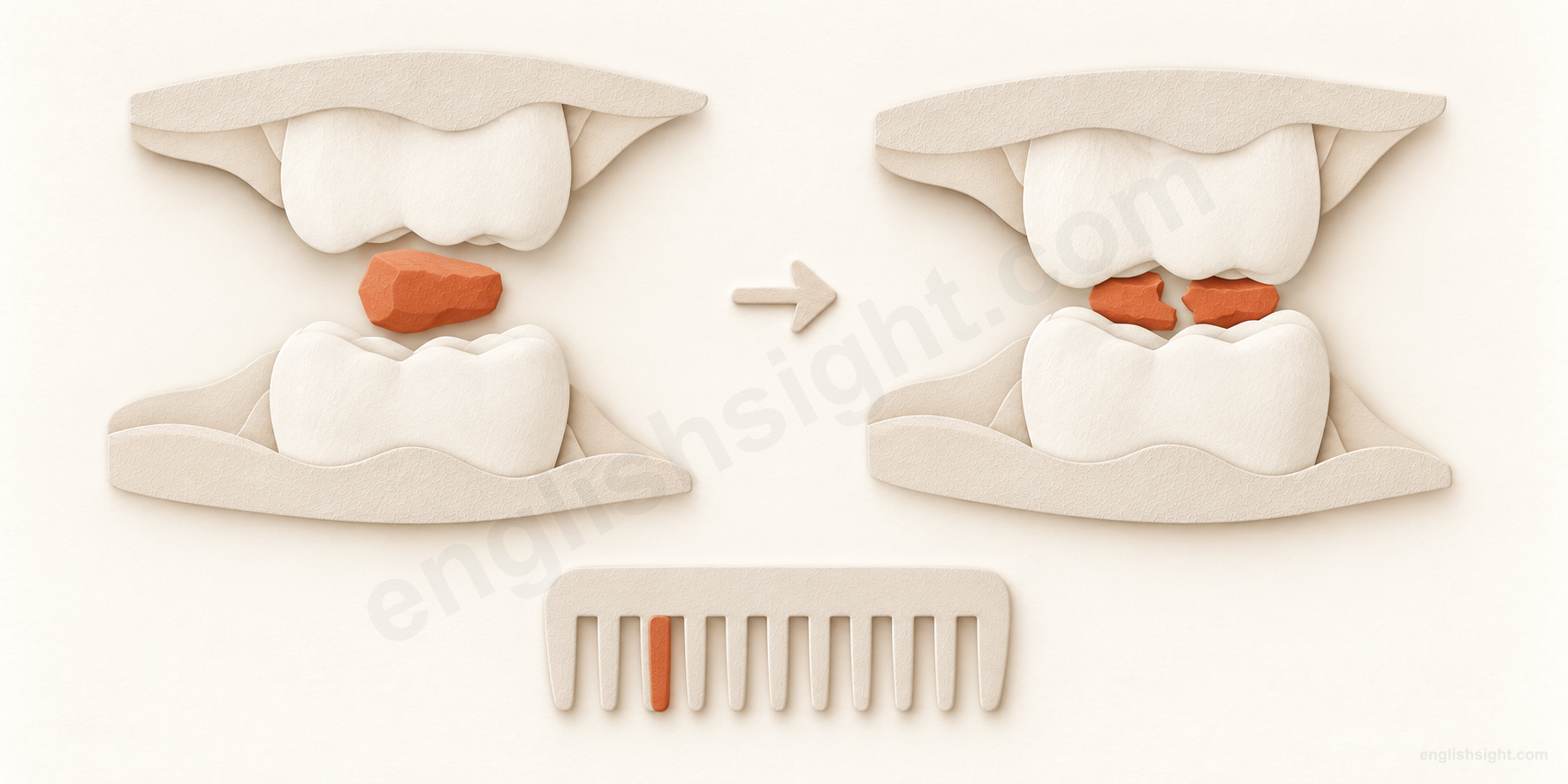
A piece of food lies between opposing teeth.
tooth
The food is broken into two smaller pieces.
The teeth close and press into the food.
Teeth break down food; a comb's projections are also called teeth.
A tooth is a hard structure in the mouth used for biting or chewing. The name also extends to similar projecting parts on objects.
The sketch shows a literal function. It helps connect shape and biting power to some extensions; it does not derive every idiom or represent a picture shared by all English speakers.
Tooth first names a concrete part of the mouth. It also names projecting parts of objects, and teeth can represent effective power. Many everyday expressions use tooth or teeth in fixed combinations.
Keep those layers separate: a comb has real projecting teeth, a law with teeth has enforcement power, and a sweet tooth is a preference. The whole phrase and situation guide the meaning.
01
Teeth in everyday life
Start with the countable body-part noun, then learn useful ways to talk about cleaning, growth, different kinds, and a dental visit.
01
a tooth; two teeth; one of my teeth
a tooth / teeth
one or more hard structures in the mouth used to bite or chew
Situation / starting point
You are talking about one part of your mouth.
Meaning / result
Your listener knows whether you mean one tooth or several.
Tooth is singular; teeth is its irregular plural.
A tooth is one of the hard structures in a person’s or animal’s mouth. Teeth can bite, tear, or break down food. Not every tooth is pointed: broad back teeth are teeth too.
Say a tooth, two teeth, and one of my teeth. The vowel changes from /tuːθ/ to /tiːθ/; the final /θ/ stays the same. Use my front tooth for one and my front teeth for more than one.
In a sentence
One of my front teeth is chipped.
Watch the difference Use one of my teeth, not one of my tooth or two tooths. Teeth takes plural agreement: my teeth are… .
02
brush / clean + possessive + teeth
brush your teeth
clean the teeth with a toothbrush
Situation / starting point
You are getting ready for bed.
Meaning / result
You describe cleaning your own teeth.
The verb supplies the cleaning action; teeth names what is cleaned.
Brush my teeth, brush your teeth, and brush her teeth change the owner to match the situation. Clean your teeth is also ordinary, especially in British English; brush specifies the tool and action more directly.
Toothbrush, toothpaste, and tooth decay use singular tooth as the first part of a compound. This does not mean that only one tooth is involved. Tooth decay names damage to teeth, not a cleaning action.
In a sentence
I brush my teeth before bed.
Watch the difference When speaking about your own routine, I brush my teeth is the usual wording; brush the teeth is less personal and more typical of instructions or general descriptions.
03
a baby cuts a tooth; a child loses a baby / milk tooth
cut a tooth / lose a baby tooth
grow a new tooth, or lose one from the first set
Situation / starting point
A family notices a change in a young child’s mouth.
Meaning / result
A tooth has appeared, or a first-set tooth has come out.
Cut a tooth describes emergence; lose a tooth describes its loss.
When a baby cuts a tooth, a new tooth grows through the gum. Nobody cuts it with a tool. You can also say a tooth is coming through.
A baby tooth belongs to a child’s first set, which is later replaced. Milk tooth is another name, especially in British English. Its plural is milk teeth. Losing a baby tooth is different from cutting a new one.
In a sentence
Mia lost her first baby tooth yesterday.
Watch the difference Do not confuse the literal cut a tooth with cut your teeth on a job, which means gain early experience.
04
a front tooth; back teeth; a wisdom tooth
front teeth / wisdom teeth
identify teeth by position or type
Situation / starting point
You need to identify which tooth you mean.
Meaning / result
A position or established name narrows the reference.
The modifier identifies the tooth; it does not change the plural rule.
Front teeth are at the front of the mouth; back teeth are farther back. Wisdom teeth are the last large back teeth to emerge, generally in the late teens or adulthood. Wisdom does not describe someone’s intelligence here.
Use a wisdom tooth for one and wisdom teeth for more than one. Names such as incisor and molar identify particular types, but tooth remains the general word.
In a sentence
The dentist checked my wisdom teeth.
Watch the difference Say wisdom teeth, not wisdom tooths. A front tooth is not automatically a wisdom tooth.
05
wear / have + false teeth; a set of false teeth
false teeth
artificial replacements for natural teeth
Situation / starting point
Someone has artificial replacements for missing natural teeth.
Meaning / result
You refer to the replacements as a set.
False means artificial here, not dishonest.
False teeth is normally a plural expression for a set of replacement teeth. A set of false teeth is singular because set is the grammatical head: the set is new, but the teeth are new.
The ordinary expression does not accuse anyone of lying. Compare the separate idiom lie through your teeth.
In a sentence
His new false teeth fit well.
Watch the difference Use false teeth are when the plural noun is the subject; use a set of false teeth is when the subject is a set.
06
have a tooth out / pulled / removed; have a tooth filled
have a tooth out
have a tooth removed by a dentist
Situation / starting point
A tooth needs dental treatment.
Meaning / result
A dentist removes or repairs it.
Have + object + past participle can describe treatment arranged or received.
Have a tooth out is an everyday way to describe removal, especially in British English. Have a tooth pulled or removed names the procedure more explicitly. Have a tooth filled describes repairing it, not taking it out.
For discomfort, My tooth hurts identifies one tooth. Toothache names pain in a tooth or teeth; I have a toothache is common. British English also uses I have toothache without an article. These sentences describe a problem rather than diagnose it.
In a sentence
I had a tooth removed last week.
Watch the difference I had a tooth removed does not mean I performed the removal myself. Pull out a tooth is a verb phrase; tooth itself is the noun.
02
What teeth and jaws do
The surrounding verb supplies the action: showing teeth, chattering, and holding them together communicate different things.
07
bare + possessive + teeth
bare your teeth
show teeth as a threat
Situation / starting point
An animal feels threatened.
Meaning / result
It exposes its teeth in an aggressive display.
Bare is the action of uncovering; teeth are what become visible.
A dog that bares its teeth is displaying them threateningly. Show your teeth can be literal too, but context matters: a broad smile can show teeth without any threat.
Writers can use bare your teeth figuratively for showing hostility. Do not assume that any visible teeth mean anger.
In a sentence
The dog bared its teeth when the stranger approached.
Watch the difference Bare and bear are different words. Use bared its teeth, not beared its teeth.
08
possessive + teeth + chatter
your teeth chatter
teeth repeatedly strike together, often from cold or fear
Situation / starting point
You are shivering after standing outside.
Meaning / result
Your teeth make repeated small knocking sounds.
Teeth is the subject of an involuntary repeated action.
Teeth chatter when the jaw shakes so that the teeth knock together. Cold is a common context; fear can also be a reason. The situation tells you why it is happening.
This differs from clenching, which holds teeth tightly together, and grinding, which rubs them against one another.
In a sentence
My teeth were chattering after the swim.
Watch the difference Use plural agreement: my teeth were chattering, not my teeth was chattering.
09
clench / grind / gnash your teeth; say something through clenched teeth
through clenched teeth
speak with the teeth held tightly together
Situation / starting point
A person is tense or trying to control anger.
Meaning / result
They speak while holding their jaw tight.
The verb distinguishes holding, rubbing, and an emphatic expression of frustration.
Clench your teeth means press them firmly together. Through clenched teeth describes a tense way of speaking, often with restrained anger. Grind your teeth describes rubbing them together; it can also happen during sleep.
Gnash your teeth can describe pressing or striking the teeth together in anger. Figuratively, gnash your teeth over a decision means be very angry or frustrated about it; actual tooth movement need not occur.
In a sentence
“That is enough,” she said through clenched teeth.
Watch the difference Clenched teeth do not always prove anger. Read the context; tooth is not an emotion word on its own.
03
Projections and effective power
Some objects have parts shaped or arranged like teeth. Figurative teeth can also mean the power to make a rule work.
10
the teeth of / on + object; a tooth on a gear
the teeth of a comb
projecting parts along an object’s edge or wheel
Situation / starting point
You inspect a comb, saw, zip, or gear.
Meaning / result
You identify the repeated parts sticking out.
The extension concerns shape, arrangement, or contact with another object.
A comb’s teeth pass through hair. A saw’s teeth cut. Gear teeth engage with another part. The functions differ, so calling a part a tooth does not mean it chews food.
One projection is a tooth; several are teeth. In gear teeth, gear identifies the object. A missing tooth can therefore describe a damaged machine as well as a mouth.
In a sentence
Two teeth have broken off this comb.
Watch the difference Do not use tooth for every small piece of an object; this is an established name for particular projecting parts.
11
have teeth; give something teeth; put teeth into something; without teeth
a law with teeth
a rule or organization with effective power
Situation / starting point
A rule exists but cannot be effectively enforced.
Meaning / result
New enforcement powers make it harder to ignore.
Figurative teeth means practical force, not merely severe wording.
A law with teeth has effective means of enforcement. Give the regulator teeth or put teeth into the rules means supply such powers. Without teeth means lacking that practical force.
The biting function provides a useful metaphor for effectiveness. This is a plural use: it does not normally describe one legal tooth. Toothless can similarly describe an ineffective rule or organization.
In a sentence
The new penalties give the safety rules real teeth.
Watch the difference Having teeth does not guarantee fair or successful enforcement in every case; the expression describes available power.
04
Getting involved and keeping going
These expressions draw on biting, holding, or enduring. Learn the whole phrase: enthusiasm, first experience, persistence, and resistance are different ideas.
12
sink your teeth into + food; get / sink your teeth into + task
sink / get your teeth into something
bite into something, or become deeply involved in it
Situation / starting point
You have food to bite, or a substantial task to begin.
Meaning / result
Teeth enter the food, or your attention becomes fully engaged.
The object separates a physical bite from enthusiastic involvement.
Sink your teeth into a peach means bite into it: She sank her teeth into a ripe peach. Sink your teeth into a project and get your teeth into a problem mean work on it with interest and commitment. A task worth getting your teeth into offers something substantial to tackle.
The figurative connection is sustained engagement, not actual eating. Keep the possessive matched to the person: she got her teeth into the assignment.
In a sentence
At last, we have a project we can really get our teeth into.
Watch the difference Use into before the task: get your teeth into it, not get it your teeth into. These are fixed expressions containing a noun, not phrasal verbs formed from tooth.
13
cut + possessive + teeth + on something; cut your teeth as / in…
cut your teeth on something
gain early practical experience
Situation / starting point
Someone is beginning to learn a kind of work.
Meaning / result
Early jobs provide useful practical experience.
The expression concerns a beginning stage, not physical damage.
Cut your teeth on small projects identifies what gave you early experience. Cut your teeth as a reporter identifies a role; cut your teeth in local journalism identifies a field or setting.
The association with a baby’s first teeth is a memory aid, not a rule for inventing new expressions. Unlike cut a tooth, this idiom uses plural teeth with a possessive.
In a sentence
She cut her teeth on short films before directing a full-length movie.
Watch the difference This normally concerns initial experience, not simply any activity you have done for years.
14
grit + possessive + teeth; grit your teeth and + verb
grit your teeth
hold the teeth tight, or decide to endure difficulty
Situation / starting point
A necessary task is unpleasant or painful.
Meaning / result
You make yourself continue despite the discomfort.
The figurative focus is endurance rather than enjoyment.
Grit your teeth can describe a literal tightening of the jaw. Figuratively, grit your teeth and carry on means accept the difficulty and keep going with determination.
Compare get your teeth into a project, which emphasizes interested involvement. Gritting your teeth emphasizes enduring something you may dislike.
In a sentence
We gritted our teeth and finished the long clean-up.
Watch the difference The idiom does not tell someone to enjoy the task, and it is not a claim that actual tooth clenching is required.
15
fight tooth and nail to + verb; fight something tooth and nail
fight tooth and nail
oppose something or pursue a goal with great determination
Situation / starting point
A proposal threatens something important to a group.
Meaning / result
They make every possible effort to resist it.
The phrase intensifies the determination of the fight.
Fight tooth and nail to keep a service emphasizes determined effort toward a goal. Fight the closure tooth and nail puts the opposed proposal directly after fight.
The words evoke using teeth and nails in a struggle, but a petition, legal challenge, or negotiation can be described this way. Physical violence is not required.
In a sentence
The residents fought tooth and nail to keep their library open.
Watch the difference The fixed expression has singular tooth and nail, with no articles: not fight teeth and nails.
05
Preferences, discomfort, and difficult interactions
These familiar expressions belong to their full wording. A sweet tooth, a lie, and a disappointment cannot be predicted just from the body part.
16
have / have got + a sweet tooth
have a sweet tooth
particularly like sweet foods
Situation / starting point
Someone often chooses cake or other sweet food.
Meaning / result
You describe a general taste preference.
The whole phrase means a liking, not a type of tooth.
Have a sweet tooth is an informal way to say you particularly enjoy sugary food. It describes preference; it does not report whether your teeth are healthy.
Keep a in the singular expression: I have a sweet tooth. Tooth does not generally replace taste in new combinations, so do not build an expression such as a salty tooth by analogy for ordinary use.
In a sentence
I have a sweet tooth, so I always look at the dessert menu.
Watch the difference Do not interpret sweet as the flavor of the tooth itself.
cause a strong feeling of discomfort or irritation
Situation / starting point
A harsh sound is difficult to tolerate.
Meaning / result
You react with intense discomfort or irritation.
The disturbing thing is the subject; the affected person owns the teeth.
A scraping noise may set your teeth on edge. The phrase can also describe a voice, taste, or behavior that you find intensely unpleasant.
The reaction may feel almost physical, but actual tooth pain is not necessary. The fixed expression is stronger and more vivid than simply saying you dislike something.
In a sentence
That scraping noise sets my teeth on edge.
Watch the difference Say sets my teeth on edge, not sets me teeth on edge. Tooth itself does not mean irritation.
18
lie / be lying + through + possessive + teeth
lie through your teeth
tell a blatant lie
Situation / starting point
A person knows what happened but denies it.
Meaning / result
You strongly accuse them of dishonesty.
This idiom intensifies an accusation; it does not describe speech mechanics.
Lie through your teeth is informal and forceful. It presents the statement as a deliberate, obvious lie, not an innocent mistake.
It is different from speaking through clenched teeth, which concerns tension or anger. A liar need not hold their teeth together or even show them.
In a sentence
He was lying through his teeth when he said he had never seen the invoice.
Watch the difference This is a strong accusation. It does not merely mean that someone gave an incorrect answer.
19
something is / feels like + a kick in the teeth + for / to someone
a kick in the teeth
a deeply upsetting disappointment or rejection
Situation / starting point
You expected support or fair treatment.
Meaning / result
An event leaves you feeling badly let down.
The physical blow is a metaphor for emotional hurt.
A rejection after a great deal of effort can feel like a kick in the teeth. The phrase is informal and expresses a strong personal reaction.
You can also say someone kicked you in the teeth when they treated you badly or refused needed support. Context distinguishes that figurative use from actual violence.
In a sentence
Losing the funding was a kick in the teeth for the volunteers.
Watch the difference In the noun expression, keep a kick in the teeth; a kick of teeth does not express this meaning.
20
getting someone to + verb + is like pulling teeth
like pulling teeth
extremely difficult, especially when seeking cooperation
Situation / starting point
You keep asking for a simple response.
Meaning / result
Getting cooperation requires far more effort than expected.
The comparison describes difficulty, not a real dental procedure.
Getting answers out of someone can be like pulling teeth when they resist or give very little information. The expression can also describe a task that is frustratingly hard to complete.
Pulling teeth literally means removing them. Like signals the comparison, so nobody needs to be a dentist in the figurative situation.
In a sentence
Getting a clear answer from the office was like pulling teeth.
Watch the difference This is informal and critical. It does not mean the answer was physically painful.
06
Margins, age, danger, and detail
Use these established phrases for a narrow success, age, weapons, strong resistance, or a careful examination. Pay attention to fixed singular and plural forms.
21
succeed / escape / pass + by the skin of + possessive + teeth
by the skin of your teeth
succeed or escape by a very small margin
Situation / starting point
A result is very close to failure.
Meaning / result
You just manage to succeed.
The fixed phrase points to a narrow margin, not an easy victory.
Pass by the skin of your teeth means pass only just. Escape by the skin of your teeth similarly places the escape very close to failure.
Treat skin of your teeth as fixed wording. It is not an anatomical explanation, and the expression does not tell you how much effort the person made.
In a sentence
I passed the test by the skin of my teeth.
Watch the difference This normally describes a success or escape that nearly failed; it does not mean I failed by a small margin.
22
be / get + a bit + long in the tooth; long in the tooth for / to…
long in the tooth
old or becoming too old for a situation
Situation / starting point
Someone questions whether age makes an activity unsuitable.
Meaning / result
They refer to age with a humorous or unkind expression.
The phrase describes age, not the measured length of someone’s teeth.
Long in the tooth is informal and often humorous or disapproving. A person may use it about themselves when wondering whether they are too old for a new activity.
It can sound unkind when directed at someone else. It is more evaluative than a neutral age statement such as She is sixty.
In a sentence
“Am I getting a bit long in the tooth for this?” he joked.
Watch the difference Do not treat it as a neutral compliment or a statement about dental health. The fixed form uses singular tooth.
23
be + armed to the teeth; armed to the teeth with + weapons
armed to the teeth
equipped with many or very effective weapons
Situation / starting point
A report describes an armed group.
Meaning / result
The wording emphasizes how heavily equipped they are.
To the teeth intensifies armed; it does not locate weapons in the mouth.
Armed to the teeth emphasizes a large amount of weaponry or highly effective weapons. It often appears in reporting or vivid descriptions.
The phrase does not simply mean brave, angry, or prepared in any ordinary way. Its central meaning concerns weapons; any playful extension depends on context.
In a sentence
The guards at the gate were armed to the teeth.
Watch the difference Do not read the words as saying that the guards were biting their weapons.
24
in the teeth of + opposition / criticism / a gale
in the teeth of something
despite strong opposition, or directly against a strong wind
Situation / starting point
A plan faces fierce criticism, or travelers face a strong headwind.
Meaning / result
The action continues while meeting that resistance.
The phrase presents something forceful that must be faced.
In the teeth of fierce opposition means despite determined resistance. The thing after of names the obstacle: criticism, opposition, or another serious difficulty.
In the teeth of a gale can mean directly into the oncoming wind. For example, They struggled back to shore in the teeth of a gale. This wind use is more concrete than the opposition use, though neither gives the wind actual teeth.
In a sentence
The council approved the plan in the teeth of fierce opposition.
Watch the difference It does not mean because of the opposition or after the opposition had ended. This is vivid wording; despite is a plainer alternative.
25
go over / through + something + with a fine-tooth / fine-toothed comb
go through something with a fine-tooth comb
examine something in great detail
Situation / starting point
A document may contain small errors.
Meaning / result
You examine it closely rather than skim it.
The full comparison expresses a thorough search.
A fine-tooth comb has thin teeth close together. Figuratively, going over a document with one means inspecting small details carefully.
Fine-toothed comb is also used. The singular tooth in fine-tooth is part of a compound modifier; it does not say that the comb has only one tooth.
In a sentence
We went through the contract with a fine-tooth comb.
Watch the difference Keep the comb in this expression. Going through a contract with fine teeth is not the usual idiom.
Let the whole expression guide you
A noun, including inside verb phrases
The ordinary word is a countable noun: tooth / teeth. Brush your teeth, grit your teeth, and fight tooth and nail are expressions built with verbs and nouns; they are not all phrasal verbs. Rare technical verbs meaning provide with teeth or engage like gears are outside this lesson.
Singular and plural are part of the expression
Use teeth for the ordinary plural and for many idioms, but keep a sweet tooth, long in the tooth, and tooth and nail in their fixed singular forms. A compound often keeps tooth before another noun: toothbrush, tooth decay, and fine-tooth comb.
Connections are useful, predictions are limited
Shape helps with saw teeth; biting force helps with a rule that has teeth. It does not let you invent a salty tooth, explain a lie anatomically, or predict every established phrase. Learn the example and its full construction together.
Recognition beyond the main selection
Get the bit between your teeth means become so enthusiastic about an activity that you are hard to stop. Give your eye teeth for something, especially in informal British English, expresses wanting it very much. An eye for an eye and a tooth for a tooth is a saying about answering harm with equivalent harm. These are useful recognition items, rather than extra senses of the body-part noun.
Scope
This is a selection of modern uses, not a frequency ranking or a complete dictionary. Detailed anatomy, botanical teeth, the tooth of drawing paper, rare technical verbs, literary red in tooth and claw, and the old-fashioned exclamation Hell’s teeth are not developed here.
Choose the meaning that fits
Read the situation and the whole expression. Watch singular and plural forms.
1. You are describing two damaged parts of a comb. Which sentence uses the standard plural?
2. A regulator now has the power to impose penalties. What does The regulator finally has teeth mean?
3. A chef cut her teeth in a small café. What does this describe?
4. A task is unpleasant, but you decide to continue. Which phrase highlights enduring the difficulty?
5. You passed by the skin of your teeth. How close was the result?
6. She sank her teeth into the research project. What does the object tell you?
Sources and teaching notes
The sources below support the meanings and expressions. Explanations and examples are original. The diagram illustrates a literal function; connections to idioms are teaching aids, not rules for predicting their meanings.
This diagram helps explain a connection; it is not a picture shared by every native speaker.