Top can select an upper part, a leading position, or a maximum; the full construction decides the use.
Select the uppermost part of a whole
An uppermost part needs a reference
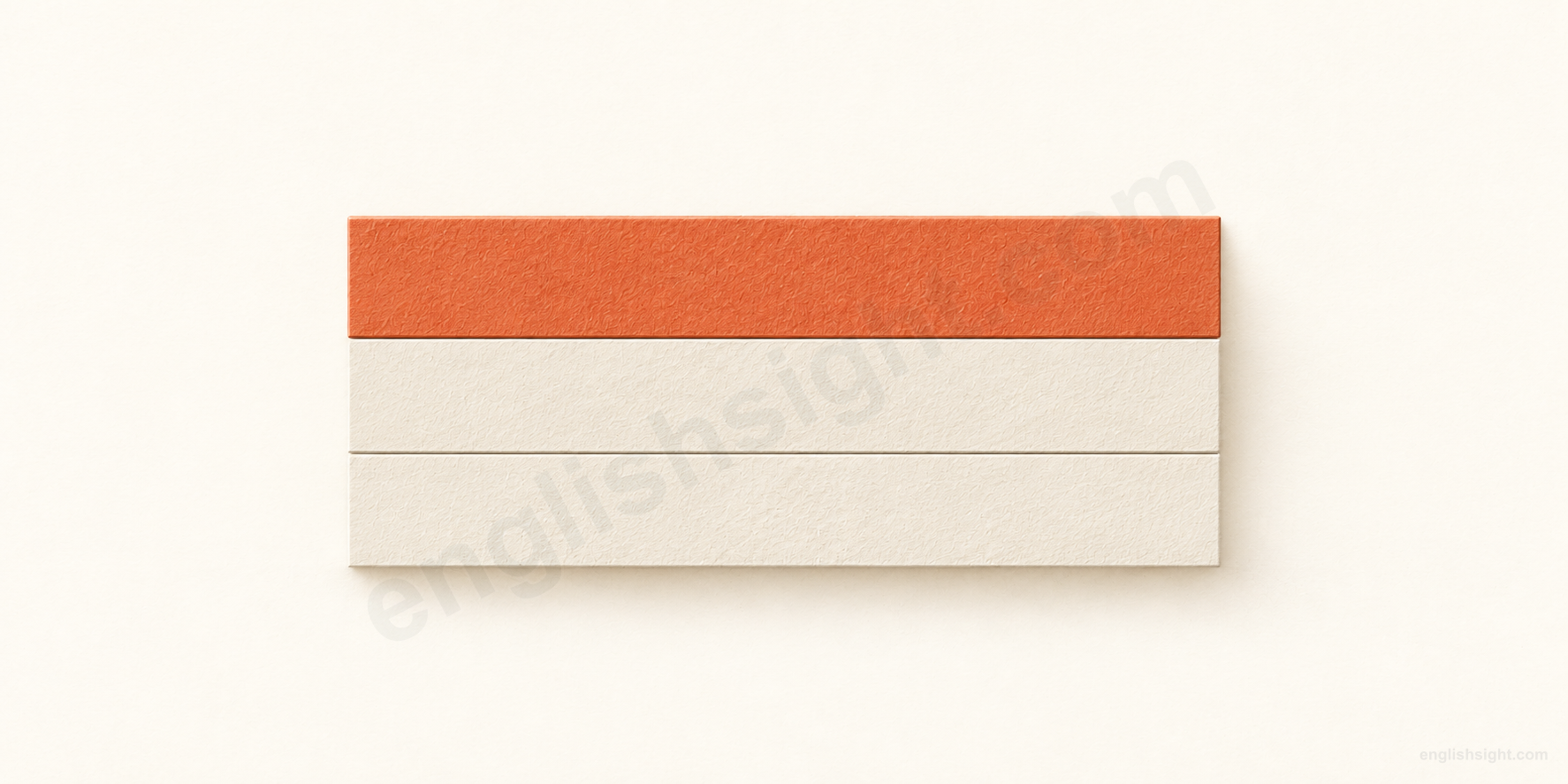
Three aligned layers form one stack.
top
It is the top of this stack; nothing moves.
Identify the uppermost layer, highlighted in orange.
Top selects the uppermost part of the relevant whole. Here, the orange layer is the top of the stack.
Top identifies the uppermost part, position, or level relative to a relevant whole or ordering.
The highlighted upper layer belongs to the same stack as the lower layers. This static relationship illustrates selection, not upward motion. Rankings and limits extend the ordering idea; fixed expressions and the spinning toy need their own explanations.
Ask “the top of what?” A staircase supplies a physical whole, a league supplies a ranking, and a speed scale supplies a maximum. These connections make many uses easier to understand.
Some meanings are established names or expressions: a top can be a garment or a spinning toy, and blow your top means lose your temper. The model is a teaching aid, not a rule that predicts every combination or a picture shared by every native speaker.
01
Upper parts, surfaces, and named things
Begin with a reference whole and its upper part, then distinguish established nouns for a closure, a garment, plant growth, and a toy.
01
the top of + noun; at / to the top
the top of the stairs
the highest part or point of a whole
Situation / reference
The stairs lead from the hall to the landing.
Meaning in context
You identify the upper end of that same staircase.
Top is a part of a reference whole, not a separate object above it.
The noun top selects the highest part or point of something. The top of a hill is its summit; the top of a page is its upper region. The relevant whole is supplied by of, by a possessive, or by the situation.
At the top locates something in that upper area; to the top makes it a destination or limit: We climbed to the top. You can say the very top for emphasis. Bottom names the opposite end.
Above the stairs only says higher than the stairs. It does not identify part of the staircase. The picture in this lesson highlights an upper part rather than an object floating above the whole.
Original example
Leave your bag at the top of the stairs.
Choice and limit Use the top of the stairs for the location; top is a noun here, not a general substitute for above.
02
the top of + object; a table top
the top of the table
the upper surface of something
Situation / reference
A table has legs, sides, and a flat upper surface.
Meaning in context
You select the surface where objects can rest.
A top may be a broad surface rather than one highest point.
Top can name the upper face of a table, desk, or other object. Wipe the top means clean that surface, not clean the whole object.
A table top is the surface itself; something on top of the table is resting on or over it. The surface need not be detachable. Compare a bottle top, which normally names a removable closure.
Original example
The top of the desk is covered in pencil marks.
Choice and limit Do not assume that every top is a lid you can take off.
03
top + noun; on the top floor; in the top corner
the top shelf
the highest item or part in an arrangement
Situation / reference
A cupboard has several shelves.
Meaning in context
One shelf is higher than all the others.
The adjective selects the uppermost member of a set.
Before a noun, top identifies the highest shelf, floor, layer, or corner in the relevant arrangement. A top-floor room is on the building’s highest floor.
Upper can identify a generally higher region without selecting the highest one. Top shelf normally selects the highest shelf in the set being discussed. Say the shelf is at the top to give an ordinary location after be.
Original example
Keep the spare blankets on the top shelf.
Choice and limit For ordinary spatial description, prefer the top shelf or the shelf at the top to The shelf is top.
04
at the top of + street / garden / table
the top of the street
the far or conventionally upper end
Situation / reference
You are near the usual entrance to a street or garden.
Meaning in context
You point out the end farther away from that entrance.
An established orientation can matter even when the ground is level.
Especially in British usage, the top of a street, garden, or table can mean its far end from the usual approach. A street need not climb a hill for speakers to use this description.
The chosen end depends on how the place is normally approached or understood. At the top of the table may refer to its far or principal end, not to standing on the tabletop. Ask which end if the orientation is unclear.
Original example
There is a small gate at the top of the garden.
Choice and limit This use is context-dependent; it does not mean north in every location.
05
a bottle / pen top; put the top on; take the top off
a bottle top
a cap or small cover that closes something
Situation / reference
A bottle is open.
Meaning in context
Its removable closure can be screwed back on.
Top can name a separate piece that closes an opening.
A bottle top or pen top is a small closure. Here a top is countable: one top, two tops. With a known object, the top identifies its particular closure.
Cap is often natural for a bottle or pen; lid is natural for a saucepan or box. These choices overlap, but top is not equally natural for every kind of large cover. Put the top on and take the top off describe attaching and removing it.
Original example
Screw the top back on the bottle before you pack it.
Choice and limit In take the top off, take is the verb and top is its noun object; this is not the phrasal verb top off.
06
a + material / colour + top; a pyjama / bikini top
a cotton top
a garment for the upper body
Situation / reference
You choose clothes to wear with trousers.
Meaning in context
You select a separate upper-body garment.
A top names the garment, not the highest point of a person.
A top can be a shirt-like or other upper-body garment. A pyjama top or bikini top names the upper piece of a set. This use is not limited to women’s clothing.
I bought a top means a garment; I bought the top of the dress would suggest a part of that dress. The connection with upper is useful, but the noun has its own established clothing meaning.
Original example
This cotton top goes well with those trousers.
Choice and limit Use a top for one garment, not a tops. Tops is the ordinary plural in clothing contexts.
07
carrot / beet tops
carrot tops
the leafy upper parts of root vegetables
Situation / reference
Carrots still have their leaves attached.
Meaning in context
You separate the leafy parts from the roots.
The plural tops can identify plant material above the root.
Carrot tops and beet tops refer to the leaves and upper growth, rather than the roots normally sold as the vegetables. The whole phrase identifies which plant is meant.
The related verb top can mean cut a plant’s top off. The noun and verb do not by themselves say whether the removed parts are edible or should be discarded.
Original example
Wash the carrot tops separately from the roots.
Choice and limit Do not interpret these tops as bottle-like caps.
08
a (spinning) top; spin a top
a spinning top
a toy that rotates on its point
Situation / reference
A toy is balanced on its pointed base.
Meaning in context
A quick twist makes it spin.
The toy meaning is a separate branch, not a prediction from uppermost.
A top is also a small spinning toy. You can spin a top, and a spinning top names the toy while emphasizing its action.
Treat this as a separate noun meaning. Its being called a top is not evidence that every use of top means spinning, or that the spatial model explains the toy’s name.
Original example
The child spun a wooden top on the floor.
Choice and limit A spinning top is a whole toy, not the upper part of another toy.
02
Rank, quality, importance, and limits
An ordered scale can have a top even when nothing is physically high. Identify what is being ordered and whether top means first, leading, best, or maximum.
09
at / to the top of + ranking; come / finish top in + subject
at the top of the league
in the highest position in a ranking or hierarchy
Situation / reference
Teams have different points totals.
Meaning in context
One team holds the leading position.
A ranking is understood as an ordered scale, with top at its highest end.
The top of the league, class, charts, or profession refers to a leading position. Reach the top and make it to the top describe achieving great success. From the top can identify senior management as the source of a decision.
The adjective also occurs after be, come, or finish in established ranking patterns, especially in British usage: She came top in maths; They are top of the league. This does not make every spatial use natural after be.
At the top of the tree, heap, or pile can similarly describe high status in a profession, organization, or society. These are figurative expressions, not literal claims about height.
Original example
Our team is at the top of the league this week.
Choice and limit A physically tall person is not automatically at the top of a profession; the ordering here is achievement or authority.
10
a top + role; top-quality + noun; top marks
a top player / top-quality materials
among the leading or best in a field
Situation / reference
Many people or products differ in ability or quality.
Meaning in context
You identify a leading performer or excellent product.
Top can describe excellence without asserting one unique first place.
A top player is one of the leading players; top officials are senior officials. The exact criterion comes from the noun and situation. Top-quality materials and top marks emphasize high quality or achievement.
In British informal speech, a top bloke or a top night out expresses approval. This is conversational praise, not a measured ranking. Compare the top player, which can identify a particular leading player in context.
A team’s top scorer has scored the most goals or points for that team in the relevant period; the title does not by itself rank every other skill. The top choice in a poll can likewise mean the option chosen most often. Here top selects the leader by a stated count, rather than simply expressing praise.
Original example
She is one of the country’s top violinists.
Choice and limit A top violinist need not be the single highest-ranked violinist. Top normally precedes the noun in this use.
11
a / our top priority; at the top of the list / agenda
top priority
the matter given greatest importance
Situation / reference
Several jobs need attention.
Meaning in context
One job must be treated as most important.
The scale orders importance rather than physical height.
Our top priority means the thing we regard as most important. At the top of the list or agenda can likewise mark an item as especially important or first to be dealt with.
A literal list has an upper position; the priority meaning uses that ordering to organize attention. A top news story is a leading story, not a story about something high in the air.
Original example
Making the building safe is our top priority.
Choice and limit A priority can be important without being the top priority; top adds the strongest ordering in the current context.
12
a top speed of + amount; at top speed; in / on top form
top speed / top form
the highest level of a quantity or performance
Situation / reference
A vehicle has a maximum speed; a player has a best level of performance.
Meaning in context
You identify that upper level.
Top can mark a limit or a best condition, not a location.
A car’s top speed is its maximum speed. At top speed describes moving as fast as possible in the context. Top form describes performing or feeling at one’s best; British English commonly uses on top form.
The scale depends on the phrase: top speed measures speed, while top form evaluates performance or condition. Neither expression implies that the person or vehicle is above another object.
Original example
The runner was in top form after a week’s rest.
Choice and limit Top form concerns condition or performance; it does not mean the first form on a page.
13
the top + number + plural noun; in the top + number
the top three
the highest-ranked group of a stated size
Situation / reference
Candidates are placed in order.
Meaning in context
You select the three highest-ranked candidates.
The number gives the size of the leading group.
The top three candidates are the three highest-ranked candidates, not necessarily three candidates tied for first. In the top three means within those first three positions.
The noun can be omitted when the group is understood: She finished in the top three. The ordering might concern scores, sales, popularity, or another stated criterion; top does not supply that criterion by itself.
Original example
Two of our designs reached the top ten.
Choice and limit Say one of the top ten designs, with a plural noun after ten.
14
amount + tops; be (the) tops
twenty minutes, tops
no more than the stated amount
Situation / reference
You estimate how long a repair will take.
Meaning in context
You give an informal upper limit.
Tops after an amount marks a maximum, not a position.
Tops follows an amount in informal speech: twenty minutes, tops means no more than twenty minutes. It is a fixed use of the form tops, not agreement with the number.
The separate expression be (the) tops means be excellent. Oxford marks that praise expression old-fashioned and informal. The amount use is useful in ordinary informal estimates; the two should not be confused.
Original example
The repair should take twenty minutes, tops.
Choice and limit Keep the -s even with a singular amount: one hour, tops. This is not the clothing plural.
03
Leading, surpassing, adding, trimming, and replenishing
The verb and its objects matter. Top the charts, top a cake with cream, and top and tail beans describe different relations; up, off, and out create further established constructions.
15
subject + top + list / charts / poll
top the charts
hold the leading position in an ordered list
Situation / reference
Songs have different sales or listening figures.
Meaning in context
One song occupies the leading chart position.
As a verb, top can mean occupy the top position.
A song tops the charts when it is ranked first. An issue can top a list of concerns, and a candidate can top a poll. The subject is the leading item or person; the list, chart, or poll follows as the object.
This is common in reporting. Compare at the top of the charts, a noun phrase giving the position. Top the charts uses top as the main verb and takes no of.
Original example
Her new album topped the charts in June.
Choice and limit Say topped the charts, not topped of the charts.
16
top + number / amount
top a thousand
exceed a particular number or amount
Situation / reference
Ticket sales approach a thousand.
Meaning in context
The total goes beyond a thousand.
The number is a threshold that the total exceeds.
Sales topped a thousand says that sales exceeded that number. The number or amount is the direct object, without at. This usage is especially familiar in news and business reporting.
The phrase does not say sales stopped there. Contrast sales topped out at a thousand, which describes an upper level with no further rise in the relevant period.
Original example
Ticket sales topped a thousand before noon.
Choice and limit Top a thousand means exceed it; top out at a thousand means reach that maximum.
17
top + offer / achievement / that
top that
surpass a previous achievement, offer, or story
Situation / reference
Someone has already made an impressive offer.
Meaning in context
A new offer is even better.
Top compares a new action or result with an earlier standard.
Top an offer, performance, or story means do better than it, or produce something more striking. Can you top that? asks whether anyone can improve on what has just been mentioned.
The subject supplies the new achievement; the object is the thing it surpasses. No physical object needs to move upward. You cannot top that can express enthusiastic praise rather than a literal impossibility.
Original example
I doubt we can top last year’s opening show.
Choice and limit The object names the standard being beaten, not the new improvement.
18
top + base + with + addition; be topped with / by + noun
top the soup with herbs
put a finishing layer or item on something
Situation / reference
The soup is ready in its bowls.
Meaning in context
Herbs are placed on its surface.
The base is the object; with introduces the material added above it.
Top the soup with herbs tells someone to add herbs to its surface. In the passive, the soup is topped with herbs. The passive is especially common in descriptions of food and buildings.
A tower topped by a dome has the dome as its uppermost part. The active food instruction usually describes a deliberate action; the passive may simply describe the resulting arrangement. A glass-topped table has a top made of glass.
Original example
Top each bowl of soup with fresh herbs.
Choice and limit In The soup is topped with herbs, the herbs are added; the soup is the base. This is not the cutting-off sense.
19
top and tail + vegetable; top + plant
top and tail the beans
cut off upper and lower ends during food preparation
Situation / reference
The beans still have their ends.
Meaning in context
Both ends are trimmed before cooking.
This established verb use removes a top rather than adding one.
In British cooking instructions, top and tail vegetables means trim off their top and bottom ends. The vegetables are the object; the phrase describes preparation, not covering them with a topping.
The verb top on its own can also mean remove the upper part of a plant. Because top can describe either adding or removing an upper part, the construction and object matter: top a cake with cream adds; top and tail beans removes.
Original example
Top and tail the beans, then rinse them.
Choice and limit Do not infer the direction of change from top alone; the full cooking phrase tells you what to remove.
20
top + container + up (with + liquid); top it up / off
top up a glass / top it off
add more liquid to a partly filled container
Situation / reference
Some of the drink has been used.
Meaning in context
More is added to restore or raise its level.
The container already has contents; the particle phrase describes replenishing.
Especially in British English, top up a glass means add more drink to it. You can also offer Can I top you up?, meaning refill the other person’s glass. With names the added liquid: top it up with water.
American English commonly uses top off for filling a tank or container to capacity. British top up can mean replenish to the level wanted; it need not promise liquid exactly at the brim.
These are separable particle verbs: top the glass up or top up the glass, but top it up. In the American filling sense, use top it off in the same way.
Original example
Could you top my glass up with water?
Choice and limit With a pronoun, say top it up, not top up it. Top off also has a separate finishing sense.
21
top up + credit / income / savings; a top-up payment
top up your phone credit
add to an amount to reach a useful level
Situation / reference
Your prepaid credit is running low.
Meaning in context
You add money to increase the available balance.
Replenishing can concern an amount rather than a physical liquid.
Top up phone credit means add more money to a prepaid balance. In British English, top up my phone often has this meaning; it does not ordinarily mean charge the battery.
You can top up income or savings by adding money. A top-up is the corresponding noun, and a top-up payment supplements an existing amount. The hyphen belongs to the noun or modifier, not the two-word verb.
Original example
I need to top up my phone credit before the trip.
Choice and limit Distinguish top up your phone credit from charge your phone: money and battery power are different resources.
22
top + event + off + with + final addition; be topped off by / with
top the evening off with dessert
complete something with a final touch or event
Situation / reference
A pleasant evening is nearly over.
Meaning in context
A final dessert completes it.
Off marks completion; with introduces the concluding addition.
Top something off with something adds a finishing touch. A meal can top off a day, or people can top off the day with a meal. The completed event is the object of top off.
Often the final touch is satisfying, but context can make it dramatic or annoying. This is distinct from the American container-filling sense. With pronouns, put the object between verb and particle: top it off.
Original example
We topped the evening off with homemade ice cream.
Choice and limit Top it off can describe a final event; it does not always refer to filling a container.
23
top out (at + amount)
top out at a hundred
reach a level and go no higher
Situation / reference
A reading rises over time.
Meaning in context
It reaches its upper value for the period.
Top out describes the upper limit, unlike top plus an amount.
Top out at a number means reach that maximum and stop rising in the relevant context. The subject is the quantity or thing reaching its limit. There is no direct object in this pattern.
A machine can top out at a certain speed because that is its limit; prices can top out at a level in a particular period. The phrase need not mean that the value can never rise again in any future circumstances.
Original example
The sensor reading topped out at 100 degrees.
Choice and limit Use at with the maximum: topped out at 100. Compare topped 100, which means exceeded 100.
04
Different relationships in on top of
The same phrase can describe an upper position, an extra amount, control, pressure, or crowded proximity. Read the subject and the surrounding situation.
24
on top of + noun / pronoun; on top
on top of the box
on or over the upper part of something
Situation / reference
A box has a clear upper surface.
Meaning in context
A folded blanket rests above it.
The phrase relates one object to the upper part of another.
On top of the box locates something on or over the box’s upper part. Books on top of one another form a stack. On top can stand alone when the supporting object is understood: Put the blanket on top.
On top of often suggests contact or covering, unlike above, which simply gives a higher position. It does not always describe stable support: a roof can collapse on top of someone, emphasizing impact and covering. Read the scene and verb as well as the phrase.
Original example
Put the folded blanket on top of the box.
Choice and limit Use on top of it when naming the supporting object; not on top it.
25
on top of + amount / noun; on top of that; amount + on top
on top of the rent
in addition to an existing amount or situation
Situation / reference
You already have a rent payment.
Meaning in context
Another cost is added to it.
An extra layer becomes an extra cost, task, or problem.
On top of the rent means in addition to the rent. It can introduce welcome extras or additional problems. On top of that refers back to what was just mentioned.
The stacking connection is a teaching aid: an amount is being added, not physically placed on another amount. On top alone can also mean extra: The price is fifty euros, with delivery on top.
Original example
We pay for electricity on top of the rent.
Choice and limit The phrase does not automatically mean a problem; bonuses can come on top of a salary too.
26
be / stay / keep / get on top of + task / situation
stay on top of your work
remain in control of tasks or a situation
Situation / reference
Messages and tasks arrive regularly.
Meaning in context
You deal with them before they accumulate.
The person is managing the work rather than being overwhelmed by it.
Be on top of your work means understand and control what needs doing. Stay or keep on top of it means maintain that control; get on top of it means achieve it.
Here the person is the grammatical subject and the work follows of. Compare the reverse relationship in The work is getting on top of me: the work is overwhelming the person. The word order changes who controls whom.
Original example
I set aside an hour each morning to stay on top of my emails.
Choice and limit Get on top of the work means gain control; the work gets on top of you means you struggle to cope.
27
work / problems + get on top of + person
the work is getting on top of me
a burden is becoming too much to manage
Situation / reference
Demands have continued to increase.
Meaning in context
You are finding it hard to cope.
The burden is the subject; the person follows of.
If the work is getting on top of me, it is becoming too much for me. This use presents the demand as a pressure on the person, rather than the person as in control.
It can describe accumulating responsibilities or other difficulties. It is not a literal claim that papers are resting on your body, and it is not equivalent to I am getting on top of the work.
Original example
The constant paperwork is getting on top of me.
Choice and limit Read the subject first: I get on top of it and it gets on top of me have opposite control relationships.
28
live / work + on top of each other
live on top of each other
live or work uncomfortably close together
Situation / reference
Too many people share a small space.
Meaning in context
They have little privacy or room to move.
The closeness is exaggerated as if people were stacked together.
Living on top of each other usually means living very close together in a cramped space. It need not mean that one flat is literally above another.
Each other refers to the people sharing the space. This is an established use of on top of for proximity; it differs from the control and addition meanings.
Original example
In that tiny office, we were all working on top of each other.
Choice and limit Do not picture literal bodily stacking unless the surrounding context actually describes it.
05
Everyday fixed expressions
These expressions use familiar ideas of height, limits, or completeness, but their wording and communicative meanings must be learned as whole phrases.
29
come out on top; be / remain on top
come out on top
win or finish in the strongest position
Situation / reference
Two sides have been competing.
Meaning in context
One finishes with the advantage.
The outcome puts one side ahead of the others.
Come out on top describes winning a contest, argument, or difficult struggle. The expression highlights the final outcome, not physical emergence from underneath something.
Be or remain on top can describe a continuing leading position. Come out on top presents how the contest ends; get on top of your tasks instead describes managing them.
Original example
After a close debate, Maya came out on top.
Choice and limit Come out on top does not guarantee that the winner will stay ahead forever.
30
feel / be + on top of the world
on top of the world
feeling extremely happy or proud
Situation / reference
You receive news you have been hoping for.
Meaning in context
You feel delighted and successful.
This is an emotional high, not a geographic location.
Feel on top of the world and be on top of the world express great happiness or pride. The whole phrase carries that emotional meaning.
It often follows success or good news, but it does not claim that you are the world’s best person at something. Contrast at the top of your profession, which describes standing in a field.
Original example
After hearing the good news, he felt on top of the world.
Choice and limit Keep the fixed article: on top of the world.
31
be / go over the top; an over-the-top + noun
over the top
more extreme than the situation calls for
Situation / reference
A small mistake prompts a huge response.
Meaning in context
Someone judges the reaction excessive.
The implied boundary is a reasonable degree, not a physical surface.
An apology, performance, decoration, or reaction can be over the top if it is excessive or exaggerated. The expression is informal, especially familiar in British English; OTT is a common abbreviation.
Before a noun, hyphens help show the phrase as a modifier: an over-the-top reaction. Compare the balloon went over the top of the wall, a literal movement description. The idiom’s meaning depends on context.
Original example
A formal complaint seems over the top for such a small mistake.
Choice and limit Over the top is usually a judgment about excess; it does not simply mean excellent.
32
off the top of + possessive + head
off the top of my head
from immediate memory without checking
Situation / reference
Someone asks a factual question unexpectedly.
Meaning in context
You answer from what you remember at once.
The phrase marks an unprepared answer, not a piece of the head.
Off the top of my head means without checking facts or thinking carefully first. It can introduce an estimate, a suggestion, or something recalled immediately.
I can’t tell you off the top of my head says you cannot retrieve the answer right now; it does not say that the answer is unknowable. The possessive follows the person whose memory is involved.
Original example
Off the top of my head, I think we need six chairs.
Choice and limit An answer given this way may be right; the phrase describes how it was produced, not proof that it is wrong.
33
shout / sing / scream + at the top of + possessive + voice
at the top of your voice
as loudly as you can
Situation / reference
A child needs to be heard across a noisy playground.
Meaning in context
The child shouts at full volume.
Top marks a maximum level of loudness in this fixed phrase.
Shout, sing, or scream at the top of your voice means do it as loudly as you can. The possessive refers to the person making the sound.
This expression is about loudness. It does not necessarily mean a high musical pitch: a deep voice can shout loudly. The maximum-scale connection helps explain the phrase, but its wording is established.
Original example
She called his name at the top of her voice.
Choice and limit Say at the top of her voice, not on the top of her voice.
34
blow + possessive + top
blow your top
suddenly become very angry
Situation / reference
A person discovers that a promise was broken.
Meaning in context
They react with a burst of anger.
The whole informal expression names a loss of temper.
Blow your top means suddenly lose your temper. The possessive belongs to the angry person: He blew his top. The past form comes from blow, not from top.
Treat this as a fixed expression. The image of a lid being forced off can help you remember it, but it does not define top in unrelated contexts or make every mention of a top about anger.
Original example
Dad blew his top when he saw the broken window.
Choice and limit Use blew for the past: blew his top. The phrase is informal and can sound dramatic.
35
verb + from top to bottom; covered / dressed + from top to toe
from top to bottom / from top to toe
throughout the whole place or over the whole body
Situation / reference
You want every part to be covered or checked.
Meaning in context
Nothing in the relevant whole is left out.
The two extremes stand for the full extent between them.
Search or clean a room from top to bottom means do so thoroughly throughout it. The phrase often emphasizes completeness rather than a compulsory order starting at the ceiling.
From top to toe describes the whole body, for example clothing or mud covering someone. Head to toe is another familiar way to express that bodily extent; toe belongs to the fixed expression, not to top’s general definition.
Original example
We searched the kitchen from top to bottom.
Choice and limit The idiom need not instruct you to move physically downward in a fixed sequence.
36
take + performance / it + from the top; at the top of the hour
take it from the top
start again from the beginning
Situation / reference
A group stops halfway through a rehearsal.
Meaning in context
They restart the piece at its beginning.
Top can name the beginning of an ordered sequence.
Take it from the top is an informal rehearsal instruction to begin again. It is common with music and performance; from the top can also introduce a retelling from the beginning.
At the top of the hour means at the beginning of an hour, such as 3:00 rather than 3:15. This is a conventional time expression, often heard in broadcasting. Neither use means a physically high place.
Original example
Let’s take the song from the top and try a slower tempo.
Choice and limit From the top concerns a starting point; from top to bottom emphasizes full extent.
37
to top it all, + clause; to top it all off, + clause
to top it all (off)
introduce a final striking detail after earlier events
Situation / reference
Several things have already gone wrong.
Meaning in context
You add one final unwelcome development.
The last detail intensifies the accumulated situation.
To top it all often introduces a final bad thing after other problems: the train was late, then your bag broke, and to top it all it started raining. To top it all off is a related expression.
The fuller top off family can also introduce a satisfying finish, so the tone must come from the context. Here the fixed phrase organizes a story; it does not name a physical topping or a maximum price.
Original example
My train was late, and to top it all, I had left my keys at work.
Choice and limit The fixed it does not need a particular physical object as its referent.
38
pay / earn / charge + top dollar; pay top dollar for + noun
pay top dollar
pay a very high or the highest market price
Situation / reference
A rare item is much in demand.
Meaning in context
A buyer pays a premium price for it.
Top identifies the upper end of the price scale.
Pay top dollar for something means pay a very high price, often the highest price available in that market. Earn or charge top dollar similarly concerns a high rate of payment. The expression is informal.
Dollar is fixed in the expression; it does not mean that the amount is one dollar. A buyer can use the phrase figuratively when talking about an expensive purchase rather than reporting a precise maximum.
Original example
Collectors pay top dollar for original concert posters.
Choice and limit Do not add an article or plural ending: pay top dollar, not pay a top dollar or top dollars.
Let the whole construction guide you
Noun and adjective grammar
A top is countable for a garment, lid, or toy; the top often identifies a particular upper part or leading position. Adjective top usually comes before a noun and normally has no -er or -est comparison. Ranking patterns such as come top and be top of the class are established exceptions to the usual before-noun position.
Top, upper, above, and on top of
Top selects the highest part in the relevant set; upper can describe a generally higher area. Above gives a higher position relative to something else. On top of can describe an upper surface relationship, but it also has separate addition, control, pressure, and proximity uses.
Verb forms and particle position
The forms are top, tops, topped, topped, topping: double the p before -ed and -ing. Ordinary active and passive forms are possible where the meaning allows them, especially soup topped with herbs. Top up and top off are separable with object pronouns before the particle; top out at a value is intransitive. There is no general top someone to do something causative pattern.
Common use, not every specialist sense
The lesson covers modern everyday senses and useful fixed expressions, with regional and informal labels where relevant. Specialist sport, sailing, chemistry, particle physics, slang killing senses, and the literary verb for reaching a hilltop are outside the teaching scope. Separate compounds such as top hat, top secret, top gear, and top dog need their own full-expression meanings.
Choose the relationship
Use the grammar and situation to decide what top contributes.
1. A report says ticket sales topped 1,000. What does that tell you?
2. Your workload has become hard to manage. Which sentence expresses that?
3. You want someone to add more water to your partly filled glass. Which request works?
4. The hotel charges for breakfast on top of the room price. What should you expect?
5. An instruction says to top and tail the beans. What should you do?
6. A colleague answers off the top of her head. What does the phrase establish?
Sources and teaching notes
The sources below support the usage inventory. The explanations and examples are original; the upper-part model is a teaching interpretation with stated limits.
The diagram illustrates a relationship; it does not claim that all native speakers share one mental picture.