Use touch for meeting surfaces, feeling, affecting, connecting, and adding a small difference.
From a gap to contact
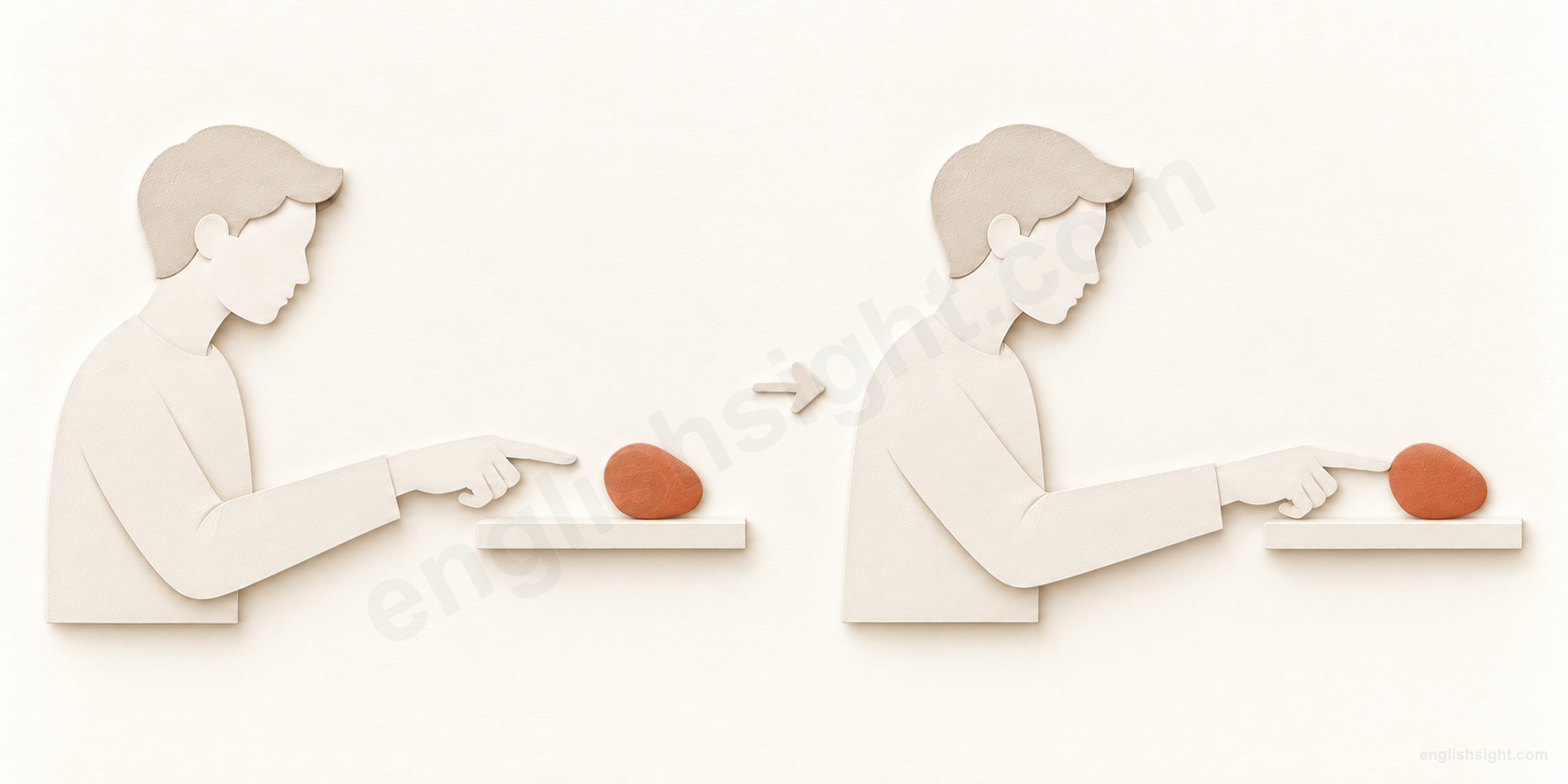
Meet at a point of contact
A gap separates the fingertip from the stone.
touch
The fingertip is in contact; the stone stays on its ledge.
The hand moves closer until the fingertip meets the surface.
The fingertip meets the stone without grasping it or moving it.
To touch is to make or be in contact, without the word itself saying that you grasp, move, or change what you meet.
The hand and stone demonstrate physical contact. Wider uses can treat a person, topic, or activity as something reached or affected. In touch, lose your touch, and other idioms have established meanings that the sketch alone cannot predict.
A fingertip can meet a stone without grasping it or moving it. That contact relation is a useful starting point for touch. Contact may be momentary or continuing, gentle or forceful; those details come from the situation or other words.
English also uses touch for involvement, emotional influence, communication, traces, and skill. Some connections are easy to see; others belong to fixed expressions. The lesson makes those differences explicit rather than treating every phrase as a literal tap.
01
Contact and physical sensation
Start with the contact relation, then distinguish an action, a continuing meeting of surfaces, a counted touch, and the sense that supplies information.
01
touch + object; touch + person + on + body part; touch + object + with + instrument
touch something / someone
make physical contact with a thing or person
Situation / starting point
A finger is near a stone, with a gap between them.
Meaning / result
The fingertip meets the stone’s surface.
Contact does not by itself mean holding, pushing, or changing the object.
The person or body part making contact can be the subject: I touched the stone; My finger touched the stone. Touch takes a direct object here. You can touch gently or firmly, accidentally or deliberately; the verb alone does not settle those details.
Touch someone on the shoulder names the person first and the body area after on. Touch the screen with your finger names the instrument after with. In the diagram the gap closes, but the hand does not grasp or move the stone.
In a sentence
Mia touched my shoulder with two fingers to get my attention.
Watch the difference Touch my shoulder and touch me on the shoulder are natural. Touch on my shoulder is not the usual way to express this action without a person object.
02
two things + touch / are touching; thing + touch + thing
The edges are touching.
have no gap at a point of contact
Situation / starting point
Two cards lie near each other.
Meaning / result
Their edges meet.
Things can touch without anyone actively touching them.
Two objects can be the plural subject: The cards touch. One object can also be the subject and the other the object: One card touches the other. The contact may continue, so Their edges are touching is natural.
Touching does not mean overlapping, being stuck together, or covering a whole surface. The contact could be at one point. In sport, touching a ball is ordinary physical contact; it does not imply taking possession or scoring.
In a sentence
Move the cards apart; their edges are touching.
Watch the difference Touch can describe an ongoing relation. Do not assume every touch must be brief.
03
a + adjective + touch; a touch on + body part; at the touch of + control
a gentle touch / at the touch of a button
one instance of physical contact or light pressure
Situation / starting point
A control has not been pressed.
Meaning / result
A small movement activates it.
The countable noun names the contact itself.
A touch can be a single contact: I felt a touch on my arm. Adjectives such as gentle, light, and firm describe its manner. The noun does not require a long hold.
At the touch of a button presents a task as easy to activate by pressing a control: The lights change at the touch of a button. At her touch instead means in response to her contact. Neither expression describes the sense of touch in general.
In a sentence
The curtains close at the touch of a button.
Watch the difference Use a touch for an instance. General sensory ability is touch without a: the sense of touch.
04
the sense of touch; recognize / identify / find + object + by touch
the sense of touch / by touch
recognize something through physical sensation
Situation / starting point
You cannot see the object clearly.
Meaning / result
You identify it by feeling it.
Touch is an uncountable sensory ability in this use.
Sight tells you what something looks like; touch gives information through contact with the body. Sense of touch names that ability. By touch tells us the method used to identify or find something.
I found the key by touch means feeling helped you locate it. Touch as a verb merely reports contact; feel can emphasize exploring a surface or noticing a sensation. Touching a bag does not necessarily mean checking what is inside it.
In a sentence
In the dark, I found the raised switch by touch.
Watch the difference Do not add an article in by touch. This is a method, not one counted contact.
05
be / feel + adjective + to the touch
soft to the touch
have a quality that can be felt through contact
Situation / starting point
You wonder what the fabric feels like.
Meaning / result
Your hand detects a soft surface.
The adjective describes the object as experienced through touch.
Soft, rough, warm, cool, and similar adjectives can be followed by to the touch. The fabric is soft to the touch reports a tactile quality. It does not say someone is touching it right now.
Compare The fabric feels soft, which gives a similar description. Soft to touch is also understandable, but learn the established expression to the touch. In too hot to touch, to touch is an infinitive describing an action that is difficult or unsafe; it is a different construction.
In a sentence
The new towel is surprisingly rough to the touch.
Watch the difference To the touch describes a perceived quality; by touch describes a method of finding or identifying something.
06
do not + touch + person / belongings; not touch a hair of + possessive + head
Don’t touch my things.
leave something alone; in a denial, say you did not harm someone
Situation / starting point
Someone might move or interfere with belongings.
Meaning / result
The speaker tells them to leave the belongings alone.
Context can make touch mean more than merely contacting a surface.
Don’t touch my files can prohibit opening, moving, or changing them, even digital files. Don’t touch me can reject unwanted physical contact. The exact action depends on what is at risk.
In an argument, I never touched him can deny hitting or otherwise harming him. I won’t touch a hair of her head is an emphatic promise not to hurt her at all. These meanings arise from the situation or the whole expression, not from a rule that touch always means attack.
In a sentence
Please don’t touch the folders on my desk; I have put them in order.
Watch the difference A physical touch need not be harmful. A denial such as I never touched him needs context to imply a denial of violence.
02
Use, work, feelings, and influence
The object and sentence tell you whether contact concerns consuming something, doing work, affecting a person, reaching a level, or equaling a standard.
07
hardly / barely + touch + food; never touch + food / drink; not touch + funds
hardly touch your food / never touch alcohol
eat, drink, or use little or none of something
Situation / starting point
A full meal is available.
Meaning / result
Almost all of it remains uneaten.
Here touch concerns consumption or use rather than fingertip contact.
You’ve hardly touched your soup means you have eaten very little of it. I never touch alcohol means I do not drink it. The negative or near-negative wording is especially usual for this meaning.
Money can be untouched too: We haven’t touched our savings means we have not spent or used them. The statement does not tell you whether someone physically handled cash. Hardly leaves room for a little; haven’t touched often emphasizes none.
In a sentence
We haven’t touched the emergency savings this year.
Watch the difference In I touched the soup with a spoon, the instrument makes literal contact likely. Read the object and context, not only the verb.
08
not touch + task / project; work / place + has not been touched
I haven’t touched the report.
have not started or done work on something
Situation / starting point
A report still needs attention.
Meaning / result
No work has been done on it.
Touch can extend from physical involvement to doing a task.
I haven’t touched the report all week says I have done no work on it. It does not necessarily mean I have avoided its paper surface. The object identifies the task or project.
The passive is useful when the work matters more than the worker: The back room hasn’t been touched for years. Depending on context, it has not been cleaned, renovated, or otherwise dealt with. The intended work should be clear from the surrounding conversation.
In a sentence
The website needs updating, but I haven’t touched it since Monday.
Watch the difference Touch the report is not a general replacement for write the report. This no-work meaning is particularly natural with negative or limiting wording.
09
something + touch + person; be touched by + cause; be touched that + clause; be touched to + verb
be touched by / touched that / touched to hear
feel emotionally moved, often by kindness or sadness
Situation / starting point
A person discovers a thoughtful action.
Meaning / result
The action produces a strong personal feeling.
What touches someone can be a story, gesture, fact, or event.
Her kindness touched me makes kindness the subject and the affected person the object. In I was touched by her kindness, the person becomes the subject. The emotional effect can be deep; touch is not restricted to a small or brief feeling.
Touched also works as an adjective with that or an infinitive: I was touched that they remembered; I was touched to hear their message. These describe the reason for feeling moved. Touch my heart is a familiar emotional expression, not a claim about physical contact with an organ.
In a sentence
I was touched that my neighbors remembered my birthday.
Watch the difference I feel touched means emotionally moved. I feel touching does not express that state; a touching story is a story that moves people.
10
touch + lives / areas / issues; no one will touch + project / person
touch people’s lives
affect or have a connection with people or situations
Situation / starting point
A change occurs beyond one household.
Meaning / result
Its effects reach many people.
The object can be someone’s life, an issue, or an area of experience.
The new policy touches every part of school life says its influence reaches those areas. This broader affect meaning is more formal or written than ordinary physical touch. It may involve practical consequences rather than tender emotion.
A related involvement use appears in No insurer will touch this project: none will agree to become involved with it. Everything she touches succeeds likewise means every activity she gets involved in. These are extensions of contact, but the particular relationship depends on the object and sentence.
In a sentence
The factory closure has touched the lives of families across the town.
Watch the difference Touch people’s lives need not mean make them happy. It can describe harmful effects as well as helpful ones.
11
temperature / price / speed / total + touch + value
touch a level
reach a value or point on a scale
Situation / starting point
A measured quantity rises.
Meaning / result
It reaches a particular value.
A scale supplies the point being reached.
Temperatures touched 35 degrees says they reached that value. Touch often makes the value sound like a high point reached during the period, but does not itself say how long it lasted. Reach is a more general choice.
This use occurs in reports about prices, temperatures, speeds, or totals; Collins labels it mainly British. The scale is a useful teaching extension of contact with a point, not a claim that a number is a physical object.
In a sentence
Temperatures touched 35 degrees in the city yesterday.
Watch the difference Do not add to before the value: touched 35 degrees. Rose to 35 degrees uses a different verb pattern.
12
no one / nothing + can touch + person / thing + for + quality
Nobody can touch her for speed.
be unable to equal someone’s ability or quality
Situation / starting point
You compare several people’s performance.
Meaning / result
One performs much better than the others.
Negative touch can express a comparison rather than physical inaccessibility.
No one can touch her for speed means no one is as fast as she is in the relevant activity. For introduces the quality being compared. When it comes to speed can make the field equally clear.
The typical pattern is nobody can touch or nothing can touch, followed by the outstanding person or thing. It is an emphatic judgment, not a measured fact about every competitor. It has no ordinary progressive meaning in this comparison.
In a sentence
For a quick repair, nobody can touch Sam.
Watch the difference Can’t touch him can also mean cannot physically reach him. The comparison needs a context such as skill, speed, or quality.
03
Communication and staying aware
In touch is an established relationship expression. Different verbs establish, maintain, restore, or lose that relationship; the object can also make it about understanding.
13
get / be in touch with + person; put + person + in touch with + person
get in touch / put someone in touch
establish communication or connect two people
Situation / starting point
You have not yet contacted the relevant person.
Meaning / result
You open a channel of communication.
In touch is a contact relationship, not bodily contact.
Get in touch with the office asks you to contact the office, perhaps by email, phone, or a message. Get marks the start of communication. Be in touch names the resulting contact; I’ll be in touch commonly promises a later message.
Put someone in touch with someone else means help them contact one another: I can put you in touch with our designer. Put identifies a person who makes the connection possible. Neither expression requires a meeting or physical contact.
In a sentence
Please get in touch with our office if your address changes.
Watch the difference Say get in touch with her, not get touch her. Contact her takes a direct object instead.
14
keep / stay / be + in touch + with + person
keep / stay in touch
continue communicating over time
Situation / starting point
Two people are about to live in different places.
Meaning / result
They continue exchanging news.
Keep and stay maintain a relationship that already exists.
Keep in touch and stay in touch ask people to continue communicating. Let’s keep in touch is a common farewell when people may not see each other regularly. It leaves the frequency and method open.
We’re still in touch reports the continuing relationship. Compare We got in touch last week, which tells when communication was established or resumed. The contact metaphor helps, but the whole in touch expression has to be learned.
In a sentence
We live in different cities, but we stay in touch by voice messages.
Watch the difference Keep in touch does not promise daily communication. It asks for some continuing contact.
15
lose touch with + person; be out of touch with + person; get back in touch with + person
lose touch / be out of touch with someone
stop communicating with someone
Situation / starting point
Friends used to exchange news.
Meaning / result
They no longer communicate.
Lose touch describes the change; out of touch describes the situation.
I lost touch with Leo after school means our contact stopped. We’ve been out of touch for years describes the period without communication. Neither wording proves that the people had an argument.
To reverse this, get back in touch with someone. Back adds the idea of restoring an earlier connection: We got back in touch last winter. Do not confuse losing touch with a person and losing your touch at an activity.
In a sentence
I lost touch with Ana after we left college, but she emailed me last week.
Watch the difference Lose touch has no possessive here. Lose my touch means lose my usual skill, not stop receiving news from a friend.
16
be / keep in touch with + developments; be out of touch with + people / reality; lose touch with + reality
in / out of touch with reality
understand or fail to understand current conditions or other people
Situation / starting point
A manager receives little information from staff.
Meaning / result
Her assumptions no longer match their experience.
Contact with a subject can mean awareness, not exchanging messages.
Keep in touch with developments means stay informed about what is happening. Be out of touch with ordinary people means fail to understand their lives or views. A person can send many messages and still be out of touch in this second sense.
Lose touch with reality means cease to understand the situation accurately; it can be a criticism of unrealistic plans, not necessarily a medical description. The object after with tells you whether the issue is communication, knowledge, or understanding.
In a sentence
The committee seems out of touch with the problems of people who rent.
Watch the difference Out of touch with voters describes a lack of understanding; out of touch with an old friend can simply mean no communication.
17
touch base with + person; touch base about + topic
touch base with someone
make brief contact to exchange an update
Situation / starting point
Colleagues need to check how a task is going.
Meaning / result
They have a short conversation or exchange messages.
This informal idiom names a check-in.
Let’s touch base tomorrow proposes a brief contact, often in work or planning. With names the other person, and about can introduce the topic. It does not necessarily mean a physical meeting.
Base belongs to the fixed expression; it is not an ordinary object to replace with another location word. The idiom overlaps with get in touch, but often suggests checking progress or renewing contact rather than contacting someone for the first time.
In a sentence
Can we touch base on Friday about the delivery dates?
Watch the difference Use touch base, with no article or plural ending. This is informal and can sound like workplace language.
04
Small amounts, finishing details, and personal skill
Noun patterns can name a trace, a pleasing addition, an approach, or an ability. The article, modifier, and possessive are important clues.
18
a touch of + substance / quality / condition
a touch of something
a small amount or trace of something
Situation / starting point
A dish needs only a little extra flavor.
Meaning / result
A small amount gives it that flavor.
A touch of can name a small quantity or a slight quality.
A touch of lemon can mean a small addition to food. A touch of sadness in someone’s voice means a detectable trace of that feeling. The phrase is flexible, but it does not name an exact measurement.
The smallness belongs to this noun expression, not to every use of touch. A touch of frost and a touch of a cold describe a slight presence or mild case in ordinary language; neither provides a technical measurement or diagnosis.
In a sentence
Add a touch of lemon to the sauce before serving.
Watch the difference Use of: a touch of sweetness. A touch sweet belongs to the separate slightly pattern.
19
a touch + adjective / comparative; a touch + too + adjective
a touch too loud / a touch more
slightly or a little
Situation / starting point
A setting is close to suitable.
Meaning / result
You describe or request a small difference.
A touch can modify an adjective or comparison without of.
The music is a touch too loud means it is slightly louder than desired. Could you move it a touch closer? asks for a small change of position. In this use the expression behaves like a degree modifier.
Compare a touch of salt, which names a small amount of a thing. A touch warmer describes a small difference in temperature. This use is common in conversational adjustments and evaluations, but is not a precise unit.
In a sentence
Could you make the text a touch larger?
Watch the difference Do not insert of before the adjective: a touch larger, not a touch of larger.
20
a nice / thoughtful / decorative touch; add a touch to + thing; personal touches
a nice / decorative touch
a small detail that improves something
Situation / starting point
A room or event is already usable.
Meaning / result
A thoughtful detail makes it more pleasing.
The countable noun evaluates an addition, not a physical tap.
Calling a handwritten welcome card a nice touch praises a thoughtful detail. Add a decorative touch describes a small improvement to appearance. The added element may be a gesture, arrangement, or feature.
There can be several touches: The room has some lovely personal touches. This noun can be counted because it refers to individual details, unlike the uncountable sensory ability in sense of touch.
In a sentence
Leaving a map and a welcome note in the room was a nice touch.
Watch the difference A nice touch praises a detail. A gentle touch describes the manner of physical contact.
21
put / add the finishing touches to / on + work
put the finishing touches to / on something
add the final details that complete or improve work
Situation / starting point
The main work is finished.
Meaning / result
A few final adjustments complete it.
Finishing identifies the last stage, not any small addition.
The finishing touches are final details such as adjusting spacing, adding a title, or checking a display. The plural is particularly usual. A single addition may also be the finishing touch.
Put the finishing touches to the display and put the finishing touches on the display are both used. The work is near completion; this expression would mislead if you had barely started the main task.
In a sentence
We’re putting the finishing touches on the exhibition before it opens tomorrow.
Watch the difference Finishing touches are the last refinements. They do not mean doing the entire project.
22
give / add a personal / professional touch to + thing; have a personal touch
a personal / professional touch
a recognizable manner or quality in how something is done
Situation / starting point
A service could feel routine and anonymous.
Meaning / result
Someone adds individual care or style.
Touch can describe an overall manner as well as one extra detail.
A personal touch makes something feel individually cared for rather than impersonal. A professional touch suggests the finish or style associated with skilled work. These qualities may be conveyed by several actions, not one physical contact.
This overlaps with a nice touch, but the focus differs: a nice touch identifies a pleasing detail; a personal touch describes the individual care or character behind it. The noun does not itself tell you whether the result is good; the modifier supplies that judgment.
In a sentence
Her recorded welcome gives the online course a personal touch.
Watch the difference Personal touch is usually positive in this context. It does not refer to touching someone’s body.
23
have / lose / regain + possessive + touch; have a magic touch with + activity / object
have / lose your touch
have or lose your usual ability to do something well
Situation / starting point
You once performed a skill reliably.
Meaning / result
You can no longer achieve your usual standard.
The possessive makes touch someone’s characteristic skill.
I’m losing my touch can be a serious or joking comment after repeated mistakes. You haven’t lost your touch reassures someone who still performs well. A magic touch describes a special ability to get good results; it need not be literally magical.
The skill belongs to the person: my touch, her touch, your touch. Compare I’ve lost touch with Jo, where there is no possessive and the lost thing is a contact relationship. Regain your touch describes getting the skill back.
In a sentence
After three ruined cakes, I began to think I was losing my touch.
Watch the difference Lose your touch concerns skill. Lose touch with someone concerns communication; the possessive changes the expression.
24
handle / treat + subject + with a light touch
handle a subject with a light touch
deal with something sensitively and without heaviness
Situation / starting point
A topic could easily become tense or dull.
Meaning / result
The speaker handles it gently and with restraint.
A manner of handling a topic is compared to light physical pressure.
A light touch in writing, teaching, or dealing with people suggests a sensitive, relaxed, or understated approach. It can involve humor, but humor is not compulsory. The expression does not mean ignoring the subject.
A pianist’s light touch may instead describe delicate physical control. In both cases light qualifies the manner; it is not a rule that touch itself always means gentle. A heavy touch would suggest a different manner.
In a sentence
The writer handles a painful subject with a surprisingly light touch.
Watch the difference A light touch is about approach. A touch of humor names a small amount of humor in that approach.
25
have / lack + the common touch
the common touch
an ability to relate naturally to ordinary people
Situation / starting point
A public figure might seem remote from everyday life.
Meaning / result
The person communicates easily with ordinary people.
Common refers to ordinary people, not a commonly repeated physical action.
The common touch is often used of leaders, famous people, or others in positions of power. It praises their ability to talk to and understand people outside that position.
The expression is fixed and usually has the: She has the common touch. It describes social understanding and manner, not how many people somebody physically touches or the number of messages they send.
In a sentence
Despite her fame, the actor has never lost the common touch.
Watch the difference Learn the whole phrase with the. A common touch is not the usual form of this idiom.
26
have + the Midas touch
the Midas touch
an ability to make ventures financially successful
Situation / starting point
Someone starts or invests in a series of projects.
Meaning / result
The projects repeatedly make money.
This is a specific financial-success idiom, not the general sense of touch.
Someone described as having the Midas touch seems able to turn business activities into financial successes. The name comes from a myth about a king whose touch turned things into gold.
The phrase is praise or an impression, not a promise that every future investment will succeed. A magic touch can describe skill in many areas; the Midas touch specifically points to financial success.
In a sentence
After two successful restaurant openings, people said she had the Midas touch.
Watch the difference Capitalize Midas. Do not use this idiom as a general synonym for kindness or good physical coordination.
27
be touched with + quality / color
be touched with a quality
show a small amount or trace of a quality
Situation / starting point
A face, voice, or appearance has a mainly different character.
Meaning / result
A slight additional quality is noticeable.
This written expression presents a quality as a light mark.
Her voice was touched with sadness means some sadness could be heard in it. Hair touched with gray contains some gray. This passive-looking expression is especially associated with descriptive writing.
Compare I was touched by her sadness, where someone feels emotionally moved. With introduces the trace or quality here; by commonly introduces the cause of an emotional response. The choice of preposition and the subject matter both help identify the meaning.
In a sentence
His dark hair was touched with gray at the temples.
Watch the difference Touched with sadness describes a trace of sadness; touched by kindness describes being moved by kindness.
05
Touch with a particle or preposition
Learn the meaning and object placement of each combination. Similar-looking words such as on, up, down, and off do different jobs.
28
touch on / upon + topic; topic + be touched on / upon
touch on / upon a subject
mention or deal with a subject briefly
Situation / starting point
A talk has many topics available.
Meaning / result
The speaker gives one topic only limited attention.
On or upon introduces the subject; the whole combination means brief treatment.
We’ll touch on costs means we will mention or discuss costs briefly rather than cover them in detail. Upon has the same relevant meaning and can sound more formal. The topic follows on or upon.
This pattern is not separable: touch on it, not touch it on. A passive is possible: The issue was touched on briefly. Compare touch me on the arm, where me is a person object and on the arm identifies a bodily location.
In a sentence
The guide touches on local history before describing the walking routes.
Watch the difference Touch on does not mean explain fully. Use cover in detail when that is what you intend.
29
touch up + thing; touch + thing + up; touch + pronoun + up
touch something up
make small improvements to appearance or finish
Situation / starting point
Paint has a few small damaged spots.
Meaning / result
Only those spots are repaired.
Up belongs to a fixed improvement expression, not upward movement.
You can touch up paint, makeup, or a photograph by correcting small details. Touch up the photo and touch the photo up are possible; a pronoun goes in the middle: touch it up. A touch-up is the related noun for a small repair or adjustment.
Changing the object changes the interpretation. In informal British English, touch someone up can refer to unwanted sexual touching. That is a different, serious meaning, not a way to say improve someone’s appearance. Use touch up her makeup if makeup is what you mean.
In a sentence
We only need to touch up the paint around the handle.
Watch the difference Say touch it up, not touch up it. Do not use touch someone up for styling someone’s hair or clothes.
30
plane / spacecraft / tornado + touch down; touch down on + surface; touch down at / in + place
touch down
reach the ground when landing
Situation / starting point
An aircraft is in the air.
Meaning / result
It makes contact with the landing surface.
Down contributes a landing relation in this established combination.
A plane or spacecraft touches down when it reaches the ground during landing. The aircraft is the subject and no direct object is needed. On can name a landing surface, and at or in can identify a destination.
Weather reports also use touch down of a tornado making contact with the ground. This is a separate situation with the same ground-contact relation. A rugby scoring use exists, but its rules are outside this general lesson.
In a sentence
Our plane touched down just before the rain began.
Watch the difference Touch down is two words as a verb. Do not treat it as a separable verb with a passenger object.
31
touch off + event; touch + event / pronoun + off; event + be touched off by + trigger
touch off an argument / a fire
cause a reaction, event, or disturbance to begin
Situation / starting point
A situation is ready to react.
Meaning / result
One event triggers a larger response.
Off belongs to a trigger expression; it does not mean stop here.
A remark can touch off an argument, and a spark can touch off a fire. The subject is the trigger; the object is what starts. The result is often difficult, violent, or unwelcome, especially in reports.
Touch off can be separated from its object; with a pronoun use touched it off. A passive can focus on the event: The dispute was touched off by a misunderstanding. The trigger need not involve physical contact.
In a sentence
One careless remark touched off an argument that lasted all evening.
Watch the difference Touch off means trigger, not end. To end an argument, use a different expression such as settle it.
06
Sensitive subjects, luck, refusal, and close outcomes
These expressions have conventional meanings. The contact model can help some of them feel memorable, but cannot calculate their meanings word by word.
32
touch / hit / strike + a (raw / sensitive) nerve
touch a nerve / a raw nerve
raise a subject that provokes a sensitive emotional reaction
Situation / starting point
A person has a painful or sensitive concern.
Meaning / result
A comment brings that concern to the surface.
The nerve is a metaphor for sensitivity, not necessarily a medical nerve.
Touch a nerve means say something that makes someone upset, angry, or embarrassed because it connects with a sensitive concern. Raw or sensitive strengthens that idea. Hit and strike also occur in this idiom.
The reaction may surprise the speaker; it need not be a deliberate insult. This is more specific than touch someone emotionally: the focus is a sensitive subject being activated, rather than gratitude or tenderness.
In a sentence
My joke about missed deadlines touched a raw nerve with Dan.
Watch the difference Touch a nerve is not the same as get on someone’s nerves, which means annoy them.
33
touch / strike + a chord + with + person / audience
touch / strike a chord with someone
evoke sympathy, recognition, or shared feeling
Situation / starting point
An audience hears an experience similar to its own.
Meaning / result
The story connects with the audience emotionally.
A chord suggests a response that resonates with someone’s experience.
A story, comment, or song can touch a chord with people because it expresses something they recognize or feel. Sympathy and enthusiasm are possible responses. The expression does not require an actual musical performance.
With introduces the responding person or group. Strike a chord is a common alternative. Unlike touch a nerve, the expression often highlights a shared response rather than an exposed sore point, though the shared feeling can involve sadness.
In a sentence
Her story about starting over touched a chord with many listeners.
Watch the difference Use chord, the musical spelling, not cord. This idiom is about emotional resonance, not physical contact.
34
statement of good luck / hope + touch wood
touch wood
express hope that good luck will continue
Situation / starting point
You mention that something has gone well.
Meaning / result
You add a familiar good-luck expression.
The expression is a social convention rather than a prediction.
In British English, touch wood is often added after reporting good luck or a hope, as if to avoid tempting bad luck. Speakers may touch something wooden, but the words can stand as the expression.
Knock on wood is the usual American counterpart. Neither expression guarantees a result or states a logical cause. Learn it as a familiar conversational custom, not as a literal instruction in every context.
In a sentence
The old car has been reliable so far, touch wood.
Watch the difference The regional counterpart is knock on wood. Do not interpret touch wood as an ordinary command when it follows a statement of luck.
35
would not touch + person / thing + with a bargepole / a ten-foot pole
wouldn’t touch it with a bargepole / a ten-foot pole
refuse strongly to have anything to do with something
Situation / starting point
A proposal looks risky or deeply unattractive.
Meaning / result
The speaker rejects any involvement.
Imagined distance intensifies the refusal.
I wouldn’t touch that offer with a bargepole is an informal British way to reject involvement emphatically. American English commonly uses with a ten-foot pole. The pole is figurative; there need not be anything to touch.
This can concern a business, plan, product, or person. Applied to a person, it is a strong and potentially insulting rejection. The whole idiom intensifies the broader involvement meaning of touch.
In a sentence
With those hidden fees, I wouldn’t touch that contract with a ten-foot pole.
Watch the difference This is emphatic informal rejection, not a neutral way to decline a routine invitation.
36
be touch and go; it is / was touch and go whether + clause; a touch-and-go situation
It was touch and go.
the outcome was uncertain and success was in doubt
Situation / starting point
A result could go either way.
Meaning / result
People still do not know whether it will succeed.
This fixed expression describes a precarious situation.
It was touch and go whether we would catch the train says catching it was seriously in doubt. It does not, by itself, tell us the eventual result. Context may then say that we caught it or missed it.
Before a noun, hyphens are usual: a touch-and-go situation. The idiom does not mean a brief friendly touch followed by leaving. Its uncertainty meaning must be learned as a whole.
In a sentence
It was touch and go whether the outdoor concert could continue in the wind.
Watch the difference Do not infer success from the expression alone. It highlights uncertainty, not the final outcome.
37
be + a soft / easy touch
a soft / easy touch
someone who is easy to persuade, especially to give money
Situation / starting point
Someone wants a favor or money.
Meaning / result
They approach a person expected to agree easily.
Here touch describes a persuadable person, not the softness of contact.
Calling someone a soft touch suggests that people can easily get favors or money from them. It is informal and may criticize their lack of firmness or suggest that others take advantage of their kindness.
An easy touch has the same relevant meaning. Compare a soft touch on the arm, which can be literal contact; and a light touch, which can praise a sensitive manner. The noun’s referent and the surrounding phrase determine the interpretation.
In a sentence
The children ask their uncle for extra treats because he’s a soft touch.
Watch the difference A soft touch is not simply a warm compliment meaning kind person; it often implies being too easily persuaded.
38
be / come + within touching distance of + place / goal / -ing
within touching distance of something
very close to a place or an achievement
Situation / starting point
A team is near its target.
Meaning / result
Success is close but has not yet been reached.
Physical nearness extends to nearness to a goal.
Within touching distance is informal and can describe something physically very close. With a goal or achievement, it means almost there: We’re within touching distance of our savings target. It does not mean the target has already been achieved.
Of introduces the place or goal and can be followed by an -ing form: within touching distance of winning. The phrase makes the closeness vivid without providing an exact measured distance.
In a sentence
After months of saving, we’re within touching distance of our target.
Watch the difference Of is a preposition here: of winning, not of win. Closeness does not guarantee success.
39
person + touch bottom; career / situation + touch bottom
touch bottom
reach the ground under the water; figuratively, reach the worst condition
Situation / starting point
A swimmer lowers her feet in the water.
Meaning / result
Her feet meet the bottom.
A literal contact point also supports a low-point metaphor.
In swimming, I can touch bottom means my feet can reach the ground under the water. The familiar expression has no article. It does not tell you that the whole area is safe or equally shallow.
Figuratively, a career or situation can touch bottom when it reaches its worst condition. That is a separate extension from the physical depth image. Hit rock bottom is another established expression; the word touch alone does not turn every sentence into a metaphor about failure.
In a sentence
Near the steps I could touch bottom, but farther out the water was deeper.
Watch the difference Touch bottom is a fixed no-article expression. Touch the bottom of the box is ordinary contact with a specified surface.
Keep the pattern and the situation together
Contact is not automatically a tap
Touch does not specify a brief or gentle action: The surfaces are touching can describe continuing contact. Tap, stroke, rub, press, hold, and handle add different actions or manners. Feel often emphasizes noticing or investigating a sensation.
Articles and possessives matter
Touch is uncountable for a sensory ability; a touch counts a contact or detail. A touch of sadness is a small trace. Lose touch with a friend means stop communicating; lose your touch means lose your usual skill.
Do not confuse two on patterns
Touch me on the shoulder contains a person object and a location. Touch on the subject means mention it briefly. In the topic pattern keep the object after on: touch on it.
Objects matter with touch up
Touch it up means make small improvements to a thing. In informal British usage, touch someone up can mean unwanted sexual touching. Name the actual item, such as makeup or paint, when you mean improve its appearance.
Forms, passive, and complements
The forms are touch, touches, touched, touching; touch is pronounced /tʌtʃ/, and touched ends in /tʃt/. Physical and emotional uses can be passive: The surface must not be touched; I was touched by the message. I am touched to hear that describes an emotional response, not a causative touch-someone-to-do pattern. Touch does not have a general causative construction meaning make someone do something.
A contact model has limits
The diagram is a teaching model, not a claim about a picture shared by all native speakers. Emotional touch can be profound, not just slight. In touch, a soft touch, touch wood, and touch and go need their own explanations. This course selects common modern uses and some recognizable extensions, without claiming every historical, regional, or technical use.
Read the whole expression
Use the object, preposition, article, and situation to choose the meaning.
1. Two cards lie with their edges meeting. Which statement describes their present relation?
2. A child has eaten only one spoonful of a full bowl of soup. What does She has hardly touched it mean here?
3. Your friend sent a thoughtful message. You feel grateful and moved. Which sentence fits?
4. You want a friend to continue sending news after moving away. Which request fits?
5. An excellent cook makes another wonderful meal after years away. Which compliment means the skill is still there?
6. The talk will mention travel costs briefly. Choose the natural pronoun pattern.
7. The photograph needs a few small corrections. Which sentence has the right pronoun placement?
8. It was touch and go whether we would finish on time. What does this sentence establish?
Sources and teaching notes
The publisher pages below were read to check meanings, patterns, and expressions. The explanations and examples are original. Connections drawn between uses are teaching interpretations, not claims that every expression follows mechanically from physical contact.
The contact sketch is a teaching aid, not a picture shared by every native speaker.