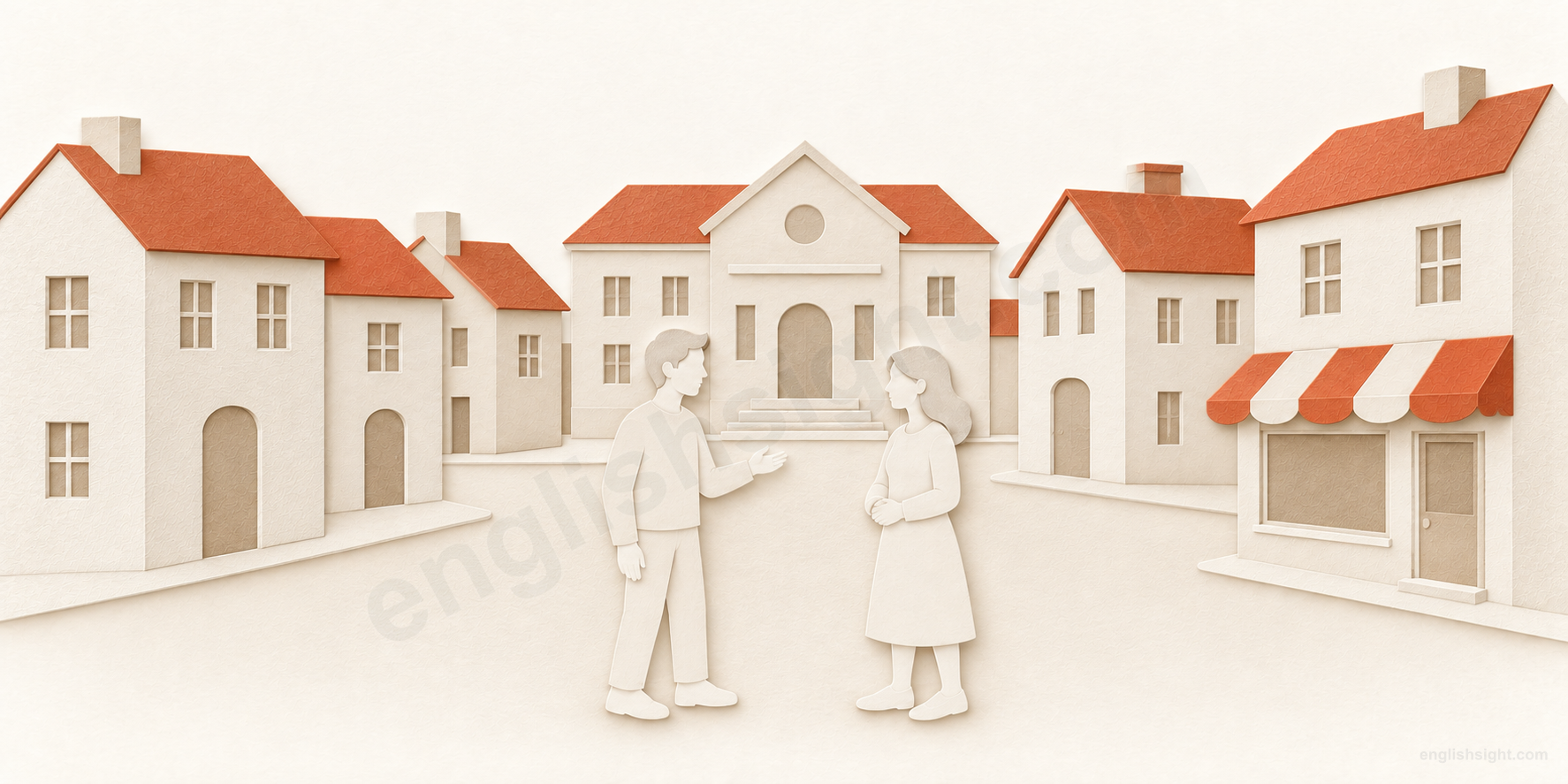
Use town for a settlement, its community, the local centre, and familiar everyday expressions.
One settlement, shared daily life
Homes and services form an inhabited place
Homes and local services stand around a shared square.
town
The buildings and community form one inhabited settlement.
Two residents talk in the space they share.
Homes, services and residents share one town. The picture sets no legal boundary or population threshold.
A town is a built-up place where people live and work, understood as one settlement and community.
This is a stable relationship, so the sketch has no change-of-state arrow. The buildings and residents are illustrative; official town status and population size vary by country. Fixed idioms need separate learning.
Think of homes and services close enough to form a shared place of daily life. That is a useful starting point for town; context can then focus on the people, the local area, or its busy centre.
Some expressions are established idioms and need their own explanation. This lesson organizes common uses rather than claiming a frequency ranking or one mental picture shared by every speaker.
01
A place, its people, and urban life
Start with an inhabited settlement, then notice when town refers to the community or contrasts with the countryside.
01
a / the + town; adjective + town; the town of + name; plural towns
a town / the town / towns
a built-up place where people live and work
Situation
You describe where your family lives.
What you mean
You identify one settlement rather than an isolated house.
Homes, shops, and shared daily life form a town.
Town /taʊn/ is normally a noun; its regular plural is towns. A town is usually thought of as larger than a village and smaller than a city, but official names and local systems do not follow one worldwide population rule.
Use a town to introduce one place, the town when the listener can identify it, and towns when discussing several. In the town of Riverton, of introduces the name; it does not mean the town belongs to Riverton.
The picture groups homes and services together. It represents an inhabited place, not a rule that every town has exactly these buildings.
In a sentence
We live in a small town beside a river.
Watch the difference In ordinary counting use a determiner: in a small town, not in small town. The special phrase in town is explained separately.
02
the (whole) town + verb
the whole town
the people of a town considered together
Situation
Local people hear that the library may close.
What you mean
Residents act as a community.
A place name can stand for its inhabitants.
When the whole town signs a petition, the buildings do not sign it: town stands for local people. The whole town often emphasizes a widespread response rather than making a precise claim about every resident.
This is a natural connection between a place and its community. The town can also refer to the local municipality in a sentence such as The town owns the swimming pool; context points to the local authority rather than each individual resident.
In a sentence
The whole town came together to save the library.
Watch the difference Do not assume that town always means buildings or land; check whether people or a municipal body are doing the action.
03
town and country; the town versus the country; town life
town and country
urban life contrasted with rural life
Situation
You compare busy streets with open countryside.
What you mean
You discuss two kinds of living environment.
Town can describe an urban way of life rather than one named place.
Especially in British English, town and country contrasts built-up places with rural surroundings. Here country means countryside, not a nation.
The town can express urban life generally: She prefers the town to the country. Town life is another useful form, with town modifying life. American speakers often use city when making this broad contrast.
In a sentence
She enjoys town life but spends her weekends in the country.
Watch the difference In this contrast, in the country does not mean abroad. Do not remove the article mechanically from every phrase with town.
02
Being local and finding your way
Articles, prepositions, and context distinguish the whole local place from its centre and from places elsewhere.
04
be / stay / be back + in town; be new to town; superlative + in town
in town / back in town / new to town
present in the local place or the place being discussed
Situation
A friend wants to arrange a meeting.
What you mean
You say when you will be locally available.
Town may refer to an understood town or city without an article.
In town often means in the place relevant to the conversation, including a city. It need not be the speaker’s birthplace or a place officially classified as a town. I am in town this week can describe a temporary visit. This local-area use is uncountable; contrast the countable use in a town or two towns.
Back in town marks a return. New to town describes someone who has recently arrived to live there. The best café in town compares cafés in the relevant local area.
In the town also works when referring to a particular settlement already identified. The article changes the framing; its presence is not automatically an error.
In a sentence
I’ll be back in town on Tuesday; can we meet then?
Watch the difference Use in for location and to for destination: in town, but coming to town.
05
be / go + out of town; leave town; out-of-town + noun
out of town / leave town
away from the local place
Situation
Your colleague is travelling elsewhere.
What you mean
You explain why they cannot meet locally.
Out of town places someone elsewhere; leave town describes departure.
She is out of town says she is away from the town or city relevant to the conversation, often on a trip. She left town describes going away; it does not by itself mean she has moved permanently.
Before a noun, write out-of-town: an out-of-town guest comes from elsewhere. An out-of-town shopping centre is away from the centre of the town or city. The modifier therefore needs its noun and context to be interpreted.
Compare outside the town, which gives a physical position beyond the settlement, with out of town, which commonly explains local absence.
In a sentence
Maya is out of town until Friday, so we’ll meet next week.
Watch the difference Use spaces in She is out of town and hyphens in an out-of-town visitor. Neither expression means out of the country automatically.
06
go / walk / take a bus + into town; in the town centre / center
go into town / in the town centre
visit or be in the main shopping and business area
Situation
You live in a residential area and need to buy something.
What you mean
You travel to the area with the main shops.
Town can narrow from the whole settlement to its commercial centre.
In a local shopping conversation, go into town often means go to the central area. A person can already live within the town’s boundaries and still go into town to shop.
Into emphasizes movement toward or into that area; in gives a location. Town centre is common British wording; town center uses American spelling, while downtown is a common American choice for the central business area.
Go to town can also be literal travel to a town. Context matters because the same words have an informal idiomatic meaning in go to town on something.
In a sentence
I’m taking the bus into town to buy a birthday present.
Watch the difference In town can mean the central shopping area or the whole local place. Do not force one reading without the situation.
07
across / around / through town; the edge / centre of town; the old town
across town / the edge of town
locate something within or near a settlement
Situation
The clinic is far from your neighbourhood.
What you mean
You describe its position within the same town.
The preposition identifies location, route, or extent.
Across town can describe movement from one part to another or a location on the other side: They live across town. Around town suggests various local places; through town describes a route passing through the settlement.
The edge of town is its outer part; the centre of town is its middle or main commercial area. The old town usually means the historic district of a larger place, not necessarily a separate settlement.
These are ordinary spatial constructions. The route comes from across, around, or through; town identifies the place. They are not phrasal verbs built from town.
In a sentence
The new clinic is across town, near the river.
Watch the difference Across town does not imply travel to a different town. Say another town when you mean a separate settlement.
03
Home, kinds of town, and public places
Read the modifier and the head noun together. Some combinations describe a type of town; others name an institution or an established concept.
08
possessive + home town / hometown
my home town / hometown
the place associated with your birth or childhood
Situation
Someone asks where you grew up.
What you mean
You name the place you come from.
A personal history connects someone to a particular place.
Home town is usual British spelling; hometown is usual American spelling. It refers to the place where someone was born or lived as a child, and can be a city.
Your home town need not be where you live now. Compare my home town with my home: the first names a place or community, while the second may mean your house or current living place.
In a sentence
I moved away at eighteen, but I still visit my hometown every summer.
Watch the difference Do not assume that someone’s hometown and present address are the same.
09
seaside / university / market + town
a seaside / university / market town
describe a town by a notable setting or function
Situation
You choose a destination or describe an area.
What you mean
A modifier explains what distinguishes the town.
The first word selects a feature of the settlement.
A seaside town is by the sea; a university town has a university as an important feature of local life. These combinations describe a kind of town rather than a new grammatical meaning of town.
In British contexts, a market town has or historically had a regular market. It does not simply mean any town where there is a supermarket. The established compound supplies that more specific history.
In a sentence
They spent the weekend in a seaside town with a quiet beach.
Watch the difference In a seaside town, town is the head noun: the plural is seaside towns.
10
the town hall; town council / square; a town hall (meeting)
the town hall / a town hall meeting
a civic building, or a public question-and-answer event
Situation
Residents want to ask about a proposed bus route.
What you mean
They attend an event with local officials.
A town-related institution can name a building or a meeting format.
The town hall is a building used by local government; in Britain it may also contain a hall for public events. Town council names the local governing body, not its building. In town square, town similarly identifies a public space belonging to the settlement.
In North American usage, a town hall or town hall meeting can be an event where a politician or public official answers questions from the public. It can be held somewhere other than the town hall building.
Town modifies another noun in these combinations. The second noun determines whether you mean a building, a group, a space, or an event.
In a sentence
At the town hall meeting, residents asked the mayor about the new bus route.
Watch the difference A meeting described as a town hall does not have to take place inside a building called the town hall.
11
a ghost town; like a ghost town
a ghost town
a formerly inhabited place that is now deserted
Situation
A mine closes and residents move away.
What you mean
Buildings remain with little or no community life.
The settlement remains while its former activity has disappeared.
Ghost town names a place that used to be populated and busy but has become deserted. Ghost evokes the remains of its earlier life; it does not claim that supernatural beings live there.
People also compare an unusually empty place to a ghost town: The centre was like a ghost town on Sunday. This is a contextual comparison, not evidence that the whole town has been permanently abandoned.
In a sentence
After the mine closed, the settlement became a ghost town.
Watch the difference A quiet town is not necessarily a ghost town; loss of former population or activity is central to the expression.
04
Attention, evenings out, and familiar idioms
These expressions carry meanings learned from the whole phrase. The settlement model offers a connection in some cases but does not generate every idiom.
12
be / become + the talk of the town
the talk of the town
a person or thing attracting widespread local discussion
Situation
A surprising café opens in the neighbourhood.
What you mean
People keep discussing it.
Town stands for the community whose attention is involved.
To be or become the talk of the town is to be a widely discussed person, event, or thing. Talk is a noun here: the expression names the topic people are discussing, not a speech delivered by the town.
The attention may be admiring, curious, or scandalized. The phrase alone does not say whether the publicity is welcome, and it need not literally include every resident.
In a sentence
The café with the glass floor quickly became the talk of the town.
Watch the difference Keep the fixed articles: the talk of the town. It does not mean that the café itself is speaking.
13
a night on the town; go (out) on the town; hit the town; paint the town red
a night on the town / paint the town red
go out to enjoy restaurants and other entertainment
Situation
Friends arrange an evening celebration.
What you mean
They spend the evening visiting entertainment venues.
The whole expression describes an outing rather than a precise location.
A night on the town or go out on the town suggests going out for entertainment, often to restaurants, bars, clubs, or theatres. It is informal and more specific than simply being somewhere in town. Hit the town is another informal way to describe going out for entertainment: We hit the town after dinner.
Paint the town red is an informal, vivid expression for going out and enjoying a lively celebration, often at several bars or clubs. No actual paint is involved. Learn it as a whole idiom rather than deriving the celebration from red alone. For example: After the exams, let’s paint the town red.
In a sentence
We celebrated the end of the course with a night on the town.
Watch the difference Compare in town, a location, with on the town, an entertainment outing. On is part of this established expression.
14
go to town (on + noun / -ing form)
go to town on something
do something with great enthusiasm or intensity
Situation
Someone decorates a cake for a celebration.
What you mean
They add far more detail and effort than usual.
The idiom concerns the scale of an activity, not a journey.
Informal go to town on something means put considerable enthusiasm, effort, or intensity into it. It can involve generous spending, but money is not required. The object after on names the activity or thing receiving the attention.
The phrase can praise elaborate work or suggest excess, depending on the speaker. It can also describe intense treatment of a story or issue. Without on, context can still make the idiom clear: We really went to town.
Compare We went to town to buy candles: that is a literal trip. The decorating example below uses the established idiom; the picture of a settlement cannot predict this meaning by itself.
In a sentence
Ravi went to town on the cake, adding flowers made of sugar.
Watch the difference Do not read went to town on the cake as physically travelling on a cake. The whole expression is idiomatic.
15
be + the only game in town; not the only game in town
the only game in town
the only available or worthwhile option in a situation
Situation
You need transport after the trains stop.
What you mean
You identify the remaining practical option.
Town can belong to an idiom whose scope is a whole situation.
Informal the only game in town refers to the only available option, or the only one worth serious consideration. The option can be a person, company, service, or plan.
It need not involve a game or a geographical town. In Our method is not the only game in town, the speaker acknowledges that other approaches are available.
In a sentence
Once the last train had left, a taxi was the only game in town.
Watch the difference The phrase expresses a judgment about available options; it does not automatically prove that every imaginable alternative is impossible.
16
a one-horse town
a one-horse town
a small place dismissed as dull or unimportant
Situation
A traveller complains that there is little to do.
What you mean
They give a negative opinion of the place.
An idiom adds a dismissive evaluation to the ordinary settlement meaning.
A one-horse town is an informal, uncomplimentary description of a small, uninteresting place. It tells you the speaker’s attitude rather than giving an objective geographical classification.
The phrase does not count horses. Use a small town for a neutral description; calling someone’s home a one-horse town can sound rude.
In a sentence
He called it a one-horse town, but I liked its quiet streets.
Watch the difference Keep one-horse together before town. This expression can insult a place and its residents.
Keep the place, grammar, and idiom distinct
Town is not a worldwide population category
Town often contrasts with village and city, but local naming and legal status vary. Do not judge an official place name only by its population.
Articles are part of the expression
In a town introduces a settlement; in the town refers to an identifiable one; in town often means locally or in the commercial centre. There is no rule that town always takes the or always drops it.
Forms and scope
This lesson teaches the modern noun town, plural towns, and selected compounds and idioms. Before another noun, town is commonly a modifier. Some dictionaries label that use adjectival; it does not create an ordinary comparative such as more town. Verb tense, passive, and causative constructions do not apply to the noun itself.
The picture has limits
The settlement and community model helps connect ordinary uses. It cannot predict go to town on, paint the town red, or the only game in town. Those expressions are learned as whole phrases.
Choose the intended meaning
Use the situation and the complete expression to choose.
1. A colleague is travelling elsewhere until Monday. Which sentence explains their local absence?
2. You live in a residential part of the town and are going to the central shops. Which sentence fits?
3. Lina added many handmade decorations to the party room. What does She really went to town on the decorations mean?
4. The whole town supported the appeal. What does town refer to here?
5. You grew up in Porto and now live in Berlin. Which statement can be true?
Sources and teaching notes
Dictionary entries support the uses and usage distinctions. The explanations, examples, and relationship sketch were created for this lesson; the visual model is a teaching aid.
The sketch illustrates a connection; it does not describe a mental picture shared by every native speaker.