Use train for rail travel and connected sequences, or as a verb for learning, preparation, and direction.
A connected line, with a separate training branch
Follow the connection, then check the branch
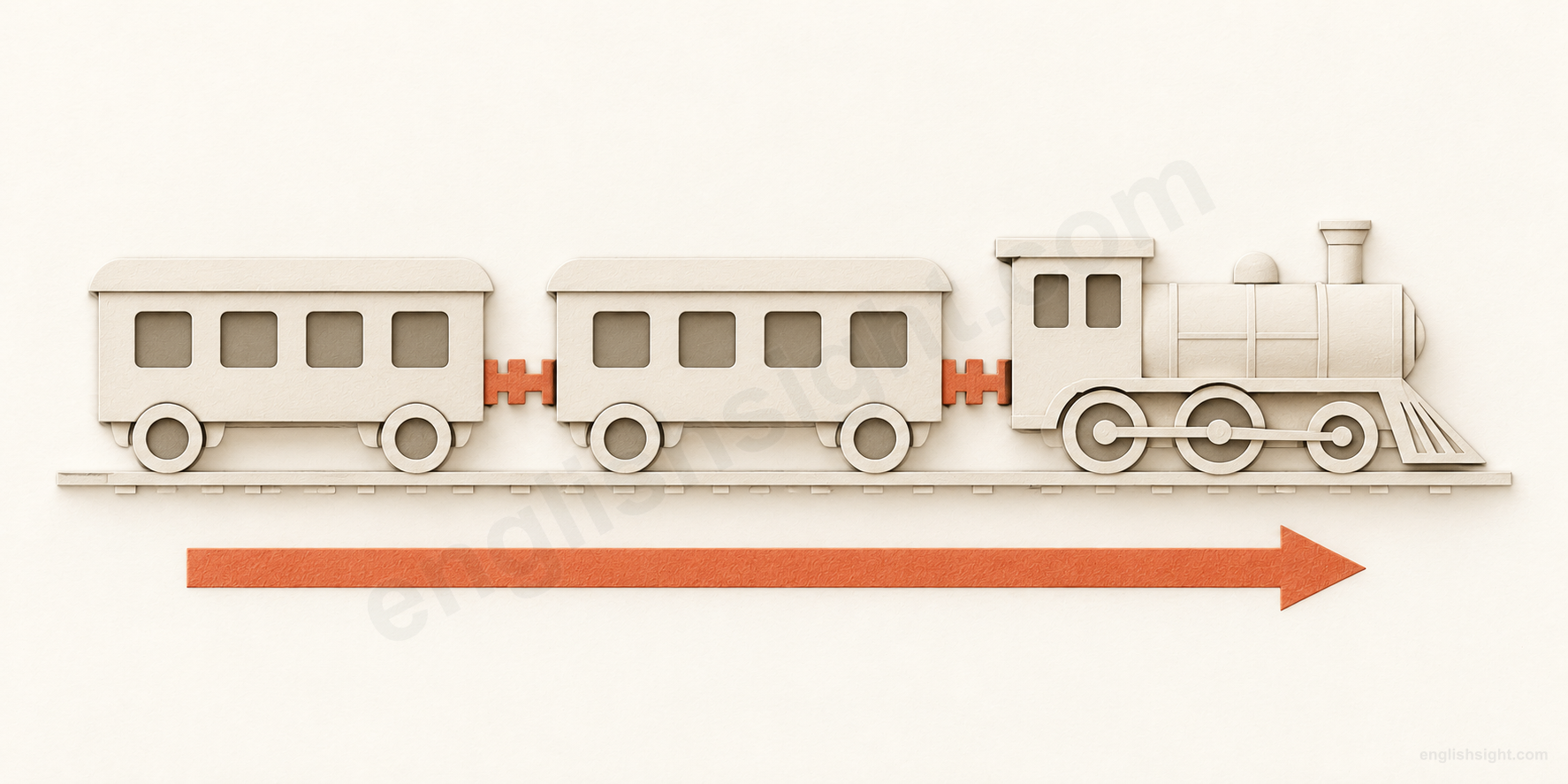
Two carriages follow a locomotive.
train
The whole linked train moves right.
Couplings join the vehicles into one line.
Linked parts follow together. Thoughts and events can also form a connected sequence.
In the noun family, a train can be a connected line whose members follow together. In the main verb family, to train is to develop ability or readiness through directed practice.
The sketch illustrates the connected-line noun family. It is a teaching model, not a claim about every speaker’s mental image or a rule deriving the training, aiming, and plant-growth senses.
A railway train has parts that follow together. A train of thought has ideas that follow one another. These noun uses make a connected-line picture useful, while the verb train often concerns developing an ability through instruction and practice.
These are distinct branches to learn with their constructions. A camera trained on a door is aimed at it, and a dress train trails behind its wearer. A single picture cannot replace those differences or predict every fixed expression.
01
Rail travel and everyday journeys
Start with the countable railway noun, then choose the verb and preposition that express your journey.
01
a / the + train; passenger / freight / goods + train; train + noun
a passenger / freight train
a railway vehicle or connected set of vehicles
Starting situation
People and goods need to travel by rail.
What follows
A railway service carries them to another place.
Train names the whole railway vehicle or connected set, not just its engine.
A passenger train carries people; a freight train carries goods. Goods train is also used, especially in British English. The railway noun is countable: a train, two trains, the next train.
A train may have a locomotive and several connected carriages or cars, or be a self-propelled unit. Carriage is usual British wording for a passenger section; car is usual American wording. Do not assume that every train is pulled by a separate steam engine.
Train also modifies another noun: train station, train ticket, train driver, and train journey. These describe a station, ticket, person, or journey associated with rail travel; they are not new meanings of train.
In a sentence
The last passenger train leaves at eleven.
Watch the difference An engine can be one part of a train; it is not always a synonym for the whole train.
02
go / travel / come by train; take the train; on / get on / get off + a / the train
travel by train / be on the train
name the transport method or your location
Starting situation
Someone asks how you travel or where you are.
What follows
You identify rail travel or a particular service.
By train gives the method; on a train locates someone aboard.
We went by train answers How did you travel? With by plus a transport method, train has no article and is singular. We took the train is another ordinary way to say we used rail transport.
I am on the train tells someone where you are. Use an article or other determiner for a particular train: on a train, on this train, on the eight-thirty train. Get on and get off describe boarding and leaving.
The train to York identifies its destination; the train from York identifies its origin. In a timetable, the nine-fifteen train identifies a service by its departure time.
In a sentence
I usually travel by train, but today I am on a bus.
Watch the difference Use by train for the method and on the train for being aboard; avoid by the train when you mean the general method.
03
catch / miss / take + the train; change trains (at + station)
catch / miss / change trains
manage a departure, fail to board, or transfer
Starting situation
Your journey depends on the departure and connections.
What follows
You board in time, arrive too late, or transfer to another service.
The verb around train supplies the action in these travel expressions.
Catch the train means reach and board it in time. Miss the train means fail to board it, often because you arrive too late. Take the train simply chooses that service or transport method and need not emphasize timing.
Change trains means leave one train and board another as part of a journey. We change trains at Leeds names the transfer station. A direct train avoids that change; it can still stop at intermediate stations.
Catch, miss, and change are the verbs here. Train remains the ordinary railway noun; these are useful collocations, not three phrasal verbs built from train.
In a sentence
We need to change trains at Leeds to catch the last service home.
Watch the difference Change trains refers to transferring; a direct train does not necessarily mean a non-stop train.
02
Things that follow in a line or sequence
Some noun uses connect a moving line with a course of thought, a chain of events, or a trailing part. Formal expressions need their own wording.
04
a train of + plural noun
a train of camels / vehicles
a line of things moving one behind another
Starting situation
Several animals or vehicles travel in the same direction.
What follows
They form an extended moving line.
The members follow one another without having to be physically coupled.
The train of camels coming along a path is a line of animals, not a railway vehicle carrying camels. The of-phrase tells us what makes up the line.
This extends the connected-line picture: the members belong to the same procession, even when nothing joins them mechanically. A train of people can likewise describe people following one another. In everyday conversation, a line of cars is often simpler than a train of cars, which could be mistaken for railway cars.
In a sentence
A train of camels followed the guide across the sand.
Watch the difference A train of vehicles is a procession; a train full of vehicles would carry them.
05
a / someone’s train of thought; lose / follow + someone’s train of thought
lose your train of thought
lose the connected sequence of ideas you were following
Starting situation
An interruption breaks your explanation.
What follows
You cannot remember the next idea you meant to express.
The train is the link from one idea to the next.
A train of thought is a connected course of thinking. I lost my train of thought is a natural way to explain why you have stopped speaking after a distraction.
Follow someone’s train of thought means understand how their ideas connect. The thought sequence may be coherent to its speaker without being correct; this expression does not certify the reasoning.
The railway connection helps memory: one idea follows another. Learn the full noun phrase, including of thought; lose my thought train is not the usual expression.
In a sentence
Sorry, that noise made me lose my train of thought.
Watch the difference This refers to interrupted reasoning, not a claim that you have forgotten everything.
06
a train of events; set off / set in motion + a train of events
set off a train of events
start a connected sequence of happenings
Starting situation
One incident leads to a response, which leads to another.
What follows
A series of related events unfolds.
The events are presented as connected, rather than merely listed.
A train of events emphasizes the way happenings follow from one another. Set off or set in motion supplies the idea of starting the sequence; train alone does not mean cause.
This wording is useful in reports and narratives. A series of events is a plainer alternative. It does not require proof that the first event directly caused every later detail.
In a sentence
One mistaken email set off a train of events that delayed the launch.
Watch the difference Use train of events for a sequence, not train events when you mean linked happenings.
07
a dress with a train; the train of + dress / gown
the train of a wedding dress
the long back part of a dress that trails behind
Starting situation
A formal dress has extra fabric at the back.
What follows
That part extends behind the wearer along the ground.
Here train is a trailing part, not several separate units.
The train belongs to the dress. It may trail along the floor or be held up by someone helping the wearer. This noun is countable: a long train; the train of her dress.
The connection with something following behind is useful, but the fabric is one part of one garment. Do not turn this into a claim that train always means a chain of separate objects.
In a sentence
Her sister lifted the train of the dress before they climbed the steps.
Watch the difference The train is the extended fabric behind the wearer, not the person carrying it.
08
set + process / arrangements + in train; be in train
set something in train
start a process or put arrangements into operation
Starting situation
A plan exists, but action has not begun.
What follows
The process is started.
In train is an established expression for a process under way.
Set the arrangements in train means start making them happen. The arrangements are in train means they are already under way. There need not be any rail travel.
Collins marks this chiefly British; it often appears in administrative writing. Set in motion or get under way may be clearer in a general international conversation.
In a sentence
The committee has set the selection process in train.
Watch the difference Do not substitute on the train: that normally refers to being aboard a railway vehicle.
09
bring + consequences + in its / their train
bring problems in its train
have further difficulties follow as a result
Starting situation
A major change creates new difficulties.
What follows
Other problems follow from that change.
The possessive points back to the event that has the consequences.
The closure brought unemployment in its train means unemployment followed as a consequence of the closure. Its refers to the closure; their is possible when the earlier noun is plural.
This is a formal, often literary way to discuss consequences. Brought further problems or led to further problems is usually plainer. It is different from set in train, which concerns starting a process.
In a sentence
The factory closure brought further problems in its train.
Watch the difference In its train means following as a consequence; in train means under way.
03
Skills, preparation, and learned responses
As a verb, train can put an instructor or a learner in the subject position. Objects and following phrases tell you who learns, what develops, and why.
10
train + person; train + person + to-infinitive; train + person + in + skill / on + system
train someone to do something
teach someone the practical skills needed for a task
Starting situation
A new employee does not yet know the procedure.
What follows
Instruction and practice prepare the employee to carry it out.
The object is the learner; the to-clause names the skill or task.
The supervisor trains new staff tells us who provides the instruction and who receives it. Train someone to use the scanner adds the intended ability. Train staff in first aid names an area of skill; train staff on the new system names the equipment or system they learn to use.
Train often suggests preparation for a particular practical goal. Teach is broader: you can teach a fact, a subject, or a skill. Tell someone to do something gives an instruction on an occasion; train someone to do it concerns developing the ability or habitual response.
This is the training branch of the word. The railway drawing does not explain who teaches whom or guarantee that instruction succeeds; the sentence pattern does that work.
In a sentence
We train new staff to check every label before packing an order.
Watch the difference Train someone to do is not simply make someone do: training develops readiness rather than forcing one immediate action.
11
train as + profession; train to be / become + profession; train in + field; train at / with + organization
train as a nurse / train to be a nurse
learn the skills for a profession
Starting situation
You begin professional preparation.
What follows
You work toward being qualified for the role.
With no object, the subject is the person learning.
She trains new nurses makes her the instructor. She is training as a nurse makes her the learner. As is followed by a role; to be or to become introduces that role in an infinitive clause.
Train in engineering names a field; train at a hospital or with a firm identifies the place or organization. The prepositions supply different relationships, not different forms of the word train.
The progressive is natural for a course currently in progress. She trained as a nurse states her past preparation; it does not by itself tell us whether she still works as one.
In a sentence
Maya is training to be a nurse at the local hospital.
Watch the difference In She trains nurses, nurses is the object; in She trains as a nurse, she herself is learning.
12
be trained + to-infinitive / in + skill / by + instructor; trained + noun
be trained to do / a trained professional
receive training or have a developed skill
Starting situation
Someone provides instruction to a learner.
What follows
The learner receives training or has the resulting expertise.
The passive foregrounds the learner; trained can also describe an acquired qualification.
All staff are trained to use the alarm can describe a regular training policy. All staff were trained last week reports an event. Add by the safety officer when the instructor matters.
A trained nurse describes a person who has received relevant professional training; highly trained staff emphasizes developed skill. Compare is being trained, which says the training is currently happening.
Well-trained is normally hyphenated before a noun, as in a well-trained team. Do not treat trained as meaning guaranteed to perform perfectly.
In a sentence
All volunteers are being trained to use the radio safely.
Watch the difference Is being trained describes the process; a trained volunteer describes someone with training already received.
13
train (regularly); train for + event; train + athlete / team + for + event; be in training
train for a marathon
prepare through regular physical practice
Starting situation
A race or sporting season is ahead.
What follows
You follow a programme of exercise and practice.
For names the goal; the subject may be an athlete or a coach with an object.
I train three times a week uses train without an object: I do planned physical practice. I am training for a marathon adds the event. A coach trains the team for the final makes the team the object receiving preparation.
Train with a club identifies companions or an organization; train at the gym identifies a place. Work out often focuses on exercise itself, while train commonly suggests developing performance toward a goal.
In training for the race means following a training programme. Training is a related noun here: a training session or some training, normally not a training when you mean the activity in general.
In a sentence
I am training for a half-marathon, so I run before work.
Watch the difference Train for names the event; train to run faster uses an infinitive to name the aim.
The animal is the learner, and the infinitive describes its intended action.
You can train a dog, a horse, or another animal. Train the dog to sit describes the action it learns; the passive The dog has been trained to find missing people foregrounds the animal and its acquired task.
The same training grammar works for human learners and animals, but the tasks and methods depend on the situation. A trained dog is not simply a dog that has heard a command once.
House-trained is a related description for a pet taught to avoid soiling the home; potty-trained usually describes a child who has learned to use a potty or toilet. These concern learned habits, not railway travel.
In a sentence
We trained the dog to wait by the gate until we called.
Watch the difference The animal performs the action after to; it is not the trainer who waits in this sentence.
develop an ability or habitual response through practice
Starting situation
You want to become better at recognizing a detail.
What follows
Repeated attention makes the response more reliable.
The object may be an ability or the same person as the subject.
Train your voice or train your memory focuses on a faculty you develop. Train your ear to recognize accents means improve your listening discrimination; your ear stands for hearing ability, not a body part being given spoken instructions.
I have trained myself to check the date uses myself because the learner and trainer are the same person. The intended habit follows to. This does not mean the change occurs immediately or without effort.
Practise, the British verb spelling, and practice, the American spelling, often describe the repeated activity: I practise scales. Train emphasizes developing a capacity or readiness: I train my ear.
In a sentence
I have trained myself to check the date before signing a form.
Watch the difference Use train myself to check, not train myself check; the infinitive names the learned habit.
16
train + person + up; train up + person; train + pronoun + up
train someone up
prepare someone to the required skill level
Starting situation
A recruit has potential but lacks the necessary experience.
What follows
The recruit receives preparation for the role.
Up adds a sense of building the learner toward a needed standard.
Train up is a separable phrasal verb, labelled British and informal by Collins. We will train the recruits up and We will train up the recruits are possible.
Put a personal pronoun between the verb and up: We will train them up. The expression does not promise promotion; someone may simply become ready for an existing task.
In a sentence
We can hire beginners and train them up over the summer.
Watch the difference Say train them up, not train up them.
17
train + model + on + data; model + be trained + to-infinitive
train a model on data
adjust a machine-learning model using examples
Starting situation
A model has not yet learned the patterns needed for a task.
What follows
A training process adjusts its parameters using data.
Here a model, rather than a human learner, is the object of train.
In computing, train a model refers to a learning procedure using examples. The team trained a model on photographs names both the system and the data used. A model trained to recognize birds names the intended task.
This is a technical extension of developing an ability, not evidence that the model learns exactly like a person. On data names the training material; it does not mean a screen the model sits on.
Using a trained model to make a prediction is different from training it. An example can be processed during use without automatically becoming part of a new training run.
In a sentence
The team trained a model on labelled photographs of birds.
Watch the difference Training changes the model through a learning process; simply asking it for an answer need not do so.
04
Aim something or guide its growth
An aimed camera and a guided plant do not acquire human skills. These uses concern maintained direction or shaped development.
18
train + camera / light / eyes + on + target; be trained on + target
train a camera / your eyes on something
point and keep something directed at a target
Starting situation
A target attracts attention.
What follows
A camera, light, weapon, or gaze stays directed toward it.
On identifies the target, not the topic of a lesson.
Train a camera on the entrance means aim it there and keep it directed there. The construction also occurs with binoculars, lights, guns, and eyes. All eyes were trained on the door says everyone was looking intently at it.
Compare They trained staff on the camera: staff are learners and the camera is equipment they learn to use. They trained the camera on the door: the camera is aimed and the door is its target. The object changes the meaning.
The direction connection can help memory, but no repeated practice is required in this aiming sense. A trained camera in this context is positioned, not a camera that attended a course.
In a sentence
The photographer trained her camera on the empty doorway.
Watch the difference Distinguish train a person on equipment from train equipment on a target.
19
train + plant + up / along / over + support; train + plant + to grow + direction
train a rose up a wall
guide a plant to grow in a chosen direction or shape
Starting situation
A climbing plant needs support and guidance.
What follows
Its stems are guided along a wall or frame as it grows.
Training shapes growth over time rather than teaching a plant to understand.
Train a rose up a wall means guide its growth, commonly by tying stems to supports and pruning. Up describes the direction; along a fence describes a different route.
You can also say train the plant to grow along the frame. The to-clause gives the intended growth pattern. This resembles directing development, but the mechanism is physical support and shaping, not animal learning.
Train a person up is a phrasal verb about preparation. Train a plant up a wall contains a directional phrase with a place after up; the two uses should not be confused.
In a sentence
We trained the climbing rose along the fence.
Watch the difference The plant grows along the support over time; train does not just mean move a pot beside a wall.
05
Two vivid expressions to recognize
Learn these compounds as complete expressions, with their evaluative tone. Their meanings cannot be predicted from a railway sketch alone.
20
be on / ride + the gravy train
be on the gravy train
benefit from easy money with little effort
Starting situation
People receive generous payments for very little work.
What follows
A speaker criticizes that comfortable source of income.
This idiom adds a disapproving judgment, not a literal destination.
The gravy train is an easy source of money or advantages, especially one the speaker considers undeserved. Be on or ride the gravy train presents someone as benefiting from it.
The phrase occurs in journalism and informal criticism. It is stronger than simply saying a job pays well: it implies that the rewards are too easy or unjustified. Use it carefully when speaking about a person’s work.
In a sentence
Critics said the consultants were on the gravy train.
Watch the difference Do not use gravy train as a neutral compliment about a good salary.
21
a train wreck; something + be + a train wreck
a train wreck
a rail crash or, figuratively, a disastrous mess
Starting situation
A presentation goes badly wrong.
What follows
A speaker describes it as a complete disaster.
The figurative meaning belongs to the whole compound.
A literal train wreck involves a train crash. In figurative use, The interview was a train wreck means it went disastrously badly; no railway accident is being reported.
This is a vivid and harsh description, often informal. Calling a person a train wreck can be hurtful. A difficult meeting is a milder description when the situation does not warrant such a strong judgment.
In a sentence
With no working microphone and no slides, the presentation was a train wreck.
Watch the difference The whole expression means a disaster; train by itself does not have that meaning.
Keep the noun, the verb, and the construction distinct
Forms and countability
The noun has plural trains. Verb forms are train, trains, trained, training; the final n is not doubled. Training is normally uncountable when it names instruction or exercise: some training, a training course, two training sessions.
Learning is not the same as one instruction
Train usually concerns developing skill, fitness, or a response. Tell someone to wait gives an immediate instruction. Train someone to wait develops a learned response. Neither phrase alone guarantees that the person will actually wait on every occasion.
Read the object before on
Train staff on a system teaches people how to use it. Train a camera on a door aims equipment. Train a model on data names the material used by a computational learning process. The shared preposition does not make these identical actions.
Boundaries of this lesson
The connected-line picture supports several noun uses but does not derive every verb or idiom. Specialized mechanical and astronomical senses, historical retinues, obsolete meanings, and the uncommon verb meaning travel by rail are not developed here. This is a selection of useful modern uses, not a frequency ranking.
Choose the intended meaning
Use the subject, object, and following phrase to decide which branch is active.
1. You want to state your usual transport method. Which sentence fits?
2. Nora is learning a profession, rather than teaching other people. Which sentence says this?
3. The camera stays pointed at the entrance. What does the sentence mean?
4. An interruption makes you forget the next idea in your explanation. Which expression fits?
5. Choose the natural placement of a pronoun with the phrasal verb train up.
Sources and teaching notes
The sources below support the meanings and constructions. The explanations, situations, and examples are original teaching material; the connected-line drawing is a teaching interpretation.
The diagram helps explain a connection; it is not a picture shared by every native speaker.