Start with a living tree, then recognize branching structures and learn the idioms as whole expressions.
From a plant to branching connections
A trunk divides into branches
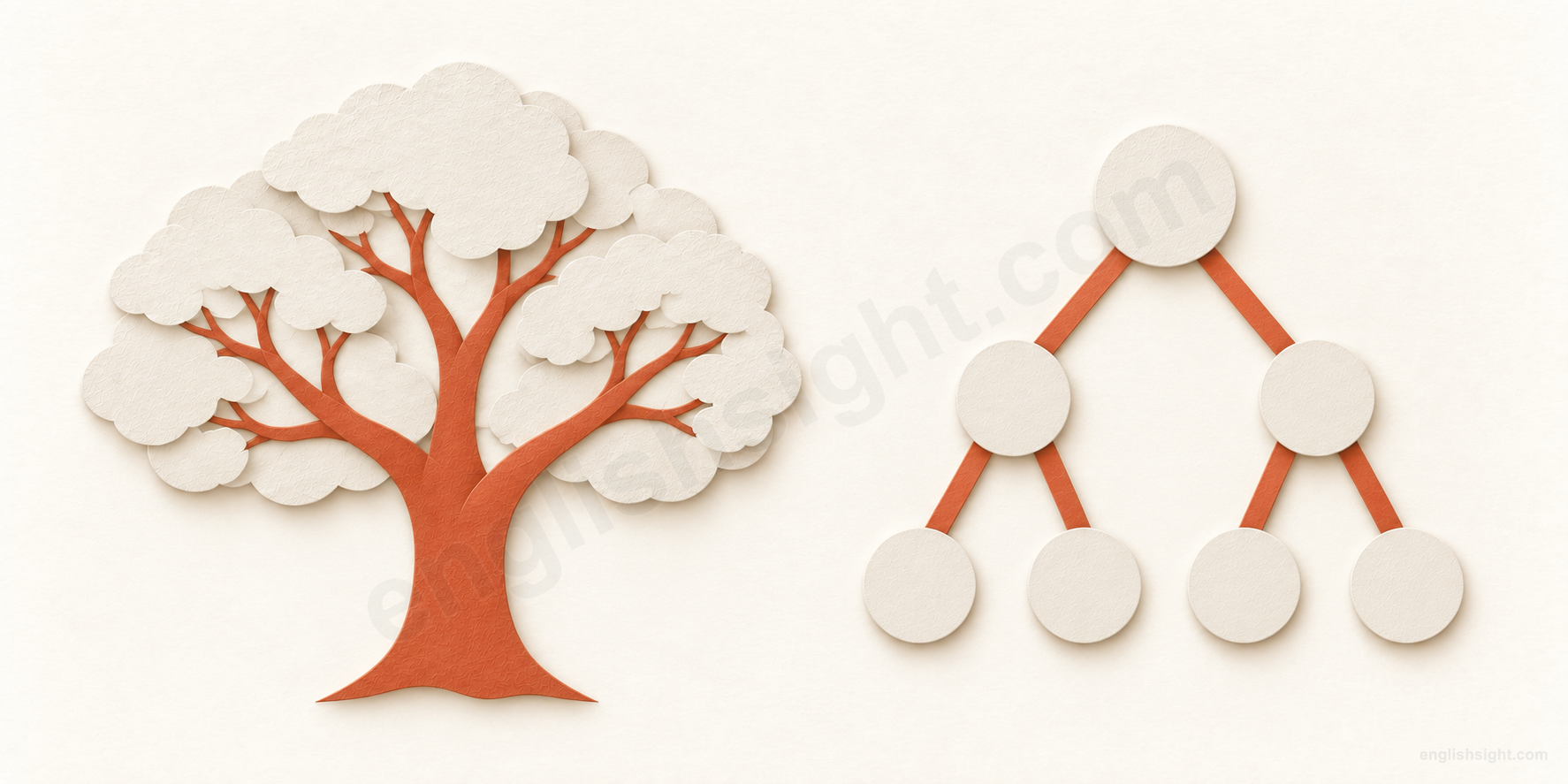
A living tree: one trunk branches outward.
tree
A tree diagram: one starting node branches downward.
Compare the connected branching pattern.
The plant and diagram share branching connections. This comparison does not explain every tree idiom.
A tree has a main trunk that divides into branches; tree also names structures organized by branching connections.
This is a teaching connection between the plant and structural uses. The two sides of the sketch compare forms, not earlier and later events. Idioms require their own explanations.
A tree is first a plant. Its trunk and branches also offer a useful comparison for connected information, as in a family tree or a tree diagram.
That comparison does not unlock every expression. Money doesn’t grow on trees and barking up the wrong tree have meanings you learn from the whole phrase.
01
Trees in the world around you
Identify a tree, describe its parts and location, and talk about growing, removing, or decorating it. The surrounding words supply the action.
01
a / the / this + tree; number + trees
a tree / trees
a plant with a lasting main trunk and branches
Situation / starting point
You notice a large plant beside a gate.
Meaning in context
You identify it as one tree.
Tree names the whole plant, not just its wood.
A tree typically has a firm trunk with branches growing from it. This is the concrete starting point for the lesson. Everyday names such as palm tree also belong here; the simple sketch is not a strict botanical test.
Tree is countable: a tree, one tree, two trees. Use an article or another determiner for an ordinary singular reference: That tree is old. Trees need water speaks about trees generally.
Wood names the material in a wooden chair. A tree is the plant that can supply that material. A forest is an area with many trees, not another word for one tree.
Original example
A young tree stands beside the gate.
Watch the difference Say a tree in the garden, not a wood when you mean one plant.
02
kind + tree; tree + part noun; part + of + the tree
an apple tree / a tree trunk
name a kind of tree or a part of one
Situation / starting point
You need a more precise description.
Meaning in context
You identify the type or the part.
The final noun tells you what the phrase names.
An apple tree is a tree that produces apples; a pine tree names another kind. A fruit tree is a category, not a particular species. The word before tree narrows the kind.
In tree trunk, tree branch, and tree roots, the last word names the part. The trunk is the main stem; branches extend from it and roots anchor the plant below. Compare a tree branch with a branch of the tree.
Keep the modifying noun singular in ordinary compounds: tree roots, not trees roots. For possession, this tree’s roots and the roots of these trees are clear alternatives.
Original example
The apple tree has a crack in its trunk.
Watch the difference Apple tree is the whole plant; tree trunk is only its main stem.
03
in / on / under + a/the tree; climb + a tree
in / on / under a tree
locate something among branches, on a surface, or below
Situation / starting point
You want to say where the cat or fruit is.
Meaning in context
The preposition supplies the spatial relationship.
Tree remains the same object while the location changes.
A cat in a tree is among its branches, not inside the wood of the trunk. A person can climb a tree, go up a tree, and come down from a tree. Up and down describe direction; they do not turn tree into a verb.
Apples growing on a tree are attached to it. Something on a branch rests on that branch. A bench under a tree is below its branches. These are useful defaults, not a rule that animals must always take in and objects must always take on.
Compare The cat is up a tree, which can be literal, with We’re up a tree without the keys, which can express a difficult situation. The context decides.
Original example
The cat is in the tree, and its owner is waiting under it.
Watch the difference Use in the tree for the usual branch-area location, not inside the tree unless you mean an internal space.
04
plant / grow / prune + a tree; cut a tree down / cut it down
plant / grow / cut down a tree
describe a tree’s growth or what people do to it
Situation / starting point
A garden needs shade, or a damaged tree needs removing.
Meaning in context
The verb identifies the change.
Planting, growing, pruning, and felling are different actions.
Plant a tree means put a young tree into the ground to grow. A tree grows describes the plant becoming larger; grow trees can also describe people cultivating them. Tree itself does not mean either action.
Cut down a tree means make it fall by cutting its trunk. With a pronoun, use cut it down. Fell a tree is another verb for this action. A fallen tree has already come down, whether through cutting, wind, or another cause.
Trimming or pruning a tree removes selected growth, not necessarily the whole tree. Compare We cut down the tree with We cut a branch off the tree. The different objects and particles change what is removed.
Original example
We planted a tree last spring, and it is growing well.
Watch the difference Tree is not the everyday verb for planting: say plant trees, not tree the garden.
05
a Christmas tree; put up / decorate / take down + the Christmas tree
put up / decorate a Christmas tree
prepare a real or artificial tree for Christmas
Situation / starting point
The household is preparing Christmas decorations.
Meaning in context
A decorated tree is ready for the celebration.
A Christmas tree can be artificial and need not be alive.
Christmas tree is an established compound for the tree used as a Christmas decoration. It may be a real evergreen or an imitation. Context, not the noun alone, tells you which.
Put up the Christmas tree means set it in place or assemble it. Decorate it means add lights and ornaments; take it down means remove it after use. These actions come from the verbs, not a special verb sense of tree.
Christmas keeps its capital letter. The plural is Christmas trees: only the head noun tree changes.
Original example
We put up an artificial Christmas tree in the hall.
Watch the difference Putting up this tree does not mean planting it in soil.
02
Branches that organize information
Tree can name a connected branching arrangement. Families, decisions, and computer information use this resemblance in different ways.
06
draw / trace / research + a family tree; somebody’s family tree
a family tree
a chart of family connections across generations
Situation / starting point
You have names from several generations.
Meaning in context
A chart shows how the people are related.
The branches represent family connections, not physical plants.
A family tree links relatives across generations. You can draw one to show how your grandparents, parents, and cousins connect. It organizes relationships rather than simply listing everyone’s names.
The branching resemblance connects this use to the living tree. A family chart may run downward or sideways, so physical upward growth is not part of the meaning. Real family relationships may also be more complex than the simplified drawing.
Use my family tree for the chart connected with your family. A family is the people; a family tree presents their relationships.
Original example
We added my great-grandparents to our family tree.
Watch the difference Family tree does not mean a tree planted by a family.
07
draw / follow + a tree diagram; a decision tree
a tree diagram / a decision tree
a branching diagram of relationships or choices
Situation / starting point
A question has several possible answers.
Meaning in context
Each answer can lead to a different next question.
The lines show connected alternatives or levels.
A tree diagram shows connections by splitting lines into further branches. It can organize relationships, processes, or choices. The resemblance is the branching organization, not leaves, wood, or a living plant.
A decision tree uses that format to lay out choices and their consequences or next steps. For example, a yes answer can lead to one instruction and a no answer to another. Read each branch rather than treating every outcome as happening together.
A tree can be drawn with its starting point at the top. The diagram’s orientation does not change its branching relationships. Tree is also used alone when the kind of diagram is already clear.
Original example
Follow the decision tree to choose the right repair.
Watch the difference A tree diagram is not necessarily a drawing of a botanical tree.
08
a tree structure; organize / display + information + in a tree
a tree structure
information organized in connected levels
Situation / starting point
Information has broad categories and smaller subdivisions.
Meaning in context
Each branch connects a level with the level below it.
A hierarchy reuses the branching relationship.
In computing, a tree structure organizes information in levels. A folder display can show this idea: open a main folder to see subfolders, then open a subfolder for another level. The displayed tree is information, not a plant.
Words such as root, branch, and parent describe positions or connections in such a structure. A parent folder contains a lower-level folder; parent here does not mean a person.
This lesson gives the everyday reading needed for software instructions. Formal definitions and algorithms require further study; not every network is a tree.
Original example
The program displays the folders in a tree structure.
Watch the difference Do not assume that any list or any network is a tree structure.
03
Read these expressions as a whole
These sayings and informal expressions have established meanings. A picture of a trunk and branches cannot predict them by itself.
09
be + barking up the wrong tree
be barking up the wrong tree
pursue an idea or approach based on a mistaken assumption
Situation / starting point
You blame the network for an error.
Meaning in context
You learn that a local setting caused it.
The effort is aimed at the wrong explanation or solution.
You’re barking up the wrong tree tells someone that their approach or assumption is mistaken. It can redirect an investigation or reject a request made to the wrong person. It does not simply mean working slowly.
The expression is informal and commonly occurs as be barking up the wrong tree. Keep the whole phrase, including up and the wrong tree. Its meaning is established; tree alone does not mean a mistake.
Compare a literal dog barking at a tree. In the idiom, the subject can be a person investigating a problem, and no dog or tree needs to exist.
Original example
If you think the network caused this error, you’re barking up the wrong tree.
Watch the difference This can sound blunt; use it with a reason when correcting someone.
10
cannot / can’t see the wood / forest for the trees
can’t see the wood / forest for the trees
miss the overall issue by focusing on details
Situation / starting point
A team discusses individual buttons for hours.
Meaning in context
Nobody notices that the main task is too complicated.
Attention to the parts hides the larger picture.
Can’t see the wood for the trees is the British form; can’t see the forest for the trees is the usual American form. Both describe attention to details that prevents understanding the whole situation.
The metaphor contrasts individual trees with the larger wooded area. For here introduces what blocks that wider view; it does not mean that trees benefit from the forest.
Compare noticing a real forest through a window. The idiom can concern a report, a project, or an argument with no actual trees. Keep trees plural in this established expression.
Original example
We’re arguing about button colors and can’t see the forest for the trees.
Watch the difference The idiom concerns the overall view, not an inability to see individual details.
11
money / it + doesn’t grow on trees
money doesn’t grow on trees
money is limited and should not be wasted
Situation / starting point
Someone wants to replace a working device.
Meaning in context
You point out that the cost matters.
The saying treats easy abundance as something unavailable.
Money doesn’t grow on trees is a familiar warning about spending. It suggests that money takes effort to obtain and is not available without limit. Speakers often use it when refusing an unnecessary purchase.
The saying may sound parental or impatient. I can’t afford that is a more personal, direct explanation of your own budget. Neither sentence gives an actual price.
The negative matters: the familiar saying is not an assertion that money grows like fruit. Tree by itself does not express scarcity.
Original example
We can’t replace every tablet this year; money doesn’t grow on trees.
Watch the difference Use the whole negative saying; do not read it as gardening advice.
12
the apple doesn’t fall / never falls far from the tree
the apple doesn’t fall far from the tree
a child resembles a parent in behavior
Situation / starting point
A daughter repeats her father’s favorite joke.
Meaning in context
Someone comments on the family resemblance.
The fruit and tree stand for a child and parent in this saying.
The apple doesn’t fall far from the tree comments on a child behaving like a parent. The apple never falls far from the tree is another form. It is especially associated with North American English.
The comment can be affectionate or critical depending on the behavior being compared. It is a saying about resemblance, not a scientific rule about every child or a claim that people cannot change.
Compare our family tree: that names a chart of relationships. This saying makes a judgment about similarity. Sharing the word tree does not make the two expressions interchangeable.
Original example
“She tells the same jokes as her dad.” “The apple doesn’t fall far from the tree.”
Watch the difference The saying can imply criticism when the shared behavior is undesirable.
13
be at / reach / get to + the top of the tree
at the top of the tree
at the highest level in a career or profession
Situation / starting point
Someone has developed a successful career.
Meaning in context
They hold one of the highest positions in their field.
Vertical height stands for professional rank.
At the top of the tree is a British expression for the highest professional level. Get to or reach the top of the tree describes attaining it; at describes the position already held.
Context separates this figurative use from a bird at the top of a real tree. In a career discussion, the tree represents a ranking, not a family history or a literal climbing task.
For an audience unfamiliar with the idiom, at the top of her profession expresses the point directly. Success need not mean holding a particular job title.
Original example
After years of research, she is at the top of the tree in her field.
Watch the difference Keep the in the idiom: at the top of the tree.
14
be + up a tree; be + up a gum tree
be up a tree
be stuck in a difficult situation
Situation / starting point
The only key has gone missing.
Meaning in context
You have no easy way into the building.
The literal sense of being stranded supports an established figurative use.
Informal North American be up a tree can mean being in a difficult position or not knowing how to proceed. If the only key disappears, We’re up a tree means we are stuck, not sitting in branches.
Be up a gum tree is a British informal variant marked old-fashioned by Oxford. It also describes serious difficulty; you do not need to know what a gum tree looks like to understand the idiom.
Compare The cat is up a tree, where the surroundings may make the literal location clear. The preposition up alone does not mean being in trouble.
Original example
If the spare key is missing too, we’re up a tree.
Watch the difference Treat up a gum tree as a marked expression, not the default neutral way to say there is a problem.
15
be + out of + possessive + tree
be out of your tree
behave very strangely or seem wildly unreasonable
Situation / starting point
Someone proposes an obviously impractical plan.
Meaning in context
A friend reacts with a strong informal expression.
This expression judges behavior; it does not describe a location.
Out of your tree can describe someone behaving very strangely or irrationally. It can also refer to behavior affected by alcohol or drugs, but intoxication is not required in every context.
The possessive changes with the subject: He’s out of his tree; They’re out of their tree. You must be out of your tree can be a forceful reaction to a proposal rather than a literal conclusion about where someone is.
This is very informal and can be insulting. You are a person outside a tree is not a paraphrase, and the expression is not a clinical description.
Original example
“You want to walk forty miles tonight? You must be out of your tree!”
Watch the difference Use care when addressing someone: the phrase can sound dismissive or rude.
04
Recognize the less usual verb
Tree is mainly useful to beginners as a noun. The verb is worth recognizing in stories about animals; it is not the ordinary verb for planting.
16
tree + animal/person; be treed + by + pursuer
tree an animal / be treed
force an animal or person up a tree
Situation / starting point
A dog chases a raccoon.
Meaning in context
The raccoon escapes into a tree and remains there.
Here tree is a transitive verb, and the chased animal is its object.
As a verb, tree can mean chase or force something up a tree. The forms are trees, treed, and treeing. It belongs especially in accounts of animals or pursuit, rather than basic gardening instructions.
Compare The dog treed the raccoon with The raccoon was treed by the dog. The passive keeps the same event and makes the animal the subject. A raccoon that simply climbs a tree has not necessarily been treed.
Dictionaries also record figurative tree meaning corner someone or put them at a severe disadvantage. That is recognition material here, not a general replacement for cause a problem. Specialized shoe-shaping uses are outside this lesson.
Original example
Our dog treed a raccoon before we called the dog back.
Watch the difference Do not confuse treeing an animal with planting or growing trees.
Keep the plant, the structure, and the expression distinct
Countable plant, material, and wooded area
Tree /triː/ has the regular plural trees /triːz/. A tree is an individual plant; wood can mean its material; a wood or forest can name an area of trees. Bush and shrub overlap with tree in everyday naming, so height alone is not a universal test.
The grammar belongs to the whole expression
In cut down a tree, cut down is the action and tree is its object. In a tree diagram, tree modifies diagram. In a family tree, tree is the head noun. These are not three phrasal verbs with tree.
Scope and register
The plant and branching structures are central here. Regional and very informal idioms are labeled for recognition. Historical wooden-post, gallows, and cross senses, shoe and saddle structures, detailed botanical classifications, and specialist medical or mathematical terminology are not expanded.
Read the whole expression
Choose the sentence or meaning that fits the situation.
1. You want to name the living plant beside your house. Which sentence fits?
2. A pet is sitting among the branches. Choose the usual description.
3. You are adding grandparents and cousins to a chart. What are you making?
4. Someone is investigating the wrong cause of a fault. What does You’re barking up the wrong tree mean?
5. A team checks tiny wording changes but misses the project’s main purpose. Which comment fits?
6. The dog treed the raccoon. What happened?
Sources and teaching notes
The dictionary pages below support the meanings and usage notes. Explanations and examples are original; the branching comparison is a teaching model.
The sketch illustrates a useful connection, not an image shared by every native speaker.