Name the clothing, count pairs, and recognize the expressions that go beyond it.
Two legs joined in one garment
Two legs joined in one garment
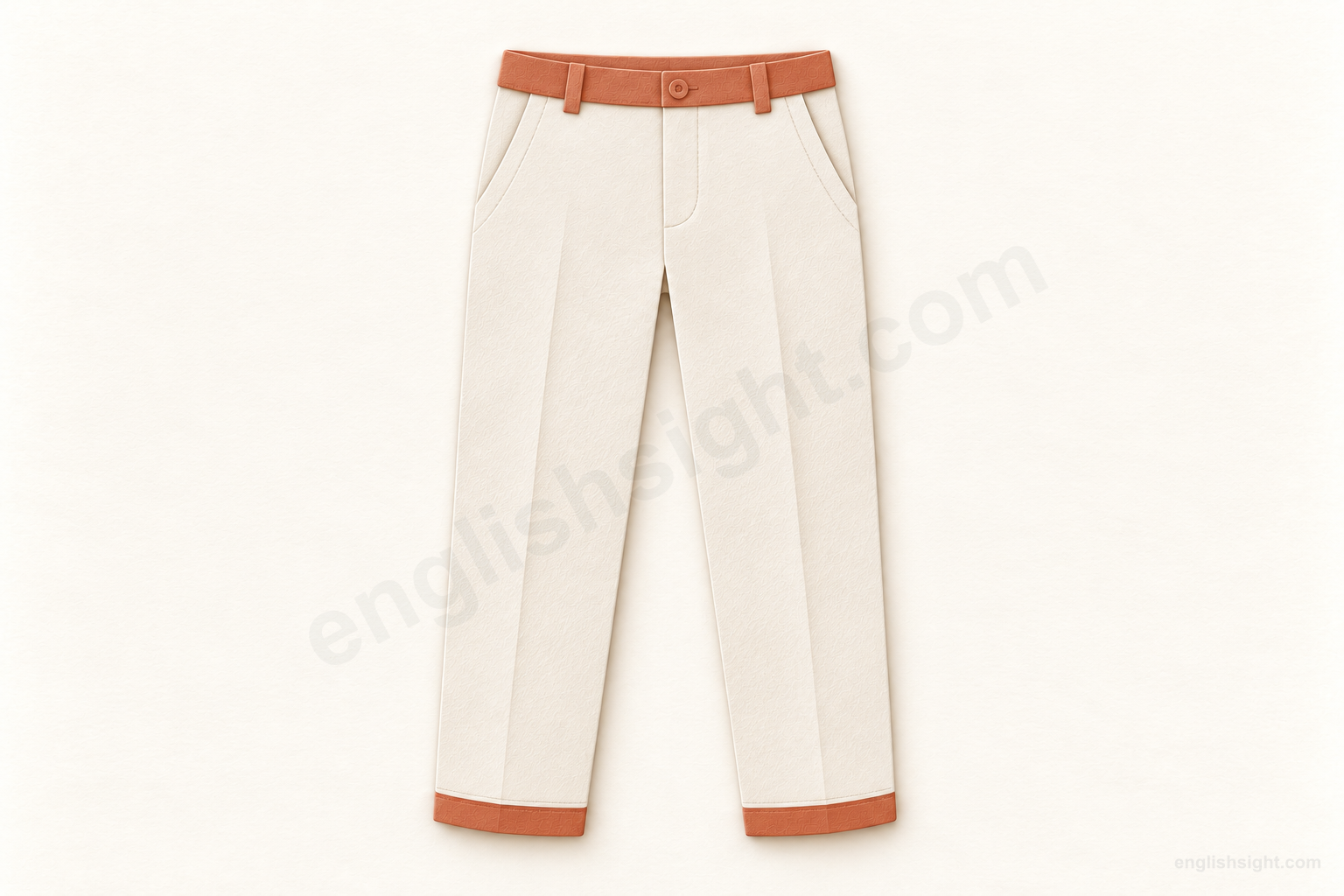
One joined waistband and upper section.
trousers
Together they form one complete garment.
Two separate leg sections extend below the joined upper part.
A static structure: one garment with a separate section for each leg.
The word trousers names a lower-body garment whose joined upper part leads into a separate section for each leg.
This is a structural view, not an action or a change over time. It supports identifying the garment; pair, agreement, and idioms require their own explanations.
A pair of trousers has two separate leg sections joined at the top. That simple structure helps you identify the item; its plural grammar is an English usage pattern to learn alongside the picture.
Most everyday uses keep this clothing meaning. Descriptions and verbs supply the details. A small set of fixed expressions has separate meanings and particular tones.
01
Name it, count it, and choose the regional word
Start with the garment, then separate plural grammar from the number of complete items.
01
wear / buy / need + trousers
trousers
a garment with a separate section for each leg
Situation / starting point
You need to name the lower part of an outfit.
Meaning / result
You identify one garment with two leg sections.
The two legs belong to one connected item of clothing.
Picture a waistband joined to two separate leg sections. That is the useful physical connection in this lesson. A skirt has a different structure: it does not enclose each leg separately.
Trousers can be worn by anyone; the noun does not specify the wearer’s gender. In everyday shopping, the unmodified word usually suggests long outer clothing. A description such as cropped trousers tells you more about the length.
Example
I need some trousers for my new job.
Watch the difference The word names the garment, not the legs of the person wearing it.
02
these / those / my trousers + are / have; they / them
these trousers are…
use plural grammar even for one garment
Situation / starting point
You hold up one item in a shop.
Meaning / result
You describe it using these, are, and they.
The noun’s grammatical number differs from the number of garments.
Say These trousers are wet. They need drying. Trousers takes plural agreement even when you mean just one garment. These and those fit this pattern; this trousers does not.
My trousers have a stain uses have, not has. The two-leg sketch can help you remember the form, but it is a memory aid, not a rule that every object with two parts must have a plural name.
Example
These trousers are clean, but they are still damp.
Watch the difference Avoid a trousers or a trouser when naming one whole garment in ordinary conversation.
03
a / one pair of trousers + is; two pairs of trousers + are
a pair of trousers
count complete garments with pair
Situation / starting point
You choose one garment, then add another.
Meaning / result
You have two pairs of trousers.
A pair here counts one complete garment, not two separate garments.
Use a pair of trousers for one item and two pairs of trousers for two items. In This pair of trousers is cheaper, singular pair is the head of the subject, so use is. These trousers are cheaper describes the clothing with plural trousers as the head.
Compare This pair is blue and These two pairs are blue. If the item is already clear, you can ask Do you have another pair? Some trousers leaves the exact number unspecified; it does not necessarily mean several garments.
Example
I packed two pairs of trousers and a spare shirt.
Watch the difference Do not say two trousers to count two whole garments; use two pairs of trousers.
04
British English: trousers; American English: usually pants
trousers / pants
choose a clothing word for the variety of English
Situation / starting point
You discuss the same garment with different speakers.
Meaning / result
The ordinary label may be trousers or pants.
Regional vocabulary can change the likely interpretation.
Trousers is especially British; pants is the usual American word for this garment. Trousers is also understood and used in American English, including clothing descriptions. This is a preference, not a claim that Americans never say trousers.
In British English, pants commonly means underwear. If a British shop assistant asks whether you mean trousers, check which garment you are discussing. Neither word tells you its material: denim, cotton, and wool are separate descriptions.
Example
In the US shop, I asked where the pants were.
Watch the difference Do not assume pants always means outer clothing in every English-speaking setting.
02
Getting dressed, shopping, and describing parts
Ordinary verbs and modifiers explain what happens to the clothes and which kind or part you mean.
05
wear / put on / pull on / take off / pull up / lower / drop + trousers; be in trousers
wear / put on / take off trousers
distinguish wearing from getting dressed or undressed
Situation / starting point
The trousers are not on your body.
Meaning / result
You put them on and then wear them.
The verb supplies the action or state; trousers keeps its clothing meaning.
Wear describes having clothing on: I’m wearing trousers. Put on describes getting into it, while take off describes removing it. Pull on is another natural way to describe putting trousers on. In a woman in black trousers, in describes what she is wearing. Pull up your trousers means raise them into position at your waist; lower or drop your trousers means move them down. These actions need not completely remove the garment.
With pronouns, say Put them on and Take them off. Put on them is not the ordinary order for this clothing sense. These are patterns of put and take, not phrasal verbs formed from trousers.
Example
I put on my trousers before I went downstairs.
Watch the difference I am wearing them describes the current state; I am putting them on describes the dressing action.
06
trousers + fit + person; be too tight / loose / long / short; try them on
trousers that fit
discuss size, comfort, and alterations
Situation / starting point
You try a garment on in the changing room.
Meaning / result
You decide whether its size and length suit your body.
Fit and length are properties of the garment, not new meanings of trousers.
These trousers fit me says their size and shape are suitable. They are too tight describes insufficient room; They are too long describes excessive length. You can ask Could you shorten these trousers? when the leg ends need altering.
To test the size, try the trousers on, or try them on. Buying them and trying them on are different actions: you can try something on without deciding to buy it. Keep plural grammar when the subject is trousers: These trousers fit, not fits.
Example
These trousers fit at the waist, but they are too long.
Watch the difference Too short for me is a size judgment; short trousers can name a deliberately shorter style.
07
material / style description + trousers
cotton / smart / wide-leg trousers
describe material, occasion, and shape
Situation / starting point
Several garments have the same basic two-leg structure.
Meaning / result
You distinguish them with a description.
Modifiers add details while trousers still names the garment.
Cotton trousers describes material; smart trousers suggests a neat appearance suitable for a more formal setting. Baggy and tight describe roominess. Wide-leg trousers have broad leg sections, while cropped trousers end higher than full-length styles.
Jeans names a familiar kind of clothing usually made of denim; it is not a word for every kind of trousers. Choose the description that answers the actual question: cotton answers What material?, while wide-leg answers What shape? These combinations are not separate idiomatic senses.
Example
She chose wide-leg cotton trousers for the trip.
Watch the difference Trousers does not itself mean formal, tight, male, or made of one particular fabric.
08
trouser + leg / pocket / suit; one trouser leg, two trouser legs
a trouser leg / trouser pocket
use trouser before another clothing noun
Situation / starting point
You refer to one part rather than the whole garment.
Meaning / result
The following noun names the part you mean.
Trouser modifies leg or pocket; it does not become an ordinary singular garment name.
The usual form before another noun is trouser: a trouser pocket, one trouser leg, two trouser legs. Oxford treats this use as an adjective; Collins notes it as a modifier. Either description helps you keep the form without final s.
In I rolled up my trouser legs, legs are the fabric sections, not the person’s bare legs. In My trousers have deep pockets, trousers names the whole garment and stays plural. A trouser suit is an outfit of a matching jacket and trousers, usually sold as women’s clothing; the whole phrase names the outfit.
Example
I found the ticket in my trouser pocket.
Watch the difference A trouser pocket is a pocket; it is not one trouser meaning one whole garment.
03
Recognize the fixed expressions
These British expressions have meanings beyond clothing. Their wording and social tone need to be learned with the whole phrase.
09
someone + wears the trousers; American English: wears the pants
wear the trousers
have the main decision-making power in a relationship
Situation / starting point
People discuss which partner makes the decisions.
Meaning / result
The expression identifies the partner with greater control.
The fixed phrase concerns authority, not the clothing someone has on.
Wear the trousers is a British informal idiom; the American equivalent is wear the pants. In this use, the refers to a fixed expression. The phrase can imply disapproval and sound dated because it draws on traditional gender expectations.
For neutral conversation, say Who makes the decisions? A literal sentence such as He wears grey trousers merely describes his clothes. The garment sketch does not explain or justify the social stereotype behind the idiom.
Example
“Who wears the trousers in their relationship?” “They make decisions together.”
Watch the difference This can sound intrusive or judgmental; it is useful to recognize without adopting it as neutral wording.
10
catch + someone + with their trousers down; be caught with your trousers down
catch someone with their trousers down
find someone embarrassingly unprepared
Situation / starting point
A team has not prepared the figures for an unexpected inspection.
Meaning / result
The inspection exposes its lack of preparation.
A vulnerability image becomes an idiom for being caught unready.
This informal expression need not involve anyone undressing. It can describe an unexpected question, inspection, or event that exposes someone’s lack of preparation. The passive form is be caught with your trousers down.
The image is deliberately embarrassing, so choose caught unprepared in a neutral report. Pants can replace trousers, especially in American wording. Do not assume the idiom proves dishonesty; the context must supply any accusation of wrongdoing.
Example
The surprise audit caught the accounts team with their trousers down.
Watch the difference Their refers to the people caught; no actual clothing needs to be involved.
11
be + all mouth and no trousers
all mouth and no trousers
talk boldly about acting but fail to follow through
Situation / starting point
Someone repeatedly promises impressive action.
Meaning / result
The promised action never follows.
The whole British idiom contrasts talk with actual performance.
Calling someone all mouth and no trousers criticizes a gap between their words and their actions. The expression is informal and mocking; trousers does not independently acquire the general meaning action.
Use a concrete context to identify the unfulfilled claim. He talks a lot is broader: someone may be talkative and still act effectively. A neutral alternative is He makes promises but does not follow through.
Example
He promised to organize everything, but he is all mouth and no trousers.
Watch the difference Learn this as a whole expression; do not invent new phrases by treating trousers as a synonym for action.
12
be + (still) in short trousers
(still) in short trousers
refer to someone’s boyhood
Situation / starting point
An adult recalls when a much older event happened.
Meaning / result
The phrase places him back in childhood.
Short clothing evokes a boy’s younger years in this British expression.
In a recollection, I was still in short trousers can mean I was only a boy then. The phrase reflects an association between boys and short trousers; it does not state a rule about what children or adults must wear.
Short trousers also has a literal clothing meaning. The surrounding story decides whether you are describing a garment or recalling childhood. I was still a child then is a more neutral alternative that does not depend on that cultural image.
Example
When that bridge opened, I was still in short trousers.
Watch the difference Do not interpret every mention of short trousers as an idiom; a shop description may be completely literal.
Keep the noun, construction, and idiom separate
Form and pronunciation
Trousers is a plural noun: British /ˈtraʊzəz/, American /ˈtraʊzərz/. The stressed vowel is /aʊ/, as in now. Use a pair to count one garment. Trouser before another noun is a separate modifier use.
One picture has limits
The diagram shows the garment’s structure. It does not establish the historical reason for the plural or predict the meanings of fixed expressions. It is a teaching aid rather than a picture all speakers share.
Scope
This lesson covers everyday clothing language and selected established British idioms, including expressions best learned for recognition. Verb tense, passive, and causative families do not belong to this noun. The separate informal British verb trouser, derived adjectives such as trousered, and specialist theatrical trouser roles are outside this lesson.
Choose the natural meaning and form
Check whether the sentence names the whole garment, counts pairs, describes a part, or uses an idiom.
1. You point to one garment that has not dried. Which sentence is standard?
2. Your bag contains two complete trouser garments. Which wording counts them clearly?
3. You mean one fabric section that covers a leg. Which expression fits?
4. An unexpected inspection caught a team with their trousers down. What does the idiom tell you?
5. Which sentence uses pair as the head of the subject?
Sources and teaching notes
The dictionary pages below support the meanings, regional labels, and expressions. Explanations and examples were written for this lesson; the structural sketch is a teaching aid.
The diagram highlights the garment’s structure; speakers need not share one mental picture.