Use true for factual accuracy, genuine qualities, and faithfulness to a reference.
An account agrees with reality
An account agrees with reality
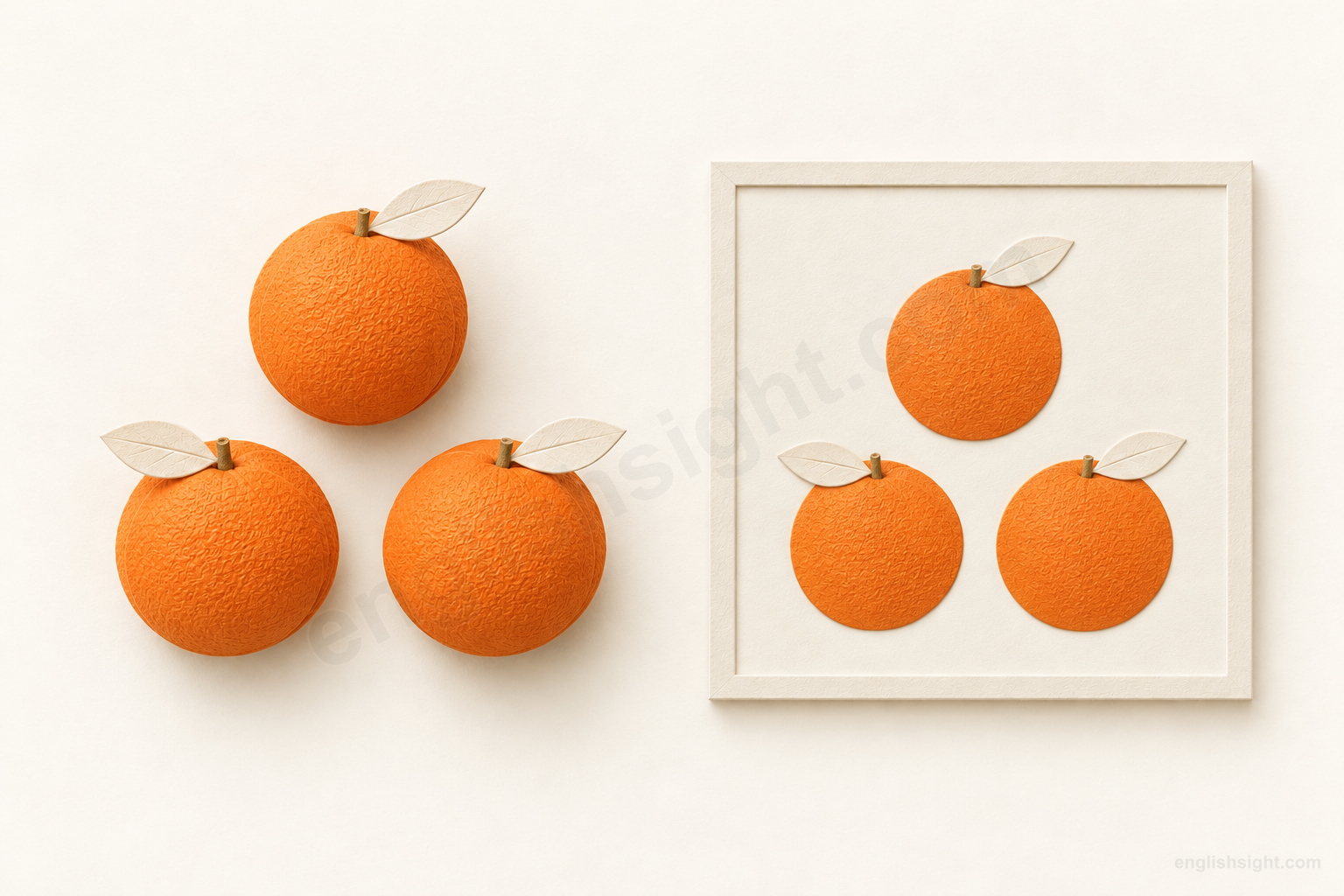
Three actual oranges in a triangular arrangement.
true
The picture shows the same number and arrangement.
Compare reality with the picture.
The picture agrees with the actual arrangement: a visual model of factual truth.
For factual claims, true means that what is said agrees with how things actually are.
The drawing compares a real arrangement with its representation; it shows agreement, not movement or a change in the facts. Loyalty and fixed expressions need the separate explanations below.
The simplest starting point is a claim that agrees with reality. A true account matches what happened; a true story is more than a believable invention.
Other uses concern genuine character, loyalty, or accurate representation. Comparing something with a relevant reality or commitment is a useful teaching connection, but it does not mechanically generate every idiom.
01
Facts, confirmation, and argument
Check a claim, say where it applies, or accept a point before qualifying it.
01
true + story / statement; statement + be / prove + true; turn out to be true
a true story; that is true
agree with what actually happened
Situation / reference
Someone tells you about an event.
Meaning in this use
You accept that the account matches the facts.
True evaluates a statement or account against reality.
A story can be entertaining without being true. Calling it true says that its events actually happened. In That is true, that can stand for the whole previous claim.
Use true before a noun or after be: a true account; the account is true. Is that true? asks for confirmation; That is not true denies the claim. A true-or-false question asks you to choose between the two.
Not entirely true and partly true allow for a claim that gets some details right. Strictly true emphasizes complete or exact accuracy. A technically true answer may be accurate in a narrow sense while still leaving a misleading impression. Prove true and turn out to be true describe later confirmation, rather than a change in the past facts.
In a sentence
The story about the missing painting turned out to be true.
Watch the difference Use a correct answer for an answer without a mistake; a true statement specifically agrees with the facts. Say You are right about the date, rather than You are true about the date.
02
it + be + true + (that) + subject + verb
Is it true that…?
ask whether a whole claim is factual
Situation / reference
You hear that the library will close early.
Meaning in this use
You ask someone to confirm the information.
The clause after that supplies the claim being checked.
In It is true that…, it is a grammatical placeholder; the following clause supplies the content. That may be omitted in ordinary speech: Is it true the library is closing?
To reply briefly, use Yes, that is true or No, that is not true. Do not insert an extra is before the clause: Is it true that the library closes at four? already contains the verb needed inside each clause.
In a sentence
Is it true that the library closes at four today?
Watch the difference Keep the statement order inside the that-clause: that the library closes, not that does the library close.
03
be true of / for + noun; hold true (for + noun / in + situation)
true of / for; hold true
apply to the people or circumstances named
Situation / reference
A statement fits one group.
Meaning in this use
You check whether it also fits another group.
Of and for identify where a claim applies.
The same is true of… carries an earlier point over to another subject. True for… also identifies the people or situations covered; the two prepositions overlap substantially here.
Hold true means that a rule or generalization is valid in the stated circumstances. It is common in explanation and argument and somewhat formal. Still holds true emphasizes continuing validity; it does not mean someone is holding an object.
Compare This is true of our team, about the team, with She is true to her team, about her loyalty. The preposition changes the relationship.
In a sentence
The rule holds true for small groups as well as large ones.
Watch the difference A statement can hold true in some circumstances without applying everywhere. State the scope when it matters.
04
True, but + clause; it is true (that) + clause, but + clause
True, but…
accept one point before adding a qualification
Situation / reference
Someone presents a genuine advantage.
Meaning in this use
You accept it and introduce another consideration.
Agreement with one fact need not mean agreement with the conclusion.
True, but… is a short conversational concession. You acknowledge the earlier point, then explain why another factor matters. It is true that… but… gives the same argumentative shape in a full sentence.
True enough can also introduce a qualification. The contrast comes from but or the surrounding argument, not from a special meaning of true that makes the first point false.
In a sentence
True, the bus is cheaper, but it takes twice as long.
Watch the difference A reply such as True does not automatically agree to a plan; listen to what follows.
02
What something really is or represents
Distinguish hidden reality, genuine qualities, accurate representation, and convincing fiction.
True can distinguish the underlying reality from an incomplete impression.
The true cost includes what the attractive headline price hides. The true reason is the actual reason, which may differ from the explanation someone gave. Your true feelings are what you really feel, even if you conceal them. The true owner is the person who actually owns something, even if someone else claims it.
In these combinations true normally comes before the noun. The sentence Her feelings are true can suggest sincerity and is not always equivalent to She revealed her true feelings. Read the whole noun phrase.
In a sentence
We did not discover the true cost until the final bill arrived.
Watch the difference True does not itself mean expensive, secret, or unpleasant; the contrast depends on context.
06
a true + person / role; true + quality; in the truest sense of the word
a true professional; true love
fully deserve a description
Situation / reference
Someone remains considerate under pressure.
Meaning in this use
You praise the person as an excellent example of their role.
True can emphasize the qualities expected of a genuine example.
A true professional shows the standards you associate with professionalism. True love emphasizes genuine affection rather than a performance. These expressions evaluate qualities; they are not simply fact-checking a sentence. Not every use is praise: a true emergency genuinely meets the description of an emergency.
This use is normally before a noun. In the truest sense of the word emphasizes that the label fits especially well. Truer and truest exist, but factual questions are usually framed as true or false rather than as competitions in truth.
In a sentence
She stayed calm and helped everyone: a true professional.
Watch the difference A true friend often emphasizes loyalty too. Do not replace every real with true: a real chair is an actual chair, while a true professional is an evaluation.
07
be / remain true to + source; a true + copy / likeness / record
true to the original
represent a source accurately
Situation / reference
A novel is adapted for television.
Meaning in this use
You compare the adaptation with its source.
To introduces the original being represented.
A version that is true to the original preserves important features of its source. A true copy, a true likeness, and a true record emphasize accurate representation, though the relevant details differ for a document, portrait, or account.
This is fidelity of representation, not loyalty to a person. An adaptation can be true to a fictional book without depicting events that actually happened. The reference is the source, not necessarily real-world history.
In a sentence
The film changes the setting but stays true to the spirit of the novel.
Watch the difference True to the spirit allows changes in detail; it does not promise a word-for-word copy.
08
be true to life; true-to-life + noun
true to life
portray experience convincingly
Situation / reference
A story is invented.
Meaning in this use
Its characters behave like recognizable people.
Realistic representation does not require a factual plot.
True to life describes a convincing portrayal of life. A fictional conversation can be true to life when the reactions feel believable. A true story, in contrast, claims that the events happened.
Use The dialogue is true to life after be. Before a noun, hyphenate the phrase: true-to-life dialogue. This is an established description of representation, not a demand that every fictional detail be documented.
In a sentence
The plot is invented, but the family arguments are true to life.
Watch the difference Do not infer that a film is based on real events merely because someone calls it true to life.
03
People, promises, and values
True can describe commitment that stays consistent. The person or principle after to is the reference.
09
a true friend; be / stay / remain true to + person / belief
a true friend; remain true to
continue to support a person or principle
Situation / reference
Supporting a friend becomes inconvenient.
Meaning in this use
You remain dependable instead of abandoning them.
Here true concerns continued loyalty, not factual accuracy.
A true friend is dependable and loyal. Be true to a person or belief means keep your commitment to them. Remain and stay emphasize that support continues despite changing circumstances.
To is a preposition here: remain true to your principles. This family connects to the teaching idea of consistency with a commitment, but it should be learned as an established meaning, not derived from whether a person is factually correct.
In a sentence
Even under pressure, she remained true to her principles.
Watch the difference A true friend is loyal; a truthful friend tells the truth. The descriptions can overlap, but they emphasize different qualities.
10
be / remain true to + possessive + word
true to your word
do what you promised
Situation / reference
You promise to repair a neighbour’s gate.
Meaning in this use
You return and carry out the repair.
Word refers to the commitment you made.
If someone is true to their word, their actions fulfill a promise. The possessive changes with the person: true to my word, her word, or their word. Word is singular in this fixed expression.
Compare Her words were true, which evaluates the accuracy of what she said. She was true to her word evaluates whether she did what she had promised. The small grammatical changes matter.
In a sentence
True to his word, Leo returned on Saturday to fix the gate.
Watch the difference True to his word is not an instruction to repeat his exact wording.
11
be / stay / remain true to + reflexive pronoun
be true to yourself
act according to your own values
Situation / reference
Others push you toward a choice you do not believe in.
Meaning in this use
You make a choice consistent with your convictions.
The reference point is your own values or identity.
Be true to yourself is advice to act in a way that reflects what you honestly believe or value. Yourself agrees with you; a third-person subject takes herself, himself, or themselves as appropriate.
The phrase concerns personal integrity. It does not guarantee that a belief is factually correct or that every impulse is wise. The connection is consistency between values and conduct.
In a sentence
She chose work that let her stay true to herself.
Watch the difference Use to, not with, in this expression: true to yourself.
04
Established expressions in everyday use
The surrounding words contribute realization, credibility, suspicion, character, habit, or reliability. Learn each whole expression.
12
dream / wish / prediction + come true; make + dream + come true; a dream come true
come true; a dream come true
become an actual event or fulfilled hope
Situation / reference
You have long hoped to perform on stage.
Meaning in this use
You finally get the opportunity.
Come contributes the change from an imagined possibility to reality.
Dreams, wishes, and predictions can come true. The subject is the thing that happens, not the person who wishes. A prediction coming true need not be pleasant: a warning can also be fulfilled.
Make a dream come true means bring about its realization. After make, use come, not to come. In a dream come true, the words come true follow dream as a fixed description of a fulfilled wish.
In a sentence
Playing at the festival was a dream come true for Nina.
Watch the difference Say My wish came true, not I came true. A claim proves true when evidence confirms it; a wish or prediction comes true when the imagined event happens.
13
account / explanation + ring true (to + person)
ring true
sound believable or sincere
Situation / reference
You hear an explanation.
Meaning in this use
It fits your experience and seems credible.
Ringing true describes an impression rather than proof.
An account, explanation, or excuse can ring true to someone. The verb ring is figurative: no actual sound or bell is required. The past tense is rang: her explanation rang true.
An explanation that rings hollow sounds insincere or unconvincing. Neither expression proves what happened. Someone can be persuaded by an account that later turns out to be false.
In a sentence
His explanation rang true to me, but I still checked the dates.
Watch the difference Keep the distinction between It rings true and It is true: credibility is a judgment; truth concerns the facts.
14
seem / sound / look / be + too good to be true
too good to be true
seem so attractive that you doubt it
Situation / reference
An offer promises an unusually large benefit.
Meaning in this use
You wonder what problem or condition is hidden.
The whole expression signals suspicion or delighted disbelief.
If an offer looks too good to be true, its apparent advantages make you doubt that it is genuine or as favorable as it seems. Too…to… supplies the idea of exceeding a believable limit.
The expression can also convey delighted disbelief about genuine good fortune. Tone and context decide how suspicious the speaker is. It does not literally mean that good things cannot happen.
In a sentence
A free holiday with no conditions sounded too good to be true.
Watch the difference This phrase expresses a reaction, not a verified finding of fraud.
15
show / reveal + possessive + true colours / colors; see someone in their true colours
show your true colours
reveal your real character
Situation / reference
Someone appears friendly while seeking a favour.
Meaning in this use
Their later conduct reveals a less generous attitude.
Colours is a conventional metaphor for character.
Show your true colours means let people see what you are really like. It often criticizes a character previously concealed, but the phrase can also describe someone revealing admirable qualities in a challenge.
British spelling is colours; American spelling is colors. Use a possessive, as in show his true colours. The phrase is about character and motives, not someone’s actual favourite colours.
In a sentence
He showed his true colours when he blamed the mistake on a new colleague.
Watch the difference The expression often carries disapproval, but context can support a positive use. Do not make a negative meaning an absolute rule.
16
True to form, + clause; behave / run + true to form
true to form
behave in the familiar expected way
Situation / reference
A friend regularly arrives late.
Meaning in this use
They do the same thing again.
Form refers to an established pattern of behaviour.
True to form comments that someone or something has done what experience led you to expect. It is often mildly critical or amused, though a repeated positive performance can also fit.
At the start of a sentence, True to form, … comments on the following event. Unlike be true to your word, it does not imply a promise; unlike a true story, it does not simply check factuality.
In a sentence
True to form, Marta arrived ten minutes after the meeting started.
Watch the difference Form here is not a document to fill in or a physical shape.
17
a tried-and-true + method / recipe; method + be + tried and true
tried and true
reliable because it has worked before
Situation / reference
You need a method you can trust.
Meaning in this use
You choose one with a successful history of use.
The whole phrase links reliability to prior experience.
A tried-and-true method has been used successfully before. Tried means tested by use here, not merely attempted without success. The phrase commonly describes practical advice, methods, and products.
Tried and true is especially North American; tried and tested or tried and trusted are common British alternatives. Before a noun, the compound is often hyphenated, as in a tried-and-true recipe.
In a sentence
For a busy evening, I chose a tried-and-true recipe.
Watch the difference Past success supports confidence; the phrase does not guarantee success in every new situation.
05
Recognize two specialist branches
Navigation and mechanical accuracy use true in specific ways. These recognition notes are not a full technical course.
18
true north; point toward true north
true north
use geographic north as the reference
Situation / reference
You compare two kinds of north on a map.
Meaning in this use
You distinguish the geographic pole from magnetic direction.
True identifies a geographical reference in this fixed technical term.
True north is the direction toward the geographic North Pole, defined by the earth’s axis. Magnetic north is the direction indicated by the earth’s magnetic field. This is a navigation term, not a claim that other compass directions are dishonest.
You may meet the term when reading maps or travel instructions. The everyday truth-versus-falsehood contrast does not explain its technical details; learn the complete term.
In a sentence
The guide explained the difference between true north and magnetic north.
Watch the difference Do not assume a compass needle always points exactly toward true north.
19
be in / out of true; true / true up + object; fly straight and true
out of true; true a wheel
refer to accurate mechanical alignment
Situation / reference
A wheel wobbles instead of turning evenly.
Meaning in this use
A mechanic adjusts its alignment.
This specialist family concerns physical accuracy.
Out of true means not accurately aligned or shaped; in true means correctly aligned. Here true functions as a noun in a fixed technical phrase. A mechanic can also use true as a verb: true a wheel, meaning adjust it to run accurately.
The verb takes an object and can be passive: the wheel was trued. Forms are trues, trued, and truing or trueing. True up is also used for accurate adjustment. These are workshop expressions, not productive verbs meaning make a statement factual.
The related adverb in fly straight and true means move accurately along a course. Oxford marks the general adverb use as old-fashioned or literary. In ordinary prose, use truly for genuinely and tell the truth for speaking honestly.
In a sentence
The mechanic trued the wheel because it was slightly out of true.
Watch the difference The technical verb allows a passive; the ordinary adjective in The story is true is not a passive verb.
Choose the reference and read the whole expression
True, real, truthful, and truth
A true report agrees with facts. A real object actually exists; a true professional fully fits a description. A truthful person tells the truth. Truth is the noun: tell the truth, not tell the true. Truly is the ordinary adverb in truly grateful.
Form and degree
True is pronounced /truː/. The comparative and superlative are truer and truest. Completely true, not entirely true, and partly true distinguish full from partial accuracy; they do not mean truth is simply personal preference.
Grammar is not one large phrasal-verb family
Be true to contains an adjective and a preposition. Come true, ring true, and hold true are established verb-plus-complement expressions, not separable phrasal verbs. Only the separate technical verb true, as in true a wheel, has its own object and passive.
Scope of this lesson
The main focus is modern everyday adjective use and familiar expressions, with brief recognition notes for navigation and alignment. Specialist biology, detailed surveying or accounting uses, literary nominal the true, and compounds such as true-blue and true crime are not expanded.
Choose the meaning in context
Compare the complete expressions before choosing.
1. A novel is invented, but its conversations feel realistic. Which description makes that point?
2. Jo promised to call and then called at the agreed time. Which phrase evaluates Jo’s conduct?
3. An explanation seems believable, but you have not checked it. Which description preserves that distinction?
4. Sam finally gets the trip he has dreamed about. Which sentence describes the wish becoming reality?
5. A finding applies to new employees as well as experienced staff. Which wording fits?
Sources and teaching notes
The dictionaries below support the usage inventory. Explanations and examples are original; the diagram is a teaching model of agreement between an account and reality.
The diagram illustrates a teaching connection, not a mental picture shared by every English speaker.