From winding strands and turning a cap to a surprising story development.
Turning changes alignment
Turning changes the relationship between parts
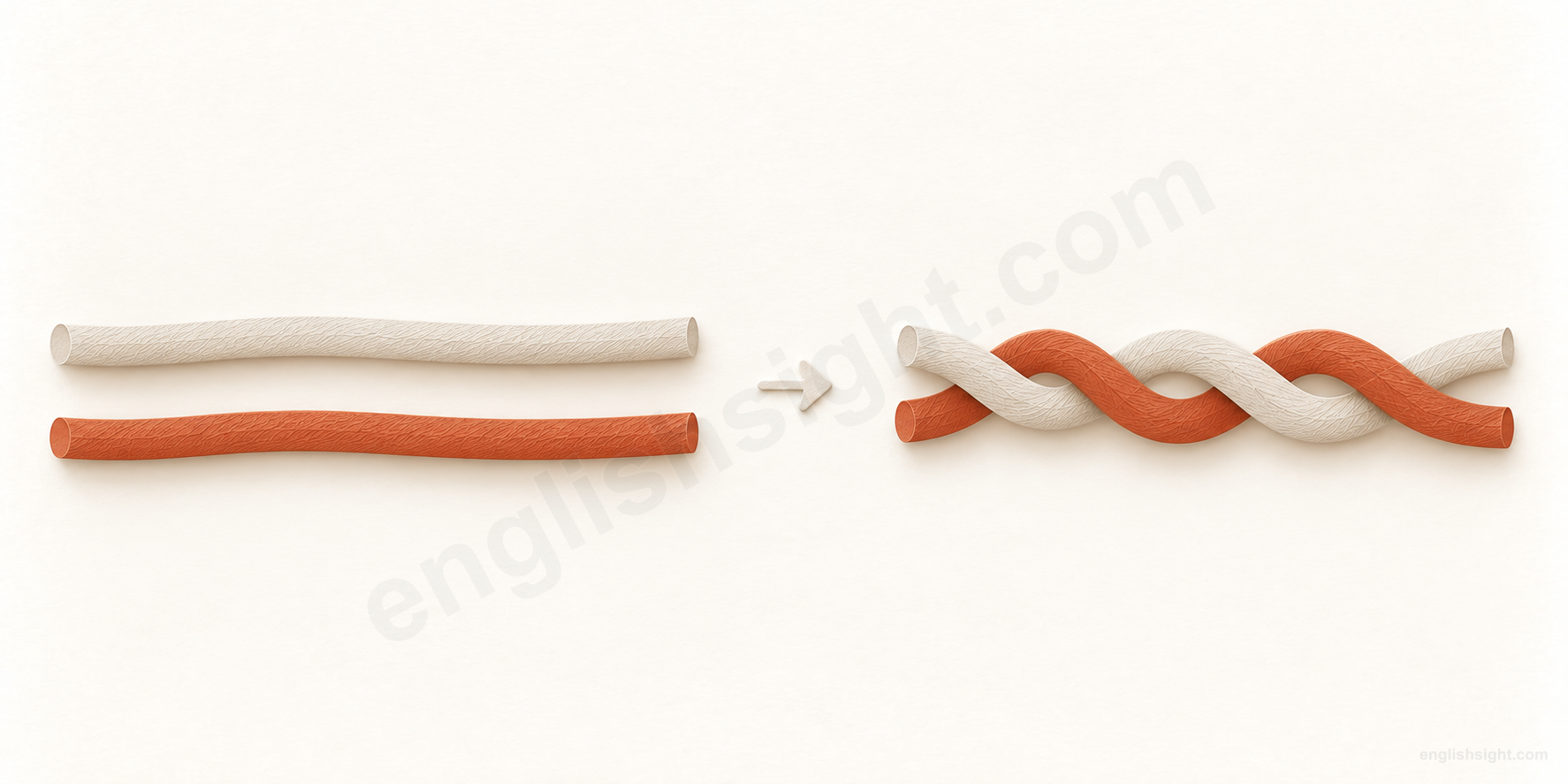
Two separate strands
twist
The same strands are intertwined.
The strands wind around one another.
Turning winds the strands together. This is one physical example of twist, not a model for every meaning.
A useful physical starting point is turning one part relative to another, sometimes winding parts together or changing their alignment. Extended uses can present a changed course or meaning.
The sketch shows strands being wound together. It does not claim that every twist joins strands, causes damage, or reverses something. Controls, routes, and established idioms need their own context.
Twist is both a verb and a noun. Its physical uses involve turning, winding, or a change from a straight or normal alignment. A knob can twist without bending; a cord can twist into a new shape.
The same word helps describe a misleading account, an unexpected event, or a new version of something familiar. These connections are useful for learning, but they do not let us guess every fixed expression.
01
Turn, shape, and wind things together
A turning action can operate a control, change a material’s shape, join strands, or remove a part. The object and the following words tell you the result.
01
twist + object + into + shape
twist something into a shape
form something by turning or winding it
Starting situation
A piece of soft wire is straight.
Action, result, or interpretation
It has been shaped into a loop.
Into names the resulting shape, not a destination.
You act on a flexible object and change its form. Twist the wire into a loop tells us both the action and the result; twist your hair into a bun follows the same grammatical pattern.
Twist often suggests turning or winding, whereas bend can describe a simple change of angle. The verbs overlap with flexible materials; they do not describe exactly the same hand movement in every situation.
A passive is natural when the material matters more than the maker: The wire was twisted into a loop. This is ordinary passive grammar, not a separate meaning of twist.
Original English example
We twisted the soft wire into a loop for the handle.
Watch the difference Into introduces the result. Twist into is not a separable particle verb here.
02
twist + plural object + together; twist + material + into + cord
twist strands together
wind separate lengths around one another
Starting situation
Two lengths of cord lie separately.
Action, result, or interpretation
They wind around one another.
Together describes strands becoming intertwined.
The strands turn around one another rather than merely lying side by side. You can twist threads together or twist several lengths into a thicker cord. Together highlights their combination; into specifies what is made.
This is the relationship shown in the sketch. It need not involve damage or a knot. Braid usually suggests a more specific interlacing pattern, so it is not always interchangeable with twist.
Original English example
Twist the two cords together before tying the ends.
Watch the difference Putting cords next to each other does not by itself mean twisting them together.
03
twist + object + around / round + support; subject + twist around + support
twist something around something
wind one thing around a support
Starting situation
A thin wire is loose beside a post.
Action, result, or interpretation
The wire winds around the post.
Around introduces the object encircled by the wire.
Here a flexible object takes a winding course around something else: twist the wire around the post. Around is a preposition with its own object, not a detachable word meaning that the job is finished.
The winding thing can also be the subject: The vine twists around the support. That describes its course or growth without naming a person who makes it happen. Compare twist around to look behind you, which concerns bodily orientation.
Original English example
She twisted the wire around the wooden post.
Watch the difference Do not confuse literal winding around a post with the idiom about someone’s little finger.
04
twist + control; give + object + a twist; a twist of + body part
twist a knob; give something a twist
rotate something, often with the hand
Starting situation
The knob is in its starting position.
Action, result, or interpretation
A turn changes its position.
The object can rotate without changing its shape.
Twisting a knob or handle means turning it with your hand. Unlike twisting soft wire, this does not necessarily deform the object: the knob turns relative to the panel or mechanism around it.
The countable noun a twist can name one turning action. Give the knob a gentle twist and a twist of the wrist describe the movement, not a new object or a donation. The words gentle, quick, or another specify the action.
Original English example
Give the knob a gentle twist to lower the volume.
Watch the difference Turn is the broader word; twist emphasizes the turning movement rather than every kind of change of direction.
05
twist off + object; twist + object + off; twist it off; cap + twist off
twist off a cap
remove a part by turning it
Starting situation
The cap is attached to the bottle.
Action, result, or interpretation
Turning removes the cap.
Off supplies the removal result.
Twist off combines the turning action with separation. It can describe unscrewing a cap or turning and pulling a small part free; it does not guarantee that every object has a screw thread.
With a noun, both twist off the cap and twist the cap off are possible. Put a personal pronoun in the middle: twist it off. The cap twists off describes how the cap comes away without naming the person.
Original English example
The cap is stiff, but you can twist it off.
Watch the difference Say twist it off, not twist off it. Twist the cap alone does not state that it comes off.
06
twist + object + out of shape; be twisted; a twist in + object
twisted out of shape; a twist in a hose
deformed or wound into an unwanted position
Starting situation
A frame is straight and a hose is open.
Action, result, or interpretation
The frame is distorted or the hose has a kink.
A twist may be a changed shape rather than a useful turn.
Twist something out of shape emphasizes an unwanted result. The metal was twisted out of shape presents what happened to it; the metal is twisted can describe its present condition.
The noun also names a twisted place: a twist in the hose may restrict the flow. Untwist the hose means reverse the winding. A twist is not necessarily a tied knot, and not every bent object is best described as twisted.
Original English example
A twist in the hose was reducing the flow of water.
Watch the difference Do not infer damage from every use of twisted: hair can be deliberately twisted into an attractive style.
07
a twist of + lemon / lime; a drink with a twist of lemon
a twist of lemon
a curled strip of citrus peel for a drink
Starting situation
A drink needs a little citrus flavor.
Action, result, or interpretation
A strip of peel is added.
Of lemon identifies what the curled strip comes from.
On a drinks menu, a twist of lemon normally means a narrow piece of lemon peel, often curled, rather than a slice or a squeeze of juice. Here twist is a countable thing with a twisted shape.
Compare water with a twist of lemon and a classic recipe with a modern twist. The first names a physical garnish; the second describes a variation. The surrounding noun phrase resolves the difference.
Original English example
I ordered sparkling water with a twist of lemon.
Watch the difference A twist of lemon does not normally mean lemon juice.
02
Bodies, expressions, and winding routes
Turning can involve part of a body, an uncomfortable movement, or the course of a road. Injury is one particular use, not a meaning present in every twist.
08
twist + body part; twist around / round + to-infinitive
twist around to look
turn part of the body while another part stays relatively still
Starting situation
You sit facing forward.
Action, result, or interpretation
Your upper body turns toward someone behind you.
The body turns relative to the hips or seat.
You can twist your head or shoulders, or simply twist around in your seat. The movement changes your orientation while another part of your body stays relatively still.
Around or round indicates the direction of the turn. To look begins a purpose clause: it explains why you turn. This ordinary movement does not imply injury; twisting your ankle usually does.
Original English example
Maya twisted around in her seat to answer the person behind her.
Watch the difference A body turn may be harmless. Read the body part and context before interpreting twist as an injury.
The familiar body-part expression reports an injury.
I twisted my ankle ordinarily tells someone about an injury caused by an awkward turn. Wrist and knee also occur in this pattern. Compare I twisted my shoulders to look back, which can describe a deliberate harmless movement.
Use the possessive that matches the person: she twisted her ankle. A twisted ankle is the resulting condition. Sprain names a particular type of injury; the everyday wording twisted my ankle does not establish a precise medical diagnosis.
Original English example
I twisted my ankle when I stepped off the curb.
Watch the difference Do not use twist as a general synonym for every kind of injury.
10
face / mouth + twist + in / with + emotion; twist into + expression
a face twists in pain
facial features become drawn into an uncomfortable expression
Starting situation
A person feels sudden pain.
Action, result, or interpretation
Their expression changes visibly.
The face changes shape; it is not simply looking in a new direction.
Her face twisted in pain describes a strained or distorted expression. In pain gives the accompanying feeling. His mouth twisted into a smile instead names the expression produced; the smile may look wry or strained in context.
The face can be the subject without an object: His face twisted. A passive also works: His face was twisted with pain. These patterns describe an expression; they do not necessarily mean the person physically turned their head.
Original English example
His face twisted in pain as he tried to stand.
Watch the difference Twist your head describes orientation; your face twists describes the shape of an expression.
11
twist (yourself) free; twist and turn
twist free; twist and turn
use repeated turning movements, sometimes to escape
Starting situation
A jacket sleeve catches on a hook.
Action, result, or interpretation
Turning the body releases the sleeve.
Free states the result of the movement.
Twist free means get free through a turning or wriggling movement. You can also twist yourself free, making the moving person the reflexive object. Free is a result word here, not a preposition with an object.
Twist and turn can describe repeated bodily movement, such as restless movement in bed or attempts to avoid a grasp. It does not automatically mean escape: someone can twist and turn but remain caught.
Original English example
My sleeve caught on a hook, but I managed to twist free.
Watch the difference Tried to twist free does not say the attempt succeeded; managed to twist free does.
12
road / river + twist + path phrase; twists and turns; a twist in the road
a road twists and turns
follow a winding course with changes of direction
Starting situation
A route does not continue straight.
Action, result, or interpretation
It bends repeatedly through the landscape.
The course changes direction; the road need not move.
A road or river twists when its course has repeated changes of direction. Around the hill, through the village, and down the valley add information about that course. They are ordinary path phrases, not separate idioms.
The countable noun a twist can mean a sharp bend. Twists and turns can describe several bends in a route; the same phrase also describes complicated changes in a story or a person’s life.
Original English example
The road twists and turns through the hills.
Watch the difference A twisting road describes its shape. It does not say the surface is rotating.
13
do / dance the twist; twist (dance verb)
do the twist
perform the named dance
Starting situation
Music invites a particular dance.
Action, result, or interpretation
Dancers turn their hips and bodies from side to side.
The twist is the name of a dance, not any turning movement.
The twist names a dance associated especially with the 1960s. In do the twist, the noun has the: it identifies this dance rather than one accidental twist of the body.
Twist can also be a verb meaning dance the twist. For a beginner, We danced the twist is a clear way to make the intended activity explicit. This cultural meaning is useful for recognition in songs, films, and conversation.
Original English example
At the party, my grandparents showed us how to do the twist.
Watch the difference A twist is one movement or shape; the twist can name the dance.
03
Words, stories, and new versions
Figurative uses compare a change of meaning or an unexpected development with a change of direction. Learn the actual expression rather than predicting a meaning from the sketch.
14
twist + words / facts; twist + statement + into + misleading interpretation
twist someone’s words / the facts
present information in a misleading way
Starting situation
Someone makes a statement with a particular meaning.
Action, result, or interpretation
Another person makes it seem to mean something different.
The alteration concerns meaning, not the physical words.
Twisting someone’s words is more than quoting them with different wording: it changes their message misleadingly. The accusation often suggests deliberate distortion for someone’s advantage. Twist the facts similarly criticizes how information is presented.
You can specify the resulting interpretation: They twisted my comment into an insult. My words were twisted puts the original statement first in a passive. The turning image helps memory but does not explain away the accusation of misrepresentation.
Original English example
Please don’t twist my words; I said the plan needed work, not that it was useless.
Watch the difference Paraphrase can preserve the message. Twist someone’s words normally says the message has been distorted.
15
a plot twist; a twist ending; take a twist; a twist in the tale / tail
a plot twist; a twist in the tale
an unexpected development in a story or situation
Starting situation
You expect the story to go one way.
Action, result, or interpretation
New information changes that expectation.
A twist changes the expected course of events.
A plot twist is a surprising development, often one that changes how you understand earlier events. A twist ending places the surprise at the end. In a twist in the tale, tale means story; a twist in the tail is also an established expression for a late surprise.
The noun works outside fiction: The investigation took another twist means it developed unexpectedly. Twists and turns can summarize a complicated sequence of developments. A twist need not be good, bad, or logically impossible.
Original English example
The final chapter has a plot twist that changes how we see the narrator.
Watch the difference An ordinary event is not automatically a plot twist; surprise or a change of direction matters.
16
a twist on + familiar thing; with a twist; give + object + a new twist
a twist on something; with a twist
a fresh variation on a familiar thing
Starting situation
A recipe or idea is familiar.
Action, result, or interpretation
One distinctive change gives it a new character.
The difference is a variation, not necessarily a surprise event.
A modern twist on a traditional recipe describes a new version. With a twist similarly signals a distinctive feature: a mystery with a comic twist. The feature may be planned and appealing rather than an accidental complication.
Give something a new twist presents the thing being varied as the object of give. Compare a plot twist, which normally concerns an unexpected story development. The meanings overlap in creative work, but a recipe’s twist need not involve suspense.
Original English example
This café serves a modern twist on a traditional bean soup.
Watch the difference A twist on a recipe is a variation. A twist of lemon names a physical strip of peel.
17
by / in a twist of fate; an ironic / strange twist of fate
a twist of fate
an unexpected turn of events attributed to chance
Starting situation
Two people have no plan to meet.
Action, result, or interpretation
An unlikely coincidence brings them together.
Of fate frames the surprise as something beyond a person’s plan.
By a twist of fate introduces an unexpected coincidence or outcome. It can be fortunate or unfortunate: the surrounding story tells us which. Fate here presents events as governed by chance or forces outside personal control.
An ironic twist of fate adds a mismatch between what was expected and what happened. Merely adding ironic does not mean funny. This is an established expression, not a claim that the speaker can prove the existence of fate.
Original English example
By a twist of fate, my new neighbor turned out to be my old teacher.
Watch the difference Do not assume a twist of fate always means good luck.
04
Established expressions in conversation
These phrases have conventional meanings. Physical twisting helps explain some imagery, but the complete phrase determines the message and tone.
18
twist + person’s + arm; twist someone’s arm into + -ing
twist someone’s arm
persuade or pressure someone to do something
Starting situation
Someone is reluctant to agree.
Action, result, or interpretation
Persuasion or pressure changes their decision.
The idiom concerns agreement, not necessarily physical force.
Twist someone’s arm informally means persuade or pressure them. It may suggest serious pressure, but friends also use it playfully about a welcome invitation: You won’t have to twist my arm means I am willing already.
Twist my arm can stand alone when the proposed action is already understood. Compare He twisted my arm behind my back: with that physical context, the words can describe literal force. Decide from the whole situation.
Original English example
I wasn’t planning to join the quiz, but my friends twisted my arm.
Watch the difference This idiom does not by itself report a physical injury. It can also imply pressure, not only friendly encouragement.
19
twist / turn the knife (in the wound)
twist the knife
make an already painful situation more upsetting
Starting situation
Someone is already disappointed.
Action, result, or interpretation
A cruel remark adds to their distress.
The phrase intensifies existing emotional pain.
To twist the knife is to make an unhappy person feel worse, often deliberately through an unkind remark. Turn the knife and twist the knife in the wound are related forms.
The image comes from worsening a wound, but the ordinary idiomatic use need not concern a real knife. It is a strong, critical description of the behavior of the person causing the distress, so a neutral correction is not automatically twisting the knife.
Original English example
She had already lost the match; his joke about her score twisted the knife.
Watch the difference The full idiom concerns added distress; twist alone does not carry this meaning.
20
twist / wrap / wind + someone + around + possessive + little finger
twist someone around your little finger
have so much influence that someone readily does what you want
Starting situation
Someone responds strongly to another person’s wishes.
Action, result, or interpretation
That person can easily get their way.
The finger expression describes influence, not literal winding.
Twist someone around your little finger informally describes having strong influence over them, often through charm. Wrap or wind someone around your little finger are related forms.
The person before around is the person being influenced; your refers to the influential person. In She has her uncle wrapped around her little finger, the uncle is easily persuaded. This is broader than getting agreement on just one occasion.
Original English example
Their daughter can twist her father around her little finger.
Watch the difference Keep the roles straight: the person whose little finger it is has the influence.
21
get + possessive + knickers + in a twist
get your knickers in a twist
become upset or annoyed, often over something judged minor
Starting situation
Someone reacts strongly to a problem.
Action, result, or interpretation
The speaker presents the reaction as excessive.
This informal British phrase comments on someone’s reaction.
Get your knickers in a twist is an informal British expression for becoming upset, annoyed, or confused. It is often used negatively: Don’t get your knickers in a twist. The clothing image is not literal.
It can sound teasing, dismissive, or rude because it belittles the concern. Use a direct, considerate response when someone has a serious problem. American English has the related expression get your panties in a bunch; the wording is not identical.
Original English example
He got his knickers in a twist because the seating plan had changed.
Watch the difference This is informal and potentially dismissive; it is not a neutral way to acknowledge distress.
22
go round the twist; drive + person + round the twist
go / drive someone round the twist
become or make someone extremely frustrated
Starting situation
A noise continues again and again.
Action, result, or interpretation
The person feels unable to stand it.
The phrase is informal British exaggeration.
Go round the twist can mean become crazy in informal British speech. In everyday complaints, drive someone round the twist commonly exaggerates how annoying or frustrating something is. Round the bend is a related form.
The person after drive experiences the frustration: The noise is driving me round the twist. This is not a clinical description of mental illness, and using it about another person can sound insulting. No literal road or journey is involved.
Original English example
That dripping tap is driving me round the twist.
Watch the difference Keep the fixed form round the twist in this British idiom; do not interpret it as physical travel.
23
twist in the wind; leave + person + to twist in the wind
leave someone to twist in the wind
leave someone without help in a difficult situation
Starting situation
A person faces criticism or a difficult decision.
Action, result, or interpretation
Others provide no support.
The idiom describes being left exposed and unsupported.
Twist in the wind means face a difficult situation without support. You may hear someone was left to twist in the wind when colleagues or leaders would not defend or help them. The phrase is especially useful to recognize in commentary about public disputes.
Leave someone to twist in the wind emphasizes the people who withhold support; someone is twisting in the wind emphasizes the exposed person’s situation. This is a critical image, not a description of weather or literal movement.
Original English example
When the proposal drew criticism, the committee left its author to twist in the wind.
Watch the difference The wind phrase is fixed. Ordinary twisting in a breeze does not by itself express abandonment.
Read the object and the whole expression
Forms and grammar
The forms are twist, twists, twisted, twisted, twisting; twisted ends in an extra syllable, /ɪd/. Active actions can use the progressive: She is twisting the wire. Transitive uses allow passives: The wires were twisted together. Intransitive uses have no object: The road twists. There is no need to invent a separate causative pattern; ordinary twist + object already names an action on something.
Turn, bend, twist, and spin
Turn is a broad word for changing direction or orientation. Bend emphasizes a curve or angle. Twist often brings relative rotation, winding, or distortion into focus. Spin usually suggests rotation, often repeated or rapid. The choices overlap; twist does not always require opposite movements at both ends, and it does not always mean a full revolution.
A noun can name an action, shape, or development
Most noun uses here are countable: a twist, another twist, several twists. A twist of the wrist is an action; a twist in a hose is a shape; a twist in a story is a development. The twist can name the dance. The article and surrounding words matter.
Scope of this lesson
This selection covers modern everyday verb and noun uses, common constructions, and familiar idioms, without claiming a frequency ranking. Technical yarn measurements, firearm rifling, specialist sporting movements, older slang for cheating, and derived words such as twister are not developed here. The sketch is a teaching model, not a shared mental image claimed for all English speakers.
Choose the intended meaning
Use the object, the following words, and the situation to decide.
1. You replace the noun in twist the cap off with it. Which form is natural?
2. A friend says, You won’t have to twist my arm, after you suggest going for pizza. What do they mean?
3. A menu promises a modern twist on a traditional soup. What should you expect?
4. Which sentence ordinarily reports an injury rather than a deliberate change of orientation?
5. You say a report twisted your words. What are you criticizing?
6. The road twists through the hills. What does this say?
Sources and teaching notes
The dictionary entries below support the meanings and constructions. This lesson’s explanations and English examples are original; the visual connection is a teaching interpretation.
The diagram offers a useful connection, not an identical mental picture for every English speaker.