A unit is a complete thing or amount considered as one, often within something larger.
One whole within a larger whole
One whole within a larger whole
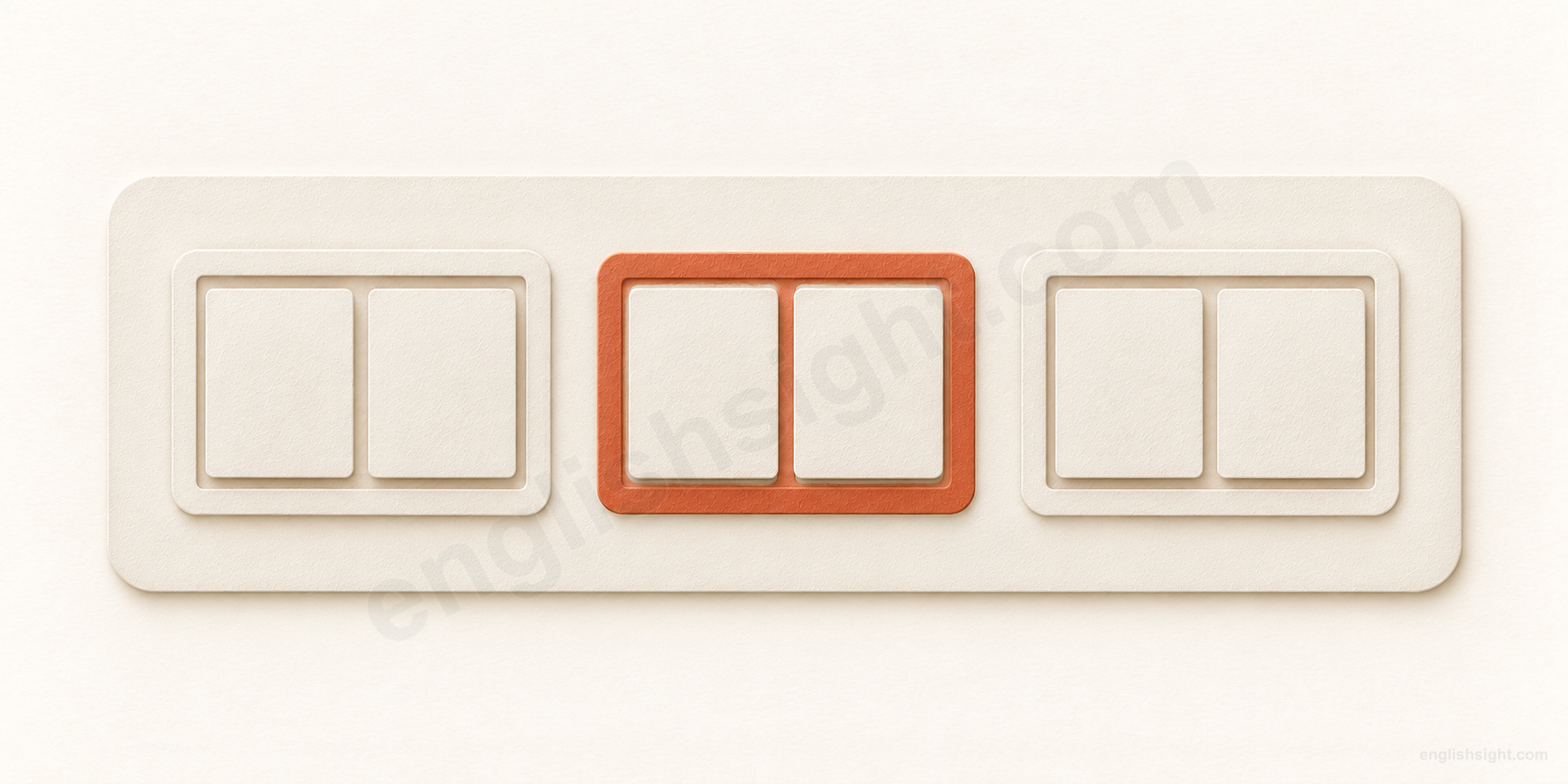
Three two-part assemblies belong to a larger arrangement.
unit
One unit contains two distinct parts.
Treat the orange-bordered assembly as one whole.
The orange-bordered whole counts as one unit, with two parts inside. The picture shows grouping, not a change over time.
Treat something as one complete thing or amount for a particular purpose; it may contain parts and may itself be part of something larger.
Unit is usually a noun, not an action. Counting, measuring, and organizing supply the context. A measurement unit additionally needs an agreed standard amount.
Unit helps us decide what we are counting, measuring, or treating together. One unit may be a product, a group of people, a machine, a home, or a section of learning.
The useful question is: one of what, for which purpose? A unit can contain many parts. The diagram offers a way to understand this relationship, not a picture that every English speaker shares.
01
Decide what counts as one
Unit lets us treat something as one whole, count products, or compare the cost of each item.
01
a single / basic unit; a unit of + larger system; treat something as a unit; divide into units
a single unit / a basic unit of…
something treated as one complete whole
Context / larger whole
A device has several connected parts.
What counts as one
You treat the complete assembly as one thing.
One unit can contain parts and can itself belong to a larger whole.
Ask what counts as one for this purpose. A battery pack may contain several cells yet be supplied as a single unit. Unit does not necessarily mean the smallest possible object.
In a basic unit of a larger system, basic describes its role as a building block. You can divide a larger system into units without saying that the units have no internal structure.
Treat something as a unit describes a way of considering it. It does not say the pieces have physically melted together. This is the relationship illustrated in the diagram.
In a sentence
The motor and its control box are supplied as a single unit.
Watch the difference Unit says how you group or count something; unique means unlike anything else. A unit need not be unique.
02
produce / sell / order + number + units
sell / produce 500 units
count individual products or saleable sets
Context / larger whole
A factory makes many lamps.
What counts as one
Its report counts the lamps sold.
A unit is one item as defined for the product being counted.
Sales and production reports use units when the type of product is already known. If the report is about lamps, 500 units means 500 lamps, not 500 kinds of lamp.
One saleable unit can also be a set or a pack. If a shop sells a pair of gloves as one unit, each glove is not counted as a separate saleable unit in that report. Establish what is being counted before comparing totals.
In a sentence
The factory sold 500 units of its new lamp last month.
Watch the difference In ordinary conversation, I bought a lamp is usually more natural than I bought a unit. Unit is useful in stock and sales contexts.
03
amount + per unit; unit price / cost
per unit / unit cost
state an amount for each one
Context / larger whole
You know the total price of several identical items.
What counts as one
You compare the price of one item.
Per means for each; unit names the item or amount used for comparison.
At $6 per unit, three units cost $18 before any other charges. Per is followed by singular unit. A unit price is the price charged for one; unit cost commonly concerns the cost of making or obtaining one.
In unit price and unit cost, unit modifies another noun. It normally stays singular even when you compare many products. Some dictionaries classify this modifying use separately as an adjective.
A comparison only works when the unit is clear. A price per bottle and a price per litre may compare different amounts; the word unit alone does not specify which amount the seller uses.
In a sentence
These filters cost $6 per unit, so two will cost $12.
Watch the difference Say per unit, not per units. Do not assume that the unit price and the cost of a whole package are the same.
02
Measure with a named standard
A measurement needs a standard amount. In arithmetic, the word units also contrasts with tens and hundreds.
04
a unit of + measurement / length / time / currency; metric units; per unit of + quantity
a unit of measurement
use an agreed amount as a measuring standard
Context / larger whole
A quantity needs to be measured.
What counts as one
You state how many standard amounts it contains.
The number tells how many; the unit tells how much each one represents.
In five metres, five is the number and metres names the unit. A metre and a centimetre measure the same kind of quantity but use different-sized standards. Metric units and imperial units name different measurement systems.
Unit of length, unit of time, and unit of weight identify what is measured. A unit of currency, such as a dollar, is a monetary standard. On an electricity bill, a unit commonly refers to a kilowatt-hour; check the named measure in that bill.
The pattern per unit of energy means for each specified amount of energy. Unit does not always mean one physical object: it can be a standard amount of something continuous.
In a sentence
Please give the length and the unit of measurement, not just the number.
Watch the difference Ten units is incomplete without context: ten metres, ten seconds, and ten dollars describe different quantities.
05
number + units of alcohol
units of alcohol
count alcohol using a specified standard amount
Context / larger whole
Two drinks may contain different amounts of alcohol.
What counts as one
A label or chart expresses the alcohol amount in units.
The units measure alcohol content, not simply the number of glasses.
In British discussions of alcohol, units are a way of expressing the amount of alcohol. A glass is a container; a unit is a measurement. Two glasses need not contain two units.
This is the standard-amount sense in a familiar public-information setting. Read the definition used by the label or source; unit is not a universal name for one serving.
In a sentence
The chart shows the units of alcohol in each serving.
Watch the difference Do not replace units with drinks or glasses: those expressions count different things.
06
the units column / place; tens and units
the units column
refer to the ones position in a number
Context / larger whole
You split a whole number into tens and ones.
What counts as one
The final digit goes in the units column.
Here units means ones, in contrast to tens or hundreds.
In 64, the 6 represents six tens and the 4 represents four units, or four ones. For a whole number written without a decimal point, the units column is the rightmost column.
With a decimal point, the units position is immediately to its left. The digit to the right represents tenths. You may also hear ones column or ones place; these describe the same position.
In a sentence
In 64, put 6 in the tens column and 4 in the units column.
Watch the difference The units digit in 64 is 4. The whole number represents 64 ones, grouped as six tens and four ones; 4 names only the digit in the units position.
03
People organized for a purpose
Several people can form one unit. In an institution, unit can name a team or a department with a particular role.
07
work / act as a unit; family / research / business / military / police unit; members of a unit
work as a unit / a family unit
regard people as one organized group
Context / larger whole
Several people have separate tasks or roles.
What counts as one
They belong to or act together as one group.
The group counts as one unit without becoming one person.
A family unit presents the family as a group within a wider community. Work as a unit emphasizes coordinated action: different people contribute to one shared task.
A research unit or business unit is an organized part of an institution or company. The modifier identifies its function. A military unit or police unit names an organized group in that service; unit alone does not fix its size or rank.
In work as a unit, as gives the role or manner of working. It is not a phrasal verb. A single unit can have many members, so single does not necessarily mean one member.
In a sentence
The rescue team worked as a unit, with each member taking a different role.
Watch the difference A crowd is not automatically an organized unit. Use the modifier and context to show what holds the group together.
08
intensive care / maternity unit; in / admitted to / transferred to a unit
an intensive care unit
name a specialized department or care area
Context / larger whole
A hospital provides several kinds of care.
What counts as one
One department has a particular care function.
Unit can name an organized service and its care area, rather than a single machine.
An intensive care unit is often shortened to ICU. A maternity unit concerns maternity care. These are established names for hospital services or areas, not literal units of measurement.
The words before unit identify the kind of care. In the intensive care unit locates someone in that department or area. A nurse in the unit and a patient in the unit have different roles in the same setting.
In a sentence
The nurse works in the hospital’s maternity unit.
Watch the difference Do not confuse a hospital unit with a dose or a piece of medical equipment; the surrounding noun phrase determines the meaning.
04
Equipment, furniture, and spaces
A working assembly or a separately usable space can count as one unit. The surrounding words tell you which kind.
09
function / equipment name + unit; install / replace a unit
an air-conditioning unit
name a machine or assembly with one function
Context / larger whole
An installation contains several working parts.
What counts as one
One complete assembly performs a particular job.
One unit may include several components and may connect to a larger system.
An air-conditioning unit is a piece of equipment used for air conditioning. A heating unit and a filter unit are named by their function too. Unit does not mean that the equipment contains only one part.
A central processing unit, or CPU, is another established compound. Learning a familiar abbreviation helps identify the equipment, but unit by itself does not tell you the technical design.
Replace the unit means replace the assembly being discussed. Replace a part means change one component, which may be a smaller repair.
In a sentence
The technician replaced the air-conditioning unit on the wall.
Watch the difference A unit can be part of a larger machine or a complete device in its own right. Do not equate unit with a tiny component in every context.
10
kitchen / wall / floor / storage unit; fit / install units
kitchen units / a wall unit
name fitted or coordinated furniture
Context / larger whole
A kitchen needs cupboards that fit together.
What counts as one
You select and fit separate cupboard sections.
Each furniture unit is usable as a piece and can fit into a coordinated arrangement.
Kitchen units commonly means the cupboard sections in a fitted kitchen, especially in British usage. Wall units are fitted on the wall; floor units stand below. The location words distinguish where the furniture goes.
A storage unit can also mean a piece of furniture for keeping things. This use describes an object inside a room; another use of storage unit names the room itself.
In a sentence
We fitted two wall units above the kitchen counter.
Watch the difference A kitchen unit is furniture; an air-conditioning unit in the kitchen is a machine. The modifier, not the location alone, identifies it.
11
housing / residential / rental unit; retail / industrial unit; a building with + number + units
a housing / rental unit
count a separately usable dwelling or premises
Context / larger whole
A building contains several separate homes.
What counts as one
Each dwelling is counted as one unit.
One building can contain several units; one unit need not be the whole building.
A housing unit or residential unit is a separately usable home in a building or development. Rental unit emphasizes that it is rented out. These terms are common in property descriptions and formal housing reports; in everyday conversation you may simply say apartment, flat, or house.
A retail unit or industrial unit is a separately usable commercial space. This is the premises sense, not a department of the company operating there. Context tells you whether unit means the space or the organization.
In Australian and New Zealand usage, unit can also be used for a home or flat. The word does not by itself specify the building’s exact design.
In a sentence
The building contains eight rental units and one shared laundry room.
Watch the difference Eight units does not necessarily mean eight buildings. Check whether the count concerns separate dwellings, premises, or whole buildings.
12
rent a storage unit; put / keep something in a storage unit
rent a storage unit
use a separate space to keep belongings
Context / larger whole
You need somewhere to keep boxes during a move.
What counts as one
You use a separately available storage space.
Storage unit can mean a room or space, as well as storage furniture.
In We rented a storage unit, the usual picture is a separate space at a storage facility. In We bought a storage unit for the bedroom, it may be furniture. The verb, place, and surrounding description help you choose the intended meaning.
Both uses organize storage into a separately usable whole. Neither tells you the exact size, construction, or rental conditions.
In a sentence
We rented a storage unit for our boxes while we moved house.
Watch the difference Do not assume that every storage unit is a cupboard or that every one is a rented room; read the setting.
05
Divide learning into manageable amounts
A unit can organize course content or measure academic work. These are related ways of dividing learning, but they are not interchangeable.
13
Unit + number; a unit on + topic; in a unit; complete a unit
Unit 4 / a unit on…
organize lessons around one topic or part of a course
Context / larger whole
A course contains a lot of material.
What counts as one
One named section groups related learning activities.
A teaching unit may contain several lessons or exercises.
Turn to Unit 4 directs a learner to a numbered section. A unit on food groups content by topic. Unit does not automatically mean one page or one lesson; the course decides its size.
Use in Unit 4 to locate content and on food to name the topic. Capital Unit is usual when it forms part of a numbered label; a general reference such as the next unit is normally lowercase.
In a sentence
The next unit has three lessons on asking for directions.
Watch the difference A lesson is a teaching session or section; a unit is a way of grouping course material. They can overlap, but are not always the same size.
14
earn + number + units; a number-unit course; a course worth + number + units
a three-unit course
measure academic work for credit
Context / larger whole
A college assigns a credit value to a course.
What counts as one
Completed work counts toward an academic requirement.
Here units count credited academic work, not the number of textbook sections.
In some educational systems, especially in the US, a unit measures work counted toward academic credit. A three-unit course has a stated credit value of three units; it need not have three lessons or three chapters.
In three-unit course, three-unit is a compound modifier, so unit stays singular and is linked to three with a hyphen. After the noun, write The course is worth three units. The institution determines how its units are calculated.
In a sentence
This course is worth three units toward my degree.
Watch the difference A unit of credit and a unit in a textbook answer different questions: how much credited work, and which part of the material.
Identify the unit before you count
A unit, not an unit
Unit begins with the consonant sound /j/, like the beginning of yes: a unit, a useful unit. The plural is units. The spelling begins with a vowel letter, but the sound determines a or an.
One does not mean one component
A single unit can contain parts, people, or lessons. It may be part of a larger system, but it need not be the smallest possible part. Specify the counting or grouping purpose.
Modifiers select the meaning
A unit of time is a standard amount; a military unit is a group; a kitchen unit is furniture. Unit price is a modifying use, not a new action. This noun has no tense, passive, causative, or phrasal-verb family to learn.
Technical uses have their own definitions
Academic credit, drug activity, and advanced mathematics can use unit in specialized ways. This lesson introduces the credit sense but does not teach drug quantities, unit vectors, algebraic units, or investment products such as unit trusts.
Find what counts as one
Use the setting and the full noun phrase to identify the kind of unit.
1. A battery pack contains six cells but is sold as one complete assembly. Can it be called a single unit?
2. Filters cost $4 per unit. You buy three filters, with no extra charges. What is the total?
3. Someone rented a storage unit at a facility while moving house. What does unit most likely name?
4. A university course is worth three units toward a degree. What do the units tell you?
5. Which digit is in the units column of 82?
Sources and teaching notes
Dictionary entries support the usage inventory below. The explanations, examples, and grouping diagram were written for this lesson; the visual relationship is a teaching model.
The diagram models grouping; it does not claim that all speakers imagine the same picture.