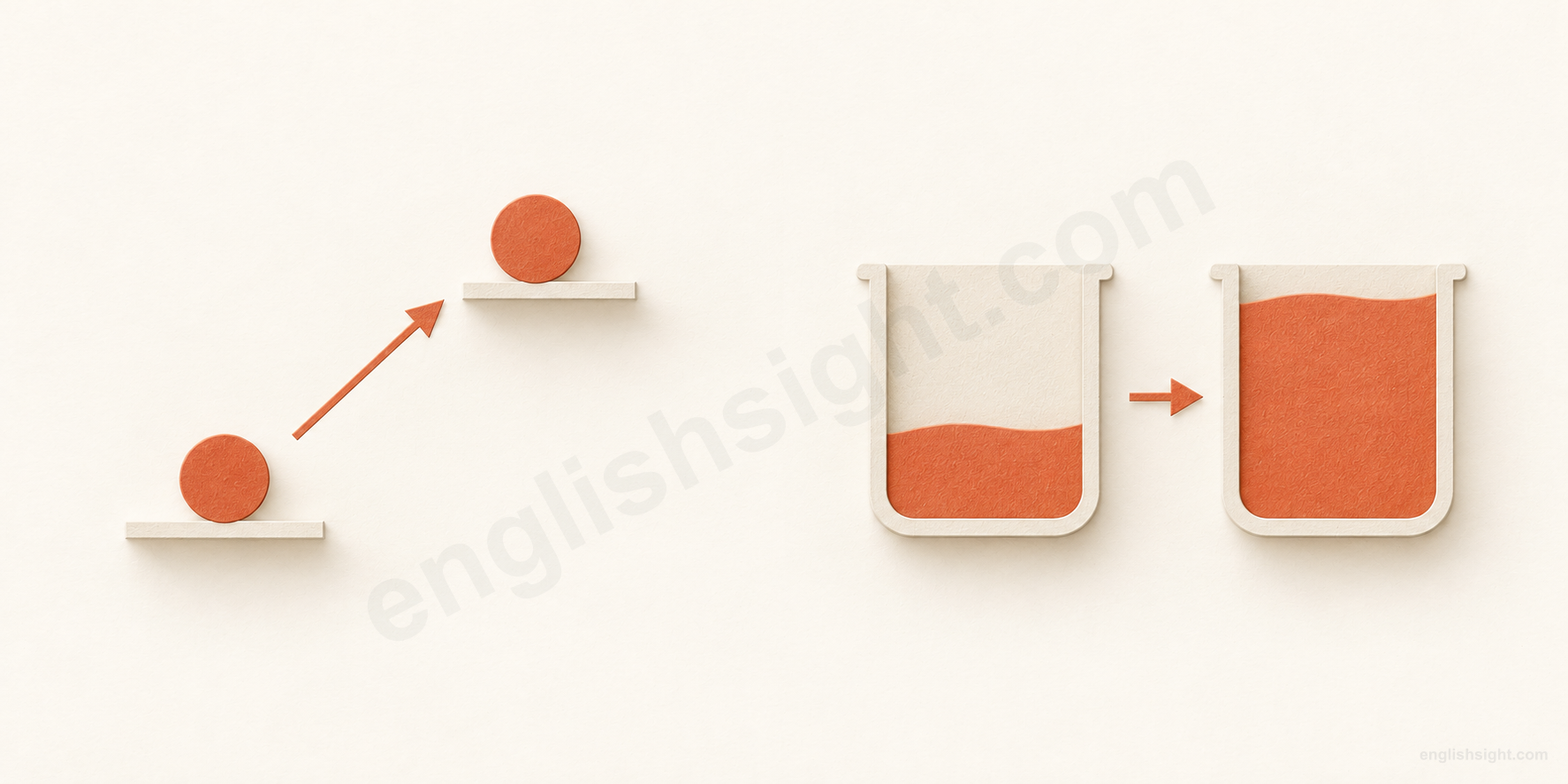
Read the direction, the scale, and the complete expression.
Direction and a reached state
Direction and a reached state
A lower position and a partly filled vessel.
up
A higher position and a full vessel.
The object rises; the amount increases toward a full state.
Up can mark a higher position or greater amount; fill up illustrates reaching a full state.
The rising arrow connects lower and higher positions or levels. Beside it, a separate horizontal arrow points toward a marked endpoint: a reminder that an action can reach a result.
These are teaching connections, not one rule that generates every combination with up. Some meanings must be learned as whole expressions.
Up can mark a higher place, a greater amount, or the extent of an action. Other uses belong to familiar constructions: up to you is about responsibility, not physical height.
This sketch is a memory aid, not a claim about a picture shared by all native speakers. A connection may help you remember a phrase, but its grammar and context determine its meaning.
01
Positions and directions
Ask where someone is, where they move, or which way they face. A route after up has a different job from an object in a particle verb.
01
go / look + up; up + place; be + up
go up / be up
toward or at a higher position
Situation before
The cat is near the ground.
Meaning or result
It moves higher on the ladder.
Up marks direction or position.
Up the ladder names a route toward a higher position; look up gives a direction without naming a route. Be up on the roof describes position rather than a journey. These uses are closest to the rising arrow in the sketch.
Face up means the front faces upward; the sun is up means it has risen. An up escalator carries people upward: here up describes the escalator before the noun. Put a notice up means display it, often by fixing it to a wall; putting a tent up means erecting it. The object and verb identify the particular action.
English example
The cat climbed up the ladder.
Watch the difference Go up does not necessarily mean reach the top; above describes relative position.
02
stand / sit + up
stand up / sit up
into an upright posture
Situation before
You are sitting.
Meaning or result
You rise to your feet.
The verb identifies the posture reached.
Stand up describes moving into a standing posture, often from sitting. Sit up describes moving from lying or slouching into an upright sitting posture. Up helps specify the resulting position; stand alone can simply describe an existing posture.
Please stand up asks the listener to change position. Please stand here identifies a place for standing. Neither expression says that the person must climb onto anything.
English example
Please stand up when your name is called.
Watch the difference Sit up does not mean stand up.
03
get / be / stay + up
get up / stay up
out of bed or remaining awake
Situation before
You wake but remain in bed.
Meaning or result
You leave bed an hour later.
Waking and getting out of bed are distinct.
Get up usually concerns leaving bed; wake up concerns stopping sleep. Be up describes being out of bed, while stay up late means delay going to bed. Up and about often describes resuming activity after illness.
The verb supplies the change or duration: get up is an event, be up is a state, and stay up describes continuing without going to bed. In The noise kept me up, someone or something prevented sleep; up itself is not the verb.
English example
I woke up at six but got up at seven.
Watch the difference You can wake up without getting up.
04
up + road / river; up and down + route
up the road / up the river
along a route or toward a river’s source
Situation before
You locate a shop on a road.
Meaning or result
You identify a place further along it.
A road need not slope upward.
Up the road can mean further along the road; local perspective determines direction. Up a river usually points toward its source. Up and down can describe vertical movement or movement back and forth along a route.
Compare She walked up and down the hall while waiting with The lift went up and down. The first describes back-and-forth travel; the second describes repeated changes in height. The route and context resolve the difference.
English example
The bakery is just up the road, beyond the bridge.
Watch the difference Up the river is not necessarily north.
05
come / go / walk + up to + person / place
come up to someone
nearer to a person or destination
Situation before
A visitor is some distance away.
Meaning or result
The visitor reaches you.
Up to marks approach to a reference point.
Come up to me means approach my position; go up to the desk means approach the desk. Up does not require climbing. To introduces the destination, not the activity or responsibility found in other up to patterns.
A car drew up outside the gate describes arriving and stopping near a place. In each case the main verb tells how the approach happens. In these approach patterns, up marks reaching a relevant location, without requiring a change in height.
English example
A visitor came up to me and asked for directions.
Watch the difference Come up to me differs from come up with an idea.
06
up north; up to + destination
up north / up to the city
toward the north or a conventionally important place
Up north refers to the north of a country or region. Up to the city may reflect local convention or a major destination, not a hill. The traditional British use up at university is a special convention, not a rule for every campus.
English example
We drove up north to visit our cousins.
Watch the difference Up does not give an exact compass direction in every travel expression.
07
vehicle / driver + pull up + place expression
pull up
bring a moving vehicle to a stop
Situation before
A taxi is moving toward the entrance.
Meaning or result
It stops beside the entrance.
The completed movement ends in a stop.
A taxi pulled up outside the hotel means it arrived there and stopped. Up can accompany stopping with certain verbs; it does not mean that the taxi rose into the air.
Compare She pulled the blind up, which describes raising the blind. The subject and object distinguish stopping a vehicle from lifting something. This stopping pattern is learned with its verb; it is not available after every motion verb.
English example
A taxi pulled up beside the hotel entrance.
Watch the difference Pull up beside the gate does not mean reverse; back up is a different expression.
02
Amounts, intensity, and change
A higher level can concern price, sound, speed, success, or mood. Other comparisons concern matching a pace or ranking among significant examples. Greater does not necessarily mean better.
08
be / go + up; up by / to / from; points + up
prices are up / go up
at or moving to a larger amount
Situation before
The price is eight dollars.
Meaning or result
It becomes ten dollars.
By gives the change; to gives the endpoint.
Prices go up describes an increase; prices are up describes the higher level. Up from names the starting value, by names the difference, and to names the final level. Sales are up on last year compares the current figure with last year’s figure.
Two points up can mean leading an opponent by two points, so the comparison need not be with an earlier time. The level may be a ranking too: moving up in a company means reaching a higher position. A rise in price is not automatically good news for the speaker.
English example
The price went up by two dollars, from eight to ten.
Watch the difference Up by two is not the same as up to two.
09
turn + object + up; speak / speed + up
turn it up / speak up
with greater intensity
Situation before
The radio is hard to hear.
Meaning or result
You ask for louder sound.
Up increases a scale selected by the verb.
Turn up the radio and turn the radio up both ask for greater volume. Speak up means speak louder; speed up means move or work faster. A higher setting is an increase, not necessarily an improvement.
Speed up can have no object, as in The train sped up, or an object, as in The new system sped the work up. Speak up has no object in the louder-voice meaning: say Speak up, please, rather than Speak your voice up.
English example
The radio is too quiet; could you turn it up?
Watch the difference With a pronoun say turn it up, not turn up it.
10
up + object; up and + verb; upped / upping
up the price / up and leave
raise an amount; in a separate pattern, act suddenly
Situation before
A seller names a price.
Meaning or result
The seller raises it.
Up can be the verb itself.
As a verb, up can mean raise an amount: up, ups, upped, upping. The seller upped the price has an object; The price was upped is a possible passive. The double p belongs to the verb’s spelling, not to the particle in go up.
Up your game is an informal request to improve performance. Up the ante means increase demands, rewards, or risks; neither expression promises a better outcome for everyone.
Informal or humorous up and leave instead describes leaving suddenly or unexpectedly: He upped and left before dessert. This is a separate construction with and, not another way to say raise. British up sticks means move away to live elsewhere; it is a fixed expression, not an invitation to lift sticks.
English example
The seller upped the price before we could reply.
Watch the difference The price was upped is possible; the particle in go up is not a verb to conjugate.
11
have + ups and downs; on the up; feel + up
ups and downs
good and bad periods
Situation before
A business has mixed experiences.
Meaning or result
You describe both success and difficulty.
The noun plural contrasts favorable and unfavorable phases.
Ups and downs refers to mixed fortunes, not literal journeys. On the up describes improvement. Feel up can mean cheerful in informal speech, but bare up is not the most neutral general word for happy. On the up and up can mean improving in Britain or honest in North America.
The shop has had an up-and-down year similarly describes changing fortunes. The regional meanings of on the up and up need context: an American speaker describing an offer may be saying it is honest, without saying that its value is increasing.
English example
Our first year in business had its ups and downs.
Watch the difference More is not always better: prices can be up while customers feel worse.
12
keep / catch up (with + person / progress); catch up on + work; keep + effort + up
keep up / catch up
maintain the same pace or close a gap
Situation before
Your friends are walking faster than you.
Meaning or result
You try to stay level with them.
Keeping pace differs from reaching someone from behind.
Keep up with the others means continue at their pace or level. Catch up with them means close an existing gap. Neither requires a higher physical position: the comparison may concern walking, learning, or changes in information.
Catch up on work means do work that you have fallen behind with. Keep up the good work and Keep it up ask someone to maintain an effort. In keep up with it, with introduces the activity or change whose pace you are matching. Keep someone up instead means prevent them from going to bed.
English example
Please walk more slowly; I can’t keep up with you.
Watch the difference Keep it up means continue it; keep up with it means match its pace or stay informed about it.
13
be up there (with + comparison group)
up there with
among the most significant examples
Situation before
You compare several exciting journeys.
Meaning or result
One ranks among your best.
A high position in an imagined ranking need not be a physical place.
Up there with the best means among or close to the best. Up there can also concern the worst or most difficult experiences; the surrounding comparison determines the evaluation.
This trip is up there with my favourites gives it a high place among memorable trips. She is up there on the balcony instead gives a literal location. With introduces the comparison in the ranking expression.
English example
That train journey is up there with the best trips I’ve taken.
Watch the difference Up there does not always praise something; it can rank among the worst too.
03
Results and established verb combinations
Up can emphasize completion, division, formation, a growing reserve, or attention. These families help memory; individual verb combinations still have their own meanings.
14
eat / use + object + up; dry up
eat up / use up
to the end or until nothing remains
Situation before
There is paint available.
Meaning or result
No paint remains.
Up can emphasize exhaustion or completion.
Use up the paint means consume all of it; eat up stresses finishing the food. Dry up can describe losing all available water. The endpoint depends on the verb and object; it is not upward travel.
Finish up your work points to completing the remaining work. In I’m using up the last of the paint, the process is still happening; a result-oriented particle does not make every sentence a claim that the result has already been reached.
English example
We used up all the paint before finishing the door.
Watch the difference Eat some food does not necessarily mean eat it up.
15
clean / fill / do + object + up
clean up / fill up / do up
into an orderly, full, or fastened state
Situation before
Your coat is open.
Meaning or result
You fasten it.
Different verbs supply different target states.
Clean up or tidy up focuses on making a place clean or orderly; fill up makes a container full. Do up a coat, especially in British English, means fasten it. The verb and object supply the target state; the objects need not move upward.
Compare She filled the bottle up with water and The room filled up with people: one has an object being filled, while the other describes a place becoming full. Do up a house can mean repair and decorate it, a different established use from fastening a coat. Learn the object with the expression.
English example
Please do your coat up before you go outside.
Watch the difference Do it up uses a middle pronoun; the closure meaning does not apply to every object of do.
16
tear / cut / divide + object + up
tear up / divide up
into pieces or allocated parts
Situation before
An old label is intact.
Meaning or result
It becomes torn pieces.
Up can accompany division rather than assembly.
Tear up and cut up describe producing pieces; divide up the work distributes parts among people. The verb determines how division happens. Up alone does not say how many pieces or who receives them.
The road is up, in British English, can mean that its surface has been removed for work. This is a resulting disrupted state, not a road pointing into the sky. Neither tear up nor cut up requires equal pieces.
English example
She tore up the old address label.
Watch the difference Do not infer that up always means bring together.
17
set / gather + object + up
set up / gather up
into an organized whole or existence
Situation before
There is no reading group.
Meaning or result
A group is established.
Up can accompany formation or collection.
Set up a group means establish it, while gather up your belongings means collect scattered things. A group can be set up by its members: the passive keeps the same establishment meaning. These are related result patterns, not upward movement.
Set up a camera can mean prepare it for use; set up a tent can mean erect it. The group example concerns organization rather than physical height. The noun tells you what kind of setup is intended; an endpoint in the diagram is only a reminder of reaching a usable or established state.
English example
We set up a small reading group.
Watch the difference Set it up, not set up it; set up does not always mean physically lift.
18
save (money) up (for + goal); stock up on/with + supplies; stock + storage place + up
save up / stock up
build a reserve for later use
Situation before
You do not yet have enough money for a bicycle.
Meaning or result
You put money aside over time toward that goal.
A growing reserve differs from using a supply up.
Save up means gradually put money aside, often for a purchase. Save already has this meaning; up is not essential. You can save up for a bicycle or save money up for one. In We are saving up, the process is continuing and the goal need not have been reached.
Stock up on rice means obtain a supply to use later, often by buying it. This can happen in one shopping trip, rather than gradually. Stock the freezer up instead has the storage place as its object. Compare We stocked up on rice before the trip with We used up the rice during the trip: one builds a reserve, and the other consumes it.
The rising level in the sketch can help you remember an accumulating reserve. This is a teaching comparison, not a promise of completion or a rule that every verb with up means save.
English example
We’re saving up for a new bicycle.
Watch the difference Stock up on rice names the supply; stock the freezer up names the place filled. Saving up does not mean the money has been spent.
19
bring + topic + up; topic + come up
bring up / come up
into conversation or attention
Situation before
Cost has not been discussed.
Meaning or result
It becomes a topic.
The grammar distinguishes introducing from arising.
Bring up a question means introduce it; a question comes up when it arises, possibly without planning. In this use bring up takes an object and come up does not: I brought the question up, but The question came up.
Something urgent has come up means an urgent matter has arisen, even if nobody introduced it in conversation. Bring up a menu on a screen means make it appear. Bring a child up instead means raise the child: She was brought up by her aunt. These meanings need their own objects and contexts; the particle alone does not supply them.
English example
The question of cost came up during lunch.
Watch the difference Bring the topic up differs from bring a child up, meaning raise the child.
20
look + information + up; things + look up
look up a word
consult information; also improve
Situation before
A word is unfamiliar.
Meaning or result
You find its meaning in a reference.
The complete combination supplies an established meaning.
Look a word up means consult a dictionary or another reference. Contrast look up at the sky, which directs your eyes upward. Things are looking up means circumstances are improving, without an object naming information.
Look someone up can also mean contact or visit them when you are in their area: Look me up when you visit York. This contact sense differs from checking a person’s name or details in a database. The object and situation matter.
English example
I looked the word up on my phone.
Watch the difference Look it up, not look up it; search and improvement are different readings.
21
give up; give up + noun / -ing; give + object + up
give up
stop trying or abandon an activity
Situation before
A person smokes.
Meaning or result
He stops the habit.
This meaning belongs to give up as a unit.
Give up alone can mean stop trying; give up smoking means stop the activity. Give up your seat means yield it to someone else. These established meanings cannot be calculated by translating up as higher or better.
Compare I gave up after an hour, where no object is needed, with I gave it up last year, where it names the abandoned activity. Giving your seat up to another passenger transfers its use; stopping an effort and yielding something are distinct readings.
English example
He gave up smoking when his daughter was born.
Watch the difference Use give up doing, not give up to do, for stopping an activity.
22
end up + -ing / adjective / in + place / as + role
end up doing / in / as
eventually reach a situation or role
Situation before
You intend to eat at a restaurant.
Meaning or result
After trying several places, you cook at home.
End up identifies the eventual outcome of a process.
End up cooking says that cooking was what finally happened, often after other possibilities. End up in a place names the eventual location; end up as the organizer names a resulting role. A following adjective can describe the eventual condition too: We ended up exhausted.
The endpoint in the sketch helps you remember an eventual result, but end up is an established combination. It does not by itself make the outcome successful or intentional. Compare I finished cooking, which says the cooking was completed.
English example
Every restaurant was full, so we ended up cooking at home.
Watch the difference Use ended up cooking, not ended up to cook, for this outcome.
04
Finished, working, happening, and scheduled
After be, up can describe a state without movement. Other familiar patterns concern a turn, an approaching event, or an earlier scheduled time. Read the whole construction.
23
time / period + be + up
time is up
finished or expired
Situation before
A timed task is in progress.
Meaning or result
The allowed period ends.
The time period is the subject.
Your time is up announces that the available time has ended. The phrase can concern an examination, a turn, or a contract period. Up marks a finished state here; it does not say time is increasing.
English example
Your ten minutes are up; please stop writing.
Watch the difference Up to ten minutes gives a maximum; ten minutes are up says they have elapsed.
24
system + be + up; be up and running
up and running
operating or available
Situation before
A website has stopped working.
Meaning or result
Service resumes.
Up contrasts with down in a technical status.
A system is up means it is operating; up and running makes the functioning state explicit and can describe a new business too. Start up refers to starting, whereas be up describes the resulting state.
The server was brought up after maintenance describes making it operational; the status report The server is up describes its current condition. A website can be up while a particular page still has an error, so check what the reported status covers.
English example
The website is up and running again.
Watch the difference A person who is up is not automatically running a computer.
25
what / something + be + up; what’s up with + person
What’s up? / something is up
a casual greeting or a question about trouble
Situation before
You meet a friend.
Meaning or result
You ask about recent events.
Tone and context select the conversational meaning.
What’s up? can be an informal greeting, especially in North America. Something is up suggests something unusual or wrong. What’s up with Leo? may ask what is bothering him. A greeting need not imply that there is a problem.
English example
“What’s up?” “Nothing much. How are you?”
Watch the difference Do not treat every What’s up? as an alarm.
26
next up; person + be + up; event + be coming up
next up / you’re up / coming up
next in an order or due to act
Situation before
Others are speaking.
Meaning or result
Your turn is approaching.
Up can point to a scheduled next item.
Next up introduces the next act, speaker, or item. You’re up means it is your turn; you’re up next says your turn follows the current one. In baseball, being up specifically means batting.
Our holiday is coming up says that it will happen soon. Coming up! can announce that food or a requested item will be ready shortly. The progressive pattern presents an approaching event or delivery, not upward physical motion.
English example
You’re up next, so have your notes ready.
Watch the difference Next up does not mean upstairs.
27
move + event + up + from old time + to earlier time
move a meeting up
reschedule something for an earlier time
Situation before
A meeting is planned for Friday.
Meaning or result
It is changed to Wednesday.
In this scheduling use, up means earlier in time.
Move the meeting up, especially in American usage, can mean arrange it for an earlier date or time. This is a conventional time expression, not the greater-amount use of up or a prediction from the rising arrow.
Say the old and new times when clarity matters: move it up from Friday to Wednesday. This states the change directly. Next up identifies the next item in an order; moving a meeting up changes its scheduled time.
English example
We moved the meeting up from Friday to Wednesday.
Watch the difference Do not assume a change described with up is later; state the actual date or time.
05
The different jobs of up to
The words after up to distinguish a limit, a standard, capacity, responsibility, and activity. Do not translate all these patterns alike.
28
up to + number / level; number + and up
up to eight / eight and up
no more than a stated limit
Situation before
You check a lift’s capacity.
Meaning or result
You learn its maximum passenger number.
Up to gives an upper boundary, not a promise.
Up to eight people permits eight or fewer, subject to other limits. Eight and up instead begins at eight and includes higher numbers: This activity is for children aged eight and up. The order around the number reverses which end is limited.
The temperature went up to eight degrees describes an actual endpoint, rather than merely a possible maximum. Water came up to my knees names a physical level. In each case identify what is being measured and whether the sentence reports a limit or a reached amount.
English example
This lift can carry up to eight people.
Watch the difference Eight and up gives a lower boundary; up to eight gives an upper one.
29
up to + point; up until + time; up to a (certain) point
up to now / up until / up to a point
as far as a limit in time, text, or extent
Situation before
You consider events so far.
Meaning or result
None includes a refund request.
Up to relates a span or degree to its limit.
Up to now means until now; up until Friday emphasizes the same temporal endpoint as until Friday. Read up to page ten sets a reading boundary. Whether a stated date or page is included may need clarification.
Up until is an established alternative listed by Oxford and Merriam-Webster; some style advice prefers the shorter until. Up to now means so far, while from now on looks forward. Up to now, nothing has changed does not promise that nothing will change later.
Up to a point can also limit the extent of something: I agree up to a point, but the final step seems risky. This means agreement is partial, not complete; it does not set a time deadline. Learn the article in up to a point.
English example
Up to now, nobody has asked for a refund.
Watch the difference Up to now often fits the present perfect; exact deadlines should state the intended inclusion.
30
be up to + standard / expectations
up to standard
meeting a required level
Situation before
You assess a first draft.
Meaning or result
It falls below the expected level.
The complement names the benchmark.
Up to standard means good enough for a particular standard. Up to scratch and up to par are similar established expressions. Not up to much, especially in British English, means not very good, rather than not doing much.
English example
The first draft is not up to our usual standard.
Watch the difference Not up to much evaluates quality in this reading; context can also suggest little activity.
31
be / feel up to + noun / -ing
feel up to doing
capable or well enough
Situation before
You feel unwell or exhausted.
Meaning or result
Cooking feels beyond your present capacity.
Up to names ability or readiness for a demand.
Feel up to cooking concerns having the strength or mental energy to manage it. Be up to the job concerns capability. To is a preposition here, so a following activity uses -ing: up to cooking, rather than up to cook.
Are you up to it? asks whether you can manage the demand. Are you up for it? more directly asks whether you are willing to join in. A person may be willing but not well enough; capacity is also different from deciding who is responsible.
English example
I don’t feel up to cooking tonight.
Watch the difference Say up to cooking, not up to cook, in this capacity pattern.
32
it + be + up to + person + (to-infinitive)
It’s up to you.
for someone to decide or do
Situation before
Music still needs choosing.
Meaning or result
You have the responsibility or choice.
The person after to owns the decision or duty.
It’s up to you can give someone a choice. It’s up to you to choose the music assigns the decision or responsibility explicitly. The infinitive tells what the person should do; it is not governed by the capacity pattern up to doing.
In It’s up to you to call, to you identifies the responsible person and to call is a separate infinitive. In I don’t feel up to calling, to belongs to up to and is followed by an activity in -ing. The same two written words can participate in different constructions.
English example
It’s up to you to choose the music.
Watch the difference Up to you does not mean physically approaching you in this sentence.
33
be up to + something; be up to no good
What are you up to?
engaged in an activity
Situation before
You have not seen someone recently.
Meaning or result
You ask what they have been doing.
Up to can ask about activity without suspicion.
What have you been up to? is an informal way to ask about recent activities. What are those children up to? may sound suspicious in context. Up to no good explicitly suggests mischief. Suspicion is not compulsory in every question.
English example
What have you been up to since we last met?
Watch the difference What are you up to? asks about activity; are you up to it? asks about capacity.
34
be up to + possessive + ears + in + work / debt / paperwork
up to your ears in
having a great deal to handle
Situation before
Several large tasks arrive together.
Meaning or result
You have more work than you can easily manage.
The whole informal expression describes heavy involvement or workload.
Be up to your ears in work says you have a large amount of work to deal with. It can also describe a large amount of debt. The phrase exaggerates a physical depth as a memory aid; papers need not actually reach your ears.
Compare up to my knees in water, which can name a literal water level. Up to my ears in paperwork describes how much there is to manage, while up to the task describes ability to manage a task. The complement determines the reading.
English example
I’m up to my ears in paperwork this week.
Watch the difference Keep in before the thing you have too much of: up to my ears in work.
06
Everyday fixed expressions
Learn the complete wording and its usual complement. Literal height is not a sufficient explanation for these meanings.
35
be up for + noun / -ing
up for sale / up for a walk
willing, available, or under consideration
Situation before
You suggest a walk.
Meaning or result
You ask if a friend is willing.
The noun after for determines the reading.
Up for a walk or up for going out expresses willingness, informally. A house up for sale is offered for sale; a person up for election is a candidate; a proposal up for discussion awaits consideration. These are not all willingness.
Compare The proposal is up for discussion with The proposal is up in the air. The first puts it before people for consideration; the second says its outcome remains undecided. Up for does not always mean that something is about to be sold.
English example
Are you up for a walk after lunch?
Watch the difference Up for it asks willingness; up to it asks whether you can manage it.
36
be up against + problem / opponent
up against
facing a difficulty or opponent
Situation before
Your team prepares for a match.
Meaning or result
You identify a strong opponent.
Against introduces the resistance faced.
Be up against an experienced team means have to compete with it. Be up against a deadline or serious problems describes a difficult constraint. The phrase is informal; literal against a wall may instead describe physical contact.
English example
We’re up against a very experienced team.
Watch the difference Keep against; up to a problem does not express facing opposition.
37
keep / bring + object + up to date; up-to-date + noun
up to date
current or including recent information
Situation before
Travel plans are changing.
Meaning or result
You ask to receive current information.
The complete phrase relates information or equipment to the present.
Keep me up to date asks for continuing updates; bring me up to date asks for information I have missed. Up-to-date equipment is modern, while up-to-date records contain recent information. The connection is catching up with the present.
Up to date with the news refers to having the latest information, not to being early for an appointment. In an up-to-date list the words work together as a description before the noun; after be, the usual spelling is The list is up to date.
English example
Please keep me up to date with the travel plans.
Watch the difference Use hyphens before a noun: an up-to-date list; the list is up to date.
38
be / get fed up with + noun / -ing
fed up with
annoyed or bored with a continuing situation
Situation before
A reply is delayed repeatedly.
Meaning or result
You express frustration.
Fed up is a fixed informal adjective.
Be fed up with waiting means be tired of the continuing delay. Get fed up describes becoming frustrated. With can introduce a person, thing, or -ing activity. This phrase is not a claim that you have eaten enough.
English example
I’m fed up with waiting for a reply.
Watch the difference For neutral standard usage choose fed up with, not fed up to wait.
39
plan / decision + be + up in the air
up in the air
not yet decided
Situation before
A holiday is being planned.
Meaning or result
Its dates remain uncertain.
The whole idiom concerns an unsettled decision.
Dates that are up in the air have not been fixed. You can picture something not yet settled on the ground as a memory aid, but this is a teaching comparison, not a literal analysis of a plan.
English example
Our holiday dates are still up in the air.
Watch the difference Keep the article: up in the air, not up in air.
40
be up in arms about / over + issue
up in arms
angry and protesting
Situation before
A park closure is announced.
Meaning or result
Residents object strongly.
The idiom describes opposition, not arm position.
Be up in arms about a decision expresses strong anger and readiness to protest. Over can also introduce the cause. The meaning is conventional; people need not be carrying weapons or physically raising their arms.
English example
Residents are up in arms about the park closure.
Watch the difference Arms is plural in this idiom; up in an arm is not equivalent.
41
be (well) up on + subject; be / bring someone + up to speed on + topic
be up on / up to speed on
be well informed about something
Situation before
New rules have been announced.
Meaning or result
You ask a well-informed colleague for help.
On introduces the topic of knowledge in this informal expression.
Be up on the latest rules means know about them. The subject is an informed person, and on introduces the topic. You can connect this with keeping pace with information, but learn up on as a familiar expression rather than deriving it from physical height.
Compare She is up on the roof, where on the roof identifies a physical position. In She is up on the latest rules, the rules are a topic, not a place. Keep someone up to date describes supplying current information to them.
Be up to speed on a topic similarly means have the current knowledge you need: Could you bring me up to speed on the project? Up to speed can also mean performing at an expected rate or level, so it is not always about information. The topic after on makes the knowledge reading clear.
English example
Ask Nia; she’s up on the latest booking rules.
Watch the difference Up on the rules describes knowledge; up to the rules is not the normal way to express being informed.
Read the grammar before extending the picture
Not every up is the same grammatical item
Up is pronounced /ʌp/. In up the stairs it is a preposition with a route; in turn it up it is a particle. An up escalator uses an adjective; up the offer uses a verb; ups and downs contains nouns. Dictionaries sometimes classify be up differently: Oxford treats out-of-bed up as an adverb, while Collins labels that use an adjective. Follow the construction and meaning rather than forcing one label.
Object position and passive forms
Many transitive particle verbs allow a short noun on either side of up, but an unstressed object pronoun usually goes in the middle: use it up, look it up. This is not a rule for prepositions: go up it can refer to a hill. Passive forms depend on the complete verb and its sense: the group was set up is natural, while things are looking up has no object to passivize. With in keep up with introduces its own complement. Do not move every noun after every up.
Scope of this course
This lesson covers the main modern jobs of up and representative particle families. It is not a dictionary of every verb plus up. Specialized railway, nautical, legal, physics, drug-slang, offensive, and historical uses are not taught here. The picture does not predict give up, look up, or all the meanings of make up, take up, pick up, and other combinations; consult the complete verb expression.
Choose the intended meaning
Use the situation and the full construction, not only the arrow.
1. You want louder music. Which wording has the usual pronoun position?
2. An event admits up to twenty people. Which interpretation fits?
3. You are too tired to cook. Which sentence describes your present capacity?
4. A relaxed friend says “What’s up?” as you arrive. What can it mean?
5. You stop sleeping at six and stay in bed until seven. Which sentence fits?
6. Your friends are already ahead of you. You walk faster until you reach them. Which expression names closing the gap?
7. A meeting moves up from Friday to Wednesday. When will it take place?
8. You intended to eat out but eventually cooked at home. Which sentence states that result?
Sources and teaching notes
Usage was checked against the publishers below. Explanations, examples, and the diagram are original; the connections in the picture are teaching interpretations.
The diagram supports memory; it does not represent an identical image in every speaker’s mind.