Use verse for poetic writing, a section of a poem or song, or a numbered unit of scripture.
Lines and recognizable units
Lines and recognizable units
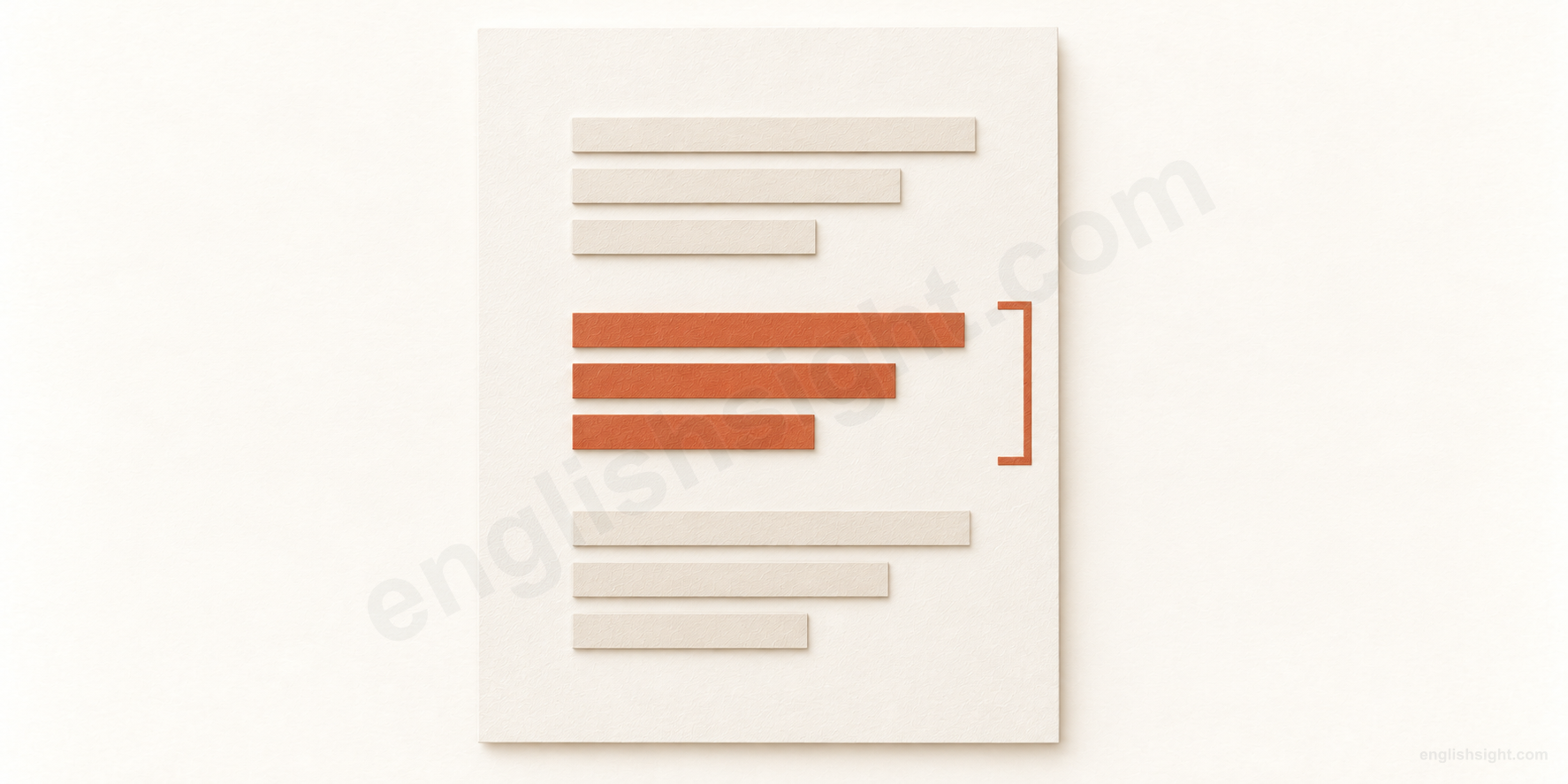
The page represents a poem arranged in lines.
verse
The orange group and bracket identify one verse within the poem.
Blank gaps separate three groups of lines.
The whole page suggests verse as poetic writing; the highlighted group is one verse, or stanza.
Verse names poetic writing or speech, often arranged in lines with a rhythmic pattern; a verse can also be one distinct unit within a poem or song. In scripture, a verse is a conventionally numbered unit.
The sketch illustrates a stanza within a poem. It does not show sound, require rhyme, or imply that all poetry has stanzas. Scripture divisions are a separate use of the unit idea.
When you say She writes verse, you describe a kind of writing. When you say Sing the next verse, you pick out one section. Countability and context help you choose the meaning.
A useful connection is the organization of words into lines and recognizable units. It is a teaching model, not a claim about a picture shared by all English speakers. Religious reference units and fixed expressions need their own explanation.
01
Verse as a kind of writing
Start with the uncountable noun: verse describes poetic writing or its form. It does not count sections.
01
write / read / recite + verse; be written / tell a story + in verse
write / read / recite verse; in verse
poetic writing, considered as a form
Context
Someone writes or performs a poem.
What verse identifies
You describe the writing as verse.
Uncountable verse names the form; in verse says how something is written or spoken.
Verse can name poetic writing or speech collectively. Write verse describes producing it; read verse and recite verse describe reading it or saying it aloud. A volume of verse is a book of such writing.
In verse describes the form of a work or speech: a story can be told in verse. Verse drama is drama with dialogue in poetic form. Compare in prose, the ordinary sentence-and-paragraph form. Verse often has patterned sound, but rhyme is not compulsory.
For an individual complete work, a poem is usually the clearest choice. Some literary uses of a verse mean a poem or a single metrical line; context matters. Do not assume a verse always means the whole poem.
In a sentence
The children told the story in verse, then read it aloud.
Watch the difference For the form generally, say She writes verse, without a or a plural ending.
02
Named forms and tones
Free, blank, and light describe different features. Learn these combinations as literary terms rather than guessing from the adjectives alone.
02
write + free verse; be written + in free verse
free verse
poetry without a fixed metrical or rhyme scheme
Context
A poet chooses line breaks without a recurring metrical scheme.
What verse identifies
You identify the form as free verse.
Free concerns freedom from a regular formal scheme, not price or lack of care.
Free verse does not follow a regular metre or rhyme scheme. Metre is an organized pattern of beats in poetic lines. The poet can still use rhythm, repeated sounds, and carefully chosen line breaks.
In The poem is written in free verse, the whole phrase names the form. Free does not mean the poem costs nothing, and free verse is not simply prose broken into arbitrary pieces.
In a sentence
Her poem about the crowded station is written in free verse.
Watch the difference A lack of rhyme alone does not distinguish free verse from blank verse.
03
write + blank verse; be written + in blank verse
blank verse
unrhymed poetry with a regular metre
Context
Lines have an organized beat but their endings do not rhyme.
What verse identifies
You describe the form as blank verse.
Blank removes end rhyme, not the words or the metrical structure.
Blank verse retains a regular metre while leaving out rhyme. In English the usual pattern is iambic pentameter: five rhythmic feet, typically moving from a less stressed syllable to a stressed one, often making ten syllables.
This is a term for studying poetry and verse drama. Compare free verse, which does not keep a fixed metrical pattern. Blank verse is not an empty page, and it need not sound flat or emotionless.
In a sentence
The class compared a speech in blank verse with a passage in prose.
Watch the difference Do not use blank verse as a name for every poem without rhyme; the regular metre matters.
04
write / read + light verse; a collection of + light verse
light verse
poetry with a playful or humorous tone
Context
A poem aims to amuse its readers.
What verse identifies
You describe its tone as light verse.
Light describes tone rather than the presence or absence of metre.
Light verse treats its subject playfully or humorously. It is a label for tone, unlike free verse and blank verse, which describe formal organization.
A short funny poem about losing a sock could be light verse. The label does not say that the paper is light, that the poem is very short, or that writing it required little skill.
In a sentence
He wrote some light verse about the office printer that never worked.
Watch the difference For the genre, use some light verse. To count complete works clearly, say three light poems.
03
A verse within a larger work
The countable noun identifies a section. The kind of work tells you what sort of section is meant.
05
a / the first / the last + verse + of a poem; a poem with + number + verses
a verse of a poem
one group of lines within a poem
Context
A poem has several groups of lines.
What verse identifies
You refer to one group, such as the final verse.
Countable verse can identify a section, while poem names the complete work.
In everyday discussion, a verse of a poem can mean a group of lines forming a unit. Stanza is the more precise literary term for this grouping. The diagram highlights such a group inside the page.
Use a verse, the first verse, or three verses when counting sections. A line is one row of words; a stanza can contain several lines. Some technical writing also uses verse for a single metrical line, so check the author’s terminology.
In a sentence
The final verse of the poem returns to the image of the sea.
Watch the difference A four-line verse can be one stanza of a longer poem; it need not be four separate poems.
06
sing / learn / forget + a verse; the first / second + verse + of a song
the first verse of a song
one section of song lyrics
Context
A song moves through several sections.
What verse identifies
The singer performs a particular verse.
A verse is a song section; the chorus is a different structural label.
A verse is a section of a song, including a hymn. In many songs, successive verses have different words over similar music, while a chorus brings back the same central words and music. A singer can also perform a guest verse on a recording.
Sing the second verse tells the singer which section to sing. It does not mean sing the second line or sing the whole song a second time. Not every song follows a verse–chorus pattern.
In a sentence
I remember the chorus, but I always forget the second verse.
Watch the difference Verse and chorus are not interchangeable names for every part of a song.
07
a verse + from / in + a sacred text; chapter + number, verse + number
a Bible verse; chapter 4, verse 6
a short numbered division of a sacred text
Context
A reader wants to locate a specific passage.
What verse identifies
A chapter and verse number identify a small unit.
Here the unit is a reference division, not necessarily poetry.
In a Bible reference, a chapter is a larger division and a verse is a small numbered division within it. Other sacred texts, including the Quran, are also described in English as containing verses.
You can quote a verse from the Bible or ask someone to read verses six to eight. A reference such as chapter four, verse six identifies a location. This sense does not require rhyme, metre, or a stanza layout.
In a sentence
Please read chapter four, verses six to eight.
Watch the difference A numbered verse may contain more than one printed line; page layout does not define the reference.
04
An expression about precise details
The reference system of religious texts also supplies an established expression used outside religion.
08
give + someone + chapter and verse + on / about + a subject; quote + chapter and verse
give / quote chapter and verse
provide exact details or a precise supporting reference
Context
Someone asks where a claim comes from.
What verse identifies
You provide a detailed account or exact reference.
The full idiom extends precise textual references to detailed information generally.
Give someone chapter and verse can mean supplying all the details about something. Quote chapter and verse can emphasize precise supporting information or the exact source for a claim. The context need not be religious.
Learn chapter and verse as a fixed combination. On or about can introduce the subject: chapter and verse on the new policy. This is more emphatic than simply saying tell me, and it can sound demanding.
In a sentence
If you say the rules have changed, give me chapter and verse.
Watch the difference The idiom normally has no articles: give me chapter and verse, not give me a chapter and a verse.
Read the noun in its setting
Form or countable unit?
Verse as a form of writing is uncountable; a verse or several verses counts units. Poetry is also uncountable, while poem counts complete works. Older books may use verses to mean poems collectively.
Related words are not interchangeable
Rhyme is a sound relationship, not a requirement for all verse. Stanza is the precise term for a group of poetic lines. Prose names a different form of writing, not necessarily a less imaginative one.
Pronunciation and scope
Verse has one syllable: /vɜːs/ in British English and /vɜːrs/ in American English. Verses has two syllables. This lesson focuses on the noun and its established combinations. The rare verb meaning compose poetry and the informal or regional verb meaning compete against are outside the active learning set.
Choose the intended meaning
Use the setting and the whole expression.
1. You want to say that someone produces poetry generally. Which sentence fits?
2. You know the repeated central part of a song but forget a later section with different words. What fits?
3. A poem has a regular metre but no end rhyme. Which term fits that description?
4. A colleague asks for chapter and verse about a policy change. What do they want?
Sources and teaching notes
Dictionary entries below support the meanings and usage distinctions. Explanations and examples are original; the diagram is a teaching interpretation of the part-and-whole relationship.
The diagram illustrates one useful relationship; it does not represent a picture shared by every English speaker.