Learn what very strengthens, what it singles out, and when a whole phrase supplies the meaning.
High degree, with a separate precision branch
Mark a high degree
A description can have different degrees.
very
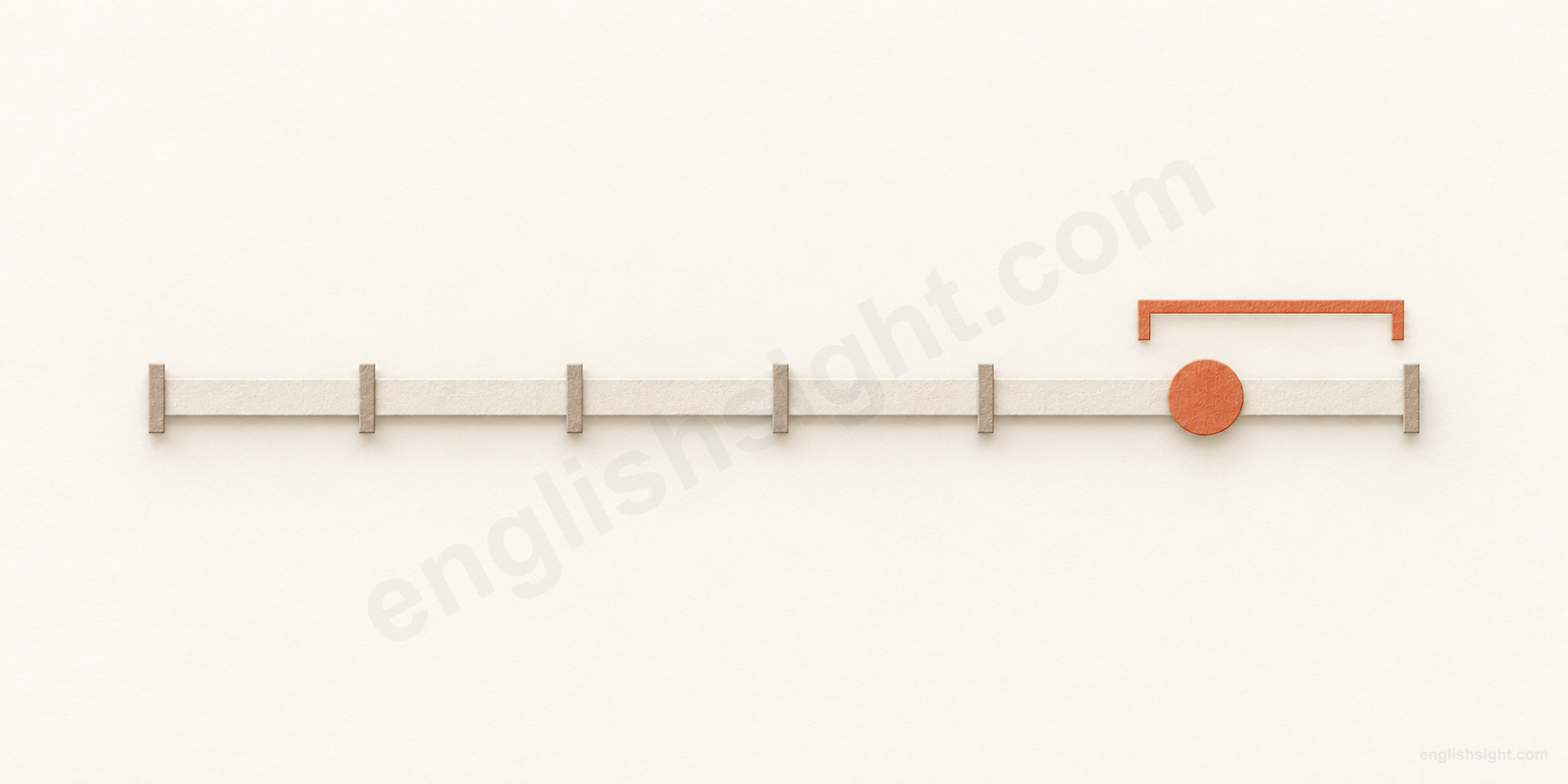
The orange marker is near the high end, before the endpoint.
Very marks a high degree on the relevant scale.
Very marks a high degree, not necessarily the maximum. The scale shows degree, not change over time.
With a gradable description, very marks a high degree of that description; before certain nouns, it instead emphasizes an exact referent or the thing itself.
The scale illustrates the ordinary degree use. It is a teaching model, not an event in which an object changes and not an explanation of every fixed expression.
Very often places a quality high on its own scale: very cold, very quickly, very little. It intensifies what follows without choosing whether that quality is good, bad, large, or small.
A second branch emphasizes precision or something itself: this very place, the very beginning, the very thought. Fixed expressions such as can’t very well need their own explanation; a single scale cannot predict them all.
01
High degree and its grammar
Strengthen a quality, manner, quantity, or personal emphasis. The following word determines what is being intensified.
01
very + adjective; a/an + very + adjective + noun
very cold / very important
describe a high degree of a quality
Situation or starting point
You describe the room as cold.
What the speaker conveys
You stress how cold it is.
Very strengthens a description; it does not make the room change.
Put very immediately before a gradable adjective: a very cold room; the room is very cold. The adjective tells us which quality to judge; very places that quality high on the relevant scale.
Cold, small, and unhappy work as well as warm, large, and happy. A high degree of smallness still means small, not large. Very gives no exact measurement.
Compare a very hot drink with a drink too hot to hold: too marks excess for a purpose, while very alone does not. So hot that I dropped it explicitly introduces a result; very hot alone does not supply that result pattern.
In a sentence
This room is very cold, so I’ll close the window.
Watch the difference Say a very useful tool, not a very tool. For direct verb emphasis, use really or very much.
02
verb + very + adverb
very slowly / very well
strengthen how an action is performed
Situation or starting point
Someone asks you to handle a fragile lid.
What the speaker conveys
You specify an especially careful manner.
Very modifies the adverb, and the adverb describes the action.
In Turn it very slowly, slowly describes turning and very strengthens slowly. In She explained it very well, well evaluates the explanation. Very does not directly modify turn or explain.
Very fast and very hard also work: fast and hard can be adverbs without -ly. She works very hard means she makes a great effort; hardly has a different meaning, almost not.
In a sentence
Turn the lid very slowly.
Watch the difference Choose the correct adjective or adverb: very careful describes a person or action; very carefully describes how someone acts.
03
very few + plural noun; very little/much + uncountable noun; very many + plural noun
very few / very little / very many
intensify a quantity expression
Situation or starting point
You count the people who stayed.
What the speaker conveys
You emphasize how small the number was.
The quantity word determines whether the amount is large or small.
Very few chairs and very little space emphasize scarcity. Use few with plural count nouns and little with uncountable nouns. Very few does not have to mean none.
Very many adds emphasis to a large number, especially in questions and negatives: Were there very many people? Not very much money means the amount is not large. In casual positive statements, a lot of is often an easier choice than very many or very much.
In a sentence
Very few people stayed until the end.
Watch the difference Very few emphasizes scarcity; a few presents a small number as present. Very few people stayed need not mean that nobody stayed.
04
verb + object + very much; very much + verb
like it very much / thank you very much
emphasize liking, gratitude, or another compatible verb
Situation or starting point
You want to express strong appreciation.
What the speaker conveys
You add very much to the whole expression.
Much enables the degree phrase to accompany a verb.
I like it very much is natural; I very like it is not standard English. Very much can come after the object or before the main verb: I very much appreciate your help.
Thank you very much strengthens thanks. In I don’t like it very much, the negative weakens the degree of liking; it can also be a tactful way to express dislike. Very much is not a replacement for every adverb of manner: run very fast describes speed.
Very much also strengthens a comparison with like: This fabric feels very much like silk means the resemblance is strong. Here very strengthens much, which supplies the degree of resemblance; this is not a rule allowing very directly before any verb or preposition.
In a sentence
I enjoyed your talk very much.
Watch the difference Keep a short object with its verb: I like this song very much, not I like very much this song.
05
not + very + adjective/adverb; “Not very.”
not very… / Not very.
deny a high degree, sometimes politely
Situation or starting point
Someone asks whether the instructions are clear.
What the speaker conveys
You give a restrained negative judgment.
Not very can soften criticism without giving an exact degree.
Not very clear normally means only a little clear or not clear enough to be useful. Depending on tone, not very impressed can convey strong disappointment. Do not mechanically treat it as the exact opposite of very.
In a reply, the understood adjective or adverb may be omitted: “Is the bag heavy?” “Not very.” An affirmative “Very” can likewise answer “Are you tired?” when tired is understood.
In a sentence
The instructions aren’t very clear.
Watch the difference Not very good is a negative assessment, often softened. It does not mean extremely good.
06
very + participial adjective; very much + passive participle
very tired / very much appreciated
distinguish a descriptive adjective from a passive event
Situation or starting point
You describe a feeling or respond to help.
What the speaker conveys
You choose the intensifier that fits the expression.
An -ed ending alone does not decide the grammar.
Very tired, very worried, and very pleased describe states with adjectives. Very interesting uses an -ing adjective. These behave like very happy.
When the participle is clearly passive, use a suitable form such as very much: Your help is very much appreciated. In The lid was very tightly sealed, very modifies tightly, which describes sealing. Learn these combinations rather than attaching very to every -ed form.
In a sentence
I was very pleased to hear that my help was very much appreciated.
Watch the difference Use very much admired or greatly admired for the passive meaning, rather than very admired.
07
the/my + very + superlative; at the very least/latest
the very best / at the very least
emphasize an extreme or a limit
Situation or starting point
You need the strongest available option.
What the speaker conveys
You stress the top of the relevant range.
Very emphasizes the superlative; it does not compare two degrees by itself.
The very best emphasizes best; my very best work stresses the highest standard I can achieve. At the very latest emphasizes a final deadline, while at the very least stresses a minimum requirement: At the very least, send a message.
Comparatives need a different modifier: much better or very much better, not very better. A very good answer has a high quality; a much better answer improves substantially on another answer.
In a sentence
Please send the form by Friday at the very latest.
Watch the difference The very best already marks an extreme. Do not say the very most best.
08
possessive + very own + noun
my very own…
emphasize personal ownership
Situation or starting point
A child has always shared a room.
What the speaker conveys
The child now has a room just for them.
Own expresses personal possession; very adds emphasis.
My very own room highlights that the room is mine to use rather than shared. Very strengthens own, not the noun room as an ordinary degree adjective.
The possessive changes with the owner: her very own desk, our very own garden. The phrase often conveys delight or pride, but that emotional interpretation comes from context.
In a sentence
At last I have my very own room.
Watch the difference Keep own in this meaning: my very room does not mean my own room.
02
Exactly this thing, point, or idea
Before certain nouns, very stresses the actual referent, an exact point, or something itself. These uses need more than a degree scale.
09
the very same + noun
the very same…
emphasize exact identity or sameness
Situation or starting point
Two people mention their journey.
What the speaker conveys
They discover their train was the same one.
This is exact sameness, not a high degree of similarity.
We took the very same train stresses that it was one and the same train. With descriptions or opinions, the phrase can emphasize complete agreement: I had the very same idea.
This use does not mean extremely same. Learn the whole pattern with same. Compare a very similar train, which may be a different train with similar features.
In a sentence
We were on the very same train without knowing it.
Watch the difference Same normally takes the or another appropriate determiner: the very same seat, not a very same seat.
10
the/this/that/possessive + very + noun
the very thing / this very place
identify precisely the relevant person, thing, or reason
Situation or starting point
You search for the tool a repair needs.
What the speaker conveys
You recognize exactly the right one.
Very singles out the actual or precisely suitable referent.
The very thing I need means exactly the thing required. This very place means precisely this place; for that very reason points back to the exact reason just given.
Before a noun, dictionaries label this very as an adjective. It is an emphatic modifier used with certain noun phrases, not a general substitute for very + adjective. Those were her very words stresses her actual wording, not merely a similar message.
In a sentence
This is the very tool I need to open the case.
Watch the difference An ordinary person cannot be described as He is very to mean he is the right person. Keep the noun phrase.
11
preposition + the very + beginning/end/top/edge/heart
the very beginning / the very edge
emphasize an exact boundary or central point
Situation or starting point
You explain where an error began.
What the speaker conveys
You place it right at the start.
The noun supplies the point; very makes the location or time emphatic.
From the very beginning excludes a later starting point. At the very end stresses the final part; on the very edge stresses a boundary. In the very heart of the city stresses the center, not a quantity of city.
The high-degree scale is only a partial memory aid here. Very is pinpointing an extreme or significant position named by the noun rather than moving an object along a path.
From the very first likewise means from the beginning: I trusted her from the very first. First names the starting point; very emphasizes it.
In a sentence
The plan had a serious flaw from the very beginning.
Watch the difference Very does not choose the preposition: from the beginning, at the top, and on the edge retain their usual relationships.
12
the very thought/idea of + noun/-ing; by + possessive + very nature
the very thought / by its very nature
emphasize something itself or its essential character
Situation or starting point
You imagine walking across a high bridge.
What the speaker conveys
Even the idea makes you uneasy.
The thought itself is sufficient; no actual crossing has happened.
The very thought of crossing it makes me nervous means that merely considering it is enough. Similarly, the very idea can stress surprise, fear, or objection.
By its very nature introduces an explanation based on an essential property: A secret is, by its very nature, not public information. The very existence of something can emphasize that its existence itself is important or at risk. These are noun-emphasis patterns, not degrees of thinking or existing.
In a sentence
The very thought of crossing that bridge makes me nervous.
Watch the difference The emotional response comes from the sentence and context. Very thought by itself does not mean a large amount of thought.
13
at this/that very moment; the very moment (that) + clause
this very moment / the very moment…
stress an exact time or immediate timing
Situation or starting point
You wonder where someone is now.
What the speaker conveys
A message says they are at the station right now.
A precise time and an as-soon-as clause use different sentence structures.
At this very moment means exactly now. At that very moment points to an exact past or otherwise identified time.
The very moment the doors open, we’ll go in means as soon as they open. Here the moment introduces a time clause; very strengthens the immediacy. The clause supplies the event that fixes the timing.
In a sentence
The very moment the doors open, we’ll go in.
Watch the difference For future time in this pattern, use the present in the time clause: the moment they open, not the moment they will open.
14
before/in front of + possessive + very eyes
before my very eyes
emphasize witnessing something directly
Situation or starting point
You are watching a bird on a wall.
What the speaker conveys
It takes food while you are watching.
Eyes names direct witnessing; very strengthens the immediacy.
Before my very eyes and in front of my very eyes mean in my presence, where I can see it happen. Surprise or distress often comes from the event being described.
Before here means in front of, not earlier than the eyes. The idiom is learned as a whole; it is not the degree reading in very bright eyes.
In a sentence
The bird stole my sandwich before my very eyes.
Watch the difference The phrase claims direct witnessing, not a report heard from someone else.
03
Whole expressions in conversation
Read the complete pattern for strong agreement, formal acceptance, plausible possibilities, practical restrictions, and objections.
15
question/claim + “Very much so.”
Very much so.
give an emphatic yes
Situation or starting point
A colleague asks whether the new schedule helps.
What the speaker conveys
You strongly confirm that it does.
So refers back to the property or claim in the question.
Very much so is a complete response meaning a strong yes. You do not need to repeat the whole description from the question.
Compare “Did you enjoy it?” “Very much.” In Very much so, so carries the reference back. It is more than an isolated very and can confirm a whole assessment.
In a sentence
“Is the new schedule helpful?” “Very much so.”
Watch the difference Use it to confirm an applicable assessment, not to answer a request for a name, number, or location.
16
“Very well, …”; “Very good, …”
Very well. / Very good.
accept a decision or acknowledge an instruction
Situation or starting point
Someone requests a different meeting time.
What the speaker conveys
You agree to the change.
The response accepts something rather than grading an action.
Very well can signal acceptance, including reluctant acceptance: Very well, we’ll meet tomorrow. Tone and context determine whether the speaker sounds satisfied. It can sound formal or firm.
Very good, sir/ma’am is a formal acknowledgment of an instruction, distinct from praise such as Your answer is very good. Ordinary Okay often fits casual agreement. Neither formula should be confused with She plays very well, where well describes performance.
In a sentence
“Could we meet tomorrow instead?” “Very well, I’ll change the booking.”
Watch the difference In I don’t feel very well, well means healthy. That is an ordinary adjective use, not this acceptance formula.
17
may/might/could + very well + base verb
may / might very well…
present a possibility as quite plausible
Situation or starting point
The road is icy.
What the speaker conveys
You take a possible delay seriously.
With a modal, well concerns likelihood rather than skill.
May very well and might very well suggest that something is quite possible or plausible. In The bus may very well be late, the claim concerns the chance of lateness, not how well the bus performs.
Very strengthens well within this modal pattern. Compare She may sing very well, which normally concerns the quality of singing. Word order and context help distinguish the readings; the possibility expression does not guarantee the event.
Very likely can also mean very probably: The bus will very likely be late. Here likely is an adverb about probability, not an adjective describing the bus. Compare It is very likely to be late, where likely is an adjective.
In a sentence
With roads this icy, the bus may very well be late.
Watch the difference Do not read may very well be late as meaning it is good for the bus to be late.
18
cannot/could not + very well + base verb
cannot very well…
say an action would be unreasonable or impractical
Situation or starting point
You have promised to help with a move.
What the speaker conveys
You feel you cannot reasonably abandon your friend.
The restriction comes from circumstances or appropriateness.
I can’t very well leave now means leaving would be difficult to justify or manage in the circumstances. It need not mean that I am physically incapable of leaving.
Compare I can’t hear very well, which describes poor hearing ability. In can’t very well leave, the established expression evaluates the proposed action as a reasonable option.
In a sentence
I promised to help, so I can’t very well leave now.
Watch the difference This is not simply the negative of doing a job very well. Read the action and the reason in context.
19
that/it + is all very well, but + clause; it is all very well for someone to + verb
all very well, but…
acknowledge an idea while objecting to its practicality
Situation or starting point
A plan looks attractive on paper.
What the speaker conveys
You point out an unresolved cost.
The whole expression introduces a reservation, not uncomplicated praise.
That’s all very well, but… concedes that a point may sound acceptable before explaining why it is insufficient or unreasonable. The objection is the communicative purpose of the whole pattern.
It’s all very well for you to say… can criticize advice from someone who does not face the same difficulty. In ordinary friendly discussion it may sound pointed, so choose it with attention to tone.
In a sentence
That’s all very well, but who will pay for the repairs?
Watch the difference Do not interpret all as meaning every action is performed well. This is an established objection pattern.
Intensity, precision, and limits
A strong description is not automatically excessive
Very difficult says the difficulty is high. Too difficult for me says it exceeds a relevant limit. A result clause normally uses so…that, not very…that.
Gradability depends on the intended meaning
Use very with ordinary gradable descriptions. Absolutely impossible and completely exhausted are safer choices for absolute or already extreme meanings. Context can make some normally ungraded qualities gradable: very French can mean strongly characteristic of France. This flexibility does not license every combination.
Repetition and emphasis
Very, very slowly repeats the intensifier for extra emphasis. Very much indeed can add further emphasis. These are emphasis choices, not new dictionary senses, and overuse may make writing less precise.
Forms and scope
Modern very functions as an adverb and, before certain nouns, an emphatic adjective. It has no ordinary inflected comparative or superlative. Verb-specific passive, causative, tense, and particle-verb inventories do not apply to very itself; the lesson covers how it modifies participles and appears inside modal expressions.
Choose the expression that fits
Use the intended degree, reference, or conversational purpose.
1. You want to say that you greatly enjoyed a concert. Which is standard English?
2. You are comparing a revised plan with the old one. Which form is natural?
3. You mean it was the identical train, rather than just a similar one. Which fits?
4. A friend needs your promised help. You say you can’t very well leave now. What do you mean?
5. “That’s all very well, but we can’t afford it.” What is the speaker doing?
Sources and teaching notes
Dictionary headwords, usage notes, and linked expressions were checked at the sources below. The explanations, examples, and scale are original teaching material; the visual model is an interpretation.
The scale is a teaching aid, not a picture shared by every native speaker.