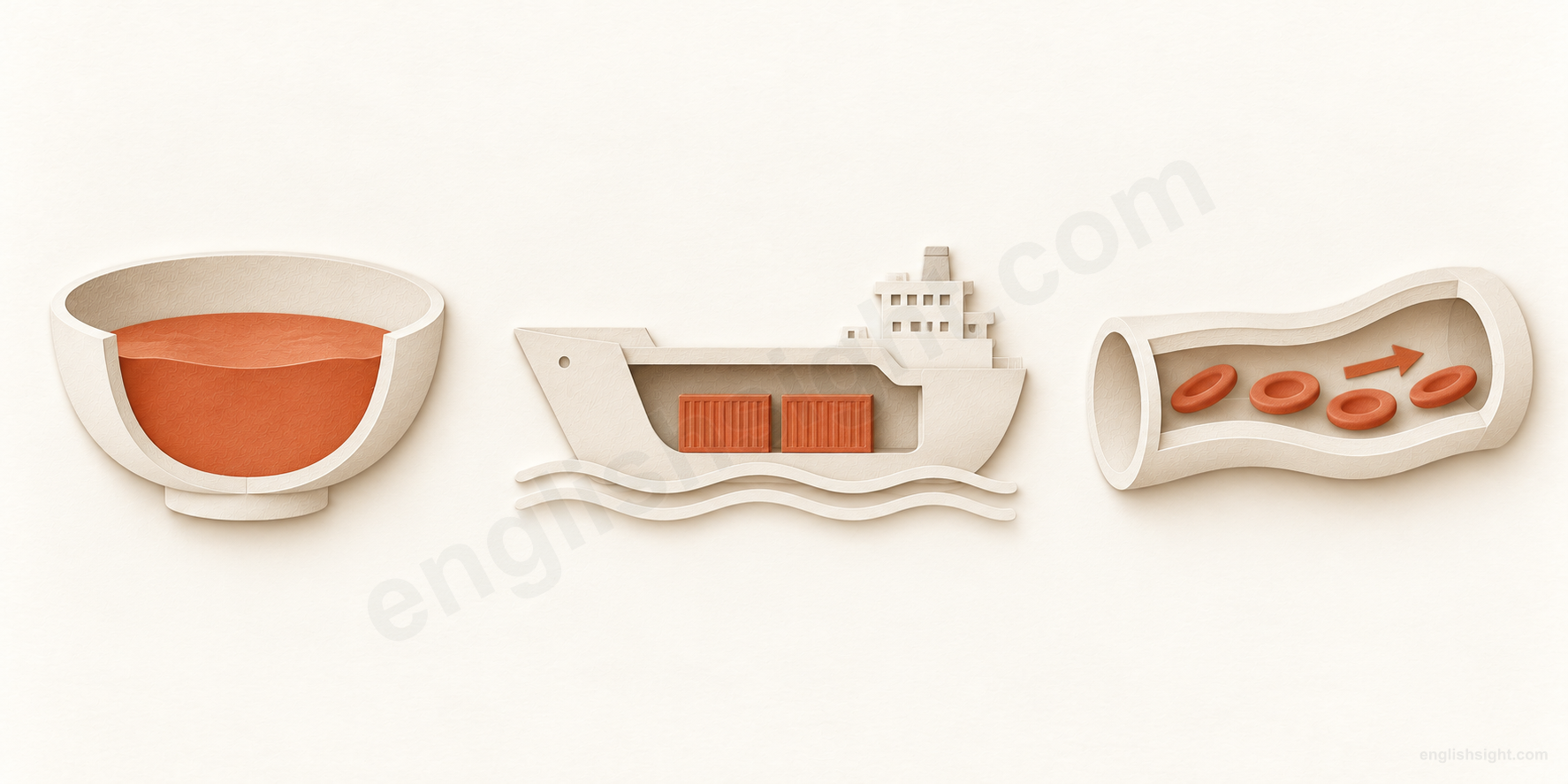
Recognize the boat, the container, and the tube—and choose the right level of formality.
An inside that holds or carries
An inside that holds or carries
An open bowl holds liquid within its walls.
vessel
A cutaway blood vessel shows blood cells and a flow arrow within the tube.
A cargo ship carries two freight containers inside its hull.
Three established senses share a useful link: contents held or carried inside.
A vessel holds contents or carries something within it; context identifies a container, a boat, or a fluid-carrying tube.
The drawing compares forms and their contents, rather than showing one object turning into another. The boat sense is an established category of watercraft, and the tube sense includes flow rather than just storage. The container sense often belongs to formal, historical, or technical descriptions.
A vessel may cross the sea, stand in a museum, or carry blood inside the body. The surrounding words tell you which kind of thing the speaker means.
A useful connection is a form that holds or carries something inside it. This teaching model links several uses; it is not a rule that makes every hollow object a vessel, or a claim that all English speakers imagine the same picture.
01
Boats and life on board
In shipping reports and official descriptions, vessel names a boat or ship. Its job and the surrounding words make the meaning clear.
01
a / the + purpose or type + vessel; plural vessels
a fishing / cargo / research vessel
a boat or ship, described in formal or specialist language
Situation / starting point
A report describes a boat and the work it does.
Meaning in context
The boat is identified as a vessel of a particular kind.
The modifier identifies the boat’s purpose; vessel supplies the general category.
In a report, a vessel is a ship or boat, usually a substantial one. A fishing vessel catches fish, a cargo vessel carries goods, and a research vessel supports scientific work. A patrol vessel is used for patrols. These are noun combinations, not separate phrasal verbs or idioms.
Vessel sounds more official than boat in a casual conversation about a trip. It is not a precise size measurement: small fishing vessels are possible too. A ship can be called a vessel without saying that all vessels are large ships.
In a sentence
A research vessel left the harbour before sunrise.
Watch the difference Do not use vessel as the ordinary general word for a car or train; this transport sense concerns watercraft.
02
board + a / the vessel; aboard / on board / alongside + a / the vessel
aboard / on board a vessel
on or into a boat or ship
Situation / starting point
People are waiting beside a ship.
Meaning in context
They board it and are then on board.
Board and the prepositions describe the people’s relationship to the vessel.
Board the vessel describes getting onto the boat. Be aboard the vessel or be on board the vessel describes being there. Go aboard the vessel describes movement onto it. The boat does not change meaning just because a different verb or preposition is used.
Compare alongside the vessel: this places someone or something beside the boat, not on it. A rescue boat can come alongside while its crew remain on their own boat. In these patterns, the is used when the particular vessel is already identifiable.
In a sentence
All six passengers were safely aboard the vessel.
Watch the difference Board takes a direct object: board the vessel, not board on the vessel. On board is a two-word prepositional expression here.
02
Objects that hold contents
Museums, crafts, laboratories, and factories use vessel for containers. In ordinary conversation, a more specific word such as bowl or jar is often more natural.
03
a + material + vessel; fill + vessel + with + contents; a vessel of + contents
a glass / ceramic vessel
a container that holds something, especially liquid
Situation / starting point
A maker needs an object that can contain liquid.
Meaning in context
A hollow glass or ceramic object holds the contents.
The vessel is the containing object, not the liquid inside it.
Vessel can name a bowl, jar, or similar hollow container without choosing one exact shape. Glass, ceramic, and metal describe what it is made from. Fill the vessel with water names the container first and then the substance put into it.
A vessel of water can mean a container together with its water; a vessel made of glass identifies its material. Context resolves of. In a kitchen request, Pass me the bowl is usually clearer than Pass me the vessel. Vessel is useful when discussing materials, design, or several kinds of container together.
In a sentence
She filled a glass vessel with coloured water.
Watch the difference A vase is a particular kind of container, commonly for flowers; vessel is broader and does not mean vase in every context.
04
a + drinking / ritual + vessel
a drinking / ritual vessel
a container identified by its use, often in museum or historical descriptions
Situation / starting point
An exhibition displays a cup from the distant past.
Meaning in context
Its label describes its function as a drinking vessel.
The first word gives a purpose, without specifying a modern cup shape.
A drinking vessel is a container used for drinking. A museum may use this label when the object’s function matters more than whether it resembles a modern cup or bowl. A ritual vessel is used in a ceremony; ritual does not itself tell you its shape or contents.
These are established descriptive combinations built on the container sense. You can understand the same object as both a ceramic vessel, which names its material, and a drinking vessel, which names its use. In everyday talk about tea, cup is the more specific ordinary choice.
In a sentence
The museum displays a bronze drinking vessel beside a clay bowl.
Watch the difference Drinking vessel names an object used for drinking, not a boat on which people happen to have drinks.
05
a + storage / pressure + vessel; material in a vessel
a storage / pressure vessel
a container used in an industrial or technical process
Situation / starting point
A factory needs a container suited to its process.
Meaning in context
A storage vessel holds material; a pressure vessel is designed to withstand a pressure difference.
The modifier describes a technical function, rather than a new everyday meaning of vessel.
Storage vessel describes a container used to keep material. In industrial writing, a vessel may also be a container in which mixing, heating, or another process takes place. It need not look like a drinking cup.
Pressure vessel is an engineering term for a container designed to hold gases or liquids at a pressure substantially different from the surrounding pressure. Often the pressure inside is higher; technical usage can also include vessels subject to external pressure. Pressure specifies the container’s design and function; it does not turn vessel into the name of a ship. Recognizing the term does not tell you how to operate the equipment.
In a sentence
The diagram shows a sealed pressure vessel inside the machine.
Watch the difference Not every closed jar is automatically a pressure vessel; this technical combination refers to the container’s design and function.
03
Tubes in living things, and an expression about anger
Blood vessels and plant vessels carry fluid. A familiar humorous expression uses the idea of a blood vessel bursting to describe anger rather than an actual injury.
06
a blood vessel; plural blood vessels; blood flows through a vessel
blood vessels
the tubes through which blood flows
Situation / starting point
A biology diagram follows blood through the body.
Meaning in context
The tubes carrying it are identified as blood vessels.
Here a vessel is a fluid-carrying tube, not a storage pot or boat.
Blood vessel is a general term that includes arteries, veins, and capillaries. The blood moves inside the vessel. Blood stays singular in the compound: one blood vessel, several blood vessels. In a passage already discussing blood flow, the writer may shorten blood vessels to vessels.
A blocked vessel has an obstruction; a narrow vessel has a small internal width. These descriptions do not mean the same thing as a broken vessel. Vessel wall names the boundary of the tube. Lymphatic vessels carry a different body fluid, so not every vessel in the body is a blood vessel.
In a sentence
The diagram shows blood flowing through several small vessels.
Watch the difference Vein is one kind of blood vessel, not a replacement for blood vessel in every sentence.
07
a blood vessel + bursts / burst; person + burst + a blood vessel; a burst blood vessel
a blood vessel bursts / burst a blood vessel
a blood-carrying tube breaks open
Situation / starting point
A sentence describes a blood vessel as intact.
Meaning in context
It describes a break in the vessel wall.
Burst supplies the event; vessel still names the tube.
A blood vessel burst makes the vessel the subject of an intransitive verb. She burst a blood vessel makes the person the subject and the vessel the object. In a literal account, both describe a vessel breaking open. Rupture is another word used for this event in medical writing.
The past tense of burst is burst: A vessel burst yesterday. A burst blood vessel uses burst as a description of the affected vessel. This vocabulary describes language in a report; the words alone do not establish the cause or seriousness of an actual injury.
In a sentence
The report said that a small blood vessel had burst.
Watch the difference Burst is not the same as blocked. In a literal statement it describes a break, not an obstruction.
08
person + (almost) burst a blood vessel; when + clause; over + noun phrase
(almost) burst a blood vessel
become extremely angry, in humorous exaggeration
Situation / starting point
Someone learns that a careless mistake has been repeated.
Meaning in context
They react with intense anger.
The whole expression exaggerates a physical event to describe an emotion.
He almost burst a blood vessel can be a humorous way to say that he became very angry. The phrase evokes an extreme bodily reaction, but in this use the speaker is not reporting a diagnosed injury. Learn the complete expression rather than assigning anger to vessel alone.
Context separates this from the literal use. A clinical report about a vessel breaking concerns the physical event; a story about someone’s fury may use the same words as exaggeration. Almost does not make every sentence figurative: a report can also describe something that physically nearly happened.
In a sentence
Ben almost burst a blood vessel when he saw the same error in the final version.
Watch the difference Do not infer that a real blood vessel broke from the idiom. Do not use a blood vessel by itself to mean an angry person.
09
vessels in + plant tissue; xylem vessels
vessels in a plant
tubes that conduct water through plant tissue
Situation / starting point
A class examines how water moves within a stem.
Meaning in context
It identifies water-conducting vessels in the xylem.
The biological tube sense extends beyond blood and animals.
In botany, vessels are water-conducting tubes in xylem, a plant tissue. They conduct water and dissolved minerals. This is a specialist application of vessel, useful when reading a science text rather than ordering something in a shop.
The connection with a blood vessel is the tube carrying fluid inside a living thing. A plant vessel is not a flowerpot: the pot holds the plant from outside, while the vessel is part of its internal structure. The shared name does not mean that plants have blood.
In a sentence
The students traced the vessels that carry water through the stem.
Watch the difference Do not interpret every vessel near a plant as a plant pot; check whether the text discusses internal tissue.
Choose the meaning from context
A countable noun
Use a vessel or the vessel for one, and vessels for more than one. The noun is pronounced with stress on the first syllable, /ˈvesəl/ (also transcribed /ˈvesl/). In blood vessels and pressure vessels, only the head noun vessel takes the plural. This lesson does not treat vessel as a productive everyday verb; tense, causative, passive, and particle-verb families are not applicable to the noun itself.
Formality depends on the sense
Boat, cup, bowl, and jar are often more natural in casual conversation when you know the specific object. Vessel is useful in shipping, descriptions of artefacts, and technical writing. Blood vessel is the normal general biological term; its use does not carry the same old-fashioned tone as asking for a drinking vessel at breakfast.
A rare metaphor is a separate branch
Literary or religious writing can describe a person as a vessel for a power or quality, treating the person as its recipient or means of expression. This is a marked metaphor, not an ordinary synonym for person. Older aircraft uses and detailed botanical classifications are outside this lesson.
A connection, not a prediction rule
A suitcase holds things and a car carries people, but the shared holding-and-carrying image does not make vessel a natural general label for either. Learn the established noun senses and combinations. The humorous anger expression also requires the full phrase, not just the core image.
A traditional saying
Empty vessels make the most noise criticizes loud talk with little substance. The empty container is a metaphor; the saying is not a literal rule about all noisy objects or a reliable test of a person’s knowledge. It can sound dismissive when applied to someone.
Read the whole expression
Use the setting, modifier, and grammar to choose the intended meaning.
1. A harbour report says a fishing vessel has returned. What has returned?
2. You are asking a friend for the ordinary bowl beside the salad. Which request fits casual conversation best?
3. A biology text discusses blood moving through vessels. What are the vessels?
4. In a humorous story, Mia almost burst a blood vessel when she saw the damage to her painting. What is the intended point?
Sources and teaching notes
Dictionary senses and register labels inform this lesson. Explanations, examples, and the visual connection are original teaching material. The anger idiom is supported by the Cambridge publisher-indexed definition and Ferrari and Akalai’s original corpus study. The Cambridge article itself remained inaccessible during preparation and independent review.
The diagram is a teaching comparison, not a mental picture shared by every native speaker.