Connect visible scenes, ways of thinking, and the act of looking or judging.
A subject seen from a position
A subject seen from a position
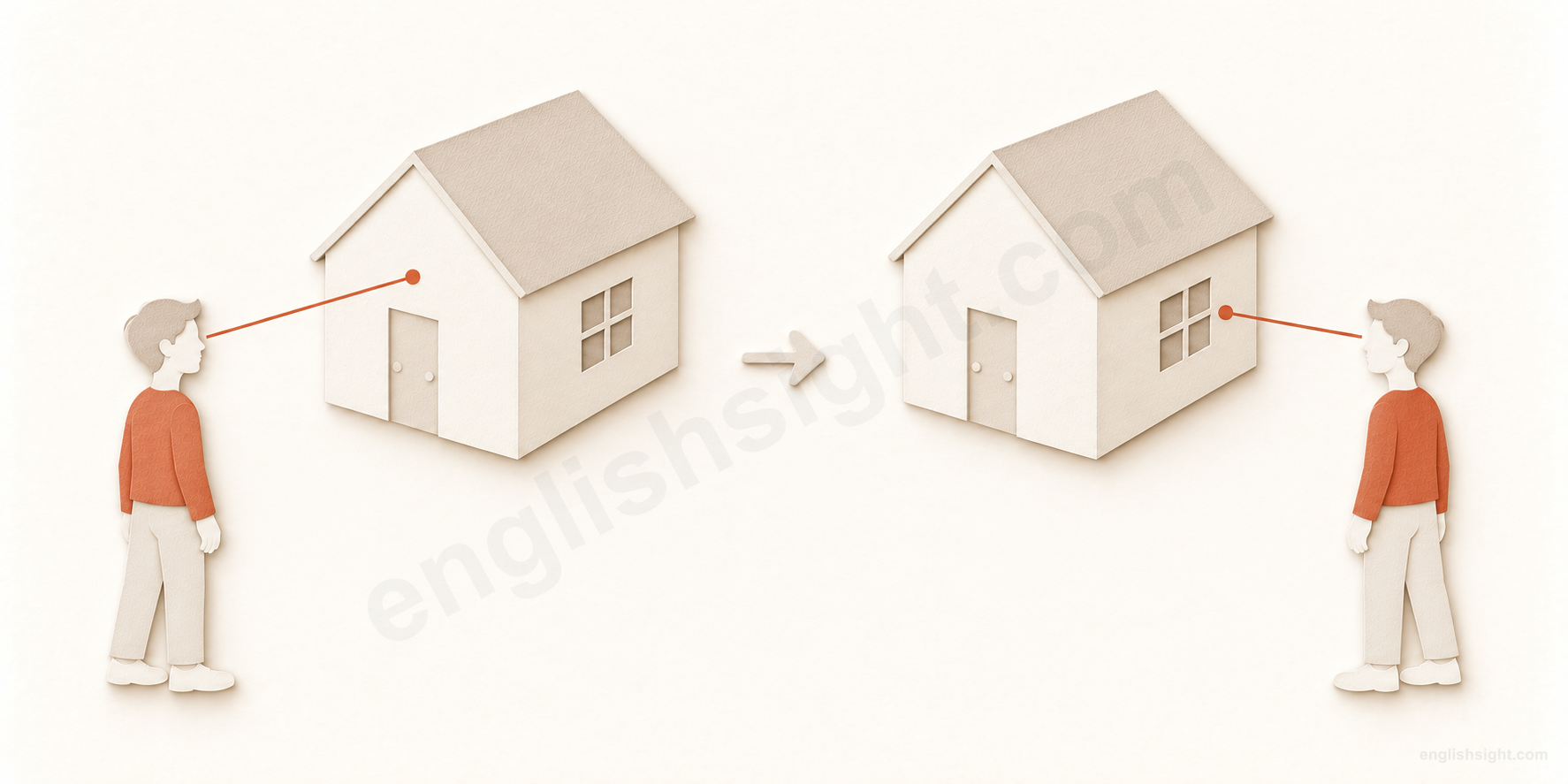
The observer looks at the house from the front.
view
The same observer looks at the house from the side.
The observer changes position; the house stays the same.
A different position gives a different view of the same house.
A view presents what can be seen or how something is considered from a particular position or perspective.
The drawing shows one observer looking at the same house from two positions. Moving reveals a different side; the house stays the same. Mental viewpoints are a useful parallel, while fixed expressions keep their own grammar.
A view can be the scene available from a position, your ability to see it, or your way of understanding a subject. As a verb, view can mean look at something or regard it in a particular way.
A useful teaching model is to keep both the observer and the object in mind: a physical position shapes what is visible, while a perspective shapes how a subject is considered. These are connections for learning, not a rule that predicts every idiom or a claim about a shared mental picture.
01
A scene and the ability to see it
First distinguish the scene available from a position from whether the observer can see it clearly. The prepositions describe place, visibility, or display.
01
a view of / over / across + scene; the view from + place; a room with a view
a view of the valley
the scene visible from a place
Situation or starting point
You stand on a balcony.
What is visible or understood
The valley is the scene you can see.
Of identifies the scene; from identifies the observer’s position.
A view is countable when it means a particular scene: a lovely view, two different views. A hotel room with a view offers something worth looking at outside; a sea view specifies what lies beyond the window.
Compare the view from the balcony with a view of the valley. From answers where you look from; of answers what you see. Over and across can describe how the scene extends: a view across the bay.
Scenery usually names the natural surroundings as a whole and is uncountable. A view selects what is visible from a position; it need not always be beautiful.
In a sentence
Our room has a view of the river from its small balcony.
Watch the difference Say beautiful scenery or a beautiful view; do not make scenery plural to mean several views.
02
a front / side / rear view of + object; a view of + place
a side view / a view of the town
an image showing a scene or an object from a particular angle
Situation or starting point
You choose a camera angle or a picture.
What is visible or understood
The image presents a particular aspect.
A view can be the representation, not only the live scene.
A front view or side view specifies the direction from which an object is shown. A photograph, drawing, or plan can show that view even when nobody is currently standing at the original position.
Views of a town can also mean pictures of that town. In an art book, three views of the harbour may be three images, rather than three opinions about it. The surrounding nouns and setting resolve the meaning.
In a sentence
The guide includes a front view and a side view of the building.
Watch the difference A side view describes the angle shown; it does not necessarily mean a view from a side window.
03
have / get a clear view of + object; block / obstruct + someone’s view
get a clear view / block my view
have or obstruct visual access
Situation or starting point
A tall sign is between you and the stage.
What is visible or understood
Changing position lets you see more clearly.
View can concern how well you can see, rather than an attractive landscape.
Have a good view of the stage describes your visual access. Get a better view can mean moving or adjusting your position so you can see more. Here good means useful or unobstructed, not beautiful.
A person, pillar, or sign can block your view. The object blocks the line between you and what you want to see; it need not cover your eyes. The diagram’s viewing relationship helps explain this use.
In a sentence
I moved to the aisle because a pillar was blocking my view of the stage.
Watch the difference A good view of the match means you can see it well; it does not judge the quality of the match.
04
be / remain in view; keep + object + in view; out of view; hidden from view
in view / out of view
visible or outside what someone can see
Situation or starting point
A bicycle is within your visible area.
What is visible or understood
Behind the wall, it is out of view.
These phrases describe visibility, without an article before view.
In view describes something visible from the relevant position. Out of view and hidden from view describe the opposite. Keep the boat in view asks someone to maintain sight of it as circumstances change.
The phrase does not say anyone is paying attention. A key can remain in view while you fail to notice it. Public view extends the idea to what the public can observe or learn about.
In a sentence
Keep the red boat in view while I check the map.
Watch the difference Use in view for visibility; in my view introduces an opinion.
05
come into view; disappear / vanish from view
come into view / disappear from view
become visible or cease to be visible
Situation or starting point
A bend hides the tower.
What is visible or understood
As you round it, the tower becomes visible.
Into and from mark a change in visual access, not necessarily movement by the object.
Come into view means something becomes visible. The observer may move, the object may move, or an obstruction may clear. A mountain can come into view from a train although the mountain stays still.
Disappear from view describes losing visual access. It does not say the thing stops existing. In the example, the road changes what the passengers can see.
In a sentence
The old tower came into view as our bus rounded the bend.
Watch the difference Come into view does not automatically mean come towards the observer.
06
in full view of + people; in plain view
in full view of / in plain view
clearly visible, often where others can see
Situation or starting point
People are nearby and able to look.
What is visible or understood
The action happens openly before them.
Full and plain emphasize visibility; they do not mean everyone noticed.
In full view of someone emphasizes that the person could directly see the object or event. In plain view emphasizes how openly or obviously something is placed. Both can suggest that an action was conspicuous or undisguised.
These are fixed visibility expressions with no article before view. Compare a full view of the building, which names a complete image or scene and uses a because view is countable there.
In a sentence
He left the envelope on the counter in full view of the customers.
Watch the difference Do not turn possible visibility into a claim that every customer actually saw the envelope.
07
be / go on view; put + object + on view
on view
displayed for people to look at
Situation or starting point
The museum prepares an object for visitors.
What is visible or understood
Visitors can now see it as part of a display.
On view adds the idea of display, beyond simple visibility.
An object on view is being exhibited or shown, as at a gallery or museum. Put something on view describes arranging this public display. On display is a useful everyday alternative.
Contrast the necklace was in view on the desk with the necklace was on view at the museum. The first concerns visibility; the second treats it as an exhibit.
In a sentence
The restored clock will be on view at the museum next month.
Watch the difference On view is about showing something for people to see, not giving an opinion on it.
08
a private view / private viewing of + exhibition
a private view
an invited preview of an art exhibition
Situation or starting point
An exhibition has not opened to everyone.
What is visible or understood
Invited guests attend an advance showing.
Here view names a particular occasion for seeing art.
A private view is an event where invited people see an art exhibition before its public opening. Private viewing is also used. The article a marks a countable occasion, not somebody’s private opinion.
This art-world expression is useful for invitations and gallery notices. It does not mean that the pictures themselves must remain secret forever.
In a sentence
The gallery invited local teachers to a private view of the exhibition.
Watch the difference A private view is an event; a personal view is an opinion.
02
Opinions and ways of understanding
The position can be a mental perspective. Identify whose judgment it is, what it concerns, and whether the expression refers to an opinion, an aspect, or a broad account.
09
have / hold / express / share + a view / views on / about + topic
views on / about an issue
beliefs or opinions about a topic
Situation or starting point
People consider a proposal.
What is visible or understood
They express or compare what they think.
Views are countable opinions; on or about identifies their topic.
You can hold, express, share, or change a view. Plural views often refers to a person’s opinions across a topic. An exchange of views is a discussion in which people state what they think; context can make it a polite description of disagreement.
Ask What are your views on the new timetable? when inviting an opinion. Share her view means agree with it; share your views with us means tell us what you think. The object and with-phrase distinguish these uses of share.
In a sentence
The survey asks residents to express their views on the new bus route.
Watch the difference Political views means political opinions, not things visible at a political event.
10
someone’s view is that + clause; take / hold the view that + clause
take the view that…
hold a stated opinion or judgment
Situation or starting point
A team considers how to proceed.
What is visible or understood
Someone states the conclusion they favor.
The that-clause gives the content of the opinion.
My view is that… directly states what you think. I take the view that… or I hold the view that… presents your position, often in discussion or formal writing. Take here does not describe physically collecting anything.
Compare her view on the delay, which names the topic, with her view that we should wait, which states the opinion itself. A claim can be supported or challenged without becoming a different grammatical kind of view.
In a sentence
We take the view that the library should stay open later.
Watch the difference Use that before the statement of belief; on normally introduces a topic such as opening hours.
11
in + possessive + view, + clause
in my view
according to my judgment
Situation or starting point
You want to make a recommendation.
What is visible or understood
You identify it as your own assessment.
A possessive identifies the person whose opinion is being offered.
In my view introduces or qualifies your opinion. In her view and in the committee’s view identify other holders of a judgment. The phrase can occur at the beginning or inside a sentence.
It does not necessarily weaken the opinion: In my view, this is completely wrong can be firm. The phrase marks the source of the judgment, not a fixed degree of uncertainty.
In a sentence
In my view, the second design is easier to use.
Watch the difference Use in my view; reserve from for from my point of view.
12
an optimistic / realistic / distorted view of + subject
a view of life
a way of understanding a subject or the world
Situation or starting point
Experience shapes how someone understands things.
What is visible or understood
They interpret situations through that outlook.
Of can introduce an understanding or outlook, not a visible landscape.
A hopeful view of life means a generally hopeful way of interpreting life. A view of education or of society can similarly be an overall understanding, rather than a single proposal you support.
This use connects naturally with perspective as a teaching metaphor. It does not mean that every opinion literally begins with sight, or that two people must disagree whenever they have different experiences.
In a sentence
Working with the volunteers gave me a more hopeful view of the future.
Watch the difference Decide from context whether a view of the city means a visible scene or someone’s understanding of city life.
13
from + possessive + point of view; from a(n) + adjective / aspect modifier + point of view; from the point of view of + noun
from a point of view
from someone’s perspective or with respect to one aspect
Situation or starting point
A decision affects different people and concerns.
What is visible or understood
You choose whose position or which aspect to consider.
The viewpoint can belong to a person or to an area such as cost or safety.
From a parent’s point of view asks how something looks to a parent. From a safety point of view means considering safety specifically; it need not identify a person who holds an opinion.
A story told from a child’s point of view presents events through the child’s experience or understanding. This use extends perspective to narration. The plural is points of view, with points carrying the plural ending.
In a sentence
From a safety point of view, the wider entrance is better.
Watch the difference From my point of view is natural; in my view is the shorter opinion phrase. Do not say points of views.
14
a bird’s-eye view of + place / subject; an overall / inside view of + subject
a bird’s-eye view / an overall view
a look from above or a broad account of a subject
Situation or starting point
You choose a high or wide perspective.
What is visible or understood
You see the larger arrangement rather than individual details.
A broad view can be literal or a metaphor for an overview.
A bird’s-eye view can be a downward look from high above. It can also mean a general overview of a subject: This introduction gives a bird’s-eye view of the project. In that figurative use, it covers the broad arrangement rather than all the details.
An overall view of a project similarly describes a broad account of its main parts. An inside view instead offers understanding from access to what happens within an organization or group. Broad coverage and inside access are different qualities.
The hill example is literal: elevation lets the viewer see the arrangement of streets. A bird’s-eye view in a written introduction need not involve any picture or physical height.
In a sentence
The hill gives us a bird’s-eye view of the village and its narrow streets.
Watch the difference Check whether a bird’s-eye view is a look from above or a general overview. Neither expression guarantees that every detail is visible or explained.
15
take the long view (of + subject); take a long-term view of + subject
take the long view
judge with longer-term developments in mind
Situation or starting point
A current setback attracts attention.
What is visible or understood
You consider what matters over several years.
Long describes the time horizon of the judgment.
Taking the long view means weighing future effects rather than attending only to the immediate situation. The related take a long-term view of something makes the time horizon explicit.
The expression does not guarantee a positive conclusion or tell you to ignore present problems. You may reject a plan precisely because its long-term effects look poor.
In a sentence
Let’s take the long view: repairing the roof now may save years of trouble.
Watch the difference The long view concerns time, not seeing a very distant object.
16
take a dim / poor view of + noun / -ing form
take a dim view of
disapprove of or judge unfavorably
Situation or starting point
Someone repeatedly misses deadlines.
What is visible or understood
Their manager regards this behavior negatively.
Dim signals disapproval in the established expression.
Take a dim view of something is an idiom for disapproving of it. Take a poor view of is a related variant. The object may be behavior, a proposal, or a person; context explains the reason for the negative judgment.
The expression does not mean the observer cannot see well or is unsure what happened. In the example, the teacher may understand the copying perfectly and still disapprove.
In a sentence
Our teacher takes a dim view of copying answers from a phone.
Watch the difference Learn take a dim view of as a whole; dim is not a measure of eyesight here.
03
Look at something or regard it in a particular way
As a verb, view usually takes a direct object. Objects and complements distinguish inspecting a house, watching content, and judging a proposal.
17
view + object; view + object + from / through + noun
view an exhibit
look at something deliberately, often carefully
Situation or starting point
An object is available to inspect.
What is visible or understood
You direct attention to its appearance or details.
View takes the object directly and often sounds more formal than look at.
To view an exhibit or a set of photographs is to look at it for a purpose. View the painting from a distance adds the observation position; view it through a lens adds the means of seeing.
In casual conversation, look at is often the easier choice: Come and look at this photo. View is natural in instructions, museum information, and descriptions of deliberate inspection. It is not the normal replacement for every use of see, such as see a doctor for an appointment.
In a sentence
The visitors viewed the sculpture from several angles.
Watch the difference Say view the sculpture or look at the sculpture; ordinary transitive view does not need at.
18
view + property; arrange / book a viewing; property + can be viewed
view a house
visit and inspect a property before deciding about it
Situation or starting point
A flat is advertised for rent.
What is visible or understood
You arrange a visit to assess it.
The property context gives viewing its practical purpose.
View a flat or house commonly means visit it before deciding whether to rent or buy. A viewing is the visit itself: arrange a viewing, book two viewings. This usage is especially familiar in British property advertisements.
The passive is useful because the property is the focus: The flat can be viewed on Friday. An appointment requirement tells you when access is available; viewing alone does not commit you to renting or buying.
In a sentence
We’re viewing a flat near the station tomorrow morning.
Watch the difference Viewing a property is inspecting it; it does not mean buying it or merely seeing a photograph online.
19
view + film / footage / page / document; be viewed by + audience
view a video / view a page
watch or look at recorded or digital material
Situation or starting point
A video or document is available.
What is visible or understood
You open it and look at its content.
The object is content being accessed, not an opinion being held.
View footage, view a video, and view a document describe looking at content. View can sound formal for watching a film, while a button labeled View is routine interface language. In everyday conversation, watch a video is often more natural.
The passive can report an audience: The film was viewed by hundreds of people. That sentence describes watching, whereas the film was viewed as offensive describes a judgment because as adds an evaluation.
In a sentence
You can view the full report by opening the attachment.
Watch the difference View a video means watch it; view a video as evidence means regard it as evidence.
20
view + object + as + noun / adjective; be viewed as + noun / adjective
view something as…
regard or classify something in a particular way
Situation or starting point
A team considers a difficult task.
What is visible or understood
They interpret it as a useful opportunity.
As introduces the category or quality attributed to the object.
In view the change as an opportunity, the change is the object being judged and an opportunity is the description given to it. As does not introduce a new owner or destination. An adjective is possible too: the proposal is viewed as unrealistic.
The passive is common when reporting a shared assessment: She is widely viewed as a capable leader. Widely tells us that many people have the view; it does not prove the judgment true. A reflexive object is also possible: he views himself as an outsider.
In a sentence
Several students viewed the group task as a chance to make friends.
Watch the difference Use “view it as useful” for this construction. Compare “consider it useful”: related verbs can require different complement patterns.
You assess it cautiously rather than accepting it immediately.
With names the attitude; an adverb can describe the evaluation.
View something with suspicion, concern, or caution identifies the attitude you bring to it. View a suggestion favorably means respond positively to it; view it negatively gives the opposite evaluation.
The same words can sometimes describe literal looking with an emotion. The abstract object offer in the example makes the evaluative reading clear. With is a preposition introducing an attitude, not a separable particle.
In a sentence
We should view the offer with caution until we know the full cost.
Watch the difference With caution describes how you regard the offer; it does not mean you have already rejected it.
From identifies the standpoint used in an evaluation.
View the situation from her perspective asks you to consider how it appears to her. View the results objectively asks for an assessment less shaped by personal feelings. Neither guarantees agreement or perfect neutrality. View an event in context means consider its surrounding circumstances; view it in isolation means consider it separately from them.
Compare view the building from the street, which gives a physical position. The grammar is similar, but an abstract object and a perspective expression make the evaluation mental. This link motivates the lesson’s model without making all view expressions literal vision.
In a sentence
Try to view the delay from the passengers’ perspective.
Watch the difference Considering another perspective does not require adopting every opinion held by that person.
04
Screen layouts and online counts
A view can be a way of displaying information or a recorded occasion of looking. A display mode, a visit, and an individual viewer are different things.
23
in + display mode + view; switch to + a named view
full-page view / list view
a way information is displayed on a screen
Situation or starting point
The same information can be arranged differently.
What is visible or understood
You select a layout suited to your task.
View here names a display mode rather than a sight outside a window.
Full-page view presents a page as a whole. List view arranges items as a list; switching to another view changes the presentation. The available names depend on the application.
Compare View the document, where view is a verb giving an action, with Switch to full-page view, where view is a noun naming the mode. Changing the view usually changes presentation rather than the underlying content.
In a sentence
Switch to list view to compare the file names.
Watch the difference A screen view is a presentation mode; one view in a traffic report is a counted access.
24
number + views; page views; attract / receive + views
a thousand views / page views
recorded occasions of watching or accessing content
Situation or starting point
People access online material.
What is visible or understood
A counter records viewing activity.
A view counts an event under a service’s rules, not necessarily a unique person.
A video with a thousand views has a count of viewing events. Page view names a visit to an individual web page. The countable noun takes an ordinary plural: one view, many views.
A viewer is a person; a view is an event or count. The same person may access material more than once, and services apply their own counting rules. A view count alone does not establish that everyone watched a whole video or agreed with its message.
In a sentence
The tutorial received two thousand views in its first week.
Watch the difference Do not equate two thousand views with two thousand different people.
05
Reasons, intended results, and prospects
Learn these whole expressions. They distinguish a reason for acting, an intended goal, and a result that seems foreseeable. Their prepositions and articles are part of the construction.
25
in view of + noun / pronoun; in view of the fact that + clause
in view of
considering a fact when making a judgment or decision
Situation or starting point
A new fact affects what is sensible.
What is visible or understood
You give that fact as a reason for your decision.
Of introduces the circumstance being taken into account.
In view of the delay, we should call ahead gives the delay as a consideration supporting the suggestion. The whole expression functions like considering or because of, often in formal explanations.
Follow of with a noun phrase, a pronoun, or the fact that plus a clause: in view of this; in view of the fact that the road is closed. It is not a statement that you can physically see a delay.
In a sentence
In view of the heavy rain, we’ve moved the lesson indoors.
Watch the difference In view of gives a reason; with a view to gives an aim. Do not swap them.
26
with a view to + noun / -ing form
with a view to doing something
with an intended or hoped-for result
Situation or starting point
You take an action now.
What is visible or understood
You hope it will support a later result.
To is a preposition here, so a following verb takes -ing.
With a view to reducing costs describes why you act: reducing costs is the intended result. A noun phrase can follow too, as in with a view to an early agreement. The expression is formal and useful in plans or reports.
The hoped-for result is not guaranteed. In the example, classes support a career-change goal, but the sentence does not say she actually changed careers. Learn the whole construction rather than interpreting it as looking at something.
In a sentence
She took evening classes with a view to changing careers.
Watch the difference Say with a view to changing, not with a view to change, when the verb expresses the intended action.
27
have + aim / end + in view; with that end in view
have an end in view
keep a particular objective in mind
Situation or starting point
You choose an objective for your work.
What is visible or understood
Your actions are directed toward it.
An end in view is a goal, not a visible endpoint on a road.
Have a particular end in view means have a specific purpose in mind. With that end in view can link a previously mentioned goal to the next action. This is formal wording; with that goal in mind is often a clearer everyday alternative.
Unlike keep the boat in view, where a real boat remains visible, the object here is an aim or plan. The phrase focuses on the intended endpoint of a project, without claiming that it will be reached.
In a sentence
We want a quieter playground; with that end in view, we’re adding a reading corner.
Watch the difference The noun end means purpose here; it does not mean the project has already ended.
28
there is no solution / agreement in view
no solution in view
no solution currently seems likely or foreseeable
Situation or starting point
People have discussed a problem for weeks.
What is visible or understood
They still cannot see a likely way to resolve it.
With an abstract outcome, in view can concern what seems possible ahead.
With a result such as a solution or an agreement, in view can mean foreseeable or in prospect. There is no solution in view says that no solution currently seems likely; it does not refer to a visible object. For example: After weeks of talks, there is still no agreement in view.
Compare We have a clear objective in view: that identifies an aim people are working toward. A desired objective is not necessarily a likely outcome. No solution in view also describes the present outlook, not proof that a solution will never be found.
In a sentence
There is still no solution in view, so the team will meet again tomorrow.
Watch the difference No solution in view does not mean a solution is permanently impossible. The phrase concerns what can currently be foreseen.
Read the noun, complement, and whole expression
Two parts of speech, one pronunciation
The noun and verb are both /vjuː/. The noun plural is views. Verb forms are view, views, viewed, viewed, and viewing. The -ed ending in viewed is pronounced /d/.
Countability depends on the construction
A view of the river, several opinions or views, and a thousand online views are countable. Fixed visibility phrases normally omit an article: in view, out of view, on view, in full view. The fixed purpose expression with a view to includes a.
View, see, look at, watch, and review
Look at describes directing your eyes; see can describe perception without deliberate effort; watch often involves attention over time. View is a more formal alternative for inspecting or watching and is routine in interface commands. Review means examine or assess again, or produce an evaluation; it is not simply the same verb as view.
Objects, passive forms, and -ing
View generally takes a direct object in the uses taught here. Physical looking supports a progressive such as We’re viewing a flat. Evaluative I view it as useful usually expresses a standing judgment. Passive forms include The house can be viewed and The change is viewed as useful. These do not form a special causative pattern.
Prepositions do different jobs
In view of and with a view to are fixed multiword expressions. View it as a risk and view it with caution are verb-complement constructions, not separable phrasal verbs. Put a pronoun directly after the verb: view it as a risk. There is no need to invent a particle-verb family for view.
What the image can explain
The diagram illustrates physical viewing position. It is a teaching aid: opinions, display modes, counting conventions, reasons, and aims still require the explanations in their own units.
Choose the view that fits
Use the situation and the complete construction to choose the intended meaning.
1. Rain explains why an outdoor event was cancelled. Which phrase supplies that reason?
2. Which sentence correctly states a hoped-for result of taking classes?
3. You want to mark a statement as your opinion. Which sentence does that?
4. A tutorial has 500 views. What can you safely conclude from that number alone?
5. What does The change is viewed as an opportunity mean?
6. A mountain comes into view as a train leaves a tunnel. What changed?
Sources and teaching notes
Modern uses were checked in the publisher pages below. Explanations and examples are original; the link between physical and mental perspectives is a teaching interpretation.
The sketch connects a viewing position with what can be seen. It is a teaching model.