Understand waiting as an activity, an experience, and part of familiar expressions.
Time before an expected event
Ready, but the expected event has not happened yet
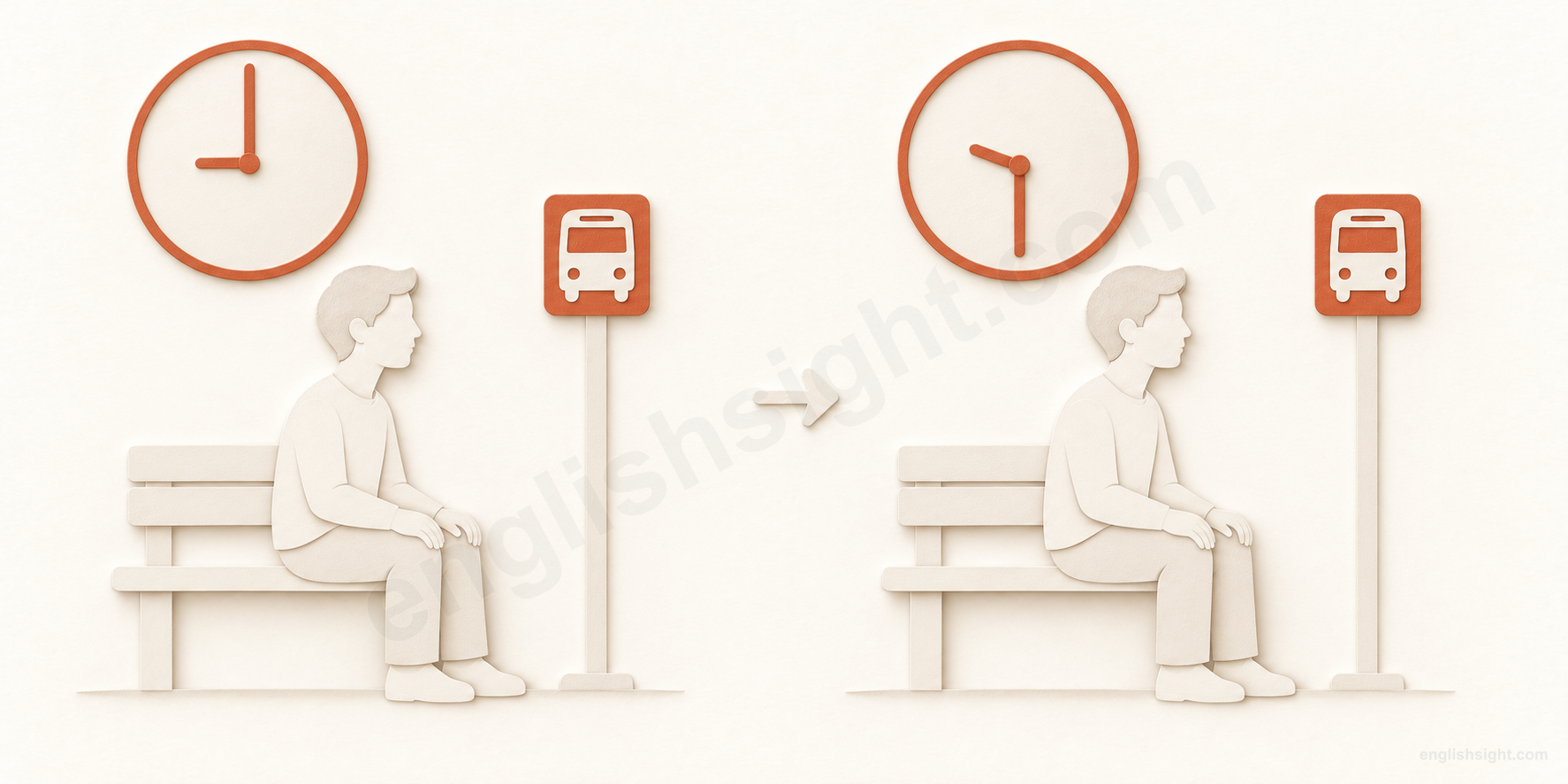
At nine, the man is seated at the bus stop; the bus has not arrived.
waiting
At nine-thirty, the same man is still waiting at the same stop.
Half an hour passes while he remains ready for the bus.
The clock changes; the expected bus has still not arrived.
Waiting is spending time before an expected event or next action, often staying ready for it.
The bus-stop example shows time passing without the expected arrival. Waiting need not be motionless, willing, or successful; the service meaning must be learned separately.
Waiting usually concerns time before an expected person, event, or action. You may stay ready for it while other parts of life continue. The expected event does not have to happen in the end.
Waiting is both the -ing form of wait and an activity noun. Common compounds and expressions add their own meanings; restaurant service is a separate established branch. The diagram offers a teaching connection, not a universal mental image.
01
What or who are you waiting for?
The words after waiting identify the expected person, event, action, time, or turn. Waiting can continue while you do other things.
01
am / is / are + waiting for + person or thing
be waiting for someone / something
spend time expecting a person or event
Situation before
The bus has not arrived.
Situation during or after
You stay available to catch it.
For introduces the person or thing expected.
In I am waiting for the bus, am marks the present tense and waiting names the ongoing activity. Without be, I waiting for the bus is not a complete standard sentence. Wait becomes waiting without doubling the t.
The expected thing can be a reply, result, chance, or change, not just a physical arrival. I’m waiting for a reply can be true while you work on other tasks; waiting does not always mean standing motionless.
Compare I expect a reply today: expect expresses a belief about what will happen. Waiting for a reply describes the time before it arrives. Await takes an object directly and is more formal: awaiting a reply, not awaiting for a reply.
Waiting patiently or anxiously describes the person’s attitude. Waiting in vain says the hoped-for result did not come. These modifiers add attitude or outcome; waiting by itself does not specify either.
In a sentence
I’m waiting for the bus, so I’ll call you when I get home.
Watch the difference Use waiting for the bus, not waiting the bus; waiting your turn is a separate established pattern.
02
be waiting to + verb; be waiting for + person / thing + to + verb
waiting to do / for someone to do
identify the action that has not happened yet
Situation before
Our group is ready, but boarding has not begun.
Situation during or after
We remain ready to board.
The infinitive names the pending action; for can give it a different subject.
We’re waiting to board normally makes we the people who will board. We’re waiting for the driver to open the door gives the opening action its own subject, the driver.
Waiting to be served or waiting to be seen uses a passive infinitive: the waiting person receives the service or attention. That does not make waiting itself passive.
These are ordinary complement patterns, not separable phrasal verbs. The action after to remains in the base form: waiting to go, not waiting to going.
In a sentence
We’re waiting for the driver to open the door.
Watch the difference Waiting to open the door makes the waiting subject the intended opener; waiting for the driver to open it does not.
03
be waiting until / till + time or clause
waiting until / till
delay the next action up to a specified point
Situation before
The rain is still falling.
Situation during or after
We postpone going outside until it stops.
Until gives the endpoint; for gives what is expected.
Waiting until the rain stops sets a limit in time. Waiting for the rain to stop names the change being awaited. These can describe the same situation through different grammatical patterns.
For a future event after until, a present form is usual: We’re waiting until the shop opens, not until the shop will open. Till has the same basic time meaning and is often conversational.
In a sentence
We’re waiting until the rain stops before we leave.
Watch the difference Say waiting until Friday or waiting for Friday; not waiting until to Friday.
04
have / has been waiting (for) + duration; since + starting point; waiting time / period
have been waiting; waiting time
say how long the activity has continued
Situation before
The appointment has not started.
Situation during or after
Twenty minutes have passed and you are still there.
For measures a duration; since identifies its starting point.
I’ve been waiting for twenty minutes connects an earlier start with the present. I was waiting when you called places the activity at a past moment. The -ing form alone does not tell you which time is meant.
Use since nine o’clock for a starting point and for twenty minutes for a length. After wait, for can sometimes be omitted before a duration: I’ve been waiting twenty minutes. Keep for before the person or thing expected.
Waiting time names the length of the delay: The waiting time is twenty minutes. A waiting period is an interval before something can begin or become available; it need not involve a physical queue.
In a sentence
I’ve been waiting since nine, and it’s nearly half past now.
Watch the difference For can have two jobs: waiting for the doctor for twenty minutes names both the expected person and the duration.
05
be waiting in line / in a queue; be waiting your turn
waiting in line / waiting your turn
wait for service in an order
Situation before
Other people are ahead of you.
Situation during or after
You stay in the order until you can proceed.
A line is the arrangement; your turn is your opportunity.
Waiting in line is especially familiar in North American English; waiting in a queue is familiar in British English. Neither expression requires you to be first.
Waiting your turn means not acting before your opportunity comes. There is no for in this established pattern, though waiting for your turn is also possible. A turn can be in a conversation or game as well as in a physical queue.
In a sentence
I’m waiting my turn to speak.
Watch the difference Waiting in line is an ordinary location phrase here; in does not carry the stay-at-home meaning of wait in.
06
waiting + people noun; noun + waiting + additional detail
waiting passengers; people waiting outside
describe people currently expecting something
Situation before
Passengers have arrived, but the bus has not.
Situation during or after
You identify the passengers by what they are doing.
A modifier can describe an actual waiting activity.
The waiting passengers means the passengers who are waiting. People waiting outside puts a longer descriptive phrase after people. In both, waiting describes the people; it does not by itself provide the main sentence tense.
Compare a waiting room: the room is intended for people to wait in. The room itself is not performing the activity. Read the noun and the whole phrase rather than treating all waiting modifiers alike.
In a sentence
The waiting passengers moved closer when the bus appeared.
Watch the difference The people waiting outside are tired is complete; The people waiting outside alone is only a noun phrase.
02
The experience of waiting
Treat waiting as an activity in its own right, or explain why someone has been delayed.
07
waiting + singular verb; a lot of / all the waiting; a long wait
waiting; all the waiting
name the activity or experience
Situation before
You repeatedly check for news.
Situation during or after
You describe the delay as tiring.
Waiting is normally uncountable when it names the activity.
Waiting can be the subject or object of a sentence: Waiting is tiring; I hate waiting. As an activity noun it normally takes singular agreement and does not have an ordinary plural waitings.
Use a wait or two long waits to count separate delays. Compare We had a long wait with There was a lot of waiting. Waiting for the results was hard includes the expected event within the subject.
The words No waiting also occur on British roadside signs. In that setting waiting concerns vehicles remaining at the roadside, not people being forbidden to expect something. The phrase has a specialized traffic context.
In a sentence
All the waiting made us restless.
Watch the difference Say a long wait or a lot of waiting; avoid a waiting for an ordinary single delay.
Keep someone waiting means cause their wait to continue. It often appears in an apology, such as Sorry to keep you waiting. In I kept her waiting, I caused the delay and she waited.
In the passive She was kept waiting, she still does the waiting; was kept makes the cause less prominent. Compare I kept waiting: with no person between kept and waiting, it means I continued to wait.
Leave someone waiting similarly describes allowing someone’s wait to continue while you do not attend to them: Don’t leave your guests waiting outside.
In a sentence
Sorry to keep you waiting; I had to finish a call.
Watch the difference Keep waiting and keep someone waiting assign the waiting activity to different people.
03
Ready things, places, lists, and calls
These uses organize what is available and what must happen before a person can proceed.
09
there is + something + waiting for + person; ready and waiting
something waiting for you; ready and waiting
be prepared or available for someone
Situation before
A parcel has arrived before you get home.
Situation during or after
It remains available for you to collect.
A thing can be waiting without having thoughts or feelings.
There’s a parcel waiting for you says it is there, ready for you to receive or deal with. A taxi waiting outside similarly remains available to take a passenger.
Ready and waiting emphasizes preparation: The team is ready and waiting for your signal. It does not mean that the signal has already been given.
Waiting to be unloaded describes goods still needing an action. Do not infer enjoyment or impatience from a thing described as waiting.
In a sentence
There’s a parcel waiting for you at reception.
Watch the difference Waiting can describe availability or unfinished work; the subject need not be a conscious person.
10
in the waiting room / waiting area
waiting room / waiting area
a place intended for people who must wait
Situation before
A clinic cannot see everyone immediately.
Situation during or after
Visitors sit in a designated space.
The modifier names the purpose of the place.
A waiting room is a room where people stay before an appointment or departure. Waiting area is a broader description and need not be a separate enclosed room.
A room for waiting is the underlying relation; the room itself is not waiting. Use in the waiting room for location. Pluralize the head noun: two waiting rooms.
In a sentence
Please take a seat in the waiting room.
Watch the difference Waiting room is a compound noun, unlike a description of a person who is waiting.
11
be on / put someone on + a waiting list
on a waiting list
registered for something not yet available
Situation before
All places on a course are taken.
Situation during or after
Your name is recorded for a possible later place.
A list records pending access; it is not a physical queue.
Being on a waiting list means your name has been recorded because the place, item, or service is not currently available. It does not guarantee when, or whether, you will receive it.
Ask Can you put me on the waiting list? Use on for membership of the list. North American English also uses wait list. Waiting list is two words; the plural is waiting lists.
In a sentence
The class is full, but you can join the waiting list.
Watch the difference Do not equate a waiting-list place with a confirmed booking.
12
call waiting; have / enable call waiting
call waiting
a phone feature that signals another incoming call
Situation before
You are already speaking on the phone.
Situation during or after
A signal tells you another caller is trying to reach you.
The whole compound names a phone service.
Call waiting alerts you to a second incoming call during an existing call. The expression names the feature, rather than simply saying that any particular call is delayed.
Compare I’m waiting for a call: that is an ordinary sentence about expecting someone to phone. It does not say you have the call waiting feature.
In a sentence
Call waiting lets me know when another person calls during a conversation.
Watch the difference Call waiting and waiting for a call have different structures and meanings.
04
Read the whole combination
Around, in, up, out, and on contribute different meanings. Restaurant service is a separate established branch.
13
be waiting around / about (for someone or something)
waiting around / about
stay with little to do while expecting something
Situation before
A departure time remains unclear.
Situation during or after
You remain nearby with no useful activity.
Around adds the sense of spending time with little to do.
Waiting around often makes the time seem unproductive. Around does not require walking in a circle; someone can sit waiting around.
Waiting about is an alternative. These are intransitive phrasal verbs in this meaning. To name the expected person, add for: waiting around for Mia.
In a sentence
We spent the morning waiting around for a decision.
Watch the difference Waiting around is not simply the same as waiting at a particular geographical point.
14
be waiting in (for someone or something)
waiting in
stay home for an expected arrival or contact
Situation before
A repair visit is scheduled for today.
Situation during or after
You stay home rather than go out.
In contributes staying at home, especially in British English.
I’m waiting in for the plumber explains why you are staying home. The phrase can also concern an expected phone call or another contact.
Compare waiting in the kitchen: there, in starts a location phrase. Waiting in as a phrasal verb does not need a room noun after it.
In a sentence
I’m waiting in for a delivery this afternoon.
Watch the difference This stay-at-home use is especially British; waiting at home is a clear alternative.
15
be waiting up (for someone)
waiting up for someone
remain awake until someone returns at night
Situation before
A family member will arrive home late.
Situation during or after
You delay going to bed until they return.
Up contributes staying awake.
She’s waiting up for her son normally means she has not gone to bed because she expects him home. It does not mean she is waiting upstairs.
Wait up! can also be an informal North American request for a person ahead to stop or slow down so you can catch up. That imperative is a different use; the night-time meaning depends on context.
In a sentence
Dad was still waiting up for me when I got home at midnight.
Watch the difference Waiting up for a return and waiting upstairs describe different things.
16
be waiting out + event; be waiting + event / it + out
waiting something out
stay until an unpleasant event ends
Situation before
A storm makes the journey difficult.
Situation during or after
You stay sheltered until conditions improve.
Out marks continuing through to the end of the event.
Waiting out a storm means allowing it to finish before you proceed. You are not waiting for the storm to start. The unpleasant event is the object of this phrasal verb.
The object can precede out: waiting the storm out. With a pronoun, put it between the verb and particle: waiting it out, not waiting out it.
In a sentence
We’re waiting out the storm in a café.
Watch the difference Waiting outside is a location; waiting the storm out describes enduring its remaining duration.
17
be waiting tables; be waiting on + customers; waiting staff
waiting tables / waiting on customers
work serving food or attending to customers
Situation before
Customers need to order and receive food.
Situation during or after
A worker attends to them during the meal.
This is the established service branch of wait.
In She’s waiting tables, she is working as a restaurant server. Waiting tables is especially North American. Waiting on customers means serving or attending to them, not merely expecting their arrival.
Waiting can also name the work itself, and waiting staff names the people who serve. Formal wait at table is another service expression.
This branch needs its own explanation. A drawing of time passing before a bus arrives does not predict the meaning of waiting tables.
Waiting on someone hand and foot means attending to nearly all their needs so they do little for themselves. It often expresses disapproval of how much service the person expects; it does not describe touching their hands and feet.
In a sentence
She’s waiting tables at a small restaurant this summer.
Watch the difference Waiting for customers means expecting them; waiting on customers can mean serving them.
18
be waiting on + person or thing
waiting on a decision
expect information or action before proceeding
Situation before
Another person has not approved the plan.
Situation during or after
Your next step remains delayed.
On can mean for in an established usage, especially informal North American English.
We’re waiting on a decision can mean we need the decision before we proceed. Here on does not mean we are serving a decision.
Waiting for a decision is a broadly useful alternative. With a person as object, context matters: waiting on a guest can describe serving them, while waiting on someone to reply concerns an expected response.
In a sentence
We’re waiting on a decision before we book the hall.
Watch the difference Do not treat every waiting on phrase as restaurant service; read the context.
05
Strategies, warnings, and encouragement
These familiar expressions extend waiting beyond a literal person standing still. Learn the meaning of the whole expression.
19
play a waiting game
play a waiting game
deliberately delay action to see how events develop
Situation before
A buyer is considering an offer.
Situation during or after
They hold back while the situation develops.
Game presents waiting as a strategy.
Playing a waiting game means choosing not to act yet so that developments may clarify the situation or improve your position. It need not involve a literal game.
The phrase does not guarantee success and does not simply mean any boring wait. The deliberate strategy distinguishes it from being stuck at a bus stop.
In a sentence
The buyer is playing a waiting game before making another offer.
Watch the difference Learn the whole expression; waiting alone does not imply a competitive strategy.
20
be waiting in the wings
waiting in the wings
ready to take over or be used when needed
Situation before
The current leader is still in charge.
Situation during or after
A possible successor stays ready without taking over yet.
The expression comes from readiness off the main stage.
Waiting in the wings describes someone or something available to take a role when required. In a theatre, the wings are the areas at the sides of the stage; figurative uses can concern managers, candidates, or other resources.
The person need not literally stand nearby or eventually get the role. Ready but not yet involved is the useful connection with ordinary waiting.
In a sentence
A younger manager is waiting in the wings to take over the team.
Watch the difference This does not refer to a bird’s wings; learn the whole phrase.
21
be + an accident / a disaster waiting to happen
an accident / disaster waiting to happen
a situation very likely to cause trouble or harm
Situation before
A loose shelf holds heavy boxes.
Situation during or after
You judge that its condition could cause an accident.
Waiting to happen makes a future risk feel close.
This expression warns that something is dangerously likely to go wrong because of its present condition or someone’s behavior. The accident is not a person literally waiting.
In That shelf is an accident waiting to happen, the shelf represents a dangerous situation. Disaster can extend the expression to a plan or arrangement likely to fail badly. It is a warning, not a guarantee about the future.
In a sentence
That loose shelf is an accident waiting to happen.
Watch the difference The expression evaluates a risk; it does not mean an accident has already occurred.
22
What are you / we waiting for?
What are you / we waiting for?
urge someone, or the group, to start
Situation before
Everyone agrees on the next step.
Situation during or after
You encourage immediate action.
A question about waiting can function as a prompt to act.
What are you waiting for? can genuinely ask what event someone expects. It can also urge action when the speaker thinks no further delay is needed.
What are we waiting for? includes the speaker and often enthusiastically suggests starting together. Tone matters: the you version can sound impatient or critical.
In a sentence
The tickets are booked and our bags are packed. What are we waiting for?
Watch the difference The question is not always a request for information; context and tone can turn it into encouragement.
Follow the grammar and the whole expression
Waiting, wait, and await
Waiting is pronounced /ˈweɪtɪŋ/. The verb forms are wait, waits, waited, waiting. I am waiting describes an ongoing activity; Waiting is tiring names the activity; a long wait counts one delay. Await is more formal and takes its object directly: awaiting a reply.
Not all waiting is inactivity
You can read while waiting for a bus or keep working while waiting for an email. The relevant arrival or next step is pending; your whole life need not stop. Waiting does not guarantee that the expected event will occur.
A limit to the -ing pattern
The ordinary expectation sense readily uses progressive forms. In This can wait, wait means something can be postponed. I can’t wait to see you normally expresses eagerness. These base-form expressions are useful contrasts; do not automatically rewrite every wait expression with waiting.
Separate service from delay
Waiting tables and waiting on customers can describe serving food. This established branch is not explained by time passing alone. Waiting for customers describes expecting them, and waiting on a decision can describe expecting information.
Choose the meaning in context
Identify who waits, which action is pending, and what the whole expression contributes.
1. You are ready to enter, but the driver must open the door first. Which sentence identifies the driver as the opener?
2. Which sentence uses a singular count noun to name one delay?
3. Mina takes orders and brings meals to restaurant customers. Which sentence describes her work?
4. There is a parcel waiting for you at reception. What does waiting suggest here?
5. I kept Jo waiting for ten minutes. Who waited?
6. We’re waiting the storm out in a café. What are we waiting for?
7. Your wait began at nine and is continuing. Which sentence identifies its starting point?
Sources and teaching notes
Usage was checked against the dictionary pages below. Explanations and examples are original; the visual connection is a teaching model.
The diagram is a learning aid, not an image shared by every English speaker.