From everyday journeys to walking away, walking someone through a task, and familiar idioms.
Movement through alternating steps
Movement through alternating steps
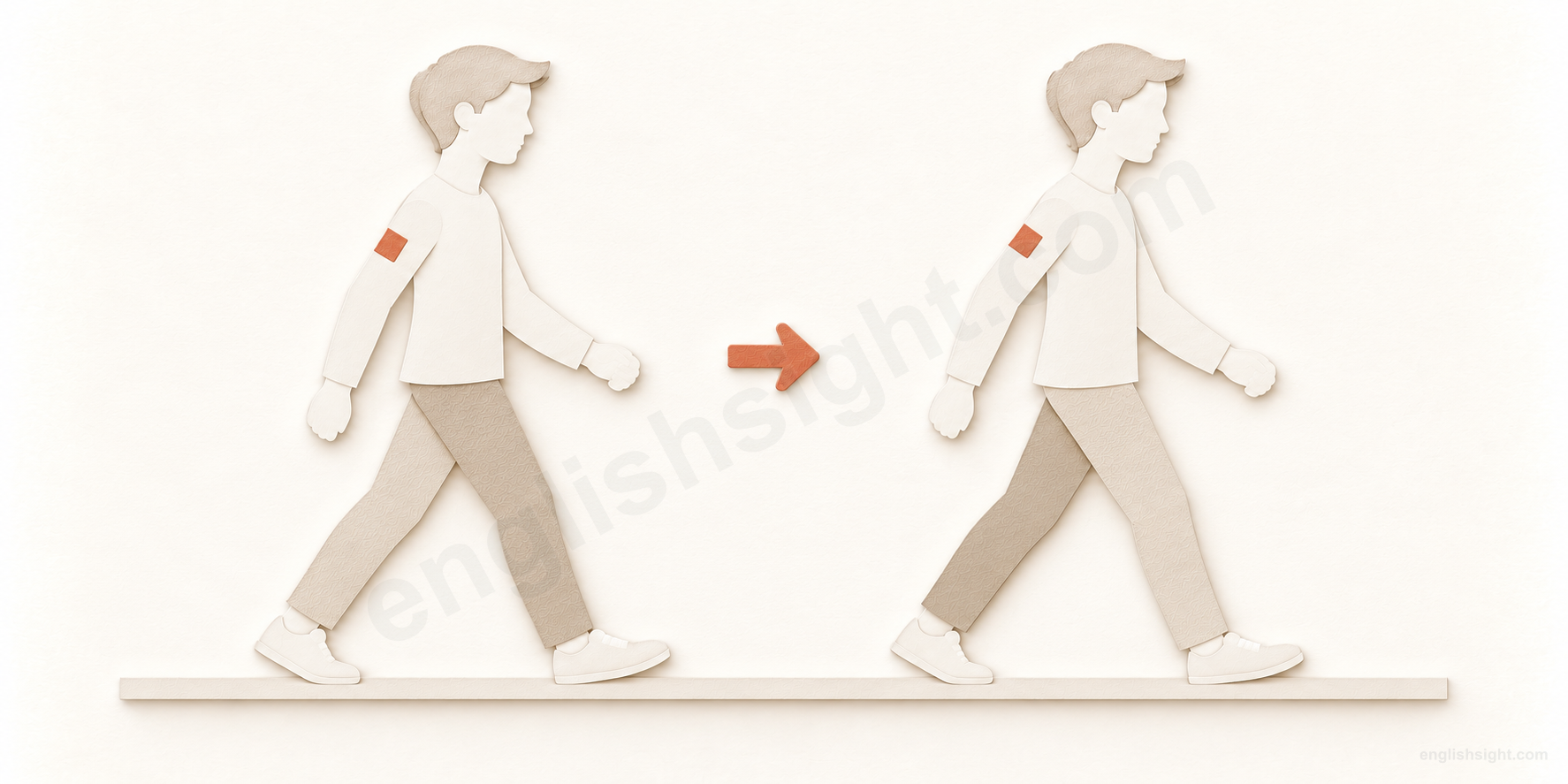
One foot leads at an earlier position.
walk
The other foot leads farther along.
Alternating steps carry the person forward along the ground.
The arrow links successive positions of one walker. Fixed expressions need their own explanations.
In its basic physical use, walk means to move on foot by taking alternating steps along the ground, rather than running.
Walking need not be slow, leisurely, or directed toward a special destination. The sketch isolates the physical action; it does not illustrate every idiom.
Walk names movement on foot. The route, the person or animal accompanying you, and the words that follow walk tell you more about the event.
The everyday step-by-step action also offers useful connections to guiding a learner or leaving a situation. These connections are teaching aids: established expressions still need to be learned as expressions, and English speakers do not all picture the word in the same way.
01
Moving on foot and accompanying others
Start with the physical action. Directions describe the path; an object may name a route, a companion, an animal, or something pushed alongside you.
01
walk; walk to + place; walk home / here / there
walk to work / walk home
travel by taking steps on foot
Situation before
You need to get to work.
Action or interpretation
You go there on foot.
Walk specifies the way of moving, not just reaching the destination.
Use walk when the method of travel matters: you use your feet rather than a vehicle or a running action. A person can walk briskly; walk does not automatically mean move slowly.
I walk describes a habit, while I am walking describes activity in progress. A child can learn to walk before being able to travel anywhere independently.
On foot is a prepositional expression for the same travel method: I came on foot. Do not use by foot as the normal counterpart of by bus.
In a sentence
I usually walk to work, but today I’m taking the bus.
Watch the difference Say walk home, not walk to home. A bare walk does not require a destination.
02
walk + along / across / through / around / up / down + place; walk in / out / away / back / on
walk along / across / through / around
specify the path of the walking
Situation before
You are near the river.
Action or interpretation
You follow its bank on foot.
The preposition or adverb supplies the route or direction.
Along follows the length of something; across crosses an area; through describes passage within and beyond something. Around can mean moving in different parts of a place or going around its edge, depending on context.
Walk up the hill and walk down the hill identify direction. Walk down the street can simply mean along the street; it need not be downhill. Walk up to someone means approach them on foot.
With an understood place, walk in means enter, walk out means leave, walk back means return, and walk on means continue. These literal directional uses need no special idiomatic meaning, though some of the same forms have fixed uses later in the lesson.
In a sentence
We walked along the river, then across the bridge.
Watch the difference Walk through a park describes passage within it; walk across it emphasizes crossing from one side to another.
03
walk + distance / route / area
walk five kilometres / walk the route
cover a distance or route on foot
Situation before
A coastal route is marked on the map.
Action or interpretation
You cover it by walking.
A direct object can measure the journey or name the route covered.
In walk five kilometres, the distance measures how far you travel. In walk the route, the object names the route you follow. A direct object does not always name a thing that is changed or moved.
Walk the streets or walk the floor describes moving around that area, sometimes repeatedly. Walk the beat is the established expression for a police officer patrolling their assigned area on foot.
A passive such as The route can be walked in a day is possible. For an ordinary destination, use to: walk to the station. The destination and the route are different roles.
In a sentence
We walked the coastal route in two days.
Watch the difference Walk the streets is possible; walk the station is not the usual way to say walk to the station.
04
walk + person + home / to + place
walk someone home
accompany someone somewhere on foot
Situation before
A friend is leaving after dark.
Action or interpretation
You go home with her on foot.
Both people walk; one accompanies the other.
The person is the object, followed by a destination. This is often an offer of company, courtesy, or help getting somewhere safely.
Compare I walked home with Mia, which simply states who came with me. I walked Mia home presents me as accompanying her. Drive Mia home specifies a car journey instead.
A passive is possible when the escort matters: She was walked to the gate by a member of staff. In ordinary friendly conversation, the active offer is simpler.
In a sentence
I’ll walk you to the bus stop.
Watch the difference Walk you home does not normally mean carry you home or force you to walk.
05
walk + dog / animal; take + animal + for a walk
walk the dog
take an animal out for exercise on foot
Situation before
Your dog needs exercise.
Action or interpretation
You take it out on a walk.
The animal is the object of the outing you manage.
Walk the dog is an ordinary transitive use. You normally go with the dog and give it an opportunity for exercise. You can also walk a horse to make it move at a walking pace.
Take the dog for a walk is an alternative. In The dog is walked twice a day, the passive focuses on the dog’s routine, without naming who takes it.
In a sentence
Sam walks the dog before breakfast.
Watch the difference Walk with a dog merely describes company; walk the dog highlights taking it out.
06
walk + bike / bicycle
walk your bike
push a bicycle while you walk beside it
Situation before
Cycling is not allowed on the narrow path.
Action or interpretation
You get off and push the bike.
The bike accompanies a walking person; the person is not riding.
This established object use tells a cyclist to dismount and move the bicycle alongside them. It is useful in pedestrian areas or where riding is unsafe.
Push your bike makes the physical action explicit. Ride your bike describes a different activity, even if the route is the same.
In a sentence
Please walk your bike across the courtyard.
Watch the difference A bicycle cannot take steps: the walking belongs to the person guiding it.
02
A walk: an outing, distance, route, or gait
As a noun, walk can package the activity as one outing, describe how far away a place is, or name a route or a way of moving.
07
go for / take / have + a walk; go walking
go for a walk / take a walk
make a walking outing
Situation before
You want a break from your desk.
Action or interpretation
You go outside to walk for a while.
A walk is one outing; walking names the activity more generally.
Go for a walk and take a walk commonly suggest leisure, exercise, or a break. Have a walk is also used, especially in British English. Take a walk can be a neutral suggestion; an abrupt command can sound dismissive.
Go walking presents walking as an activity, often an outdoor leisure activity. We went walking in the hills is natural; go for a walking is not the corresponding noun pattern.
In a sentence
Let’s go for a short walk after lunch.
Watch the difference Use a walk for one outing: go for a walk, not go for walk.
08
a + number-minute + walk; number minutes’ walk from + place
a ten-minute walk / ten minutes’ walk
measure how far away a place is on foot
Situation before
A visitor asks whether the hotel is nearby.
Action or interpretation
You give the time needed to walk there.
Time describes the walking distance, not how long the hotel exists.
The hotel is a short walk from the station places the hotel near the station in terms of a walking journey. A ten-minute walk gives a more specific estimate; it is not a promise that everyone walks at the same speed.
The hotel is ten minutes’ walk from the station is another standard construction. Minute stays singular in the compound adjective ten-minute; minutes is plural and possessive in ten minutes’ walk.
Within walking distance means close enough to reach conveniently on foot. Whether a place qualifies depends on the person and situation.
In a sentence
The hotel is a ten-minute walk from the station.
Watch the difference Before the noun use singular minute: a ten-minute walk. The alternative is ten minutes’ walk.
09
a + coastal / circular / guided / charity + walk; go on a walk
a coastal walk / a guided walk
name a walking route or an organized outing
Situation before
You are choosing an outdoor activity.
Action or interpretation
You select a route or join a group outing.
The noun can name something available to follow or attend.
A coastal walk can name a route along the coast. A circular walk returns to its starting point. The brochure lists walks describes routes you could choose, even before anyone walks them.
A guided walk is an outing led by a guide; a charity or sponsored walk raises money for a cause. We went on a guided walk of the old town describes participation in that event.
Walk can also mean a paved path in North American usage. Sidewalk is the clearer ordinary term for the pedestrian path beside a street; do not replace every occurrence of path with walk.
In a sentence
There are three marked walks near the village.
Watch the difference Three walks can mean three routes, not necessarily three outings that have already happened.
10
someone’s walk; at a walk; slow to a walk
her walk / at a walk
describe a way of walking or a walking pace
Situation before
You see someone moving from a distance.
Action or interpretation
You recognize her characteristic way of walking.
Walk can name the manner or pace, not a particular journey.
A person’s walk is their recognizable manner of moving on foot. A confident walk describes how someone appears as they move, not necessarily how they truly feel.
The horse slowed to a walk describes a change from a faster pace to walking. At a walk similarly names the pace: We led the pony at a walk. These are noun uses of walk.
In a sentence
I recognized Noor by her walk before I could see her face.
Watch the difference Her walk refers to how she moves; her walk home refers to a journey.
03
Leaving places, work, and relationships
Leaving on foot is literal. Some established combinations focus instead on withdrawing, protesting, or abandoning someone.
11
walk away; walk away from + person / situation
walk away from a deal
withdraw from involvement
Situation before
The conditions of a deal are unacceptable.
Action or interpretation
You decide not to continue with it.
Leaving a situation need not involve a literal walk.
The physical idea of leaving provides a useful link, but the established expression can describe a decision. You can walk away from a negotiation conducted entirely online.
From names what you leave. With a person, walk away from can concern a relationship; with a problem, it may suggest avoiding responsibility. Context decides whether the decision seems sensible or uncaring.
Use walk away from it, with it after from. There is no direct object to move between walk and away in this pattern.
In a sentence
If they refuse to explain the fees, I’ll walk away from the deal.
Watch the difference Walk away from the table can be literal; walk away from a deal focuses on ending involvement.
12
walk out; walk out of + meeting / performance
walk out of a meeting
leave abruptly, often to show disapproval
Situation before
A speaker insults the audience.
Action or interpretation
Some listeners leave before the event ends.
The idiomatic use adds a social message to leaving.
In a discussion, performance, or meeting, walk out often means leave suddenly because you object or are dissatisfied. You need not say out of when the event is already understood.
Walk out on a meeting is also used for abandoning an event or commitment; walk out of highlights leaving it. Neither form automatically means resign from a job.
In a sentence
Two guests walked out of the discussion after the insult.
Watch the difference Walk out of a room can be neutral physical movement. Anger, boredom, or protest comes from the full context.
13
workers / staff + walk out; walk off the job
workers walk out
stop work as a strike
Situation before
Workers reject the proposed conditions.
Action or interpretation
They stop working in protest.
A workplace walkout is collective action, not simply going outside.
This work-related use means stop work as industrial action. It does not mean the workers merely took a short walk or all resigned permanently.
Walk off the job is an established North American expression for going on strike. The noun walkout names the action: The walkout lasted two hours.
In a sentence
The warehouse staff walked out over unpaid wages.
Watch the difference Staff walked out at noon could describe a strike or an ordinary departure; use the surrounding information.
14
walk out on + person / family / commitment
walk out on someone
abandon a partner, family, or responsibility
Situation before
A partner has been relied on.
Action or interpretation
The partner leaves the relationship abruptly.
On introduces the person or commitment left behind.
This expression normally carries criticism or a sense that someone was let down. It describes more than briefly leaving the house.
Keep on with its object: She walked out on him, not She walked him out on. Do not assume that every use of walk out has this relationship meaning; the construction and context select it.
In a sentence
He walked out on his family when the children were small.
Watch the difference Walk out with someone means leave in their company; walk out on someone means abandon them.
15
person + walk; if + condition, person + will walk
walk: quit a job
leave a job abruptly
Situation before
Your employer proposes conditions you will not accept.
Action or interpretation
You decide to leave the job.
In this informal use, walk concerns ending employment.
In informal American English, walk can mean quit a job abruptly. The workplace context supplies this interpretation; the person need not literally leave on foot.
Compare workers walked out over pay, which can describe a temporary strike. If I’ll walk means I will quit, the speaker is threatening to end their own employment, rather than merely take a break or join a strike.
In a sentence
If they cut my pay again, I’ll walk.
Watch the difference Bare walk has several meanings. The employment context must make the quitting interpretation clear.
16
walk away from + accident / crash; walk away unharmed / with minor injuries
walk away from an accident
survive an accident with little or no injury
Situation before
A vehicle is badly damaged in a crash.
Action or interpretation
The people involved survive with only minor injuries.
The expression highlights escaping serious harm, rather than abandoning a problem.
In accident reporting, walk away can present survival with very little injury as remarkable. From names the event survived, while with a few scratches describes the person’s resulting condition.
Compare walk away from a deal, which concerns choosing to withdraw. In a crash report, the focus is escaping serious harm, not refusing a commitment. Unharmed explicitly says there was no injury; with minor injuries allows some harm.
In a sentence
The car was wrecked, but both passengers walked away with only a few scratches.
Watch the difference Walk away can suggest a lucky escape, but does not always mean absolutely no injury; the following words can specify the harm.
04
Entering and encountering
What follows into matters: a room, an obstacle, a trap, and a job lead to different interpretations. In on adds an unexpected interruption.
17
walk in on + person / activity; walk in on + person + -ing
walk in on someone
enter unexpectedly during someone’s private activity
Situation before
People are having a private discussion.
Action or interpretation
You enter without knowing the discussion is happening.
In marks entry; on introduces the person or activity interrupted.
The expression usually involves an unexpected or awkward discovery. It does not just mean visit someone or physically step on them.
The -ing clause can show what you discover: walked in on them arguing. Walk into the room only describes entering the room; it does not by itself convey an interruption.
In a sentence
I accidentally walked in on them arguing about the rent.
Watch the difference Keep the order: walked in on them, not walked them in on.
18
walk into + object / person
walk into a door
collide with something while walking
Situation before
You do not notice a closed glass door.
Action or interpretation
You hit it as you move forward.
The object can be an obstacle, rather than a space entered.
Into can describe contact with something that blocks your path. The type of object and the situation distinguish collision from ordinary entry.
Walking into someone in this sense is accidental physical contact. Do not use it as a general substitute for meet someone: We met at a café does not mean we collided there.
In a sentence
I was looking at my phone and walked into a post.
Watch the difference Walk into a room usually means enter it; walk into a post means hit it.
19
walk into + trap / trouble / difficult situation
walk into a trap
become involved in trouble without recognizing it
Situation before
Someone offers a deal designed to deceive you.
Action or interpretation
You accept and become caught in the deception.
Entering a situation is figurative; actual walking is unnecessary.
A trap can be a physical device, but the expression often concerns deception or a problem you failed to anticipate. Straight strengthens the sense of going directly into it.
The connection with entering a place is a helpful analogy. The criticism or surprise belongs to this established use and context, not to every sentence containing into.
In a sentence
By replying with his password, he walked straight into their trap.
Watch the difference Walk into trouble suggests entering it unwisely or unexpectedly; it does not describe every kind of accident.
20
walk into + job / position
walk into a job
obtain a job very easily
Situation before
An applicant has skills in strong demand.
Action or interpretation
They obtain a position without much difficulty.
Job is an opportunity obtained, not a room physically entered.
This informal use emphasizes how easy it was to get the position. It does not describe commuting, starting the first working day, or entering a workplace building.
The job may still involve an application or interview. Walk into a job presents the outcome as easy, rather than specifying a hiring procedure.
In a sentence
With her rare language skills, she walked straight into a job.
Watch the difference Walking into the office describes entry; walking into a job describes getting employment.
05
Guidance, effects, possession, and control
These combinations have established meanings. Read the whole pattern and put pronouns in the right place.
21
walk + person + through + process / task
walk someone through something
explain a process one stage at a time
Situation before
You do not know how to submit an application.
Action or interpretation
Someone guides you through each step.
A process is treated like a route that a guide helps you follow.
This is an established teaching and workplace expression. The guide explains or demonstrates the stages in order; both people can remain seated.
Through introduces what is explained. Compare We walked through the building, which describes a physical route. In She walked me through the building, context may instead describe a literal guided tour.
The passive I was walked through the process keeps the learner as the focus. A walkthrough or walk-through can name a step-by-step demonstration or guide; that noun is related but distinct from the verb phrase.
In a sentence
Could you walk me through the booking process?
Watch the difference Put the learner before through: walk me through it, not walk through me it.
22
walk + discomfort / meal + off; walk off + noun; walk it off
walk off a heavy lunch / walk it off
try to reduce discomfort or an after-meal feeling by walking
Situation before
You feel uncomfortable after sitting indoors.
Action or interpretation
You take a walk hoping to feel better.
Walking is the activity; off presents a hoped-for reduction.
Walk off an unpleasant feeling means walk in order to reduce it. Walk off a meal means go for a walk after eating, often with the idea of easing fullness or using some energy.
The object can follow off or go before it when it is a noun: walk off the stiffness or walk the stiffness off. A personal pronoun goes in the middle: walk it off.
Walk off without an object can simply mean leave on foot: He walked off without replying. Do not confuse that departure with doing something to reduce a feeling.
In a sentence
After the big lunch, we went outside to walk it off.
Watch the difference Say walk it off, not walk off it. The expression does not guarantee a physical or emotional result.
23
walk off with + possession
walk off with someone’s bag
take something without permission
Situation before
Your bag is beside a chair.
Action or interpretation
Another person takes it away.
With introduces the item taken; it is not the person being walked.
This informal expression highlights taking something that belongs to somebody else. It can concern theft, or an apparent mix-up when the surrounding story makes that clear.
Compare She walked off with her own umbrella, which may just describe leaving while carrying it. Ownership and context matter. Walk away with can also have the taking or stealing meaning, especially in American use; it is not restricted to prizes.
In a sentence
Someone walked off with my umbrella during the meeting.
Watch the difference Keep the object after with: walked off with it, not walked it off with.
24
walk away with / walk off with + award / prize
walk away with / walk off with a prize
win or obtain something easily
Situation before
A performer does very well in a competition.
Action or interpretation
She wins its main award.
The prize is a result obtained, rather than a stolen possession.
Both walk away with and walk off with can describe an easy or impressive win. They are especially familiar in reporting and promotional language.
The idea of leaving with a result can help you remember this use, but the expression does not require the winner to walk anywhere. Read the context to distinguish winning from taking someone else’s property.
In a sentence
The young singer walked away with the top prize.
Watch the difference With a prize, the expression often means win; it does not imply theft.
25
walk back + statement; walk + statement + back; walk back from + position
walk back a claim
withdraw, weaken, or change something previously said
Situation before
A company makes a strong public promise.
Action or interpretation
It later changes or limits the promise.
Back concerns retreat from a stated position.
This expression is common in political and public discussion. A speaker can walk back comments by qualifying them, changing them, or admitting that they were wrong; it need not be a complete withdrawal.
A pronoun goes before back in the transitive pattern: They walked it back. Walk back from a position uses from and keeps its object after the preposition.
In a sentence
The company later walked back its promise of free repairs.
Watch the difference Walk back home is a literal return. Walk back a promise concerns revising a statement.
26
walk (all) over + person
walk all over someone
treat someone badly or disregard their wishes
Situation before
A colleague keeps accepting unfair demands.
Action or interpretation
Others take advantage of that willingness.
The person’s wishes are ignored; there is no literal stepping.
This informal expression concerns unfair treatment or control. All adds emphasis; the plain walk over someone also occurs.
The image of crossing over a person can suggest disregarding them, but this is a fixed social meaning. The literal route phrase walk over the bridge uses over differently.
In a sentence
You can help the team without letting everyone walk all over you.
Watch the difference Say walk all over me, not walk me all over. Walk over to me instead means approach me.
27
walk (all) over + opponent; walk away from + the competition
walk all over a team
defeat an opponent very easily
Situation before
Two teams compete in a match.
Action or interpretation
One team wins by a large margin.
In a contest, the same domination image can describe an easy victory.
This informal competitive use means win very easily. The sporting context makes it different from disregarding someone’s wishes in ordinary social life.
Walk away from the competition can also describe an easy victory. Here the phrase concerns outdoing rivals; it does not mean refusing to take part. The object and context separate it from walking away from a deal.
In a sentence
The visitors walked all over us in the final, winning six–nil.
Watch the difference Walking all over someone in a match concerns defeating them; in a relationship it can concern unfair treatment.
06
Familiar expressions beyond literal walking
Learn these phrases with their situations. The physical image can help you remember them, but cannot predict their meaning by itself.
28
something + be + a walk in the park
a walk in the park
something very easy to do
Situation before
A familiar task causes almost no difficulty.
Action or interpretation
You describe it as easy.
The whole noun phrase evaluates the task.
This informal expression presents something as easy or requiring little effort. It does not say that the task happens outdoors.
It wasn’t exactly a walk in the park is an understated way to say something was difficult. The negative changes the evaluation; it does not describe a failed outing.
In a sentence
Compared with yesterday’s repair, this one was a walk in the park.
Watch the difference A walk in the park can also be literal. A repair described this way is an idiom.
29
be walking on air; walk on air
walk on air
feel extremely happy
Situation before
You receive wonderful news.
Action or interpretation
You feel almost weightless with happiness.
The impossible physical image expresses delight.
Walk on air, also float on air, is an established emotional expression. The progressive form is natural for someone’s happy state at a particular time.
Air contributes the light, lifted image, but the whole phrase supplies the emotional meaning. It is not a literal claim about where the person’s feet are.
In a sentence
She was walking on air after hearing that her sister was coming home.
Watch the difference This describes happiness, not being distracted or lacking practical sense.
30
walk tall
walk tall
feel or show pride and confidence
Situation before
You have overcome a difficult challenge.
Action or interpretation
You feel able to face others confidently.
Tall expresses confidence, not a change in height.
This expression encourages or describes dignity, pride, and confidence. A physical image of standing upright may help you remember it, but the meaning concerns how someone feels or presents themselves.
Compare walking on air, which emphasizes great happiness. Someone can walk tall because they acted honestly even when the outcome was disappointing.
In a sentence
After finishing the course, I could walk tall again.
Watch the difference Walk tall does not mean grow taller or require a particular walking posture.
31
walk on eggshells; be walking on eggshells around + person
walk on eggshells
be very careful to avoid upsetting someone
Situation before
A colleague reacts angrily to small comments.
Action or interpretation
You monitor everything you say around them.
The fragile surface is a metaphor for a tense interaction.
The expression focuses on avoiding offence or an unpleasant reaction. It often suggests tension: even a small mistake may seem likely to upset someone.
It is not the same as walk on air. Both use on, but their established emotional meanings differ completely.
In a sentence
We were walking on eggshells around our new manager.
Watch the difference Use plural eggshells in the usual phrase. It describes social caution, not simply walking quietly.
32
be walking / skating on thin ice
walk on thin ice
take a risk in a delicate situation
Situation before
You have already received a warning.
Action or interpretation
Another mistake could have serious consequences.
Thin ice suggests an insecure position.
This idiom presents the situation as potentially dangerous or unstable. Skating on thin ice is another familiar form.
Compare walking on eggshells, which highlights caution about upsetting people. Thin ice more broadly concerns a risky position and possible consequences.
In a sentence
After two missed deadlines, I’m walking on thin ice with my supervisor.
Watch the difference The phrase concerns risk; it need not involve trying to avoid someone’s hurt feelings.
33
walk a fine / thin line between A and B; walk a tightrope
walk a fine line / walk a tightrope
act carefully with little room for error
Situation before
You want to be honest without being unnecessarily hurtful.
Action or interpretation
You must balance competing concerns carefully.
A narrow path provides an image of limited freedom.
Walk a fine line between A and B places two possibilities close together, with a risk of crossing into the wrong one. It often describes behavior that could easily become unacceptable or ineffective.
Walk a tightrope similarly stresses difficulty and the need for care, sometimes because demands conflict. These are related fixed metaphors, not literal claims about a person’s route.
In a sentence
The teacher walked a fine line between helping and giving away the answer.
Watch the difference The line is not a clear instruction to follow; it is a narrow margin where a mistake is easy.
34
walk the walk; talk the talk and walk the walk
walk the walk
support words or claims with real actions
Situation before
A leader talks about supporting staff.
Action or interpretation
People look for evidence in what she does.
The repeated word belongs to a fixed contrast between action and talk.
This informal, often approving expression concerns actions that prove ability or commitment. Talk the talk emphasizes speaking convincingly; walk the walk asks for corresponding behavior.
The exact contrast is established usage. Do not assume that any repeated verb and noun combination will carry the same meaning.
In a sentence
He talks about fairness, but does he walk the walk?
Watch the difference The second walk is a noun. The phrase is not a request for a physical outing.
35
people from all / different / many walks of life
people from all walks of life
people with many jobs and social backgrounds
Situation before
A community event welcomes a broad range of people.
Action or interpretation
Attendees have varied backgrounds.
Walks names kinds of lives, not walking journeys.
This expression groups people by occupation, social position, or background. From all walks of life emphasizes a broad variety, not literally every individual or profession.
The route-through-life image is a memory aid. Learn the noun phrase as a unit rather than trying to assign the physical walking action to the people.
In a sentence
The evening class brings together people from all walks of life.
Watch the difference Life stays singular in the fixed phrase walks of life.
36
walk a mile in + someone’s shoes
walk a mile in someone’s shoes
imagine another person’s experiences before judging them
Situation before
You are about to criticize someone’s decision.
Action or interpretation
You consider the difficulties that person faces.
The imagined journey stands for experiencing another person’s situation.
This idiom asks you to consider how life feels from another person’s point of view, including their pressures and problems. It is often used to encourage empathy before criticism.
The shoes belong to the person whose experience you are trying to understand. Neither borrowing footwear nor covering an actual mile is required. Related expressions include put yourself in someone’s shoes and if I were in your shoes; their grammar differs, so learn each whole pattern.
In a sentence
Before you call her unreasonable, try walking a mile in her shoes.
Watch the difference This concerns understanding another person’s experience; it does not mean agreeing with every decision they make.
37
a walk / trip down memory lane
a walk down memory lane
an experience of remembering the past
Situation before
You open a box of old family photographs.
Action or interpretation
You spend time remembering earlier years.
Memory lane is an imagined route through past experiences.
The expression can describe revisiting an old place or simply recalling the past through photos, music, or conversation. It often has a nostalgic tone.
An actual visit may trigger the memories, but the idiom names the remembering experience. Do not treat memory lane as a real street unless the context specifically makes it one.
In a sentence
Looking through our school photos was a walk down memory lane.
Watch the difference No physical journey is necessary. Trip down memory lane is another established form.
38
walk / go down the aisle
walk down the aisle
get married
Situation before
A couple plan a wedding.
Action or interpretation
People refer to their coming marriage.
A familiar wedding action can stand for the marriage.
This informal expression draws on the aisle in a wedding ceremony. It can refer more generally to getting married, even without describing the ceremony’s exact movements.
Aisle names the passage between rows of seats or shelves. The wedding context selects the established marriage meaning; the same movement elsewhere does not.
In a sentence
They plan to walk down the aisle next spring.
Watch the difference Walking down a supermarket aisle is literal and has no marriage meaning.
39
try to run before you can walk; don’t run before you can walk
run before you can walk
attempt difficult things before learning the basics
Situation before
A beginner wants to skip introductory lessons.
Action or interpretation
You advise mastering simpler skills first.
The physical learning sequence becomes advice about skill development.
The expression criticizes or warns against moving ahead too quickly in a learning process. It does not say ambitious goals are always wrong.
The contrast depends on acquiring basic ability before attempting more demanding actions. Learn the whole comparison rather than giving walk a separate meaning of study.
In a sentence
Learn the basic chords first; don’t try to run before you can walk.
Watch the difference This need not concern running, walking, or children: it applies to learning many skills.
40
walk free; walk free from + court / prison
walk free
leave without punishment or continued detention
Situation before
A court finds the defendant not guilty.
Action or interpretation
The person is allowed to leave.
Free describes the person’s legal situation.
This expression is used in crime and court reporting when someone leaves without punishment or continued custody. The sentence normally supplies the reason, such as acquittal.
Informal American reporting may use bare walk for escaping punishment: He might walk. Neither expression proves innocence or guilt; those conclusions require the facts of the case.
In a sentence
She was cleared of the charge and walked free from court.
Watch the difference Walk free is reporting language; it does not by itself explain the legal reason for release.
41
can / could / will + walk it
walk it
go on foot, or achieve something easily
Situation before
A journey is short, or a challenge looks easy.
Action or interpretation
You suggest walking, or predict an easy success.
Context selects two different informal meanings.
For a journey, We can walk it means we can cover the distance on foot rather than take transport. It stands for the journey already being discussed.
For a challenge, British informal You’ll walk it means you will succeed easily. The exam context in the example selects this meaning; no actual walking is involved.
In a sentence
“Is the exam difficult?” “You know the subject well—you’ll walk it.”
Watch the difference The easy-success meaning is British informal English; do not assume it will be understood everywhere.
Keep the action, grammar, and idiom apart
Forms and pronunciation
The forms are walk, walks, walked, and walking; the past participle is walked. The l is silent. The ending of walked is /t/, not an extra syllable. Habitual I walk and ongoing I am walking are both ordinary.
Objects do different jobs
Walk three kilometres measures the movement; walk the route names the ground covered; walk someone home means accompany them; walk the dog means take the animal out for exercise. Read the object and complement together. Ordinary intransitive I walked home has no direct object to turn into a passive.
Do not invent a general causative
Walk someone to the gate is possible, but use make someone walk or ask someone to walk when you mean cause or request that action. Walk him to buy bread does not replace ask him to buy bread. Passive forms are natural when there is a suitable object: The dog is walked twice a day; I was walked through the procedure.
Scope and register
The course covers modern everyday verb and noun uses and a selection of established idioms. It does not teach the technical rules behind baseball walks, cricket walking, race walking, basketball travelling, theatrical walk-throughs, or specialist hotel and machinery uses. Literary ghosts that walk and historical senses are outside the main lesson.
Choose by situation and construction
Look beyond the word walk: identify the object, the small words, and the speaker’s intention.
1. You offer to accompany a friend on foot to the station. Which sentence says that?
2. Which phrase correctly describes a journey that takes about ten minutes on foot?
3. You need instructions for each stage of a form. Which request fits?
4. You feel full after lunch and suggest walking afterwards. Which order is natural?
5. “With her specialist skills, she walked straight into a job.” What does this mean?
6. “He walked out on his family.” Which interpretation fits?
7. A news report says, “Our team walked off with the trophy.” The team won the final. What does the phrase mean here?
8. Which sentence means that someone is extremely happy?
9. “They walked through the garden.” What is the most ordinary interpretation without any other context?
Sources and teaching notes
Definitions and usage were checked against the sources below. Explanations, example sentences, and the diagram were written for this lesson; the visual connection is a teaching interpretation.
This sketch explains the physical action; fixed expressions need their own explanations.