From a room’s side to barriers, limits, and everyday expressions.
A boundary with two sides
A boundary with space on either side
Open space on the near side.
wall
Open space on the far side.
An upright wall separates the two sides.
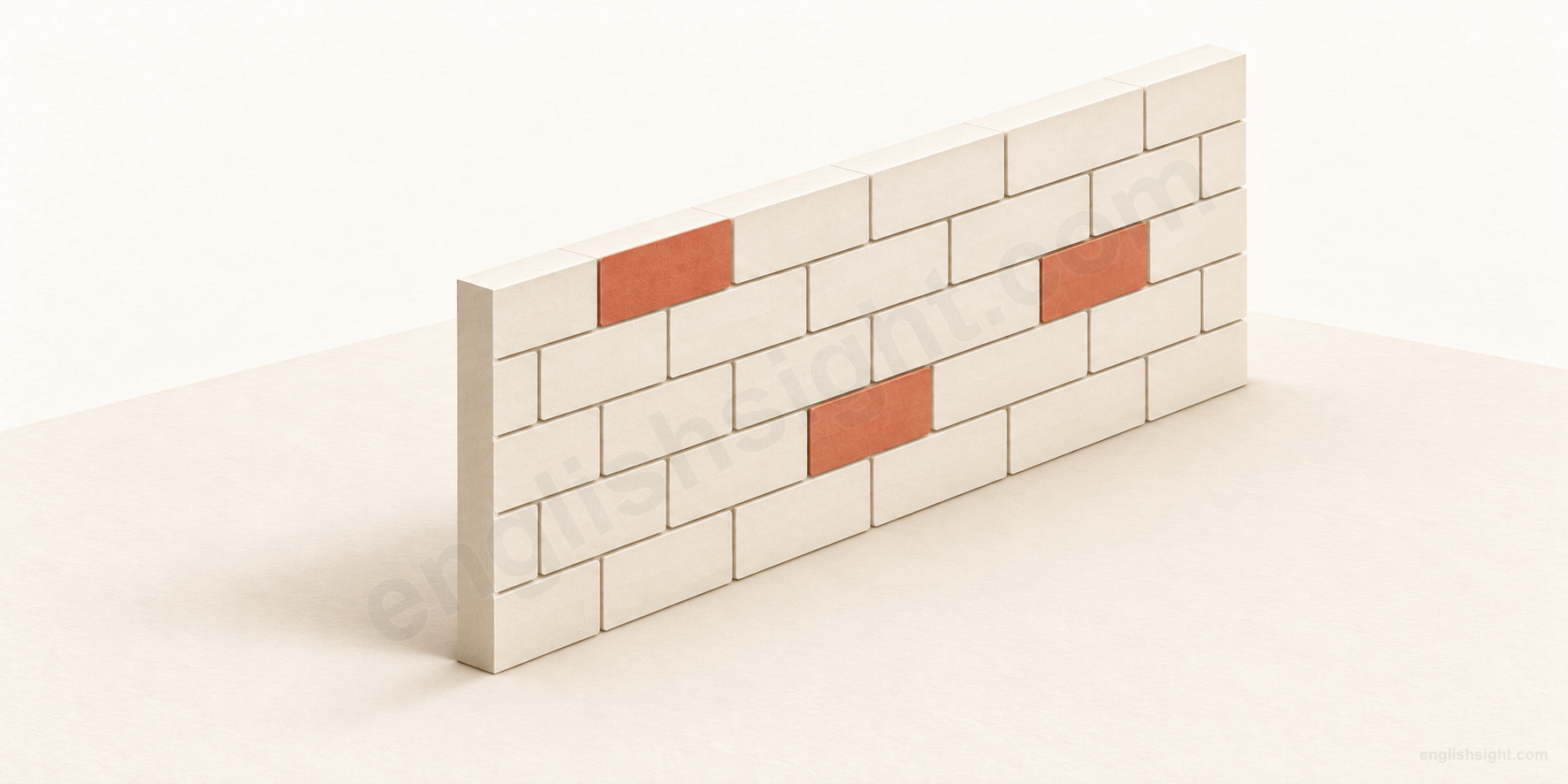
An upright wall separates two areas: a stable boundary, not an action.
A wall forms an upright boundary that encloses or divides space, often protecting what lies on one side.
The sketch shows a dividing wall as a stable relationship, not a movement or a before-and-after action. Walls may also support structures; fixed idioms add meanings that this picture cannot predict.
A wall forms an upright boundary that encloses or divides space, often protecting what lies on one side. This gives us a useful connection between a garden wall, a container wall, and something that blocks progress.
Some expressions keep that connection; others, such as off the wall or the writing is on the wall, have established meanings to learn as whole expressions. The model is a teaching aid, not a claim about an identical picture in every English speaker’s mind.
01
Walls you can touch
Start with buildings, boundaries, and the surfaces of hollow things. Prepositions tell us how another object relates to the wall.
01
a / the + wall; the walls of + room / building; a wall between A and B
the walls of a room
the upright sides of a room or building
Situation
A room needs decorating.
What is meant
You choose a color for its upright surfaces.
Walls are distinct from the floor and ceiling.
Wall is a countable noun: a wall, the wall, two walls. A room may have several walls; a particular wall can also separate two rooms. The wall between the kitchen and the hall identifies the divider.
Paint a wall, repair a wall, and knock down a wall name different actions performed on it. The noun itself does not say that the wall is being built or removed.
In a sentence
We painted the bedroom walls pale yellow.
Choose carefully A roof covers a building from above; a ceiling is the upper inside surface. Neither is normally called a wall.
02
build / put up / climb over + a wall; a wall around + place
a garden wall
a solid structure marking, dividing, or protecting an area
Situation
Two gardens lie next to each other.
What is meant
A stone boundary separates them.
An outdoor wall can stand without being part of a building.
A garden wall or city wall may enclose or protect land. Build a wall and put up a wall describe creating it; climb over a wall describes crossing above it. A low wall is still a wall.
A fence can serve a similar purpose, often using posts, wire, or separate boards. The choice depends on the structure, not just its height. A wall need not be brick: stone, concrete, wood, and glass are possible.
In a sentence
A low stone wall divides our garden from the path.
Choose carefully Wall is not a general word for every barrier: a line of tape is a barrier but is not normally a wall.
03
on / in / against / along / behind / through + the wall
on / in / against the wall
locate something relative to a wall
Situation
You decide where to put a clock and a chair.
What is meant
The clock hangs on the surface; the chair rests against it.
The preposition changes the relationship, while wall keeps its physical meaning.
On the wall normally means attached to or displayed on its surface: a picture on the wall. A hole in the wall is an opening within it. Lean against the wall means use contact with it for support.
Along the wall follows its length; behind the wall locates something on the other side; through the wall describes passage across its thickness. These are ordinary prepositional phrases, not phrasal verbs built from wall.
In a sentence
The clock is on the wall, above a chair leaning against it.
Choose carefully Compare a crack in the wall with a poster on the wall. Choosing in for an ordinary hanging poster changes the intended relationship.
describe a wall-related object or an enclosed place
Situation
You identify a clock and describe a garden.
What is meant
One hangs on a wall; the other has walls around it.
Wall before a noun and walled before a noun do different jobs.
In wall clock and wall light, wall modifies another noun: it tells you the kind or usual position of the clock or light. The whole compound is pluralized at the end: two wall clocks.
A walled garden has walls around it. Glass-walled describes what walls are made of; thick-walled describes their thickness. These forms describe a resulting condition, not necessarily a building action happening now.
In a sentence
The café has a wall clock and a small walled garden.
Choose carefully A wall garden is not the ordinary substitute for a walled garden. Use the form that expresses enclosure.
05
the wall(s) of + hollow object; a thick / thin wall
the wall of a container
the material surrounding a hollow space
Situation
A container has an inside and an outside.
What is meant
Its surrounding material separates the two.
A wall can be an enclosing layer rather than a flat building surface.
The walls of a tank or pipe are the material around the space inside. A thick wall and a thin wall describe that layer. The same extension occurs in the stomach wall, an artery wall, and a plant cell wall.
This does not make wall a synonym for every skin or surface. Learn the established name for the object: the side of a bag is often more natural in everyday conversation.
In a sentence
The tank has thick walls to withstand pressure.
Choose carefully A container’s wall is the material around the hollow space, not the empty space itself.
02
Things that act like walls
A mass, a group of players, or a social obstacle can form a barrier. One digital use names a place for posts rather than an obstacle.
06
a wall of + substance
a wall of water / smoke
a large mass resembling a barrier
Situation
Smoke spreads across the road.
What is meant
The mass blocks the view ahead.
The mass resembles a wall in shape, effect, or both.
A wall of smoke, fire, or water presents the substance as a substantial barrier. Of names the material or substance forming that apparent wall. The phrase does not require bricks or a perfectly vertical shape.
The wall is countable even when the substance is not: a wall of smoke, not a smoke. Compare a cloud of smoke, which emphasizes its spreading shape rather than its blocking effect.
In a sentence
A wall of smoke hid the far end of the street.
Choose carefully Do not read every wall of as a permanent solid object; context may describe something moving or temporary.
07
a wall of silence; walls between + people / groups
a wall of silence
a collective refusal to provide information
Situation
Investigators ask questions.
What is meant
Nobody will tell them what happened.
The barrier prevents access to information.
A wall of silence is more than a quiet room: people will not speak or cooperate. Silence acts like a barrier between the questioner and the information sought.
The broader metaphor also allows a wall of prejudice or walls between people. In We need to break down the walls between our teams, the intended action is better cooperation, not demolition.
In a sentence
Every request for details met a wall of silence.
Choose carefully A moment of silence may show respect. It does not automatically imply a wall of silence.
08
form a wall; shoot over / around the wall
a defensive wall
players forming a barrier against a free kick
Situation
The other team prepares a free kick.
What is meant
Several defenders stand together to block the shot.
People can collectively perform the blocking function of a wall.
In football, also called soccer, the wall is a group of players positioned together during a free kick. The noun refers to the group as a defensive formation, not to a stadium structure.
A player can shoot over or around the wall. Those prepositions describe the path of the ball relative to the formation. This sporting use is related to the barrier model but belongs to this specific context.
In a sentence
The striker curled the ball around the defensive wall.
Choose carefully A wall in this sense is not the whole defending team.
09
write / post + on + someone’s wall
post on someone’s wall
put a message on a social-media profile space
Situation
A website provides a profile area for posts.
What is meant
A friend leaves a message there.
The metaphor treats the page as a display surface.
On platforms that call the profile posting space a wall, write on my wall and post on her wall refer to messages displayed there. This is a digital extension of putting something on a physical wall.
Terminology varies by service and over time. Use the service’s actual term where precision matters; not every profile, feed, or private inbox is a wall.
In a sentence
She posted a birthday message on my wall.
Choose carefully On my wall normally describes a displayed post, not a private direct message.
03
Enclose, separate, or seal
The verb makes or describes a boundary. In, off, and up identify different results; passive forms are especially useful.
10
wall + object + in; wall in + noun; be walled in (by…)
wall something in
enclose a place with walls or barriers
Situation
A courtyard has open boundaries.
What is meant
Walls surround the space.
In emphasizes enclosure.
To wall in a space is to surround it. The passive is common: The courtyard is walled in. Figuratively, someone may feel walled in by restrictions, with little freedom to act.
This is a separable particle construction: wall the courtyard in or wall in the courtyard. With a pronoun, say wall it in. In a walled garden, walled can simply describe the established condition.
In a sentence
The owners walled in the courtyard for privacy.
Choose carefully Wall in emphasizes surrounding; wall off emphasizes separating one area from another.
11
wall + object + off; wall off + noun; be walled off from + place / people
wall something off
separate an area with a wall or comparable barrier
Situation
One large room contains a storage area.
What is meant
A new partition separates that area.
Off emphasizes separation from the rest.
Wall off the storage area means create a dividing boundary. The resulting space can be walled off from the main room. A complete enclosure on every side is not the focus.
Say wall it off with a pronoun. The figurative use in She walled herself off from her friends describes keeping emotional or social distance; no building work is involved.
In a sentence
They walled off part of the garage to make a workshop.
Choose carefully Do not reverse wall off and off the wall: the latter can mean unconventional.
12
wall + opening + up; wall up + noun; be walled up
wall something up
seal an opening with masonry or similar material
Situation
An old doorway is no longer needed.
What is meant
Material fills the opening so it cannot be used.
Up marks the closing or sealing result.
Wall up a doorway or window means fill the opening rather than merely close a door or its shutters. The passive is common when describing an old building: The window has been walled up.
Say wall it up with a pronoun. In historical stories, wall someone up can instead mean imprison them behind walls; the person, not an opening, is the object. This is a different, grim use of the same form.
In a sentence
The old window was walled up during the renovation.
Choose carefully Close the window does not mean wall it up. A window can be closed and still be opened again normally.
04
Progress, pressure, and failure
These expressions use a wall as an obstacle or a limit. The whole expression determines whether someone meets a problem, keeps trying, has few choices, or fails.
13
come up against / be up against + a brick wall
come up against a brick wall
encounter a problem that blocks further progress
Situation
You are making progress on an application.
What is meant
An obstacle prevents you from continuing.
The expression emphasizes the obstacle encountered.
Come up against a brick wall describes reaching a point where a difficulty stops you. Be up against a brick wall describes being in that position. The obstacle may be a rule, missing information, or refusal to cooperate.
Brick strengthens the image of a solid barrier; an actual brick wall is not required. This is an idiom involving come up against or be up against, not a particle verb with wall as its verb.
In a sentence
We came up against a brick wall when the records could not be found.
Choose carefully The idiom says progress is blocked; it does not guarantee the problem will remain impossible forever.
14
be + banging + possessive + head + against a (brick) wall
bang your head against a brick wall
keep trying without getting anywhere
Situation
You repeatedly ask for a correction.
What is meant
The same refusal comes back each time.
Repeated unsuccessful effort is the focus.
Banging your head against a brick wall is an informal way to express frustration at efforts that achieve nothing. The possessive follows the person: I’m banging my head; she’s banging her head.
Compare coming up against a brick wall, which can describe first encountering a difficulty. Banging your head against one puts the repeated, ineffective effort in the foreground.
In a sentence
Asking them to change that rule is like banging my head against a brick wall.
Choose carefully In the idiom, nobody needs to strike their head physically.
15
talking to + person + be like talking to a brick wall; it is like talking to a brick wall
be like talking to a brick wall
speak to someone who will not listen or respond meaningfully
Situation
You explain your concern, but the other person ignores it.
What is meant
You feel your words are having no effect.
The listener seems as unresponsive as a solid wall.
Talking to someone is like talking to a brick wall when they do not listen or engage with what you say. It is an informal, critical comparison: the speaker feels unable to get through to the listener.
Compare banging your head against a brick wall, which can describe many kinds of futile effort. Talking to a brick wall specifically puts failed communication in focus; it does not mean the listener cannot physically hear.
In a sentence
Trying to explain my concerns to him was like talking to a brick wall.
Choose carefully The expression criticizes the lack of a useful response; it is not a neutral description of a quiet person.
16
hit a wall (with + task); hit the wall
hit a wall / hit the wall
reach a limit beyond which continuing is difficult
Situation
Work or exercise has been going well.
What is meant
You reach a point where you cannot keep going as before.
A sudden limit interrupts progress or effort.
Hit a wall can describe a project that stops advancing. Hit the wall is also familiar in endurance exercise, describing a sudden severe loss of energy. Context tells you whether the limit is practical, mental, or physical.
The picture of meeting a barrier helps, but the sporting expression does not mean colliding with a real object. Nor does every use imply permanent failure: a rest or a new approach may allow progress.
In a sentence
Halfway through the long run, I hit the wall and had to slow down.
Choose carefully Hit a wall with the design concerns stalled progress; hit the wall during a race may concern exhaustion. Read the context.
17
have + possessive + back(s) + to / against the wall; with + possessive + back(s) + to the wall
have your back to the wall
be under pressure with few available choices
Situation
A business must pay its bills immediately.
What is meant
Its owners have very little room to choose another course.
The wall represents a lack of room to retreat.
Have your back to the wall describes a difficult, pressured position. With our backs to the wall adapts the possessive and the number of backs to the people involved.
Against the wall is also used in this expression. Unlike hit a wall, this does not focus simply on progress stopping: the emphasis is being cornered and needing to act.
In a sentence
With our backs to the wall, we accepted the only offer available.
Choose carefully The phrase does not say the people have already failed; it describes their pressured position.
18
company / business + go to the wall
go to the wall
fail financially, especially as a business
Situation
A company has been losing money.
What is meant
It cannot survive financially.
This established expression describes failure, not merely difficulty.
In business news and informal discussion, a firm that goes to the wall fails for lack of money. Go changes normally with tense: goes, went, has gone.
Compare hit a wall, which can mean a temporary limit. A company that goes to the wall has suffered a much more serious outcome. The exact legal status is not specified by the idiom.
In a sentence
Several small shops went to the wall after the factory closed.
Choose carefully Going to the wall is not the normal expression for simply walking toward a wall in an account of business failure.
05
Feelings, warnings, and private information
Learn these fixed expressions with their usual articles, prepositions, and tone. They cannot all be predicted from the physical wall.
19
something / someone + drive + person + up the wall; person + go up the wall
drive someone up the wall
annoy someone intensely
Situation
An irritating sound keeps repeating.
What is meant
The listener feels extremely annoyed.
The subject causes the irritation; the object experiences it.
This informal expression can have a person, habit, or noise as its subject. Driving me up the wall is an emphatic complaint, not a claim about physical movement.
Go up the wall can describe the person becoming very angry: Dad will go up the wall if we lose the keys. Drive needs the person affected as its object; go does not.
In a sentence
That repeated alarm is driving me up the wall.
Choose carefully Compare It drives me up the wall with I go up the wall. The participant roles change.
20
be + climbing the walls (with + feeling)
be climbing the walls
feel intensely restless, frustrated, or anxious
Situation
You have been stuck indoors with nothing to do.
What is meant
You feel unable to bear the situation calmly.
This idiom describes a person’s unsettled feelings.
I’m climbing the walls is informal exaggeration for strong restlessness or frustration, sometimes anxiety. The progressive form and plural walls are usual in this idiom.
Compare climbing a wall outdoors, which can be a literal activity. With the idiom, the setting and emotional context make it clear that no climbing action is being reported.
In a sentence
After three rainy days indoors, I was climbing the walls.
Choose carefully Climbing the walls does not necessarily mean anger at another person; drive me up the wall specifically points to a cause of irritation.
21
be + bouncing off the walls
be bouncing off the walls
be so energetic or excited that you cannot keep still
Situation
The children are very excited about the trip.
What is meant
They keep moving around instead of settling down.
The emphasis is lively energy rather than necessarily distress.
Bouncing off the walls is informal exaggeration for being full of energy. It is often used about excited children, but adults can be described this way too.
Compare climbing the walls, which typically highlights uncomfortable restlessness. The physical actions in the two images differ, and so do the usual emotional implications.
In a sentence
The children were bouncing off the walls before the school trip.
Choose carefully Do not automatically translate this as furious or anxious; the expression may describe happy excitement.
22
the writing is on the wall (for…); see the writing on the wall
the writing is on the wall
there are clear signs of future trouble or failure
Situation
A shop loses customers for months.
What is meant
People can see that its future is in danger.
The expression concerns warning signs, not actual writing.
The writing is on the wall presents a bad outcome as clearly signaled. See the writing on the wall means recognize those signs. The handwriting on the wall is another form, especially in North American English.
The expression does not usually predict good news. It is a conventional idiom; the meanings of writing, on, and wall alone do not supply the warning of failure.
In a sentence
When the main customer left, the writing was on the wall for the firm.
Choose carefully Compare a message written on a wall: that can be literal and need not predict anything.
23
be a fly on the wall; a fly-on-the-wall + noun
be a fly on the wall
observe a situation without being noticed
Situation
An interesting private conversation is about to happen.
What is meant
You wish you could hear it without taking part.
The imagined observer remains unnoticed.
I’d love to be a fly on the wall expresses curiosity about a conversation or event you are not part of. A person need not literally hide in the room; it often expresses an unrealized wish.
A fly-on-the-wall documentary follows people in their ordinary activities with little visible intervention. Hyphens join the words when the expression modifies documentary.
In a sentence
I’d love to be a fly on the wall when they discuss the surprise.
Choose carefully This expression concerns unnoticed observation, not a person who controls or interrupts the conversation.
24
Walls have ears.
walls have ears
be careful: someone may overhear
Situation
You are about to discuss something private.
What is meant
A friend warns that others might hear.
The saying warns against assuming privacy.
Walls have ears is a fixed saying. It personifies walls to suggest that unseen listeners may be nearby; it is not a statement that buildings can hear.
The warning can be serious or playful. In a real conversation, the intended action is usually to lower your voice, change the topic, or move somewhere more private.
In a sentence
Keep your voice down—walls have ears.
Choose carefully The saying warns of possible listeners; it does not prove that anybody is actually listening.
25
keep / stay + within these four walls; go no further than these four walls
within these four walls
confined to this room, especially as a secret
Situation
A group hears confidential news.
What is meant
They are asked not to pass it to outsiders.
The room’s boundaries stand for the group’s privacy.
Keep this within these four walls asks the people present not to share the information. Don’t let it go beyond these four walls gives the same practical instruction.
Four walls can also refer literally to a room, as in I need to get out of these four walls for a while. The secrecy reading depends on words such as keep, stay, or go no further.
In a sentence
What we discuss must stay within these four walls.
Choose carefully The expression does not count the room’s actual walls; its force is a request for confidentiality.
26
an off-the-wall + noun; be off the wall
off the wall / off-the-wall
unconventional, strange, or unexpectedly amusing
Situation
Someone suggests a very unusual solution.
What is meant
Others judge how unconventional it is.
The whole expression carries the evaluation.
An off-the-wall idea can be strikingly original or amusing. In another tone, calling a plan off the wall criticizes it as unreasonable. Context and the speaker’s attitude matter.
Hyphens are usual before a noun: off-the-wall humor. After be, write The idea is off the wall. Compare Take the picture off the wall, where off describes actual removal from a surface.
In a sentence
Her off-the-wall jokes made the whole group laugh.
Choose carefully Off the wall is not the same as wall off, which means separate with a barrier.
06
Full coverage, stories, and small places
These established combinations have meanings of their own. Context distinguishes a literal surface from a conventional expression.
27
wall-to-wall + carpeting / coverage / meetings
wall-to-wall
covering an entire floor, or filling time or space
Situation
A room needs a fitted carpet; a broadcaster fills its schedule.
What is meant
The coverage leaves little or no gap.
The extension is from complete physical coverage to continuous coverage.
Wall-to-wall carpeting covers the floor across the room. The walls mark the floor’s limits; the carpet does not cover the walls themselves.
Informally, wall-to-wall coverage means nearly continuous reporting, and wall-to-wall meetings describes a schedule packed with meetings. This is an established adjective before a noun, not the action of building walls.
In a sentence
The channel provided wall-to-wall coverage of the election.
Choose carefully In wall-to-wall carpet, wall names the boundaries of the floor, not the surface being carpeted.
28
break the fourth wall
break the fourth wall
acknowledge the audience from within a fictional story
Situation
A character appears to exist only inside the story.
What is meant
The character directly addresses the viewers.
The boundary separates the story world from its audience.
The fourth wall is an imagined boundary between fictional characters and the audience. A character who turns toward the camera and speaks to viewers can break the fourth wall.
No physical wall has to break. The expression refers to a storytelling convention, so it is useful in conversations about films, television, theatre, and fiction.
In a sentence
The detective breaks the fourth wall to ask the viewers a question.
Choose carefully A character speaking to another character is not by itself breaking the fourth wall.
29
a hole in the wall; a hole-in-the-wall + shop / café
a hole in the wall
a very small place; in British usage, a cash machine
Situation
You hear someone describe a café or a place to withdraw cash.
What is meant
Context identifies which established sense is intended.
This phrase has regional meanings beyond a literal opening.
Especially in North American usage, a hole in the wall can be a small, unassuming shop or restaurant. A hole-in-the-wall café uses the expression before a noun. It need not serve bad food.
In informal British English, a hole in the wall can mean a cash machine. Separately, We repaired a hole in the wall can describe an actual opening. Learn the setting rather than forcing one meaning into every sentence.
In a sentence
We found a tiny hole-in-the-wall café serving excellent soup.
Choose carefully If someone in Britain says they got cash from a hole in the wall, they may mean a cash machine, not a café.
Keep the boundary and the whole expression in view
Countable noun and regular verb
The noun is countable: a wall, walls. The regular verb forms are wall, walls, walled, walling. The verb normally takes an object, often in a passive construction: the doorway was walled up. A room simply having walls is a state, not necessarily an ongoing action.
Particles and ordinary prepositions
Wall in, wall off, and wall up are verb constructions. On the wall and against the wall ordinarily locate something relative to a noun. Drive someone up the wall is a fixed idiom; wall is not its verb.
A connection, not a rule for inventing meanings
The barrier model helps with a wall of silence or hitting a wall. It cannot predict that off the wall may mean unconventional or that writing on the wall signals trouble. Learn those complete expressions, including their tone.
Scope
This lesson covers modern everyday senses, productive wall-related forms, and useful established expressions. It introduces scientific, sporting, and media uses for recognition without teaching specialist construction, anatomy, or sports rules. It does not rank the expressions by frequency.
Choose what the wall expression contributes
Use the situation, the grammar, and the whole expression.
1. A poster hangs on the surface, not inside the structure. Which sentence fits?
2. Builders fill an unused doorway with bricks. Which description identifies that result?
3. You repeatedly ask for a change, but nobody listens. Which expression emphasizes your ineffective effort?
4. A repetitive noise annoys you intensely. Which sentence fits?
5. A channel reports on one event almost continuously. What does wall-to-wall coverage mean?
6. A business loses its last major customer, and observers expect failure. Which expression names the warning signs?
Sources and teaching notes
The dictionary pages below support the uses and forms. The explanations, examples, and boundary model were written for this lesson; the diagram is a teaching interpretation.
The diagram is a teaching aid; it does not claim a shared mental picture for all English speakers.