From armed conflict to fierce competition, campaigns, and familiar sayings.
Opposing sides in conflict
Opposing sides act against each other
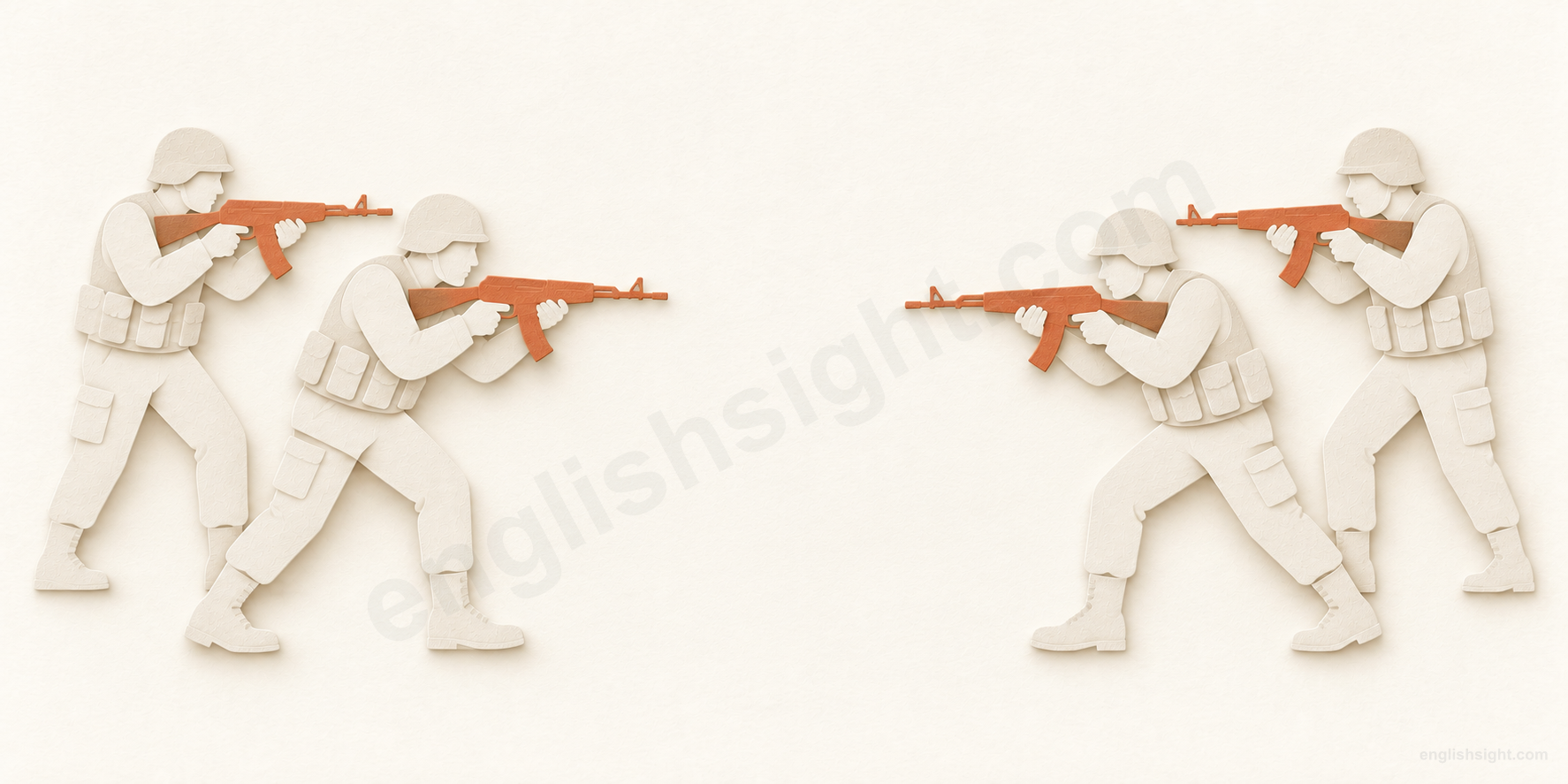
Two helmeted soldiers on each side form opposing groups.
war
The confrontation remains unresolved; no winner or ending is shown.
They aim their rifles toward the other group across the gap.
Organized sides confront each other with weapons. This illustrates literal war within a wider conflict.
War centrally names armed conflict between countries or organized groups; extended uses present a sustained struggle against an opponent or problem.
The sketch illustrates the armed-conflict branch. It does not explain every fixed expression or imply equal blame, equal strength, a formal declaration, or a guaranteed winner.
In its central use, war names armed conflict between countries or organized groups. It can name the general activity or one particular conflict. It is wider than a single battle.
Other uses compare competition, resistance, or hostility to war. Learn the whole expression and its context: a price war, a war on waste, and a war of words are different kinds of opposition.
01
Armed conflict and its grammar
Start with the literal noun, then distinguish a state, a beginning, an announcement, and ongoing action.
01
war (uncountable); a / the war; plural wars
war / a war / wars
armed conflict, generally or as a particular conflict
Situation
You discuss the effects of armed conflict.
What the expression communicates
You distinguish war in general from one particular war.
An ongoing conflict can contain many individual battles.
War can be uncountable when it names armed conflict generally: War changes people’s lives. A war is one particular conflict; wars counts several. The war refers to a conflict already identified by the context.
A battle is an individual fight or engagement; a war is the wider conflict. Conflict is broader still: a disagreement can be a conflict without becoming a war. The sketch focuses on opposing armed groups, rather than one isolated punch.
In a sentence
The museum shows how families lived during the war.
Watch the difference Use a war for one conflict, but no article in a general statement such as War causes suffering.
02
be + at war + (with someone)
be at war (with)
be in a state of armed conflict
Situation
Two countries are fighting.
What the expression communicates
You describe their relationship during that period.
At war names a state; with introduces the opposing side.
Use be at war to describe the situation, not its beginning: The countries were at war for years. With names the opponent, not an ally in this pattern.
In a war can describe someone’s participation in a particular conflict: She served in a war. At war describes the conflicting sides. Figuratively, neighbors at war with each other are in serious ongoing disagreement; the context can remove the armed meaning.
In a sentence
The two kingdoms were at war with each other for years.
Watch the difference Keep the fixed form at war, without a or the. With here does not mean fighting on the same side.
03
go to war + (with / against an opponent)
go to war
begin taking part in a war
Situation
Talks fail to settle a crisis.
What the expression communicates
A country starts fighting.
Go marks entry into the situation, not merely travel.
Go to war focuses on starting involvement. Compare be at war, which describes an existing situation. The country is the subject; its people need not all physically go anywhere.
With can name the opponent: go to war with a neighboring country. The expression alone does not tell us which side is responsible for causing the conflict.
With a person as subject, go to war can also mean join the armed forces during a war: Her grandfather went to war at eighteen. This use concerns the person’s service, rather than a country’s decision to begin fighting.
In a sentence
The leaders hoped to settle the dispute without going to war.
Watch the difference This is a fixed expression, not a separable phrasal verb. Going to the war has a different, more literal destination reading.
04
declare war on + country / problem
declare war on
formally announce war or determined opposition
Situation
A government makes an official announcement.
What the expression communicates
It publicly identifies the country it will fight.
On introduces the target of the declaration.
Declare war on a country concerns a formal announcement. It is different from reporting that fighting has broken out; an announcement and the start of fighting need not be the same event.
The same pattern can announce determined opposition to a problem: The council declared war on litter. That is campaign language, with no literal armed enemy. It is the context and target that establish this reading.
In a sentence
In the novel, the king declares war on his former ally.
Watch the difference Say declare war on, not declare a war to someone. Passive wording is possible: War was declared on the neighboring state.
05
wage war against / on; fight / win / lose / end + a war
wage / fight / win / lose a war
carry on a conflict or describe its outcome
Situation
You discuss a conflict over time.
What the expression communicates
You specify the fighting or its eventual result.
The verb supplies the activity or outcome; war names the conflict.
Wage war means conduct a sustained conflict. Fight a war is a plainer alternative. In wage war against an opponent, against identifies the target; over a disputed area can identify what the conflict concerns.
Use win or lose a war for the outcome, and end a war for bringing it to a close. These are ordinary verb–noun combinations, not separate meanings of the noun. A passive can shift attention to the conflict: A war was fought over the border.
In a sentence
The rival rulers waged war against each other for a decade.
Watch the difference Wage describes conducting the conflict; it does not itself mean win. In this use wage is a verb, unrelated in meaning to weekly wages.
06
war + break out; during / after + the war
war breaks out
armed conflict begins
Situation
A tense situation has not yet become open fighting.
What the expression communicates
War begins.
War is the subject of breaks out.
War broke out presents the start as an event. Someone started a war instead makes a person or group the grammatical subject and highlights responsibility.
The war ended reports its close. During the war places an event within that period, while after the war places it later. These time phrases do not say that the speaker fought in it.
In a sentence
War broke out before the travelers could return home.
Watch the difference Use broke out for the past. In this pattern break out has no object: not War broke out the country.
07
a civil / world war; the + historical name
civil war / world war
identify who is involved and the scale
Situation
You need to identify the kind of conflict.
What the expression communicates
The modifier narrows the meaning of war.
Civil and world contribute information about the participants and scope.
A civil war is fought between groups within the same country. Civil here does not mean polite. A world war involves countries across the world; it does not require every country to participate.
Both can be counted: a civil war, two world wars. World war can also be uncountable when the focus is global warfare in general: They feared the outbreak of world war. Established historical names use capitals, as in the American Civil War and the Second World War. World War II is another name for the Second World War.
In a sentence
The lesson compares a civil war with a world war.
Watch the difference A civil war is not simply any war involving civilians. Learn the complete compound.
08
war + noun; prisoner(s) of war
war zone / prisoner of war / war damage
name places, people, and effects associated with war
Situation
You read a report about the consequences of fighting.
What the expression communicates
The head noun tells you what kind of thing is being described.
War can modify another noun or appear in an of phrase.
A war zone is an area affected by active fighting. A prisoner of war is someone, especially a member of the armed forces, captured by the opposing side during war. The plural is prisoners of war; POW is a familiar abbreviation.
In war damage, war identifies the cause of the damage. In a war film, it identifies the subject. The head noun carries the category: damage is harm, a film is a film, and a zone is an area. Do not treat each combination as a new verb meaning.
In a sentence
The aid workers traveled to a hospital near the war zone.
Watch the difference Being affected by war does not automatically make someone a prisoner of war. This lesson teaches vocabulary, not a legal test for status.
02
Competition, campaigns, and pressure
Read the opponent, target, and full compound to decide whether war is literal or figurative.
09
a war on / against + problem; make / wage war on + target
a war on / against something
a determined campaign to reduce or defeat a problem
Situation
An organization identifies a serious problem.
What the expression communicates
It commits to sustained action against it.
The target can be an unwanted condition rather than an army.
A war on waste or a war against disease presents organized efforts as a struggle against an opponent. On and against identify what the campaign aims to reduce or defeat.
Make war on and wage war on can carry this extended reading too. The military comparison adds intensity, so a campaign against waste is a more neutral description. A war on a problem does not promise success.
In a sentence
The charity has launched a war on food waste.
Watch the difference Do not infer guns or soldiers from war alone when the object is a social problem.
10
a price war between + competitors
a price war
aggressive competition by cutting prices
Situation
Several shops compete for the same customers.
What the expression communicates
Each cuts prices in response to the others.
The competitive weapon is a lower price.
A price war is a pattern of rival businesses reducing prices to beat one another. One shop holding an ordinary sale does not by itself establish a price war.
Between can identify the competing businesses. War emphasizes the intensity of the competition; it does not mean the shops are physically attacking each other.
In a sentence
A price war between the two supermarkets made groceries cheaper.
Watch the difference Do not confuse a price war with a trade war: one concerns competing prices; the other concerns barriers to trade between countries.
11
a trade war between + countries
a trade war
economic conflict using restrictions or taxes on trade
Situation
Countries disagree about trade.
What the expression communicates
They use import taxes or restrictions against one another.
Economic measures take the place of armed fighting.
A trade war involves countries limiting or taxing imports to protect their economies or put pressure on others. Learn the compound as a whole: trade gives the domain of the conflict.
The phrase can be used in a report about tariffs, without any military fighting. A price war instead describes rivals undercutting one another’s prices. Neither compound means every disagreement about money.
In a sentence
The report warns that higher import taxes could lead to a trade war.
Watch the difference War is countable here: a trade war, several trade wars. The noun trade modifies war.
12
a bidding war for / over + property; a bidding war between + buyers
a bidding war
competition between buyers making rival offers
Situation
Several buyers want the same property.
What the expression communicates
They make competing offers to secure it.
Buyers compete to obtain one thing; higher offers may follow.
A bidding war happens when several would-be buyers compete for the same property by making rival bids. The word bidding identifies how they compete; no armed conflict is involved.
Compare a price war: rival sellers lower their prices. In a bidding war, rival buyers can push the offered price up. These compounds describe different sides of a transaction.
In a sentence
Three buyers entered a bidding war for the small house.
Watch the difference A bidding war does not mean buyers are trying to lower competing shops’ prices; that is the pattern behind a price war.
13
a war of words between A and B; a war of words with B
a war of words
a hostile exchange of criticism
Situation
Two organizations strongly disagree.
What the expression communicates
They criticize each other in public statements.
Words are the means of confrontation.
A war of words is an exchange of attacks in speech or writing. It is especially useful in news reporting. The phrase does not imply physical fighting.
Between introduces both sides; with can introduce the other side from one participant’s viewpoint: The club is in a war of words with its former coach. A calm discussion is not normally a war of words.
In a sentence
A war of words erupted between the two clubs after the match.
Watch the difference Keep plural words. A word war is not the usual form of this expression.
14
a war of nerves between + opponents
a war of nerves
a contest of psychological pressure
Situation
Two sides want the other to give in.
What the expression communicates
They try to make each other anxious or lose confidence.
The pressure is psychological rather than a direct physical attack.
A war of nerves focuses on attempts to unsettle the opponent, for example through threats or an intimidating show of confidence. Nerves points to anxiety and self-control.
Compare a war of words, where the focus is an exchange of criticism. A war of nerves may involve words, but its defining feature is pressure on the other side’s confidence, not simply a loud argument.
In a sentence
The final stage of the negotiation became a war of nerves.
Watch the difference It does not simply mean that everyone feels nervous; the expression describes opposing pressure.
15
a cold war; the Cold War
a cold war / the Cold War
hostility without direct open warfare between the main opponents
Situation
Countries remain deeply hostile.
What the expression communicates
They exert pressure without fighting each other openly.
Cold modifies how hostility is expressed; it does not describe weather.
A cold war uses political, economic, and other pressure short of direct open warfare between the opposing countries. It is different from the literal armed conflict illustrated in the sketch.
The Cold War, commonly capitalized, names the historical rivalry after the Second World War between the Soviet bloc and Western powers. That name does not say that there were no wars anywhere during the period. Lower-case a cold war can describe a similar kind of hostility more generally.
In a sentence
The exhibition explores how the Cold War shaped everyday life.
Watch the difference The historical name and the general expression have related meanings, but their reference and capitalization differ.
03
Established expressions
These combinations have conventional meanings and tone; the word war alone cannot predict them.
16
be / have been + in the wars
have been in the wars
have been injured in a fight or accident
Situation
A friend arrives with a bandaged knee.
What the expression communicates
You informally comment on the injury.
The idiom can refer to an ordinary accident, not military service.
You’ve been in the wars! can be a light, sympathetic comment when someone looks injured. It is an informal expression, associated especially with British English.
The full phrase includes the and plural wars. Compare She was in a war, which can literally place someone in an armed conflict. Do not use the humorous idiom to minimize a serious injury.
In a sentence
“You’ve been in the wars!” “Yes, I fell off my bike.”
Watch the difference This idiom does not mean the injured person has fought in several military wars.
17
win the battle but lose the war; lose the battle but win the war
win the battle but lose the war
gain a smaller success while losing the main objective
Situation
A manager wins an argument.
What the expression communicates
The team then loses trust in the manager.
A local victory can undermine the larger goal.
The expression contrasts one immediate success with a more important overall failure. The battle is the smaller contest; the war stands for the wider objective.
The reversed version, lose the battle but win the war, describes a setback followed by overall success. These are figurative assessments, not a promise that every setback is useful.
In a sentence
By forcing an apology but losing her friend’s trust, she won the battle but lost the war.
Watch the difference The comparison depends on what counts as the larger goal; winning a single argument is not automatically overall success.
18
All’s fair in love and war.
All’s fair in love and war.
a saying used to excuse questionable tactics in rivalry
Situation
Someone uses an unfair tactic to get an advantage.
What the expression communicates
They quote a saying to defend their behavior.
This is an attitude expressed by a proverb, not a factual definition of fair.
People quote All’s fair in love and war to suggest that ordinary rules can be set aside in intense competition or romance. It may be said jokingly, defensively, or critically.
All’s means all is. Treat the whole sentence as an established saying. Understanding its meaning does not require accepting the excuse, and it does not establish that any real action is lawful.
In a sentence
He hid his rival’s invitation, then joked, “All’s fair in love and war.”
Watch the difference Do not read the saying as a literal rule governing warfare or as approval of everything people do.
19
a tug-of-war between A and B; a tug-of-war over something
a tug-of-war
a rope-pulling contest, or a struggle for control
Situation
Two groups both want control of the same resource.
What the expression communicates
Neither readily gives way.
The compound can be literal sport or figurative rivalry.
In the sport, teams pull opposite ends of a rope. Figuratively, a tug-of-war is a struggle between competing sides, often over control or possession. The sport supplies the useful picture of opposing pulls.
For example, The departments are in a tug-of-war over the budget means they are competing for control of the money. It does not imply that anyone is actually pulling a rope. Tug of war without hyphens is also used.
In a sentence
The two departments are in a tug-of-war over the budget.
Watch the difference Learn the complete compound; its literal meaning is a sport, not a type of armed war.
04
Recognize the verb and warring
The noun is central, but reports also use the verb and the adjective warring.
20
war with / against someone; warring + noun
war / warred / warring
fight or be in active conflict; describe opposing groups
Situation
A report identifies groups that keep fighting.
What the expression communicates
You describe them as warring groups.
War also has an intransitive verb use; warring often modifies a noun.
The verb means engage in war or active conflict: The factions warred against each other. Its forms are war, wars, warred, warring, with double r in the last two. In ordinary conversation fight or be at war is often a simpler choice.
Warring factions and warring neighbors describe groups in conflict; the conflict may be armed or an ongoing quarrel. Collins treats warring as an adjective before a noun, while the headwords also list it as the verb’s -ing form. The grammatical job depends on the sentence.
Warring can also describe abstract things in opposition: The committee tried to reconcile warring interests. Here interests means conflicting aims or concerns, not groups carrying weapons.
In a sentence
A mediator tried to bring the warring neighbors together.
Watch the difference Do not use war as an ordinary transitive replacement for fight: say fight an enemy or war against an enemy, not war an enemy.
Let the full expression guide the meaning
War, battle, fight, and conflict
War names the wider armed conflict; a battle is one engagement. Fight can describe a small physical encounter or an effort. Conflict includes disagreements without weapons. These words overlap in figurative language, so they are not interchangeable in every sentence.
Countability and articles
Compare War is destructive, a war began, two wars ended, and during the war. Fixed expressions keep their own grammar: at war, go to war, declare war, but a war of words and in the wars.
Grammar belongs to each construction
War is chiefly taught here as a noun, sometimes modifying another noun. The verb is intransitive in the modern general use. Passives such as War was declared contain a different verb. There is no productive causative or separable particle-verb family for war to memorize.
Scope and tone
This is a selection of modern uses, not a frequency ranking or a complete military glossary. Figurative war can sound intense or exaggerated. The diagram is a teaching model, not a claim that every English speaker imagines the same scene.
Read the conflict and the construction
Choose the sentence that fits the situation.
1. You mean armed conflict in general, rather than one particular conflict. Which sentence fits?
2. The countries have already been fighting for three years. Which expression describes their continuing relationship?
3. Two shops keep lowering their prices to attract each other’s customers. What is this?
4. Two clubs attack each other in public statements, with no physical fighting. Which expression fits?
5. A British friend sees your bandaged elbow after a cycling accident and says, “You’ve been in the wars!” What is meant?
6. Someone wins an argument but permanently loses an important friendship. Which expression captures the trade-off?
Sources and teaching notes
The listed dictionaries were read to check meanings, constructions, and idioms. Explanations and examples are original; the diagram is a teaching interpretation.
The sketch is a teaching model of the armed-conflict branch, not a mental image shared by every speaker.