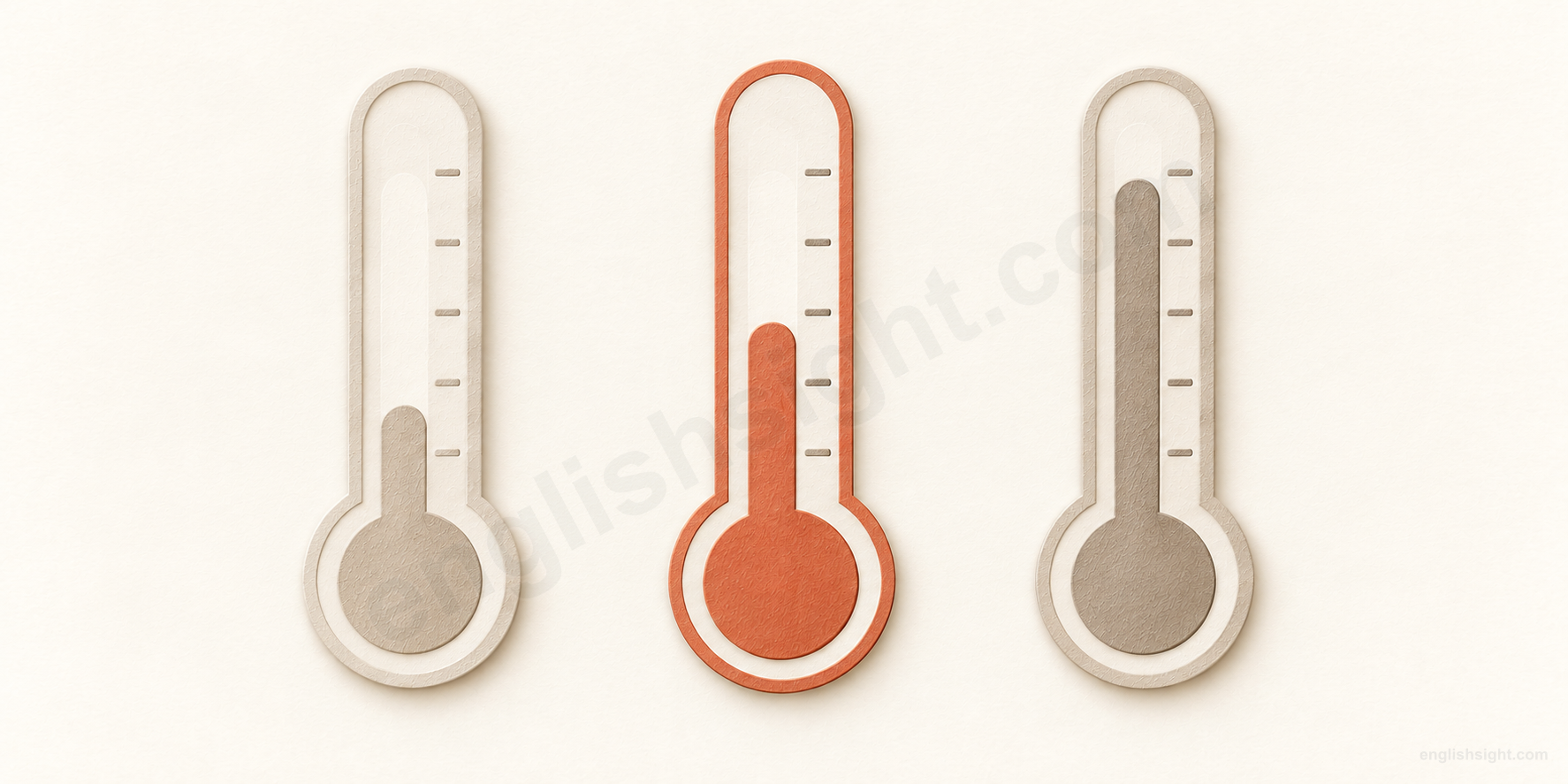
Use warm for temperature, friendliness, preparation, and growing interest.
Warm sits between cooler and hotter
Warm sits between cooler and hotter
Cooler: a low liquid level
warm
Hotter: a high liquid level
Warm: the highlighted middle level
Warm is between cooler and hotter in this comparison. These are states, not a sequence in time or fixed temperature bands.
Warm describes a moderate level of heat. The verb warm means to make something warmer or to become warmer. Some emotional uses present friendliness and interest as warmth.
The three thermometers compare degrees, not three compulsory stages in time. Warm can be pleasant or excessive in context. Colour, readiness, and fixed expressions require their own explanations.
Warm most directly describes noticeable, moderate heat: a warm room, warm water, or warm hands. The verb warm means make or become warmer. A warm coat helps retain heat rather than necessarily supplying it.
Friendliness and enthusiasm also use heat language: a warm welcome, warming to an idea, or warming up an audience. These are established English uses, not a rule that every expression containing warm means comfort.
The temperature comparison is a teaching aid. It does not represent a shared mental picture in every English speaker, and it cannot predict fixed idioms.
01
Temperature and keeping comfortable
Describe a temperature, someone’s bodily comfort, or clothing that keeps heat in. These are related uses, but a warm coat need not feel hot when you touch it.
01
warm + noun; be / feel + warm; warmer than; the warmest
warm water / a warm day
have a noticeable but moderate amount of heat
Situation / starting point
You want water that is neither cold nor hot.
Meaning / resulting state
You describe its temperature as warm.
Warm locates a temperature; it does not by itself describe heating.
Warm normally contrasts with both cool and hot. It often suggests comfort, but not always: a room can be too warm or uncomfortably warm. There is no single temperature that counts as warm for every object and situation.
Use warm before a noun or after be, feel, or become: a warm evening; the air feels warm. Warm to the touch describes how something feels when touched. In Serve the bread warm, warm describes the bread at serving time.
Comparatives are warmer and warmest: This room is warmer than the hall. A warmer day need not be warm in absolute terms; it may simply be less cold than yesterday.
In a sentence
The water feels warm, but it is not hot.
Watch the difference Warm is an adjective here. Say The water feels warm, rather than feels warmly.
02
warm + clothes / coat / blanket / sleeping bag
warm clothes / a warm blanket
help someone retain body heat
Situation / starting point
You choose what to wear on a cold evening.
Meaning / resulting state
You choose clothing that protects you from the cold.
Warm can describe an item’s ability to keep you warm.
A warm coat is suitable for cold conditions because it helps you stay warm. This describes what the coat does for the wearer, rather than claiming that the unworn coat produces heat.
The same everyday pattern applies to socks, blankets, sleeping bags, and houses that stay warm. A hot coat would usually suggest that the coat itself is hot, rather than simply good winter clothing.
Wrap up warm is an informal instruction to put on enough clothing to stay warm. Here warm has an adverb use, also expressible as wrap up warmly. This established wording does not make warm a general substitute for warmly: greet someone warmly describes a friendly manner.
In a sentence
Bring a warm jacket for the boat trip.
Watch the difference Do not read warm clothes as clothes for hot weather; the usual meaning is clothing that keeps the wearer warm.
03
keep / stay + warm; keep + object + warm
keep warm / keep someone warm
maintain a warm state
Situation / starting point
Your feet are comfortable now, but the floor is cold.
Meaning / resulting state
Socks help them remain comfortable.
Keep and stay maintain the state described by warm.
Keep warm and stay warm focus on continuing to be warm. Keep something or someone warm adds the thing or person whose temperature is maintained: a lid keeps the soup warm; gloves keep your hands warm.
Warm does not become a verb after keep. Compare The heater warms the room, which describes heating it, with The heater keeps the room warm, which emphasizes maintaining the condition. Stay warm can also be a friendly parting wish in cold weather.
In a sentence
These thick socks keep my feet warm.
Watch the difference Put the object before the adjective: keep my feet warm, not keep warm my feet.
04
get / become + warm; subject + warm up
get warm / warm up
become warmer, especially after feeling cold
Situation / starting point
You come indoors with cold hands.
Meaning / resulting state
After a while, you no longer feel cold.
Get warm describes entering a state; warm up names a warming process.
Get warm uses get plus an adjective to describe a change. Warm up uses the verb warm and the particle up. Both can describe recovering from feeling cold: Sit here until you get warm; Sit here and warm up.
The context can be a body, room, or weather. It is warming up reports rising temperature, whereas It is warm reports the current condition. Becoming warmer is not a promise of comfort: it may eventually get too warm.
In a sentence
I sat in the sunshine until I got warm.
Watch the difference I am warm describes a state. I am warming up describes a change or preparation, depending on context.
05
in / into + the warm
in / into the warm
in or into a warm place
Situation / starting point
You have been waiting outside in the cold.
Meaning / resulting state
You move to a warmer indoor place.
The warm can refer to a place with a warm temperature.
In the warm describes location; into the warm describes movement to that location. This noun use is found especially in British conversation. It does not name a particular room, but the context often points to the space indoors.
For the general quality or feeling, use warmth: the warmth of the sun. Compare Come into the warm with Come into the warm room, where warm is an adjective modifying room.
In a sentence
Let’s take the children inside into the warm.
Watch the difference The usual general noun is warmth. Do not freely use a warm to mean a quantity of warmth.
02
Making something warmer
The verb names a change in temperature. The object and any following particle tell you what changes, whether food is being reheated, and how far the heat reaches.
06
warm + object; subject + warm; be warmed by + cause
warm your hands / warm the room
make a person or thing warmer, or become warmer
Situation / starting point
Your hands feel cold beside a radiator.
Meaning / resulting state
The heat raises their temperature.
The thing receiving heat is the object of transitive warm.
Warm can take an object: The sun warms the wall. It can also be intransitive: The wall warms in the afternoon. The two sentences present a cause acting on something and the thing changing temperature.
Warm yourself by the fire is reflexive: yourself refers to the same person as the subject. A passive is possible when the receiver matters: The room is warmed by sunlight. Warming need not continue until something is hot.
The same verb appears in climate language: The planet is warming describes a rise in temperature. Global warming names that broad phenomenon; warm does not mean the change must be pleasant.
In a sentence
The afternoon sun warmed the stone wall.
Watch the difference Distinguish warm hands, an adjective plus noun, from warm your hands, a verb plus object.
07
warm up + noun; warm + noun / pronoun + up; warm + food + over
warm something up / warm it over
heat food, often food that has already been cooked
Situation / starting point
Yesterday’s soup is cold.
Meaning / resulting state
You heat it again for lunch.
Food plus warm up often means reheating rather than cooking from raw.
Warm the soup up and warm up the soup are both possible. With a pronoun, use warm it up. The particle up belongs to this separable verb pattern; it does not mean moving the food upward.
Warm can also describe gently heating an ingredient for the first time: warm some milk. The object and context establish whether this is initial heating or reheating. Warm over is another expression for reheating cooked food, especially in American usage.
The related adjective warmed-over can describe reheated food. Used disapprovingly about an idea or plot, it suggests old material reused without freshness: a warmed-over plot. That evaluative meaning is conventional, not a claim about real heat.
In a sentence
There is soup in the fridge; I’ll warm it up for lunch.
Watch the difference Say warm it up, not warm up it. The word warm alone does not specify a precise cooking temperature.
08
warm through; warm + object + through; be warmed through
warm something through
heat something so that its inside is warm as well
Situation / starting point
The outside of a portion is warm, but its middle is still cold.
Meaning / resulting state
Further heating reaches the middle too.
Through concerns the extent of heating within the food.
Warm through and warm something through focus on the whole item, including its centre. Through adds this extent meaning; up alone does not specifically contrast the surface with the middle.
Both The filling needs to warm through and Warm the filling through are possible. With a pronoun, say warm it through. This is a language distinction, not a substitute for any particular recipe’s instructions.
In a sentence
Keep the pie in the oven until the filling has warmed through.
Watch the difference Warm through does not mean carry warm food through a doorway. Read through as part of the heating expression.
03
Getting ready and becoming lively
Warm up can prepare bodies, equipment, performers, or an audience. Read the situation: these established uses involve more than a temperature description.
09
warm up before + activity; warm up for + event; warm up + voice / muscles
warm up before a run
prepare the body or a performance with preliminary activity
Situation / starting point
A runner has not begun the main run.
Meaning / resulting state
Gentle movement prepares them for it.
The activity comes before the main effort or performance.
Warm up can mean doing preliminary exercise or practice. Warm up before a race places it in time; warm up for a race names the event being prepared for. A singer can warm up their voice before a performance too.
The noun warm-up names the preliminary activity: a short warm-up; warm-up exercises. Write the verb as two words, warm up. Preparation is an established use: the important result is readiness, not simply feeling hot.
In a sentence
We warmed up with a short jog before the run.
Watch the difference Do not confuse warming up before the main effort with warming down after it.
The equipment becomes ready after starting to run.
An engine or other machine can warm up as it runs. A person can also warm it up. The intransitive version focuses on the machine; the transitive version names the person arranging the preliminary operation.
This use is about the equipment reaching an appropriate working condition. It does not mean that all machines require this step, or that warm up is another word for repair. It describes a stage before normal operation in the situation given.
In a sentence
The old projector takes a minute to warm up.
Watch the difference The machine is warm describes temperature. The machine has warmed up can describe being ready to work.
11
warm up + audience / crowd; warm + them + up; audience / event + warm up
warm up the audience / the party warms up
make people more lively, responsive, or enthusiastic
Situation / starting point
The audience is quiet before the main show.
Meaning / resulting state
An opening activity gets them laughing and responding.
The change is in energy and engagement, not necessarily body temperature.
A host or performer warms up an audience by getting people into a responsive mood. The audience warms up focuses on their response. The party warmed up likewise means it became livelier.
The noun warm-up can name a preliminary performance, and a warm-up act goes on before the main performer. These uses connect readiness with enthusiasm, rather than literally heating the people in the room.
In a sentence
The host warmed up the audience with a quick game.
Watch the difference Warm them up can refer to raising enthusiasm or temperature. Let the situation decide.
12
warm down after + activity
warm down after exercise
follow hard exercise with gentler activity
Situation / starting point
The main workout has finished.
Meaning / resulting state
You continue with a gentler period afterward.
Down marks the ending and easing-off stage of the activity.
Warm down names gentle exercise after a more demanding activity. Compare warm up before the activity with warm down afterward. Cool down is another familiar expression for this ending phase.
The expression does not mean make your body cold. Learn its place in the activity sequence as a whole, rather than treating down as the ordinary opposite of an increase in temperature.
In a sentence
After the match, the players warmed down with a gentle walk.
Watch the difference Use warm down for the stage after exercise; warm up usually refers to the preparation before it.
04
Friendliness, appreciation, and growing interest
Emotional warmth suggests affection, welcome, or enthusiasm. Warm describes a quality; warm to describes developing a feeling toward someone or something.
13
warm + person / voice / smile; be warm and friendly; smile warmly; voice / expression + warm
a warm person / a warm smile
show affection, friendliness, or sympathy
Situation / starting point
A colleague listens kindly and makes you feel welcome.
Meaning / resulting state
You describe their manner as warm.
Warm characterizes the emotional quality of a person or their behaviour.
A warm person is openly friendly or affectionate. A warm voice, smile, or embrace expresses that quality. This emotional use makes a useful connection with physical comfort, but it does not claim that the person’s skin is warm.
Warm-hearted similarly describes a kind, caring person. For the manner of an action, use warmly: She smiled warmly. In Her smile was warm, warm is an adjective describing the smile; in She smiled warmly, the adverb describes how she smiled.
The verb warm can also describe a change in manner without to or up: Her voice warmed when she mentioned her family. Here her voice became friendlier or more affectionate; a warm voice describes the quality, while a voice that warms describes the change.
In a sentence
His warm smile helped the new student relax.
Watch the difference She is warm usually concerns temperature or personality according to context. She is hot has other possible meanings and is not a safe substitute.
14
give / receive + a warm welcome; a warm reception; warm applause / support
a warm welcome / a warm reception
an enthusiastic, friendly response to someone or something
Situation / starting point
A new neighbour arrives at a community meeting.
Meaning / resulting state
People greet her with friendliness and enthusiasm.
The warmth belongs to the reception, not to the room temperature.
Give someone a warm welcome describes how the greeters receive the person. Receive a warm welcome describes it from the visitor’s side. A warm reception can also be a positive response to a speech or proposal.
Warm support and warm applause express enthusiasm or approval. Context matters: a warm debate can instead mean a vigorous or heated disagreement. Warm does not make every noun it modifies positive.
In a sentence
The neighbourhood gave our family a warm welcome.
Watch the difference A warm welcome describes friendliness. A warm room describes temperature; neither meaning automatically entails the other.
express friendly good wishes or sincere appreciation
Situation / starting point
You finish a friendly message or thank someone for their help.
Meaning / resulting state
You choose an affectionate or appreciative formula.
Warm adds personal goodwill to a conventional message.
Warm regards is a friendly way to end a message. Warmest regards makes the goodwill more emphatic. Warm thanks, warmest thanks, and warmest congratulations similarly express heartfelt appreciation or happiness for someone.
Warmest is a superlative form, but in these formulas it normally intensifies the feeling; you need not compare every person’s thanks. Choose the formula to suit the relationship and occasion rather than assuming warmer wording is always more appropriate.
In a sentence
Please accept our warmest thanks for your help.
Watch the difference Use warmly to describe an action, as in thanked her warmly; use warm or warmest before the noun thanks.
16
warm to / towards + person; warm up to + person
warm to / towards someone
begin to like someone or feel friendlier toward them
Situation / starting point
A new teammate initially seems distant to you.
Meaning / resulting state
As you talk, you begin to like them.
The subject develops a favourable feeling toward the person after to.
Warm to someone means begin to like them, not physically move closer or heat them. The feeling may develop gradually or arise quickly: I warmed to her immediately is possible. Warm towards someone also occurs.
American English also uses warm up to someone. Keep the person after the preposition: I warmed to him; I warmed up to him. Compare I warmed him up, which can mean made him warmer or more lively and uses a different object pattern.
In a sentence
I warmed to our new neighbour after we talked about gardening.
Watch the difference To is a preposition here. Do not change I warmed to him to I warmed him and expect the same meaning.
17
warm to + idea / plan; warm to the idea of + -ing
warm to an idea / a plan
become more interested in or accepting of something
Situation / starting point
At first, the proposal does not appeal to you.
Meaning / resulting state
After hearing the details, you feel more positive about it.
The change is in the subject’s attitude toward the proposal.
Warm to an idea means become more receptive or enthusiastic. Warm to the idea of doing something combines the expression with the noun idea and an of phrase: I’m warming to the idea of moving.
The wording presents a change of attitude. It does not guarantee final agreement or action. Compare I support the plan, a direct statement of support, with I’m warming to the plan, which can still leave room for consideration.
In a sentence
I’m warming to the idea of taking the train instead.
Watch the difference In warm to an idea, to introduces a noun phrase. It is not the infinitive marker in a pattern such as want to go.
18
warm to + one’s subject / theme / topic
warm to your subject / theme
speak or write about a subject with growing enthusiasm
Situation / starting point
A speaker begins with a restrained explanation.
Meaning / resulting state
As the talk continues, they become more animated.
Interest develops during the telling, not necessarily from initial disagreement.
Warm to your subject or theme often describes becoming more enthusiastic while speaking or writing about it. The person may have liked the subject all along; the expression can focus on their increasingly lively treatment of it.
This shares the growing-interest pattern of warm to an idea, but the communicative scene differs. A speaker warming to a theme is getting into the topic, whereas a listener warming to a proposal is becoming more receptive to it.
In a sentence
As she warmed to her subject, her explanations grew more animated.
Watch the difference The subject or theme is a topic here, not a person whose temperature is being raised.
The heat language describes an emotional response.
Something warms your heart when it gives you a feeling of affection, pleasure, or hope in people. You can also have a warm feeling or a warm glow when remembering something pleasant.
A warm fuzzy feeling, and the informal noun warm fuzzies, refer to comforting, affectionate feelings, especially in North American usage. Warm the cockles of someone’s heart is a more old-fashioned, especially British, idiom for making someone feel happy or contented. Learn that longer phrase as a whole.
In a sentence
Seeing the neighbours help each other warmed my heart.
Watch the difference This is emotional warmth. The heart is not literally being heated, and cockles is part of an established idiom.
05
Colour and clues in a game
Some uses borrow the language of heat without describing real temperature. Learn the colour convention and the guessing-game convention separately.
20
warm + colour / shade / tone / lighting
warm colours / warm lighting
have a colour character associated with red, orange, or yellow
Situation / starting point
You choose colours for a room or lighting for a photograph.
Meaning / resulting state
You choose tones that suggest warmth rather than coolness.
Warm describes a visual quality rather than a measured temperature.
Warm colours include red, orange, and yellow tones. A warm yellow wall or warm lighting can help create a welcoming visual impression. The term concerns the look, so an orange object can be cold to touch.
Cool colours are the contrasting colour category, often associated with blue or green. A warm colour may affect the mood of a design, but the word alone cannot guarantee that every viewer will find it comfortable.
In a sentence
We chose warm orange tones for the reading corner.
Watch the difference Warm lighting does not necessarily mean a lamp that produces much physical heat.
21
be + warm; get + warmer (in guessing/search contexts)
You’re getting warmer.
you are getting closer to the hidden thing or correct answer
Situation / starting point
A child guesses where you hid a small toy.
Meaning / resulting state
Their next guess is closer than the previous one.
Warmer is a clue about progress toward an answer.
In hiding and guessing games, warm tells the searcher that they are close. Getting warmer means moving closer to success; colder signals moving farther away. The person’s actual body temperature is irrelevant.
The same clue can be used playfully when someone is approaching a solution outside a game. Getting warmer is comparative progress, not confirmation that the answer is already correct.
In a sentence
“Is the key near the window?” “You’re getting warmer.”
Watch the difference This use normally follows be or get. It is not the ordinary meaning of a warm key or warm answer before a noun.
06
Recognizing fixed expressions
These expressions are useful to recognize in conversation or sports. Their meanings belong to the whole phrase and cannot be calculated from warm alone.
22
be / feel + (as) warm as toast
(as) warm as toast
very comfortably warm
Situation / starting point
You settle under a thick blanket on a cold night.
Meaning / resulting state
You feel cosy and comfortably warm.
The fixed comparison emphasizes comfort.
Warm as toast is an informal, cheerful way to describe being pleasantly warm. The first as may be present or absent: as warm as toast; warm as toast.
It does not mean you feel dry, crisp, or literally at the temperature of toast. This comparison has a conventional comforting meaning rather than transferring every property of the food.
In a sentence
Under that quilt, I was as warm as toast.
Watch the difference This expression usually praises comfort; it does not normally mean unbearably hot.
23
look / feel + like death warmed up / over
look / feel like death warmed up
look or feel extremely ill or exhausted
Situation / starting point
You have had almost no sleep and feel awful.
Meaning / resulting state
You use an exaggerated informal expression.
The whole idiom describes a miserable condition, not a helpful warming process.
Like death warmed up is British informal wording; like death warmed over is the North American form. Look describes appearance and feel describes the person’s own experience.
The phrase is deliberately exaggerated. It does not say anyone is dead, and its up or over cannot be interpreted using the ordinary food-heating pattern. Calling another person this can sound blunt; consider the relationship and context.
In a sentence
After the overnight journey, I felt like death warmed up.
Watch the difference Keep the fixed form warmed, not warming. This is an informal description, not a medical diagnosis.
24
player + warm the bench
warm the bench
spend time as a substitute instead of playing
Situation / starting point
A player belongs to the team but is rarely selected to play.
Meaning / resulting state
They spend much of the season sitting out.
The bench represents being on the sidelines rather than participating.
In sports, especially American usage, warm the bench means be a substitute who rarely plays. It often conveys frustration or criticism about not getting into the game.
The image connects a seated player with warming their seat, but the sporting role is the meaning. Warm up before a match is completely different: that describes preparing to play, not being left out.
In a sentence
He joined the team, but spent most of the season warming the bench.
Watch the difference This is a sporting idiom, not an instruction to heat the team’s seating.
Read the grammar and the situation
State, change, and maintenance
The room is warm states a condition. The room is warming describes a change. The heater warms the room names its cause; the heater keeps the room warm emphasizes maintaining the condition. Keep warm uses an adjective; warm up uses a verb and particle.
Warm, hot, and lukewarm
Warm usually means less heat than hot in the same setting. Lukewarm often suggests only slightly warm, sometimes disappointingly so, as with coffee. In a lukewarm response, the figurative meaning is limited enthusiasm; a warm response is more positive. These words do not define universal temperature bands.
Forms and pronunciation
The adjective has warmer and warmest. The verb has warms, warmed, and warming, without doubling the m. Common pronunciations are British /wɔːm/ and American /wɔːrm/. Warmly describes manner, as in greet someone warmly; warmth names a quality or feeling. In keep warm, warm remains an adjective, not a general replacement for warmly.
Objects and particles
Warm up is separable when it takes an object: warm the soup up / warm up the soup / warm it up. Warm to and warm towards keep the person or idea after the preposition: warm to him, not warm him to. Warm up to someone is a different construction from warm someone up.
Grammar does not promise success
The progressive is natural for a developing process: The room is warming; I’m warming to the plan. Passive warming is also possible: The room is warmed by the sun. These are ordinary active/passive and aspect choices, not extra senses. Becoming interested does not guarantee agreeing, and preparing does not guarantee a successful performance.
The model has limits
Friendly warmth, warm colours, game clues, and idioms are conventional uses. A warm debate can be heated rather than friendly. Further uses involving a quick temper, danger, wealth, punishment, or a fresh hunting scent are outside the main learning scope. This lesson organizes common uses and selected recognition items; it is not a complete inventory or a frequency ranking.
Choose the meaning or construction
Use the situation and the words around warm to decide.
1. Someone tells you to bring warm clothes for a cold camping trip. What do they mean?
2. The room is still cold, but its temperature is rising. Which sentence describes that process?
3. The soup is cold. Replace the soup with it in Warm the soup up.
4. You disliked a proposal at first, but the details are making it more appealing. Which wording fits?
5. The main match has ended. The players do a gentle walk afterward. What are they doing?
6. During a hiding game, someone says You’re getting warmer. What does this clue mean?
Sources and teaching notes
Usage was checked against the publisher pages below. Explanations and examples are original. The temperature diagram is a teaching comparison; emotional and idiomatic links are explained with their limits.
The diagram compares temperature levels. It does not claim that every speaker imagines the same picture.