From cleaning with water to moving waves and familiar fixed expressions.
Liquid removes material from a surface
Contact, removal, and a changed surface
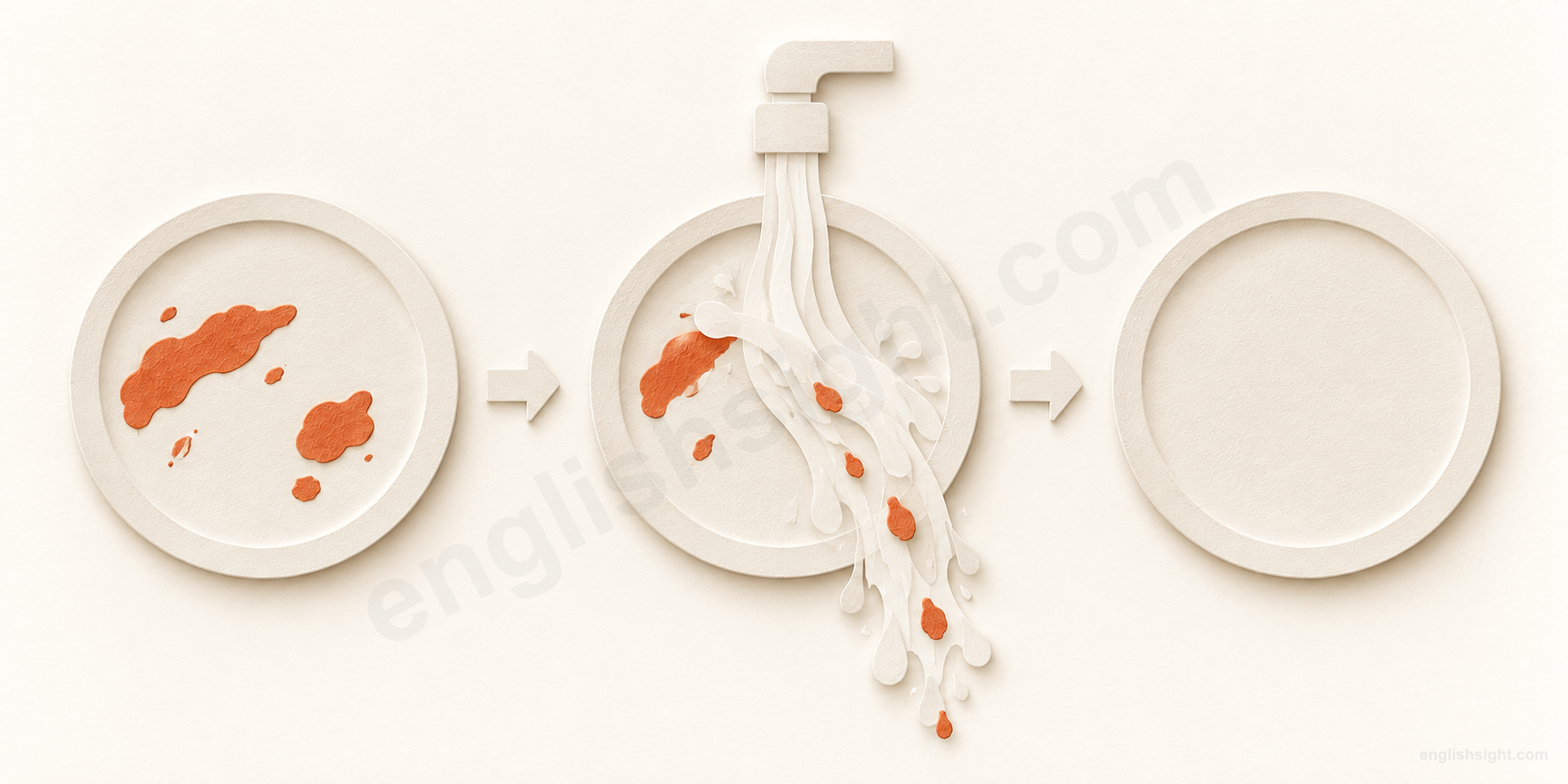
Food residue clings to the plate.
wash
The same plate is now free of the visible residue.
Water flows over the plate and carries residue off its lower edge.
The same plate before, during, and after washing: water carries residue away. This illustrates the central cleaning use.
Liquid contacts a dirty surface and carries unwanted material away, leaving the object cleaner.
This diagram models the central cleaning use. Water can also wash over or carry an object without cleaning it; coating and idiomatic uses need their own explanations.
In its central cleaning use, wash means to use liquid, usually water, to remove unwanted material from a person or thing. Start by asking what is being washed and what, if anything, is being carried away.
Other uses concern water flowing or carrying things, a layer of colour, and established figurative expressions. The cleaning picture is a useful starting point, not a rule that predicts every combination.
01
Cleaning people and things
Start with the thing being cleaned, then identify the liquid, method, or person doing the work.
01
wash + object; wash something with / in something; wash something + adjective
wash the dishes / clothes / fruit
clean something using liquid
Starting situation
A bowl has food stuck to it.
What happens / what is meant
You clean it with water and washing-up liquid.
The direct object names the thing being cleaned.
Wash normally involves water, often with soap or detergent. The object can be dishes, clothes, a car, food, or another thing; soap is not a requirement of the word.
With water or with soap identifies what you use; in warm water identifies the liquid environment. By hand and in the washing machine describe methods. Wash the bowl clean adds a result: clean describes the bowl after washing.
Clean is broader: you can clean a desk by wiping it without washing it. Rinse emphasizes using clean water to remove loose dirt or a cleaning substance, often after washing.
In a sentence
I washed the bowl in warm water, then rinsed it.
Watch the difference Do not assume wash always means use soap, or that every kind of cleaning is washing.
02
wash; wash yourself; wash + possessive + body part
wash / wash yourself / wash your hands
clean your body or a part of it
Starting situation
You have been working in the garden.
What happens / what is meant
You clean your hands before eating.
The body part normally takes a possessive determiner.
Say wash my hands, wash her hair, or wash your face. Wash without an object can mean wash yourself, especially in British English: I washed and got dressed.
Wash yourself makes the person being cleaned explicit and is useful when discussing the ability to manage personal care. Get washed is also familiar, especially in British everyday routines.
A cat washes itself by licking its fur. This established animal-grooming use is an exception to the usual human association with water.
In a sentence
Please wash your hands before you set the table.
Watch the difference Wash myself is possible, but wash my hands is the ordinary form when you name the hands.
03
be + washed; have / get + object + washed; need washing / need to be washed
be washed / have something washed
focus on an item being cleaned or arrange the cleaning
Starting situation
The hotel sends its sheets to a laundry.
What happens / what is meant
A laundry worker cleans them.
A passive and an arrangement have different subjects.
The sheets are washed every day focuses on the sheets; the cleaner can be omitted. Have the sheets washed means arrange for someone to wash them. Get the sheets washed can also mean arrange or manage to complete the task.
These sheets need washing means they need to be washed. The -ing form after need has a passive interpretation here; the sheets do not do the washing.
I am washing the sheets describes an action in progress. This ordinary action use allows the progressive, unlike many state verbs.
In a sentence
We have the blankets washed at the end of each month.
Watch the difference We washed the blankets says we did the work; we had them washed usually assigns the work to someone else.
04
clothing / fabric + wash + well / badly
This fabric washes well.
remain in good condition when washed
Starting situation
You want clothing that is easy to care for.
What happens / what is meant
The fabric keeps its shape and colour after washing.
The item is the subject, but it is not a cleaner.
A fabric that washes well withstands washing satisfactorily. This describes a general property, not a shirt actively cleaning another thing.
Compare The shirt is being washed, an event happening now. The shirt washes well describes how it responds to repeated washing. An adverb such as well or badly helps identify this reading.
In a sentence
These cotton covers wash well and dry quickly.
Watch the difference Do not change well to good here: washes well describes performance in washing.
02
Off, out, down, and up in cleaning
These combinations specify removal, an interior, a thorough wash, or a regional household task. They do not all mean the same thing.
05
wash something off (something); something washes off
wash the mud off / wash it off
remove something from a surface with liquid
Starting situation
Mud is stuck to a pair of boots.
What happens / what is meant
Water removes the mud from their surface.
The object may be the unwanted material, rather than the boots.
Off marks separation from a surface. Wash the mud off your boots names both the material and the surface. Wash off the mud and wash the mud off are also possible.
With a pronoun for the removed material, put it before off: wash it off. The mark itself can be the subject: This paint washes off means it can be removed by washing.
Wash your boots focuses on the boots being cleaned; wash the mud off focuses on what is removed. The same event can be viewed in either way.
In a sentence
Wash the mud off your boots before you put them away.
Watch the difference Say wash it off, not wash off it, when it means the substance being removed.
06
wash out + container; wash + container / pronoun + out
wash out a jar
clean the inside of a container
Starting situation
An empty jam jar still has sticky residue inside.
What happens / what is meant
You clean its interior before reusing it.
The container is the object; out directs attention to its inside.
Wash out a jar, bottle, or tank means wash its interior. It does not mean remove the whole container from somewhere.
Both wash out the jar and wash the jar out work. A pronoun goes in the middle: wash it out. Compare wash the label off the jar, where the material on the outside is being removed.
In a sentence
I washed the jar out before filling it with rice.
Watch the difference The object of wash out a jar is the container; the object of wash the jam out is the material removed.
07
wash something out (of something); something washes out
wash the stain out / the stain washes out
remove a substance from material by washing
Starting situation
There is a mark in a tablecloth.
What happens / what is meant
You try to remove it without ruining the cloth.
A person can remove the mark, or the mark can be described as removable.
Wash the stain out of the cloth focuses on removing something embedded in the material. The stain washes out describes its capacity to disappear in washing, with no cleaner named.
Wash it out uses a pronoun before the particle. Out of introduces the material the substance leaves: wash the shampoo out of your hair.
Off often suggests a surface; out often suggests a substance in cloth, hair, or a container. Actual collocations overlap, so do not treat this as an absolute physical rule.
In a sentence
Will this berry stain wash out of the tablecloth?
Watch the difference A stain that will not wash out may remain after washing; will not here need not mean a refusal.
08
wash down + surface; wash + object / pronoun + down
wash down the walls
clean a surface thoroughly with liquid
Starting situation
Dust covers the workshop walls.
What happens / what is meant
You clean the surfaces with water.
Down belongs to a cleaning combination, not necessarily downward travel of the object.
Wash down a wall, vehicle, or work surface emphasizes a thorough wash, often with a flow of water or attention from top to bottom.
The walls do not move downward. Both wash down the walls and wash the walls down are possible; with a pronoun, use wash them down. Food as the object gives a different sense, taught below.
In a sentence
They washed down the workshop walls after clearing the dust.
Watch the difference Do not use this surface-cleaning meaning to interpret wash a sandwich down with tea.
09
wash up; wash up the dishes; do the washing-up
wash up / do the washing-up
wash dishes after a meal, especially in British English
Starting situation
Dinner has finished.
What happens / what is meant
Someone cleans the used dishes and pans.
The household task depends partly on regional usage.
In British English, I’ll wash up normally means I will wash the dishes. You can name the objects: wash up the plates or wash the plates up; with a pronoun, wash them up.
Do the washing-up names the same task. Washing-up liquid is the British household name for the liquid used to wash dishes by hand. In American English, wash the dishes is the usual unambiguous choice.
Up does not mean put the plates higher. This is an established household expression.
In a sentence
You put the leftovers away, and I’ll wash up.
Watch the difference The dishes meaning is especially British; an American request to wash up may concern your hands instead.
10
person + wash up
wash up before lunch
clean your hands or face, especially in American English
Starting situation
A child comes in from playing outside.
What happens / what is meant
The child cleans their hands before lunch.
The same words can name personal washing rather than dishwashing.
In American English, wash up commonly means wash your hands and perhaps your face. Before a meal, it usually tells people to get themselves clean, rather than clean the dishes.
In British English, wash your hands or have a wash makes that intention clearer. Region and situation help disambiguate wash up; they are not rigid rules about every speaker.
In a sentence
Go and wash up; lunch is almost ready.
Watch the difference Do not assume every wash up refers to plates, or that up means washing your whole body from head to foot.
03
Water moving and carrying things
Here water is the moving force. It may cover a surface or move an object without making it clean.
11
water / waves + wash + against / over / along + place
waves wash against / over something
water flows against or across a surface
Starting situation
A boat moves through rough water.
What happens / what is meant
Waves flow across its deck.
The water is the subject; cleaning is not asserted.
Waves wash against the rocks describes contact; water washes over the deck describes coverage or passage across it. The preposition supplies the particular spatial relation.
This use can describe gentle lapping or stronger moving water, depending on the context. Wash does not itself say that the surface becomes clean.
In a sentence
Small waves washed against the harbour wall.
Watch the difference Water washed over the deck does not mean someone deliberately washed the deck.
12
water + wash something away; something be washed away
wash away a path / wash it away
water carries off material, sometimes destroying what was there
Starting situation
Heavy rain loosens soil on a path.
What happens / what is meant
Floodwater carries the surface away.
The water causes removal; no human cleaner is needed.
A flood can wash away soil, a bridge, or part of a road. Away presents removal from the original place, often with damage. The passive is common: The path was washed away.
You can say wash away the soil or wash the soil away. A pronoun goes before away: wash it away. The cleaning use also allows wash away dirt, but a washed-away bridge is not a clean bridge.
Wash out can also describe water damage: The flood washed out the road means water destroyed or made it unusable. Compare a match washed out by rain, where rain prevents the event rather than necessarily destroying a physical object.
In a sentence
The storm washed away part of the footpath.
Watch the difference Read the object: washing away dirt can help; washing away a road describes damage.
13
something washes up on + shore; be washed up / ashore / overboard
wash up on a beach / be washed ashore
water carries something onto land and leaves it there
Starting situation
A piece of driftwood is floating at sea.
What happens / what is meant
The water leaves it on the beach.
Up and ashore indicate arrival at the edge of land.
A branch washed up on the beach and A branch was washed up on the beach both describe water bringing it there. The passive highlights the object affected by the sea.
Washed ashore has a similar meaning; ashore already means onto land. Wash someone overboard instead describes carrying a person off a boat into the water.
This wash up is about transport and deposition, not dishwashing or a person cleaning their hands.
In a sentence
Several wooden crates were washed ashore after the storm.
Watch the difference A washed-up actor is a separate figurative adjective; it need not describe anyone arriving on a beach.
04
Drinks, feelings, words, and weather
Read the subject and the whole combination. Familiar extensions include strong feelings, ignored remarks, and events stopped by rain.
14
wash + food / tablet + down with + drink
wash food down with a drink
drink with or after food, often to help swallow it
Starting situation
A cracker is dry.
What happens / what is meant
You follow it with some water.
The food is the object; with introduces the drink.
Wash a cracker down with water means drink water with or after eating it, often to help it go down. The same expression can be used with tablets; this is a language pattern, not advice about how to take any particular medicine.
Wash down the cracker and wash the cracker down are possible. A pronoun goes between verb and particle: wash it down with water. This does not mean clean the food before eating.
In a sentence
She washed the dry cracker down with a sip of water.
Watch the difference Say wash it down with water, not wash down it with water.
15
feeling + wash over / through + person
relief washes over someone
a feeling strongly and suddenly affects a person
Starting situation
You have been anxious while waiting for news.
What happens / what is meant
A reassuring message brings strong relief.
The feeling behaves like a wave in a teaching comparison.
Relief, fear, or another feeling can wash over someone. The subject names the feeling, and over introduces the person affected. This is especially associated with written or descriptive English.
Relief washed over me suggests the feeling arriving strongly, rather than someone choosing to feel it. Wash through someone is also found in literary descriptions.
The image of a wave helps connect this use to flowing water, but no actual liquid or bodily washing is implied.
In a sentence
Relief washed over me when the missing dog came home.
Watch the difference Keep the person after over: relief washed over me, not relief washed me over.
16
words / events + wash over + person; let something wash over you
let criticism wash over you
remain unaffected by words or events around you
Starting situation
Someone makes an unhelpful comment.
What happens / what is meant
You do not let the comment trouble you.
Unlike a strong feeling, these words do not have a lasting effect.
If remarks or criticism wash over you, you do not absorb them or let them affect you. Let them wash over you can advise someone to leave unhelpful comments alone.
The exact effect depends on the context: it may be not paying attention, not understanding, or not becoming upset. The phrase itself does not promise that the person understood every word.
Compare relief washed over her, where the feeling does affect her strongly. The subject and situation distinguish these established meanings of wash over.
In a sentence
He let the rude comments wash over him and continued his talk.
Watch the difference Over takes its object after it: let them wash over you, not let them wash you over.
17
event + be washed out (by rain); rain washes out + event
a match is washed out
rain prevents an event or makes it stop
Starting situation
An outdoor match is planned.
What happens / what is meant
Persistent rain prevents play.
The event is cancelled or spoiled by rain, rather than cleaned.
A match was washed out means rain stopped it from happening or continuing. This use is often passive, with by rain added if useful. In the active version, rain is the cause: The rain washed out the match.
A washout can name a rain-ruined event and, informally, a complete failure even without rain: The launch party was a washout. That noun is related but is not the verb form.
In a sentence
Saturday’s tennis match was washed out by heavy rain.
Watch the difference Washed out describes the effect of rain on an event; a washed-out colour is a different adjective use.
05
A wash, the wash, and a thin layer
The noun can name an act, laundry, disturbed water, a coating, a cleaning product, or an outcome with no net advantage.
18
have a wash; give + object + a wash; after several washes
have a wash / give something a wash
an act of cleaning with water
Starting situation
You return home dusty.
What happens / what is meant
You take a few minutes to clean yourself.
The countable noun packages washing as one occasion.
Have a wash, especially in British English, means wash yourself. Give the car a wash describes cleaning the car. In both, a wash is an instance of washing.
A quick wash describes speed or duration; a thorough wash describes care. The plural can count repeated cleanings: The print faded after three washes.
In a sentence
I’ll have a quick wash before we leave.
Watch the difference In this use, wash is a noun, so keep a in have a wash.
19
do a wash; put something in the wash; be / shrink in the wash
do a wash / be in the wash
wash a load of clothes or refer to laundry being processed
Starting situation
Your favourite shirt is not in the wardrobe.
What happens / what is meant
It is waiting to be washed with other clothes.
The wash can include clothes awaiting washing, not only a running machine.
Do a wash means wash a load of laundry. A dark wash is a batch of dark clothes. Put the towels in the wash adds them to the laundry that needs washing.
My shirt is in the wash can mean it is being washed or waiting to be washed. It shrank in the wash means it became smaller during washing.
Washing is also used for clothes to be washed or already washed, especially in British English: hang out the washing means put the wet clothes outside to dry.
In a sentence
My blue shirt is in the wash, so I’m wearing the white one.
Watch the difference In the wash does not guarantee that the washing machine is running at this moment.
20
the wash of / from + boat; the wash of waves
the wash from a boat
disturbed water or waves caused by a moving boat
Starting situation
A motorboat passes a small rowing boat.
What happens / what is meant
The waves behind it rock the smaller boat.
The noun names moving water and can also name its sound.
The wash from a boat is the disturbed water it produces as it moves. A smaller boat may rock in that wash after the larger boat has passed.
The wash of waves can also refer to their movement or sound near a shore. Neither use refers to cleaning a boat.
In a sentence
The wash from the ferry rocked our small boat.
Watch the difference A boat wash here is not a service for washing boats; the context concerns waves.
21
a wash of + colour / light; wash a surface with + colour
a wash of colour / light
a thin coating or broad spread of colour or light
Starting situation
An artist starts with a pale background.
What happens / what is meant
A thin layer of colour covers the paper.
This branch spreads a layer rather than necessarily removing one.
In painting, a wash is a thin application of liquid colour. A wash of blue can describe a light, broad layer rather than a dense block of paint.
A wash of light similarly presents light spreading over a surface, especially in descriptive writing. This is not a claim that every wash removes dirt: coating is a distinct established branch.
Wash can also be a verb in this coating sense: wash the paper with pale colour. The noun is useful when discussing watercolour techniques.
In a sentence
She added a pale blue wash to the background.
Watch the difference A colour wash deposits a layer; do not force the dirt-removal model onto this use.
22
body / skin + wash; a bottle of body wash
body wash / a skin wash
a liquid product used for cleaning the skin
Starting situation
You are choosing a product for a shower.
What happens / what is meant
You choose a liquid cleanser.
Here wash names a substance rather than an occasion.
Body wash and skin wash name cleansing liquids. A bottle of body wash contains the product; it does not contain an act of washing.
The noun can be uncountable when naming the substance and countable when naming a kind or product: a gentle body wash. Compounds such as mouthwash have their own established spelling.
In a sentence
There’s a bottle of body wash beside the shower.
Watch the difference Have a wash is an action; use body wash refers to applying a product.
23
be a wash
It’s a wash.
gains and losses or advantages and disadvantages balance
Starting situation
A new route saves a small fare but needs a paid transfer.
What happens / what is meant
The extra cost cancels the saving.
The whole outcome has no net gain in the respect being compared.
It’s a wash can mean the gains and losses cancel each other. In a comparison, it can mean neither option offers an overall advantage in the respect under discussion.
For example, saving five dollars and then paying an extra five dollars makes the money result a wash. That does not say every other feature of the choices is identical.
This is an established outcome use of the noun. It cannot be reliably predicted from the physical cleaning picture.
In a sentence
The discount was five dollars, but delivery cost five dollars, so it was a wash.
Watch the difference A wash means the effects balance here; a washout means a failure and is a different word.
06
Fixed expressions and familiar adjectives
Learn these as complete expressions. A cleaning image may help memory, but it cannot supply their full social or figurative meaning.
The fixed negative use judges an explanation, not its cleanliness.
That excuse won’t wash is an informal way to say that it is not convincing or acceptable. With me or with the manager identifies the person who rejects it.
Doesn’t wash describes present unacceptability; won’t wash can reject a proposed excuse. The normal form is intransitive, often negative: the excuse is the subject.
Learn this as an established expression. It does not mean the speaker has attempted a literal cleaning test.
In a sentence
Saying you forgot again won’t wash with the team.
Watch the difference Do not confuse won’t wash meaning unconvincing with a fabric that will not wash well.
25
wash + possessive + hands + of + person / thing
wash your hands of something
refuse further involvement or responsibility
Starting situation
You have repeatedly tried to help a failing project.
What happens / what is meant
You declare that you will no longer be involved.
The whole idiom expresses withdrawal from responsibility.
Wash your hands of a project means refuse to remain responsible for or involved with it. The object after of may also be a person.
The possessive changes with the subject: I washed my hands of it; she washed her hands of it. The expression can sound strongly disapproving or final.
Unlike washing mud off your hands, this need not involve water. It states someone’s attitude to involvement; it does not prove that they have no real obligation.
In a sentence
After months of arguments, he washed his hands of the project.
Watch the difference Keep of for this idiom: wash my hands of it. Wash my hands with soap is literal cleaning.
26
wash / air + possessive + dirty linen / laundry + in public
wash your dirty linen / laundry in public
discuss private, embarrassing matters publicly
Starting situation
A family has a private disagreement.
What happens / what is meant
Its members argue about the details where everyone can hear.
The laundry stands for private troubles in an established idiom.
Wash your dirty linen in public and wash your dirty laundry in public criticize making private or embarrassing affairs public. Air your dirty laundry in public is another established variant.
The expression is disapproving. It is about exposing personal matters, not about whether someone uses an outdoor washing line.
As with other idioms, keep the whole wording in mind rather than assigning this social meaning to wash alone.
In a sentence
They were accused of washing their dirty laundry in public during the interview.
Watch the difference Dirty laundry can mean embarrassing private matters figuratively; the idiom does not make every mention of laundry figurative.
27
something will (all) come out in the wash
It will all come out in the wash.
the truth will emerge or difficulties will be resolved later
Starting situation
A confusing situation has not yet been explained.
What happens / what is meant
You expect time to clarify it or settle the problem.
The idiom can reassure, but it does not promise an investigation.
In one use, come out in the wash means the truth will eventually become known: Nobody knows who approved it yet, but it will come out in the wash.
In another, it reassures someone that problems will sort themselves out: Don’t worry about the small mix-up; it’ll all come out in the wash. The surrounding concern tells you which meaning is intended.
These are figurative uses of the whole expression. Contrast The stain came out in the wash, which can literally report a mark disappearing during washing.
In a sentence
No one knows who changed the figures, but it will all come out in the wash.
Watch the difference Check whether the context is about truth emerging, problems being resolved, or literal stain removal.
28
washed-out + colour / image; feel / look washed out
washed-out colours / feel washed out
very pale in colour, or exhausted
Starting situation
A photograph looks weak in colour; a traveller feels drained.
What happens / what is meant
You describe a faded appearance or a lack of energy.
The adjective has a visual use and a person-related use.
Washed-out colours are pale or faded-looking. The effect may resemble repeated washing, but an actual wash is not required: a photograph can look washed out because of the lighting.
A person who feels or looks washed out is exhausted or appears tired and lacking energy. This is different from being washed, which can simply mean being clean.
A hyphen is usual before a noun, as in washed-out colours. After feel or look, the phrase is often written as two words: I feel washed out.
In a sentence
After the overnight journey, I felt completely washed out.
Watch the difference A match washed out by rain is an event prevented by weather, not a tired person or a pale colour.
29
be washed up; a washed-up + person
a washed-up performer
someone whose career or success is considered finished
Starting situation
A performer has lost their former success.
What happens / what is meant
A critic dismisses their chances of succeeding again.
This informal adjective makes a harsh judgment about prospects.
A washed-up performer is described as no longer successful and unlikely to recover that success. The phrase can be insulting, and the judgment may be wrong.
Someone is washed up uses the adjective after be; a washed-up performer usually has a hyphen before the noun. It is unrelated to whether that person has washed their hands.
Distinguish a washed-up actor from driftwood washed up on a beach. The latter describes physical transport by water; the former is an established figurative assessment.
In a sentence
The review called him a washed-up singer, but his next album was a hit.
Watch the difference In the career sense, washed up judges someone’s prospects, not just their energy today. Some dictionaries also record a tired or exhausted sense, so context still matters.
Choose the object and read the whole expression
Forms and pronunciation
Forms are wash, washes, washed, washing. Washed ends in /t/ and normally has one syllable; washes ends in /ɪz/ and has two. Regional vowel pronunciations vary.
Action, property, and passive
I am washing the shirt is an action; the shirt washes well is a property; the shirt is being washed is passive. Have the shirt washed adds an arrangement. Wash does not have a general wash someone to do something causative pattern.
Particles and prepositions
In wash it off, wash it out, wash it down, and wash it away, a pronoun precedes the separable particle. In relief washed over me, over keeps the person after it. Prepositions such as with and in identify a liquid, place, or participant; they do not automatically create a phrasal verb.
Coverage boundary
This lesson selects modern everyday and useful reading uses, not every technical dictionary sense or a frequency ranking. Mining, chemical purification, metal plating, distilling wash, wash trading, specialist aviation wash, and regional landscape names are not expanded. Derived washing and washout are included only where they help distinguish common expressions.
Choose the intended meaning
Use the subject, object, and context to distinguish cleaning from other meanings.
1. A label says the covers wash well. What does that mean?
2. In an ordinary British kitchen, a guest says, “I’ll wash up after dinner.” What task are they offering to do?
3. Some removable paint is on your hand. Replace the paint with it. Which order fits?
4. “The criticism washed over her without upsetting her.” Which meaning fits?
5. You save ten dollars but pay an extra ten dollars in fees. “It’s a wash” describes what?
6. “I’ve washed my hands of the dispute.” What has the speaker done?
Sources and teaching notes
Dictionary meanings and constructions were checked against the sources below. The explanations and examples are original; the diagram is a teaching model of the central cleaning use.
The diagram is a learning aid, not a picture shared by every native speaker.