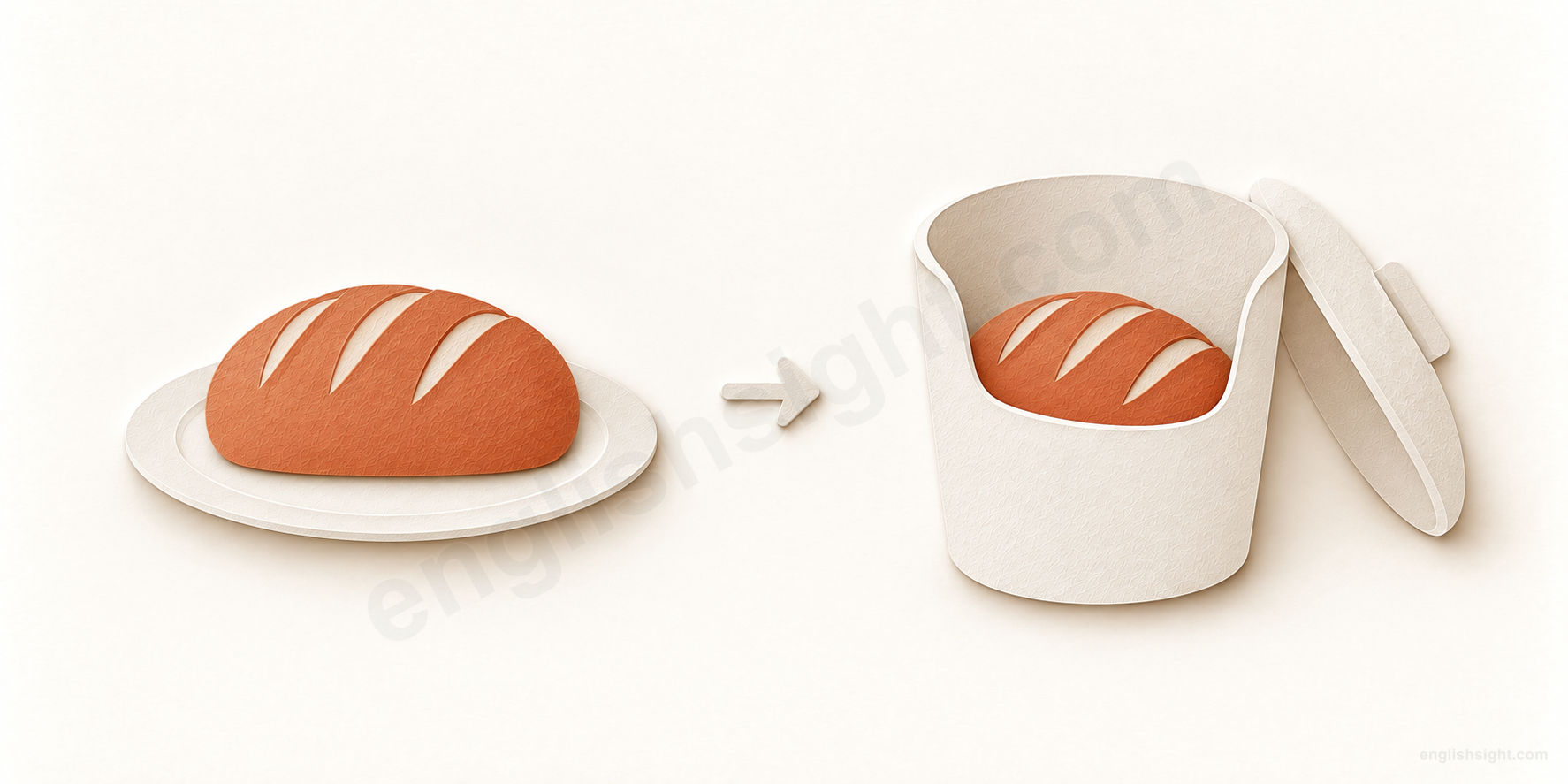
See how waste connects poor use, missed chances, leftovers, and familiar expressions.
Available value and lost benefit
Available value does not become useful benefit
An intact loaf is available on a plate.
waste
The uneaten loaf is now inside a waste bin.
It is discarded without being eaten.
The bread could have fed someone; it is discarded uneaten.
Something useful is used, lost, or left unused without bringing the benefit it could have brought.
The picture shows one clear case: edible bread is discarded without being eaten. Time, talent, and opportunities can lose their value without becoming physical rubbish; waste away and the land uses need their own explanations.
Waste often asks a practical question: did something bring the benefit it could have brought? Water can run away unused, time can pass without progress, and an opportunity can disappear without being taken.
The word is also a noun for unwanted material and a description in phrases such as waste ground. These uses are connected, but one picture cannot predict every established expression. The picture is a teaching aid, not a shared mental image claimed for all English speakers.
01
Resources, time, and missed value
Name what is poorly used, the activity it goes into, or the useful possibility that is missed. The speaker judges the use against a purpose.
01
waste + resource; waste + resource + on + noun / -ing form
waste water / money on something
use a resource with too little useful benefit
Situation / available value
A tap runs while nobody needs the water.
Use / result
Useful water has gone down the drain.
Waste evaluates the use of something against what it could usefully achieve.
You can use water, money, energy, food, or materials without wasting them. Waste adds a negative judgment: more is used than needed, or the use brings too little benefit. That judgment depends on the situation; paying for something is not automatically wasting money.
The direct object names the resource. In waste money on a broken machine, on introduces what the money goes toward. It is an ordinary prepositional complement, not a separable particle: waste it on repairs, not waste on it repairs.
The passive keeps the resource in focus: A lot of water is wasted through leaks. This need not be deliberate; a fault or a poorly designed process can waste resources too.
In a sentence
We wasted money on a printer that never worked.
Watch the difference Spend is neutral about value; waste criticizes the use. Do not use waste as a neutral synonym for use.
02
waste + (someone’s) time + (in) doing; waste time on + noun
waste time doing something
spend time on an activity that is not worthwhile
Situation / available value
You keep checking an inbox instead of preparing your work.
Use / result
The time passes without useful progress.
Time is the object; the -ing clause names the activity judged unhelpful.
In waste time looking for a file, looking tells us what occupies the time. In is possible before the -ing form, though the version without it is common. You can also say waste time on a task.
You’re wasting your time asking me can warn that I cannot help. It does not necessarily mean asking is morally wrong or that every minute has already been lost. The judgment concerns the likely result.
Compare spend time checking, which just describes how time is used. For this pattern, use doing rather than an infinitive after time.
In a sentence
I wasted half an hour checking the wrong folder.
Watch the difference Say wasted time searching, not wasted time to search, when you name the unhelpful activity.
03
waste + an opportunity / a chance + to + verb
waste an opportunity
fail to make use of an available chance
Situation / available value
A visitor offers you a chance to practise speaking.
Use / result
You do not use the chance before the visitor leaves.
Something can be wasted by being left unused, not only by being consumed.
An opportunity or a chance is a possibility available for a limited time. Wasting it means failing to use it well. Nothing needs to be physically used up or put in a bin.
To plus a verb after opportunity identifies what the opportunity allows: an opportunity to ask questions. The phrase a wasted opportunity describes the chance as not having been used well. Miss an opportunity can be more neutral; waste often suggests that it could have been used better.
In a sentence
We wasted an opportunity to ask the engineer about the fault.
Watch the difference The infinitive belongs to opportunity; it does not make waste to ask a general verb pattern.
04
person / talent + be wasted + in + setting; person + be wasted + as + role
be wasted in a job / as a manager
have abilities that a role does not use well
Situation / available value
A skilled designer has a job with no design work.
Use / result
Her ability remains underused.
The person or talent is valuable; the role fails to draw on that value.
Her talent is wasted in that job says the job does not make good use of her ability. The passive describes underuse, even when she is working hard. It does not say she has no talent.
You’re wasted as a manager can suggest that another role would suit your abilities better. In names the setting or job; as names the role. These are not particle verbs, and they are different from be wasted on a person who cannot appreciate something.
In a sentence
Your drawing skills are wasted in a job that only involves filing.
Watch the difference Calling someone wasted in a role criticizes the fit, not the person’s worth.
05
something + be wasted on + person; waste + something + on + person
be wasted on someone
be offered where it is not appreciated or understood
Situation / available value
You explain a subtle joke to someone who does not understand it.
Use / result
The joke’s effect is lost on that listener.
On identifies the recipient who fails to benefit, understand, or appreciate.
A good joke is wasted on me means I do not appreciate or understand it. Advice can be wasted on someone who ignores it. The resource is often something valuable, such as kindness, effort, or good food.
The passive is especially useful here: the joke or advice is the subject, and on introduces its recipient. In the active, Don’t waste your advice on me, advice is still the resource. Compare waste money on a ticket, where on names a purchase instead.
A negative can reverse the result: Your advice wasn’t wasted on me—I changed my plan. That says the advice did have an effect.
In a sentence
The technical jokes were wasted on me because I knew nothing about computers.
Watch the difference Do not confuse I am wasted with The joke is wasted on me; the latter describes the joke’s unsuccessful effect.
06
waste no time (in) + -ing; there is no time to waste
waste no time in doing something
begin or act promptly
Situation / available value
You receive news that needs a reply.
Use / result
You reply immediately.
No removes the delay; the following action is carried out promptly.
She wasted no time in replying means she replied straight away or very quickly. The expression does not criticize the reply as useless. No changes the interpretation from unhelpful delay to prompt action.
In can be omitted: She wasted no time replying. There’s no time to waste is a related warning that the situation is urgent; it does not report that an action has already happened. Both differ from She wasted time replying, which judges the time spent on the reply negatively.
In a sentence
When the alarm sounded, we wasted no time in leaving the building.
Watch the difference No is essential to the prompt-action meaning. Wasted time leaving does not express the same thing.
02
A poor use, or material to dispose of?
Waste can name an unhelpful use of resources or the material left over. Articles and surrounding nouns help distinguish these meanings.
07
a waste of + resource; it is a waste (of time) + -ing / to-infinitive; what a waste!
a waste of time / What a waste!
a use or loss that does not seem worthwhile
Situation / available value
You attend a meeting that settles nothing.
Use / result
You judge that the time brought too little benefit.
A waste of names the resource whose value has been lost.
That was a waste of time evaluates an event. Use a before waste in this singular expression, even though time itself is uncountable. A complete waste of money strengthens the judgment.
It’s a waste of time arguing about it and It would be a waste to throw it away are useful sentence frames. What a waste! expresses disappointment about lost value; the context supplies what has been wasted.
This is the noun use. Compare We wasted an hour, where wasted is the verb. An event can be called a waste without producing any physical rubbish.
In a sentence
The trip was a waste of time because the office was closed.
Watch the difference Say a waste of time, not a waste time, when the phrase evaluates an activity.
Uncountable waste can name the general problem rather than a single event.
We need to reduce waste can mean using resources more carefully. Here waste names a general process or problem, so no a is needed. Avoid waste, prevent waste, and unnecessary waste belong to this pattern.
The same sentence can also concern the amount of discarded material. Context decides: careful measuring may reduce inefficient use, while reusable packaging may reduce rubbish. Do not force a distinction that the speaker has left broad.
In a sentence
We measure each piece of fabric carefully to reduce waste.
Watch the difference I hate waste is general; It was a waste evaluates a particular use or event.
Homes and factories produce material they no longer need.
Use / result
The material is collected, processed, recycled, or disposed of.
The noun names material, not the action of using it badly.
Waste includes discarded food, packaging, production leftovers, and other unwanted material. It is broader than everyday rubbish or trash and can include liquids and hazardous substances. Waste can still contain recoverable value.
Waste is normally uncountable in everyday use: a lot of waste, not three wastes for three discarded objects. Wastes occurs especially for different types or streams in technical writing.
Waste collection, waste disposal, and waste management name activities involving this material. Household and industrial identify its source; toxic or hazardous identify a harmful property. These combinations are not phrasal verbs.
In a sentence
The workshop separates metal waste from the rest of its rubbish.
Watch the difference Waste is not necessarily harmless, solid, or impossible to reuse.
10
body / human / animal + waste; waste matter
body / animal waste
material eliminated by a living body
Situation / available value
A body processes food and other substances.
Use / result
It gets rid of material it does not retain.
Waste here names biological output rather than a careless action.
Body waste, human waste, and animal waste refer to material bodies get rid of, including excrement. This is useful in discussions of sanitation, farming, and the environment.
The wording is relatively general and impersonal. It does not mean the person or animal has behaved wastefully. For a specific substance, a more precise term may be needed; waste alone does not identify the exact material.
In a sentence
Animal waste must be kept out of the stream.
Watch the difference Do not interpret body waste as wasted effort or as a judgment about a person.
03
Waste before a noun, and descriptions of land
Waste material, waste ground, and the wastes belong to established descriptions. They do not all mean that somebody has carelessly spent something.
11
waste + material / paper / products; waste + bin / pipe
waste material / waste products
material left over or no longer needed for its original process
Situation / available value
A process uses material and leaves some behind.
Use / result
The leftovers may be discarded or used in a different way.
Waste before a material noun describes its status relative to a use.
Waste paper and waste products describe material not needed in its original use. That does not prove it is worthless: another process may turn it into something useful. Waste is normally placed before the noun in this adjective use.
In a waste bin or a waste pipe, the object is designed to hold or carry away waste; the bin or pipe is not itself necessarily unwanted. Dictionaries may treat particular combinations as compounds. Learn the relationship in the whole expression.
Compare a wasted sheet of paper, which focuses on a sheet used without worthwhile benefit, and a wasteful process, which uses resources poorly. Waste, wasted, and wasteful do different jobs.
In a sentence
The factory uses waste wood to make small shelves.
Watch the difference Waste wood can still be useful; the description does not mean that no one can use it.
12
waste + ground / land; the + frozen / barren + wastes; the wastes of + place
waste ground / the frozen wastes
unused land, or a large bleak region
Situation / available value
A piece of land has no current productive use.
Use / result
It is described as waste ground rather than as a wasted purchase.
Waste ground is a description of land; the wastes is a separate plural landscape noun.
Waste ground or waste land describes land that is unused or uncultivated, often neglected or unsuitable for ordinary development. The phrase does not by itself say that someone spent too much money on it. Wasted land would instead emphasize a failure to use it well.
The frozen wastes and the wastes of a desert describe large, sparsely inhabited or barren expanses. This plural noun is more formal or literary than ordinary land. It is not the same plural as industrial wastes.
These land uses belong to a related idea of unproductive or desolate space. Treat them as a branch of the word, not as literal rubbish or a rule that all unused land has no ecological value.
In a sentence
Wild flowers grew on a patch of waste ground beside the station.
Watch the difference Waste ground need not be covered in garbage. The adjective says how the land is described, not what it contains.
04
Established expressions and related forms
Learn the complete expressions. Some connect clearly with lost value; others describe physical decline or destruction and need their own explanation.
13
something + go / goes / went / has gone + to waste; let + something + go to waste
go to waste
remain unused or be lost without useful benefit
Situation / available value
There is more soup than the family can eat today.
Use / result
Unless it is saved or shared, some will be lost.
The useful thing is the subject, and no person has to be named as responsible.
Food goes to waste when it is not used and ends up being discarded. Effort or talent can also go to waste when no useful result comes from it. The expression includes lost opportunities to use something; it need not involve a literal bin.
Compare We wasted the soup with The soup went to waste. The first names an agent; the second presents what happened to the soup. To waste is a fixed phrase here, not a destination and not to followed by an infinitive.
Don’t let it go to waste is an invitation to use, save, or share it. It does not mean that every leftover must be used at any cost.
In a sentence
Freeze the extra soup so that it doesn’t go to waste.
Watch the difference Keep the fixed phrase: go to waste, not go to a waste.
14
waste + possessive + breath; waste your breath (on someone / doing something)
waste your breath
speak when your words will have no useful effect
Situation / available value
You repeatedly ask someone to stop, but they ignore you.
Use / result
Further words seem unlikely to change anything.
Breath stands for the effort of speaking, not a shortage of air.
Don’t waste your breath often means there is no point trying to persuade or explain because the listener will not take notice. It can sound resigned or dismissive; use it with care when talking about another person.
You can waste your breath on someone or waste your breath trying to persuade them. These are uses of the idiom with ordinary complements, not separate particle verbs. The idiom judges the expected effect of speaking, not whether speech physically uses breath.
In a sentence
Don’t waste your breath arguing with the recorded message.
Watch the difference The idiom is about ineffective speech. Breath is a noun; breathe is the verb.
15
person + waste away; be wasting away
waste away
gradually become thinner and weaker
Situation / available value
A person is seriously ill.
Use / result
Over time, the person loses weight and strength.
This branch describes physical decline, not an unwise use of time or money.
Waste away describes a gradual loss of bodily substance or strength, especially through illness. Away contributes the sense of progressive reduction; it does not mean moving to another place.
It is an intransitive phrasal verb in this use: the person wasting away is the subject, and there is no object to place between waste and away. It can occur in the progressive because the change develops over time.
It is strong wording, not an ordinary neutral phrase for planned weight loss. Wasted limbs can likewise describe an emaciated condition, but not the slang intoxication sense of wasted.
In a sentence
During the long illness, he began to waste away.
Watch the difference Do not use waste away to mean throw rubbish away; say throw it away or dispose of it.
16
lay waste to + place; lay + place + waste; lay waste + place
lay waste to a place
devastate or destroy a place
Situation / available value
A town is intact before a severe fire.
Use / result
The fire leaves widespread destruction.
The fixed expression presents devastation, not ordinary inefficient use.
Lay waste to an area is formal or dramatic wording for destroying it on a large scale. It appears in reports and narratives about war, fire, disasters, and other destructive forces.
The alternatives lay an area waste and lay waste an area also occur. Lay carries the tense: the fire laid waste to the town; the town was laid waste. This is an idiom with lay, not a particle verb made from waste.
The result relates to the desolate-land branch. Do not try to derive the whole expression from waste money on something.
In a sentence
The wildfire laid waste to much of the valley.
Watch the difference Use laid as the past of lay here, not layed or wasted to.
17
Waste not, want not.
Waste not, want not.
a saying encouraging careful use of resources
Situation / available value
Someone saves usable leftovers instead of throwing them away.
Use / result
The saved resources may help meet a later need.
Want in this saying means lack, not simply wish for.
The proverb connects avoiding waste now with having enough later. Its compressed grammar is traditional: do not waste, and you will not lack what you need.
It may be quoted approvingly or humorously when saving food or money. It is advice expressed as a saying, not a factual guarantee that careful people will never face poverty or shortages. The unusual wording is learned as a complete expression.
In a sentence
“We can use those scraps for the next model—waste not, want not.”
Watch the difference Do not read want not as never wanting or enjoying anything.
18
someone + be + a waste of space
a waste of space
a harsh informal insult for a supposedly useless person
Situation / available value
A speaker is frustrated with someone.
Use / result
The speaker dismisses that person as having no useful value.
Applied to a person, the expression is contemptuous rather than a neutral assessment.
Calling a person a waste of space is an insulting way to say that they are useless. It is not a suitable way to give constructive feedback about someone’s work.
The phrase dismisses the person as a whole, rather than identifying a particular problem to fix. This is different from a literal waste of space in a room, which can describe an inefficient arrangement. Learn to recognize the insult without treating it as a polite synonym for unhelpful.
In a sentence
Calling a colleague “a waste of space” is likely to offend them.
Watch the difference A person’s mistake does not make this a neutral or respectful description of them.
19
a wasted + trip / journey; be / get wasted (slang)
a wasted trip / get wasted
distinguish an unsuccessful action from slang intoxication
Situation / available value
You encounter wasted with different subjects and complements.
Use / result
The surrounding words tell you which meaning is intended.
Wasted can be a participle or an adjective; it does not always mean rubbish.
A wasted trip is a visit that fails to achieve its purpose. Compare We wasted an hour: there, wasted is a verb form describing what happened to the time. Before trip, wasted functions as a description of the unsuccessful visit.
In slang, get wasted means become strongly intoxicated by alcohol or drugs, and He was wasted can describe that state. This is different from He is wasted in that job, where the role underuses his abilities, and from physically wasted limbs.
Context matters: be wasted on someone names an unappreciative recipient; a wasted journey names an unsuccessful action. The slang belongs to informal conversation, not neutral professional reporting.
In a sentence
It was a wasted trip: the repair shop had already closed.
Watch the difference Do not use waste as a general adjective meaning drunk; the slang form is wasted.
Read the role, the purpose, and the complete expression
Waste is not the same as spend, use, or lose
Spend and use can describe worthwhile activity. Waste judges the use negatively. Lose may describe an accidental disappearance without evaluating how something was used. The purpose and context matter.
Forms, pronunciation, and grammar
Waste /weɪst/ sounds like waist, the middle of the body. The verb forms are waste, wastes, wasted, wasting; wasted has two syllables, /ˈweɪstɪd/. The ordinary resource verb is transitive and allows progressives and passives. Waste away is intransitive. Waste something on something is not a separable phrasal verb. There is no special everyday waste + person + to-infinitive causative pattern; say make someone waste time when that is what you mean.
Recognize restricted senses
In especially North American informal language, waste someone can mean kill them, or defeat them decisively in a contest. Context is essential; these are not neutral substitutes for hurt or beat. The course prioritizes resource use and everyday expressions rather than expanding violent slang, older destruction verbs, or technical legal and geological senses.
A model with limits
A resource may still exist physically even when its opportunity for useful use has been lost. Waste material may be recoverable, and unused land may have ecological value. The lesson explains ordinary descriptions and judgments; it does not say that everything called waste has no possible value.
Choose the meaning that fits
Notice the object, the complements, and whether the expression includes no.
1. You spent an hour searching the wrong directory. Which sentence names that unhelpful activity naturally?
2. The offer arrived and you accepted immediately. Which expression fits?
3. Someone says, “Your advice wasn’t wasted on me.” What do they mean?
4. You save extra bread before it spoils. Which sentence explains why?
5. You are talking about the unwanted material a workshop produces. Which sentence is natural?
6. “Her design skills are wasted in that job.” What is the criticism?
Sources and teaching notes
The dictionary pages below were consulted for meanings, constructions, and register. Explanations, examples, questions, and the visual teaching model were written for this lesson.
The picture illustrates a connection; it is not a mental image shared by every native speaker.