From observing and caring to warnings, timepieces, and keeping watch.
Attention continues as events unfold
Attention continues as events unfold
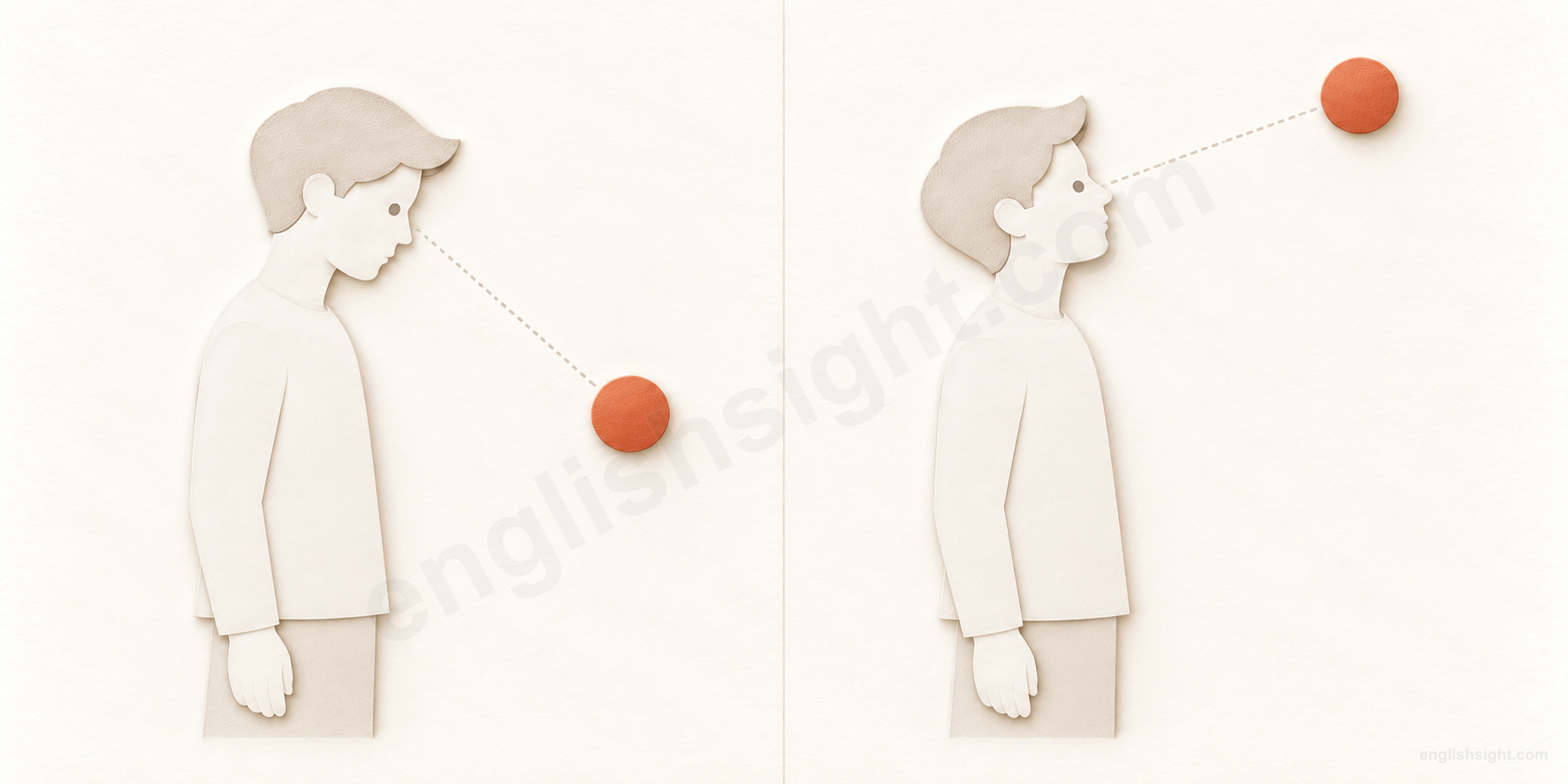
A person watches an orange ball below eye level.
watch
The observer’s attention remains on the same ball.
The ball is higher, and the observer tilts their head to follow it.
The ball changes position; the observer keeps watching it.
Keep your attention on someone or something over time, noticing what happens or changes.
The picture models attentive observation. It does not say watching causes movement, always involves danger, or guarantees continuous staring. Care, warnings, and fixed expressions add their own purposes.
Watch often asks you to stay attentive to a person, thing, or developing situation. What you do with that attention depends on the context: enjoy a game, look after a child, spot a change, or avoid a risk.
The noun a watch also names a timepiece. That object meaning deserves its own branch; a single visual model cannot predict every noun, warning, or fixed expression.
01
Follow what is happening
Watching can be a choice to observe, enjoy a performance, learn an action, or follow developments. The grammar identifies what receives attention.
01
watch + object; watch without an object
watch someone / something
keep your attention on what happens
Situation / intention
A bird is moving around the garden.
Meaning in context
You follow its activity for a while.
The watcher observes; the watched thing need not be controlled or changed.
Imagine a bird landing, pausing, and flying again. The sentence “I watched the bird” describes following that little sequence. “I saw the bird” can simply report that it entered my sight; “I looked at the bird” describes directing my eyes toward it.
Watch can stand without an object when the activity is already clear: You can play; I’ll just watch. Watching is often extended attention, but it has no required minimum duration.
In a sentence
We watched a bird build its nest.
Watch the difference Normally say watch the bird, without at. Look takes at in look at the bird; watch does not.
02
watch + TV / programme / film / event
watch TV / a film / a match
spend time viewing a programme or event
Situation / intention
A match is being shown on a screen.
Meaning in context
You follow the play as a viewer.
Watch fits an unfolding programme or performance, live or recorded.
The object names the content you give attention to: watch TV, watch a video, watch a match. Watching does not guarantee finishing it; I watched half the film is natural.
See a film is also possible, especially when talking about the experience or going to a cinema. Watch a film highlights the viewing activity. The distinction is useful, not an absolute ban on either verb.
In a sentence
We watched the first half of the match on my phone.
Watch the difference Say watch TV for the activity. Watch the TV may instead identify a particular television set or refer to it in a specific context.
03
watch + object + base verb; watch + object + -ing
watch someone do / doing something
observe an action as a whole or in progress
Situation / intention
Mina is about to cross the bridge.
Meaning in context
You can describe either her crossing as an event or her activity in progress.
The person after watch performs the second action; watch does not cause it.
I watched Mina cross the bridge presents crossing as an event viewed as a whole. I watched Mina crossing the bridge puts attention on the action while it was in progress; that wording alone does not say whether you saw her reach the other side.
Use an object pronoun for a person here: watch her cross, watch them crossing. The base verb has no to after the object in this active pattern. Watch me! can invite attention to a demonstration.
In a sentence
I watched Mina cross the bridge, then followed her.
Watch the difference Say watch her cross, not watch she cross or watch her to cross. This is observation, not a causative instruction.
04
watch + what / how clause; watch as + clause; watch to see + clause
watch what / how / as…
follow an action described by a clause
Situation / intention
A teacher is demonstrating a fold.
Meaning in context
You attend to the way the paper is folded.
A clause can identify what to observe, how it is done, or an event unfolding.
Watch how I fold this corner asks you to observe the method. Watch what I do identifies the action to attend to. Both are useful in demonstrations.
We watched as the boat left uses as to introduce the unfolding event. In We watched to see whether it would float, to see states the purpose of watching; it is not the object + base-verb construction.
In a sentence
Watch how I fold the corner, and then try it yourself.
Watch the difference Use statement word order inside the clause: watch how I fold it, not watch how do I fold it.
05
watch + situation / progress / developments; watch + object + for + sign; be closely watched
watch the situation / progress
follow developments and notice changes
Situation / intention
A project is developing over several weeks.
Meaning in context
You keep checking how it is progressing.
Attention can follow information over time without continuous visual contact.
Watch the situation can mean reading updates, checking figures, or paying attention to news. The target is a developing situation, not necessarily a visible object.
You can also name both the thing observed and the sign you want to detect: We watched the house for signs of activity. In watch + object + for + sign, the direct object is already under observation, while for introduces what you are looking for. Compare watch for the bus, where the bus itself is the expected arrival.
Watch closely and carefully emphasize the attention given. Watching does not itself mean intervening: you may observe first and decide later whether to act.
A person or project described as one to watch seems likely to do something interesting or successful: Her new team is one to watch this season. The phrase recommends future attention; it does not warn that the team is dangerous.
In a sentence
We are watching the project’s progress before approving more funding.
Watch the difference Monitoring a situation does not by itself promise that you will improve or control it.
06
watch + person; person + be (being) watched
be watched / be being watched
have your activities observed, possibly secretly
Situation / intention
Someone follows another person’s activities.
Meaning in context
The observed person becomes the grammatical subject in a passive sentence.
A passive sentence focuses on the person under observation.
The context can make watch mean surveillance rather than casual looking. The person watched may not know who is observing them.
They watched him is active. He was watched is passive. He was being watched places that surveillance in progress at a past moment. The progressive and passive are both natural with this action verb.
In a sentence
She suspected that she was being watched.
Watch the difference Be watched means be observed, not own a wristwatch. Surveillance is a contextual meaning, not the meaning of every watch + person sentence.
02
Stay attentive for someone’s safety
Observation can serve a purpose: looking after a child, guarding something, or noticing an expected arrival. The purpose comes from the situation and the full construction.
07
watch + person / thing + (for someone) + (for a period)
watch the children / my bag
take temporary responsibility for someone or something
Situation / intention
You need to leave the room briefly.
Meaning in context
Another person agrees to keep the children safe.
The situation adds a duty of care to attentive observation.
Could you watch the children? is usually a request to look after them, not simply to enjoy observing them. Watch my bag can likewise ask someone to keep it safe while you step away.
For me can name the person being helped: Could you watch my bag for me? For ten minutes gives the duration instead. Context separates care from ordinary observation.
In a sentence
Could you watch the children for ten minutes while I make a call?
Watch the difference Do not assume watch always means babysit. I watched the children dance describes observation of their dancing.
08
watch over + person / thing
watch over someone / something
guard and protect through continued attention
Situation / intention
Someone needs protection while resting.
Meaning in context
Another person stays attentive to their safety.
Over marks protective supervision here, not a necessary position above someone.
Watch over emphasizes guarding or protective care. It can sound more formal or solemn than an everyday request to watch the kids.
The person or thing follows over, even when it is a pronoun: watch over her. Learn this construction as a unit; watch her over does not express the same protective relationship.
In a sentence
Her brother watched over her while she slept.
Watch the difference The watcher need not stand physically above the person. Over contributes an established protective meaning.
09
watch for + person / thing / sign
watch for someone / something
stay ready to notice an expected arrival or sign
Situation / intention
Your friend has not yet arrived.
Meaning in context
You keep looking so you will notice her arrival.
For points toward the thing you are trying to detect.
Watch for the bus means be alert for it to appear. It does not require the bus to be visible already. Watch the bus instead can describe observing a bus that is already there.
The target can be a person, an opportunity, or a sign of change. Put a pronoun after for: watch for her. The expression combines attentive waiting with detection; it is not ordinary wait for alone.
In a sentence
Please watch for Lena while I buy the tickets.
Watch the difference Do not move the object before for: watch for her, not watch her for, for the arrival meaning.
03
Be careful about a risk or your own behavior
In warnings, watch asks someone to direct attention where care is needed. Some warnings name a physical hazard; others concern habits, speech, or conduct.
10
watch + spending / diet / weight / every penny
watch your spending / diet
pay careful attention to keep something under control
Situation / intention
Small purchases are using up your budget.
Meaning in context
You monitor and limit what you spend.
Watch can turn attention toward a habit you need to manage.
I’m watching my spending means I am being careful about money, often by spending less. Watching your diet similarly means taking care over what you eat, not looking at food on a plate.
The object supplies the area of care: watch every penny concerns small amounts of money; watch your weight concerns managing body weight. These combinations do not specify a particular plan or target.
In a sentence
We’re watching our spending until the next payday.
Watch the difference This use is about management and restraint; it does not mean the spending or diet is visually observable.
11
watch + body part / possession; watch where + clause; watch yourself
watch your head / where you’re going
take care to avoid a physical problem
Situation / intention
A low branch crosses the path.
Meaning in context
You warn someone to avoid hitting their head.
The warning names the vulnerable body part or the action needing care.
Watch your head! asks the listener to avoid a collision, not inspect their own head. Watch your bag! may warn about theft rather than ask you to babysit the bag.
Watch where you’re going! tells someone to pay attention to their route, often after careless movement. A warning can sound sharp; tone and context matter. Watch yourself! can also warn someone to take care.
In a sentence
Watch your head as you go under that branch.
Watch the difference In watch where you’re going, use normal clause word order, not where are you going.
12
watch out!; watch it!
Watch out! / Watch it!
give a quick warning to be careful
Situation / intention
A box is about to fall beside someone.
Meaning in context
You call for immediate attention to danger.
These short warnings work without naming an object after watch.
Watch out! is a familiar warning about danger. It does not mean look out through a window or take something outside.
Watch it! can warn about a hazard or tell someone to stop careless or offensive behavior. It can sound confrontational, especially when addressed directly after a disagreement.
In a sentence
Watch out! That box is falling!
Watch the difference To name a danger after watch out, use for: watch out for the box, not watch out the box. It in Watch it! belongs to the fixed warning.
13
watch out for + hazard / warning sign
watch out for a danger
stay alert to detect or avoid a problem
Situation / intention
A path may have hidden holes.
Meaning in context
You walk carefully and try to spot them.
For introduces the danger to notice or avoid.
Watch out for loose stones means stay aware so that they do not cause you trouble. With warning signs of a problem, the point may be early detection rather than avoiding a visible obstacle.
For is followed by the whole target, including a pronoun: watch out for them. Watch out for differs from watch over: the first anticipates something to notice or avoid; the second supplies protective care.
In a sentence
Watch out for loose stones on the path.
Watch the difference Say watch out for them, not watch them out for. The preposition keeps its object after it.
14
watch out for + expected person / thing
watch out for a person / opportunity
make an effort to notice something that may appear
Situation / intention
A friend is joining you in a crowded station.
Meaning in context
You stay alert for her arrival.
The target need not be a danger; context determines why you want to notice it.
Watch out for Lena can mean keep an eye open for her, not beware of her. In a threatening context, however, the same words could warn you about Lena.
For a neutral expected arrival, watch for Lena is a straightforward alternative. Neither expression says she has already arrived.
In a sentence
Watch out for Lena near the ticket machines; she said she would meet us there.
Watch the difference Do not assume every object of watch out for is dangerous. Read the situation and the speaker’s purpose.
15
watch + your / his / her + language / mouth / tongue
watch your language / mouth / tongue
be careful not to speak offensively
Situation / intention
Someone is swearing or speaking rudely.
Meaning in context
Another person tells them to control their words.
The whole expression concerns speech and its social effects.
Watch your language often asks someone to stop swearing or using offensive language. Watch your mouth or Watch your tongue can reprimand a rude remark.
These are direct warnings, not gentle requests to observe vocabulary. In a polite discussion, Please choose your words carefully is a less confrontational alternative.
Watch what you say also asks for care with your words. Unlike Watch how I fold it, the purpose is to avoid saying something harmful or unwise, not to learn by observation.
In a sentence
Please watch your language; there are young children here.
Watch the difference Watch your mouth is an idiom about speech, not an instruction to look at your lips.
16
watch + possessive + step
watch your step
walk carefully or behave cautiously
Situation / intention
The floor is uneven, or a relationship is tense.
Meaning in context
You take care with your next movement or action.
One expression has both a literal walking use and a conventional behavioral use.
On a dark staircase, Watch your step asks you to place your feet carefully. With a difficult colleague, You’d better watch your step advises caution about behavior.
The behavioral use can imply a warning about consequences and can sound threatening. The surrounding situation tells you which meaning is intended.
In a sentence
Watch your step on these wet stairs.
Watch the difference In You’ll need to watch your step with the new manager, step means conduct rather than a particular foot movement.
17
watch + possessive + back
watch your back
protect yourself against possible harm or betrayal
Situation / intention
You think someone may try to undermine you.
Meaning in context
You remain alert and take care of your own safety or interests.
Back suggests vulnerability to trouble you may not see coming.
Watch your back can concern physical danger or hostile behavior at work or in other relationships. It is a warning to protect yourself, not a guarantee that an attack will happen.
It may be friendly advice or a threat, depending on the speaker and tone. It does not simply mean rotate your head and look behind you.
In a sentence
After that argument, she told me to watch my back at work.
Watch the difference Learn the whole idiom. A literal back is not required in its workplace use.
04
Familiar expressions and their limits
These combinations carry established conversational meanings. Connect them with attention where helpful, then learn the whole expression and its tone.
18
watch the time; watch the clock
watch the time / watch the clock
keep track of time, sometimes with impatience
Situation / intention
You need to leave before the last bus.
Meaning in context
You track the time to avoid leaving too late.
Practical timekeeping and impatient clock-checking can differ in tone.
Watch the time means keep track of it so that you finish or leave at the right moment. The phrase need not criticize anyone.
Watch the clock can literally mean look at a clock, but its familiar disapproving use suggests caring more about when work ends than about the task: He watches the clock all afternoon. Read the context before treating it as criticism.
In a sentence
We can stay for coffee, but we need to watch the time.
Watch the difference Watching the time is an activity. Looking at your watch is one way to do it; watch is a noun in that second phrase.
19
watch this space
watch this space
expect more news or an announcement
Situation / intention
A plan is not ready to announce.
Meaning in context
You invite people to look for an update later.
Space points to a place for future information, often figuratively.
Watch this space tells an audience that more news is coming. A website, newsletter, or conversation can all supply the context.
The expression may sound informal and promotional. It does not require an empty physical space that people must stare at continuously.
In a sentence
Our next event is nearly ready to announce—watch this space!
Watch the difference This is an established invitation to await news, not a literal instruction to monitor a blank area.
20
just watch; you watch + prediction; watch me!
just watch / you watch / watch me
confidently predict a result or challenge someone’s doubt
Situation / intention
Someone doubts your team can win.
Meaning in context
You confidently tell them that events will prove you right.
A request to observe becomes a conversational promise of evidence to come.
Just watch or You watch can introduce a confident prediction: You watch—she’ll solve it before lunch. The speaker expects a future result to confirm the claim.
Watch me! can literally invite observation of a performance. As a reply to You can’t do that!, it can also express determination to prove the doubter wrong. That challenge depends on context; it is not the meaning of every Watch me sentence.
In a sentence
“You’ll never finish today.” “Just watch—I’ll be done by five.”
Watch the difference This use does not order the listener to stare continuously until five. Tone may be playful or defiant.
21
watch + person + like a hawk
watch someone like a hawk
observe someone extremely closely
Situation / intention
A learner is using unfamiliar equipment.
Meaning in context
A supervisor follows every movement closely.
The hawk comparison intensifies attention, often to catch mistakes or misconduct.
The phrase does not introduce an actual bird. It usually suggests that very little escapes the watcher’s notice.
It may describe careful supervision or feel intrusive to the person being watched. The idiom alone does not say whether that close attention is welcome.
In a sentence
The supervisor watched me like a hawk during my first shift.
Watch the difference Like a hawk describes the manner of watching; it does not mean that the person watched resembles a hawk.
22
a watched pot never boils
a watched pot never boils
waiting impatiently can make time feel slow
Situation / intention
You repeatedly check for a result you want.
Meaning in context
The wait seems longer because you focus on it.
The proverb comments on the experience of waiting, not the physical effect of looking.
Someone may say A watched pot never boils when another person keeps checking a download, a message, or a cooking pot.
The saying is deliberately exaggerated. It does not state that observation prevents water from boiling or that waiting patiently guarantees a result.
In a sentence
Stop refreshing your inbox every minute—a watched pot never boils.
Watch the difference Watched is a past participle describing the pot in this fixed saying; never boils is not a scientific rule.
23
watch the world go by
watch the world go by
relax while observing people and activity around you
Situation / intention
You sit by a busy square with no task to do.
Meaning in context
You enjoy seeing people move through everyday life.
World refers loosely to the activity around you, not the entire planet.
This expression commonly describes relaxed observation from a café, bench, or window. It presents watching as leisure rather than surveillance or a duty.
Go by belongs to the action you observe, using watch + object + base verb. The familiar phrase supplies its relaxed, broad meaning.
In a sentence
We sat by the square and watched the world go by.
Watch the difference It does not mean watching the Earth move through space.
05
A watch: a timepiece, vigilance, or a duty period
The countable object a watch is a small timepiece. Other noun uses name sustained attention, a guard’s shift, a period of responsibility, or a weather notice. Read the surrounding words.
24
a / my + watch; plural watches; wear / check a watch
a watch / watches
a small timepiece worn or carried
Situation / intention
You want a way to check the time while away from home.
Meaning in context
You wear a small timepiece on your wrist.
This countable noun names an object; it is a separate lexical branch from watching an event.
A watch usually means a wristwatch in modern everyday conversation. A pocket watch is carried rather than worn on the wrist. Analog and digital describe ways it displays the time.
Useful combinations include wear a watch, check your watch, a watch face, and a watch strap or band. A clock is the more general everyday choice for a timepiece on a wall or desk.
Watches is both the plural noun and the third-person verb form: Two watches are on the table; She watches TV. The sentence structure resolves the difference.
In a sentence
I checked my watch before leaving the office.
Watch the difference Say wear a watch, not watch a watch, when you mean have it on your wrist. You can look at a watch without watching it for an extended time.
25
set + watch; watch + be fast / slow; watch + gain / lose time
set a watch / a watch is fast or slow
describe a timepiece’s setting or accuracy
Situation / intention
Your watch shows 8:05, but the correct time is 8:00.
Meaning in context
You describe it as five minutes fast and adjust it.
Fast and slow compare the displayed time with the correct time.
My watch is five minutes fast means it shows a time five minutes ahead of the correct time. Five minutes slow means it is behind.
Set your watch means adjust its displayed time. A watch that gains a minute each day runs too quickly; one that loses a minute each day runs too slowly. If initially set correctly, they will be one minute ahead and one minute behind respectively after a day. My watch has stopped means it is no longer running.
In a sentence
My watch is five minutes fast, so I need to reset it.
Watch the difference Five minutes fast describes the current error; gains five minutes a day describes how that error changes.
26
keep watch (for / over); keep a close watch on; under watch; on the watch for
keep watch / keep a close watch on
maintain careful attention for safety or changes
Situation / intention
A boat is approaching a narrow channel.
Meaning in context
One person stays alert for obstacles while another steers.
Watch is the activity of being vigilant, not a wristwatch.
Keep watch means remain alert, often so you can warn others. Keep watch for names what you hope to detect; keep watch over names what you protect.
Keep a close watch on sales means follow them carefully. Here watch is a noun after keep; on links it to its target. Under watch means under observation: The building remained under watch overnight.
Be on the watch for is another established way to say be alert for something, especially a possible danger. It is not the same as being on a guard’s scheduled watch.
In a sentence
I kept watch for floating branches while Rosa steered.
Watch the difference Keep watch has no required article; keep a close watch on is also natural. Do not confuse on the watch for with a watch worn on the wrist.
27
be / go on watch; the first / night watch
on watch / the night watch
a period of guard duty or the people doing it
Situation / intention
A crew shares responsibility for staying alert overnight.
Meaning in context
Your assigned period begins at midnight.
A watch can name a shift and, by extension, the group assigned to it.
I’m on watch means I am currently doing the duty of keeping lookout or guarding. The night watch can mean a nighttime duty period or, in context, its guards.
This is a particular duty use, especially on ships or in security settings. It is not the usual word for every work shift: an afternoon shift at a shop is normally a shift.
In a sentence
My watch starts at midnight, so I’m resting now.
Watch the difference My watch starts at midnight can concern duty. My watch has stopped normally concerns a broken or inactive timepiece. Context matters.
28
on / under + possessive + watch; not on my watch
on someone’s watch / not on my watch
during a person’s time in charge
Situation / intention
A manager is responsible for a department.
Meaning in context
An event happens during that manager’s period of responsibility.
The duty-period meaning extends to a person’s authority and accountability.
The error happened on my watch acknowledges that you were in charge at the time. It does not by itself admit that you personally made the error.
Not on my watch! emphatically says that you will not allow something while you are responsible. It is often used in a determined, sometimes dramatic tone. The word watch does not refer to writing on a timepiece.
In a sentence
The records were lost on my watch, and I take responsibility for the failure.
Watch the difference Being responsible during a period does not necessarily mean personally causing every event in it.
29
issue + a weather watch; a watch is in effect
a storm / tornado watch
a notice that severe weather is possible
Situation / intention
Conditions may develop into severe weather.
Meaning in context
An authority issues a notice so people can remain alert.
This North American weather use names an alert, not an act of looking at a storm.
You may hear a tornado watch or a winter storm watch in North American weather reports. Watch here signals the possibility of severe weather in the relevant area and period.
This lesson teaches how to recognize the word in a notice. Alert categories and advice depend on the issuing authority; consult the actual local notice rather than infer instructions from the English word alone.
In a sentence
A storm watch is in effect for the area this evening.
Watch the difference A weather watch does not assert that a storm has already been observed at your location.
Attention is a useful connection, not a rule for every phrase
Watch, look at, and see overlap
Watch typically follows an activity or development. Look at directs the eyes; see can report visual perception or an experience. Context permits overlap, including see a film and watch a film. Avoid treating these distinctions as absolute rules.
Forms, tense, and passive
The verb forms are watch, watches, watched, and watching. Watched ends in the sound /t/; watches has an extra syllable. Watching an event is an action, so I am watching is ordinary. The passive is natural too: The entrance is being watched. The plural timepiece noun is also watches.
Read the grammar before assigning meaning
Watch her leave observes her action; it does not make or permit her to leave. Watch over her means protect her; watch for her means be alert for her arrival. These prepositions keep their objects after them. Watch out is a particle warning; watch your step is an idiom, not a particle verb.
Scope and the diagram
The diagram is a teaching model for sustained attention, not a shared mental picture claimed for every native speaker. The timepiece noun and conventional idioms are taught explicitly. Historical vigils, obsolete town guards, detailed nautical watch schedules, and the naming of programmes with -watch are outside this practical lesson.
Choose the meaning that fits
Use the situation and the complete construction, not a single translated meaning.
1. You saw Mina’s entire crossing from one end of the bridge to the other. Which wording presents that whole event?
2. Lena has not arrived. You want a friend to notice her when she appears. Choose the clearest expression.
3. There may be loose stones along the path. Which warning correctly names that danger?
4. A parent asks you to watch the children while she makes a call. What does she normally want?
5. It is 9:00, but your watch shows 9:05. Which description fits?
6. A manager says, “The error happened on my watch.” What is being acknowledged?
Sources and teaching notes
Modern senses, constructions, and expressions were checked in the publisher sources below. Explanations, examples, and the attention model are original teaching material; the model is not dictionary evidence.
The diagram illustrates continued attention. It is a teaching aid, not a mental image shared by all native speakers.