A liquid, a resource, and a setting for familiar expressions.
Use water for the substance, its supply and surroundings, then learn the verbs and fixed phrases in context.
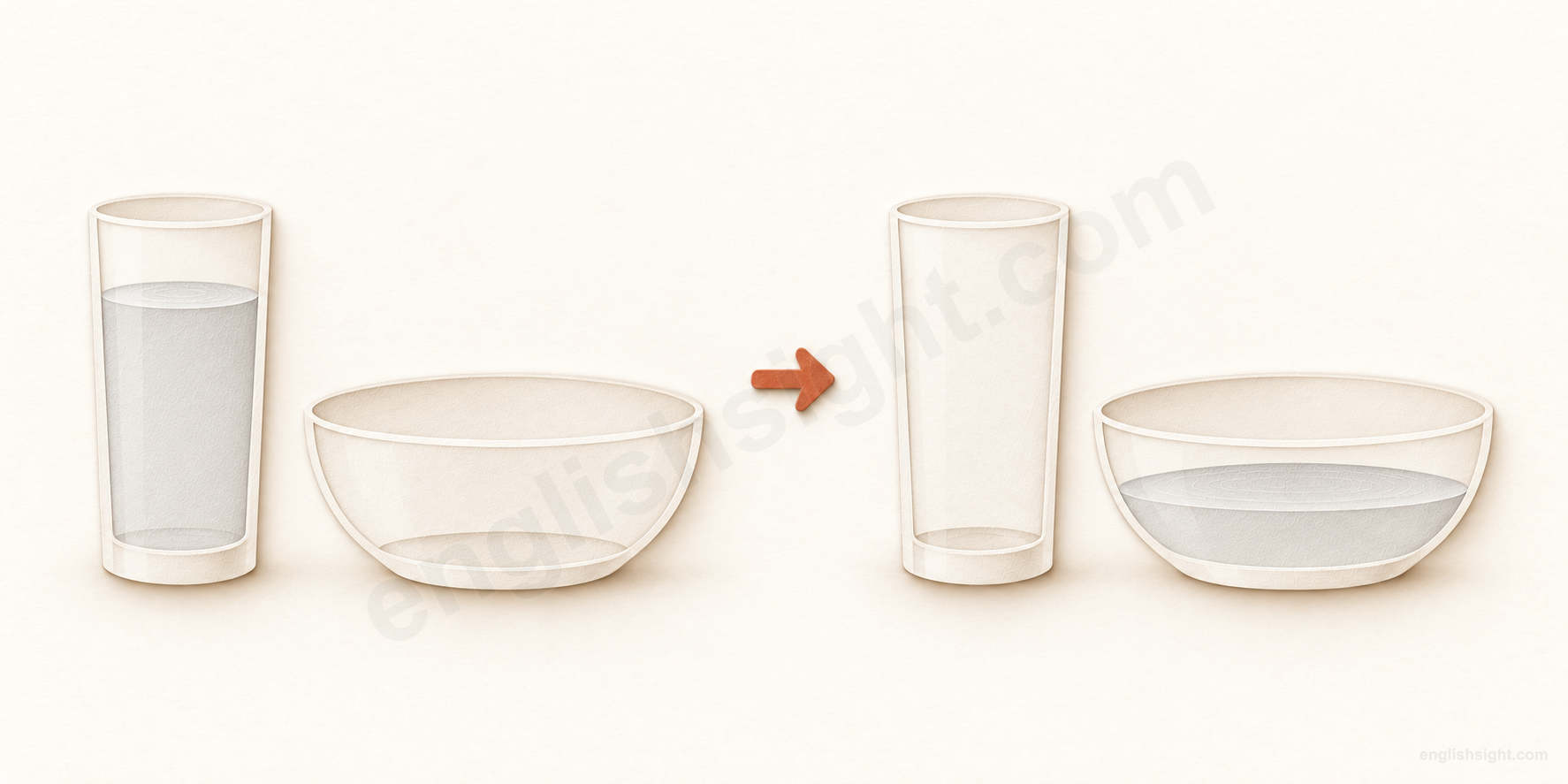
The same liquid can flow and take a new shape
The same liquid can flow and take a new shape
Water fills a narrow glass; the wide bowl is empty.
water
The glass is empty; the water takes the bowl’s wider shape.
Pour the water from the glass into the wider bowl.
The container changes the water’s outline; the substance remains water.
Water names the liquid we drink, wash with, and find in rain, rivers, and seas; changing its container does not change what the substance is.
The picture models a physical property of the ordinary liquid. Supplying water and diluting mixtures connect to this substance; body-fluid uses and idioms need their own explanations. It does not claim that every speaker imagines the same picture.
Water is first a familiar substance: it flows, collects, and takes the shape of a container. The same noun can refer to a drink, a household supply, the surface of a lake, or a stretch of sea.
The verb branches into supplying water, producing fluid in the eyes or mouth, and reducing concentration or force. Many longer expressions are established idioms; the basic liquid image helps with some connections but cannot predict every meaning.
01
Water as a substance and a daily resource
Start with the liquid itself. Quantity words, descriptions, and nearby nouns tell us how much water, what kind, or what it is used for.
01
water + singular verb; the water + description
water
the liquid used for drinking, washing, and many other purposes
Situation / starting point
You need something to drink or wash with.
Meaning / outcome
You refer to the liquid as a substance.
Water names a material, rather than one separate object.
Water is the ordinary name for the liquid in rain, rivers, and seas and for the liquid we drink or use to wash things. It is one kind of liquid: oil and milk are liquids too, but they are not normally called water.
Use water without an article for the substance in general: Water is essential for life. Use the water when the context identifies a particular supply or amount: The water in this bowl is cold. The picture emphasizes that water can flow and take the shape of its container.
In a sentence
There is water on the kitchen floor.
Watch the difference Water is normally uncountable: say The water is cold, not The water are cold.
02
some / a little / plenty of water; number + container + of water; a water / two waters (servings)
some water / a glass of water
describe an amount, container, or serving
Situation / starting point
You want a drink but have not specified a quantity.
Meaning / outcome
You ask for some water or count containers of it.
Count the glass or bottle when a precise serving matters.
Some water, a little water, much water, and plenty of water describe an amount. Use How much water? for the substance. A drop of water and two bottles of water give a countable unit around the uncountable noun.
In a café, a water or two waters can be shorthand for one or two servings. Two mineral waters is also possible. This service-context use does not make waters the normal plural for water in a tank. Two glasses of water is explicit in any setting.
In a sentence
Could we have two glasses of water, please?
Watch the difference Use too much water for an excessive amount; too many waters works only in a suitable countable context, such as orders.
03
description + water; still or sparkling?
tap / bottled / mineral / still / sparkling water
specify the source or kind of water
Situation / starting point
Someone asks which water you want.
Meaning / outcome
You identify its source, packaging, or bubbles.
Different descriptions answer different questions.
Tap water comes through the building’s taps; bottled water is packaged in bottles. Mineral water contains minerals from a natural source. These labels do not all describe the same feature: mineral water can be bottled, and it can be still or sparkling.
In a drinks order, still water has no bubbles and sparkling water has gas bubbles. Still water can also mean motionless water in a landscape. Drinking water names water intended for drinking. Fresh water, found in rivers and lakes, has very little salt compared with salt water in the sea.
Hard water contains dissolved mineral salts that make soap harder to lather. Hard here does not mean frozen. Source, bubbles, salt content, and hardness are different properties, so one description does not answer every question about the water.
In a sentence
Would you prefer still or sparkling water with lunch?
Watch the difference Sparkling water is not automatically sweet, and hard water is not another name for ice.
04
have running water; turn the water on / off; run out of water
running water / turn the water off
talk about the water supply
Situation / starting point
Water normally comes through the pipes.
Meaning / outcome
The supply is available, flowing, or shut off.
The water can stand for the supply to a building.
Running water in a home means a supply delivered through pipes. In a river, running water can simply be flowing water. The surrounding words identify the situation.
Turn the water off means stop the supply, often using a tap or valve; turn it on means allow it again. Run out of water means have none left. These are constructions with turn or run, not new phrasal verbs formed from the verb water.
In a sentence
Please turn the water off while I repair the tap.
Watch the difference The water is on describes an available supply in context; it does not mean that the liquid is resting on an object.
05
water + noun; a bottle of water
water bottle / water sports
use water before another noun
Situation / starting point
You need to identify an object or activity.
Meaning / outcome
Water tells the listener what it is connected with.
The second noun names the main thing.
A water bottle is a bottle designed or used for water; a bottle of water describes a bottle with water in it. An empty water bottle is still a water bottle. A water tank and a water pipe have related functions.
Water sports take place in or on water. Water pollution is pollution affecting water, while water pressure describes a property of the supply. The relationship varies with the following noun; water does not give all these compounds one fixed meaning.
In a sentence
I packed an empty water bottle in my bag.
Watch the difference Compare a water bottle with a bottle of water; purpose and present contents are different.
02
Water as a place, surface, or surrounding situation
Water can name the liquid around a swimmer, the surface under a boat, or a whole stretch of sea. Figurative waters can describe the conditions someone must deal with.
06
the water; deep / shallow water; at the water’s edge; high / low water; by water
the water / the water’s edge
refer to a lake, river, sea, or its boundary
Situation / starting point
You are near a lake.
Meaning / outcome
You describe the liquid area or where land meets it.
Context can identify a whole area as the water.
At the beach or beside a lake, the water usually means the nearby sea or lake rather than drinking water. Deep water and shallow water describe depth. At the water’s edge identifies the boundary between the land and water.
Water can also refer to its surface. High water and low water name a high or low level, especially at the tides. By water means transport by boat or ship and sounds more formal than by boat. These are different ways of referring to a real body of water, not different substances.
In a sentence
We left our shoes at the water’s edge.
Watch the difference Deep water literally describes depth; the fixed phrase in deep water can instead mean being in difficulty.
07
in / into / on / under / above (the) water; underwater + noun; verb + underwater
in / into / on / under water
locate something relative to water
Situation / starting point
A boat and a swimmer are near the same lake surface.
Meaning / outcome
You choose a preposition for position or movement.
The preposition supplies the spatial relationship.
In the water describes being within the water or swimming in it. Into the water describes movement from outside to inside: The ball fell into the water. On the water presents something at the surface, such as a floating boat.
Under the water or under water means below the surface. Underwater is also written as one word when used as an adjective or adverb, as in an underwater camera or swim underwater. Above water means above the surface. Water itself does not express the direction.
In a sentence
The canoe stayed on the water while the diver swam under it.
Watch the difference In describes position; into highlights entering. On the water does not normally describe a submerged object.
08
adjective + waters; the waters of + place; in / into + place-name + waters
coastal / territorial / international waters
refer to stretches of sea or other large water areas
Situation / starting point
A ship travels along a coast.
Meaning / outcome
You identify the area it is sailing in.
Plural waters refers to a region, not several glasses.
Waters is established for stretches of sea, river, or lake: coastal waters and the waters of a lake. Territorial waters are associated with a country’s territory; international waters is the familiar contrasting expression in reports about ships.
These waters are calm takes plural agreement. In contrast, The water is calm treats the same material as an uncountable mass. Waters is useful in geography, travel writing, and news; it is not the default form for every large quantity of water.
In a sentence
The fishing boats returned to calmer coastal waters.
Watch the difference Say a lot of water in the bucket, rather than many waters, when you mean an ordinary quantity.
09
enter / navigate + uncharted / troubled / murky waters
troubled / murky / uncharted waters
describe difficult, unclear, or unfamiliar conditions
Situation / starting point
A team faces a situation it has not dealt with before.
Meaning / outcome
The situation is described as uncharted waters.
The adjective identifies the kind of uncertainty or difficulty.
Uncharted waters can literally be areas not mapped for navigation. Figuratively, entering uncharted waters means entering an unfamiliar situation. Troubled or stormy waters describe difficult conditions; murky waters suggest an unclear or complicated situation.
The navigation image can help you remember the group, but the adjectives do not mean exactly the same thing. A new task can be unfamiliar without being a failure. These expressions are common in discussion and reporting, rather than names for liquid in a cup.
In a sentence
The school was entering uncharted waters with its first online course.
Watch the difference Uncharted means unfamiliar here; it does not automatically mean unsuccessful or illegal.
03
Supply water, produce fluid, or reduce strength
The subject and object matter: a gardener waters plants, eyes water by themselves, and a speaker can water down a proposal. Read each construction separately.
10
water + plants / garden; be watered; need watering; be watered by + river
water the plants
give water to plants or ground
Situation / starting point
The soil around the plants is dry.
Meaning / outcome
Someone supplies water to it.
The object receives the water.
As a transitive verb, water means give water to plants, a garden, or similar ground. The gardener is the subject and the plant or area is the object. Watering is the action; it does not guarantee that a plant immediately grows or recovers.
The plants are being watered is a normal passive. The plants need watering means they need to be watered, not that the plants must do the action. In more technical geographical writing, a valley watered by a river is a valley supplied with water by it.
In a sentence
I watered the herbs before leaving for work.
Watch the difference Water the plant names the recipient. Pour water onto the soil names the liquid and where you put it.
11
water + animal; be fed and watered (humorous, people)
water the horses
provide drinking water for animals
Situation / starting point
The animals need a drink.
Meaning / outcome
Someone gives them water.
The object is the animal receiving a supply.
Water an animal means provide water for it to drink, not pour water over its body. This use is especially associated with farming and caring for animals. Give the horses some water is a straightforward alternative.
Fed and watered can also describe people humorously: We were fed and watered before the journey. In neutral conversation about a person, offer them water or give them a drink is usually clearer than saying water them.
In a sentence
The farmer fed and watered the cattle before breakfast.
Watch the difference Water the dog would concern its drinking supply in context; wash the dog means clean its body.
12
eyes + water; make + someone’s eyes + water
my eyes are watering
have tears form in the eyes
Situation / starting point
Smoke irritates your eyes.
Meaning / outcome
Tears start to form.
The eyes are the subject; there is no object.
Eyes water when tears form, for example because of smoke, wind, or irritation. It need not mean that someone feels sad. In My eyes are watering, watering describes what the eyes are doing now.
A cause can appear in make + object + base verb: The wind made my eyes water. Here the wind is the cause, my eyes is the object of made, and water stays in its base form. Do not add to after active make in this pattern.
In a sentence
My eyes started watering as I chopped the onion.
Watch the difference My eyes watered is not the same construction as I watered the plants: one produces fluid, the other supplies it.
The mouth produces fluid; no one pours water into it.
My mouth is watering describes the reaction to appealing food. Make someone’s mouth water says that a smell, sight, or description causes that reaction. The phrase can emphasize how tempting food seems even when no literal liquid is being discussed.
Compare I need some water, which requests a drink. Mouth-watering is a related adjective for very appealing food, as in a mouth-watering dessert. In promotional or journalistic language it can also describe a very tempting offer. It is not the normal way to say that someone is thirsty.
In a sentence
The smell of warm cinnamon buns made my mouth water.
Watch the difference After made, use water, not to water or watered, in this active causative construction.
14
water down + liquid; water + liquid + down; water it down; be watered down
water something down
add water to make a liquid less concentrated
Situation / starting point
The juice is stronger than you want.
Meaning / outcome
You add water to reduce its strength.
The liquid becomes weaker in concentration, even as its volume increases.
Water down a drink, soup, or suitable mixture means dilute it with water. It is not just a synonym for pour: adding water changes how concentrated the original mixture is. The plain verb water is also used for adding water to an alcoholic drink, as in watered wine.
The particle down belongs to the phrasal verb. A noun object can come before or after it: water down the juice or water the juice down. A pronoun goes between: water it down. The juice was watered down is a normal passive.
In a sentence
The juice tasted too strong, so I watered it down.
Watch the difference Say water it down, not water down it. More liquid does not mean a stronger mixture.
15
water down + proposal / statement; water it down; be watered down; a watered-down version
water down a proposal
reduce the force or demands of a message or plan
Situation / starting point
A proposal contains strict requirements.
Meaning / outcome
The requirements are softened before agreement.
The change is figurative: less force, not more physical water.
A proposal, criticism, rule, or statement can be watered down when it is made less forceful, demanding, or offensive. This is a conventional extension from a diluted mixture. It does not tell us whether the change was wise; the context supplies that judgment.
The passive is especially useful when the changed document is the topic: The proposal was watered down. With a pronoun, retain the same separable order as the liquid meaning: They watered it down. A watered-down version is a version with reduced force or content.
In a sentence
The committee watered down the rules to win wider support.
Watch the difference Water down means weaken or soften; it does not simply mean shorten, clarify, or explain.
04
Two established expressions for body fluids
These expressions occur in conversations about the body. Learn their wording and register as vocabulary; they are separate from ordinary drinking water.
16
someone’s waters break (BrE); someone’s water breaks (AmE)
someone’s water / waters break
refer to the release of the fluid around a baby before birth
Situation / starting point
People are talking about pregnancy and birth.
Meaning / outcome
They refer to the release of the surrounding fluid.
This is an established body-fluid expression, with regional number differences.
In this expression, water or waters refers to the fluid surrounding a baby in the womb. Her waters broke is the usual British wording; Her water broke is the usual American wording. The noun number changes the present-tense agreement: her waters break / her water breaks.
The phrase names an event in pregnancy, not a broken drinking-water pipe. Its wording does not specify how soon birth happens. Learn water as singular in the usual American wording and waters as plural in the usual British wording.
In a sentence
She said her water had broken that morning.
Watch the difference Do not use waters as the everyday plural of drinking water because this fixed expression uses a plural in British English.
17
pass water; have difficulty passing water
pass water
urinate: a formal expression
Situation / starting point
A clinician asks about a bodily function.
Meaning / outcome
The question concerns urinating.
Pass water is a formal euphemism, especially familiar in British usage.
Pass water means urinate. It is a fixed expression likely to appear in a medical conversation or a formal description of bodily functions. Water here refers to urine, not to an offered drink.
Compare pass me the water, which means hand me an identified glass, bottle, or container. Adding an object such as me and identifying the water creates a different, ordinary use of pass. Learn the whole wording to avoid confusing the two.
In a sentence
The nurse asked whether he could pass water normally.
Watch the difference Pass water and pass me the water have different grammar and meanings.
05
Difficulty, survival, and a lack of progress
These fixed expressions use water as a setting for problems or effort. Their exact meanings belong to the complete phrase.
18
be in / get into hot water (with someone) (over / for something)
be in / get into hot water
be in trouble, often with someone in authority
Situation / starting point
You break a workplace rule.
Meaning / outcome
Your manager is angry about it.
The idiom describes trouble, rather than the temperature of a liquid.
Be in hot water describes being in trouble; get into hot water describes entering that situation. With + person identifies someone who is displeased, and over or for can introduce the cause.
This is informal. Context distinguishes it from literal hot water: Leave the noodles in hot water concerns cooking, while I’m in hot water with my manager concerns trouble. The idiom normally has no the.
In a sentence
I got into hot water with my manager for losing the keys.
Watch the difference Hot water is one fixed expression; replacing hot with warm does not preserve its established meaning.
19
be in / get into deep water; in deep waters
be in / get into deep water
be in serious difficulty or beyond your ability
Situation / starting point
You accept a task you are not prepared for.
Meaning / outcome
You find it difficult to cope.
The image is depth that makes coping hard.
In deep water means in difficulty, sometimes because a task or situation is beyond someone’s knowledge or ability. Get into deep water highlights getting into the problem. In deep waters is also found.
The meaning overlaps with in hot water, but hot water often concerns someone’s disapproval; deep water can emphasize how hard the situation is to handle. Neither distinction is an absolute rule. A swimming context may make deep water entirely literal.
In a sentence
Without an experienced guide, the new team was soon in deep water.
Watch the difference Deep water does not by itself mean water that is dangerous in every literal situation; context matters.
20
keep + possessive + head / heads + above water
keep your head above water
just manage to cope or survive
Situation / starting point
Expenses or work are almost more than you can handle.
Meaning / outcome
You keep going, with little room to spare.
Surviving is the focus, rather than making strong progress.
This expression means manage to cope with a difficult situation, especially financial pressure. Keeping your head above water does not imply that everything is comfortable or successful; you are avoiding being overwhelmed.
Keep our heads above water is the plural-person form. The literal swimming image can help with memory, but a business using this phrase is not necessarily near a lake. Compare tread water, which emphasizes a lack of progress.
In a sentence
Extra orders helped the small shop keep its head above water.
Watch the difference Keep your head above water means cope; it does not mean earn a large profit.
21
tread water; be treading water
tread water
stay afloat in place; figuratively, continue without progress
Situation / starting point
A swimmer moves limbs without going forward, or a team keeps doing routine work.
Meaning / outcome
The person or team stays in roughly the same position.
Effort continues, but forward progress is absent.
Literally, tread water means use movements of the arms and legs to keep upright and afloat without swimming forward. Figuratively, it means keep doing things without progressing, often while waiting for a change.
The literal and figurative meanings share a useful staying-in-place image. They remain different situations: We’re treading water until the funding arrives describes a project, not a swimming technique. The continuous form is natural when describing an ongoing period.
In a sentence
The project is treading water while we wait for a decision.
Watch the difference Treading water does not mean doing nothing: there may be considerable effort without progress.
22
be dead in the water; leave + someone / something + dead in the water
dead in the water
unable to proceed and unlikely to succeed
Situation / starting point
An essential source of support disappears.
Meaning / outcome
The plan has little prospect of moving forward.
The phrase is a strong assessment of a stalled or failed plan.
A plan, campaign, or negotiation that is dead in the water has stalled badly or failed, with little hope of success. It is stronger than merely delayed. An inactive boat is a possible literal setting, but the expression is widely used about non-physical projects.
The thing being assessed is usually the subject of be or is left in this condition: The proposal is dead in the water; the refusal left it dead in the water. It is an informal, emphatic description rather than a neutral progress report.
In a sentence
Without a venue, our festival plan was dead in the water.
Watch the difference Do not use this strong phrase for every short delay when a plan is still proceeding normally.
23
be a fish out of water; feel like a fish out of water
feel like a fish out of water
feel uncomfortable in an unfamiliar setting
Situation / starting point
Everyone else knows the customs at a new event.
Meaning / outcome
You feel awkward and out of place.
The person is outside a familiar environment.
A fish out of water describes a person who feels uncomfortable or out of place in unfamiliar surroundings. Be a fish out of water and feel like a fish out of water are both useful patterns.
The fish image gives a memorable contrast between a familiar environment and an unsuitable one. The idiom need not mean physical danger, inability, or permanent exclusion. A capable person can feel this way on a first day.
In a sentence
At my first formal dinner, I felt like a fish out of water.
Watch the difference This expresses discomfort in a setting, not simply being physically dry or away from the sea.
06
Trying ideas, judging evidence, and influencing plans
Water expressions can describe a cautious trial, a weak argument, a discouraging reaction, or a confusing discussion. The verb identifies the intended relationship.
24
test the water / waters (before doing something)
test the water / waters
explore a possible action before committing
Situation / starting point
You are considering a new idea.
Meaning / outcome
You try a limited step to find out how it may be received.
The aim is information before a larger commitment.
Test the water or test the waters means explore a situation or gauge the reaction to a possible action. A small launch, a quiet conversation, or an initial offer may serve as the test; actual water is not required.
The result may be positive or negative. The expression describes the exploratory purpose, not a promise that the plan will work. Both singular water and plural waters are established in this idiom; do not generalize that choice to every phrase.
In a sentence
We offered one weekend class to test the waters before renting a larger room.
Watch the difference Testing the waters gathers information; it is not the same as committing fully to the plan.
25
dip a toe in / into the water; dip a toe into + activity
dip a toe in / into the water
begin cautiously on a small scale
Situation / starting point
You are curious about a new activity.
Meaning / outcome
You try a little of it before going further.
The small first involvement is the focus.
Dip a toe in or into the water means begin an activity cautiously to see what it is like or whether it will succeed. You can also name the activity directly: dip a toe into online selling.
Compare test the waters, which highlights finding out about conditions or reactions. Dipping a toe emphasizes a limited first involvement. The two can describe the same small trial, but they put attention on different aspects of it.
In a sentence
I dipped a toe into photography by joining a short evening course.
Watch the difference A toe is part of the fixed image; dip a whole foot is not the usual version of this idiom.
26
(argument / explanation / theory) + hold water; not hold water
hold water / not hold water
remain convincing or consistent with the facts
Situation / starting point
Someone offers an explanation.
Meaning / outcome
You judge whether it stands up to checking.
The subject is an argument, explanation, or theory.
An argument that holds water is credible or logically sound. The idiom is especially common in negatives: That excuse doesn’t hold water. This challenges the explanation rather than describing its literal capacity.
A container can literally hold water without leaking. Treating an argument like a container without leaks is a useful memory aid, not proof that an argument is true. The expression evaluates whether it withstands scrutiny; it does not mean that someone agrees politely.
In a sentence
That explanation doesn’t hold water: the dates do not match.
Watch the difference The explanation is the subject. Do not turn hold water into water holds when you mean that an argument is sound.
27
pour / throw cold water on + idea / plan
pour / throw cold water on something
discourage an idea by criticizing it
Situation / starting point
Someone is enthusiastic about a suggestion.
Meaning / outcome
Another person gives a discouraging response.
The target after on is the idea or plan being criticized.
Pour cold water on a suggestion means express disapproval or give reasons against it, reducing enthusiasm. Throw cold water on is another established version. This is about a response to a proposal, not about diluting its wording.
Compare water down the proposal: that changes the proposal itself to make it weaker. Pour cold water on the proposal describes someone’s critical reaction. The plan might remain unchanged after the criticism.
In a sentence
Maya poured cold water on the plan by pointing out the cost.
Watch the difference Keep on before the target: pour cold water on the idea, not pour the idea cold water.
28
blow + someone / something + out of the water; blew / blown
blow someone / something out of the water
defeat decisively, outperform greatly, or impress unexpectedly
Situation / starting point
Two products are compared, or a performance exceeds expectations.
Meaning / outcome
One is overwhelmingly better, or the listener is amazed.
The subject acts on an opponent, comparison target, or impressed person.
Blow a competitor out of the water means defeat them completely; blow an older product out of the water can mean be vastly better than it. Evidence can also blow a theory out of the water by decisively undermining it. The object tells us what is defeated or invalidated.
Collins also records an impressed-person use: The performance blew me out of the water means it was unexpectedly excellent and amazed me. It does not mean that I lost a competition. These emphatic, informal uses need context; a literal explosion is not required.
In a sentence
The new speakers blew the old ones out of the water for sound quality.
Watch the difference The solo blew me out of the water can express admiration, while Their team blew us out of the water describes a decisive defeat.
29
muddy the waters; muddy / muddies / muddied / muddying
muddy the waters
make an issue harder to understand
Situation / starting point
A discussion has a clear main question.
Meaning / outcome
Extra or confusing information obscures it.
Muddy is the verb; waters is the object within the fixed expression.
Muddy the waters means make a situation or issue less clear. Someone may do it deliberately, but information can also muddy the waters without anyone planning to confuse people.
The picture of cloudy water can help you remember reduced clarity. That is a separate metaphor from water down, which reduces force. Adding detail can muddy the waters even when the original statement is just as strong as before.
In a sentence
Adding three unrelated complaints only muddied the waters.
Watch the difference The verb is muddy, not water: watery the issue is not the expression.
07
Letting go, adapting, spending, and calming conflict
Similar water images lead to different established expressions. Keep the full phrase, its participants, and its usual situation together.
30
something + be + (all) water under the bridge
water under the bridge
a past matter no longer treated as important
Situation / starting point
Two people once had a disagreement.
Meaning / outcome
They choose to leave it in the past.
The phrase concerns the present importance of an earlier event.
It’s water under the bridge means an earlier event is over and no longer worth worrying or arguing about. It can reassure someone after an apology or explain that an old disagreement is settled.
The event has not literally disappeared from history. The phrase presents it as something the speaker has moved beyond. It is more than saying yesterday: a recent event can already be water under the bridge, while a very old event can still matter.
In a sentence
We argued about it last year, but it’s water under the bridge now.
Watch the difference Keep the established phrase under the bridge; changing the preposition may create a literal description instead.
31
(criticism / advice) + be + (like) water off a duck’s back (to someone)
(like) water off a duck’s back
have no effect, especially when criticizing someone
Situation / starting point
Someone hears criticism or unwanted advice.
Meaning / outcome
They remain unaffected by it.
The criticism is what fails to have an effect.
Criticism that is water off a duck’s back does not affect the person it is aimed at. The phrase can admire resilience or complain that someone never listens; the speaker’s attitude comes from context.
Like is optional in common versions: It’s like water off a duck’s back to him, or It’s water off a duck’s back. The duck image helps with remembering an effect that does not stick. This is different from like a duck to water, which concerns easy adaptation.
In a sentence
The rude remarks were water off a duck’s back to Lena.
Watch the difference Do not confuse off a duck’s back, meaning no effect, with like a duck to water, meaning easy adaptation.
32
take to + noun / -ing + like a duck to water
take to something like a duck to water
adapt to a new activity very easily
Situation / starting point
Someone begins a new role or skill.
Meaning / outcome
They become comfortable with it quickly.
The person finds the new activity natural or easy.
Take to an activity like a duck to water means adapt to it very easily or discover a natural ability for it. The activity follows the first to; the familiar comparison follows like.
Use a noun or -ing form for the activity: take to teaching like a duck to water. That to belongs to the expression take to and functions as a preposition, not an infinitive marker. The idiom does not promise that learning requires no practice at all.
In a sentence
Arun took to acting like a duck to water.
Watch the difference Say took to acting, not took to act, when using take to for developing a liking or ease.
33
spend + money + like water; drinks + flow + like water
spend money like water
use or spend something freely in large quantities
Situation / starting point
Someone keeps buying expensive things.
Meaning / outcome
A large amount of money is spent without much restraint.
Like water describes abundance or free flow.
Spend money like water is an informal way to say spend freely and lavishly. It often carries criticism of wastefulness. Another context is Drinks flowed like water, emphasizing a plentiful supply.
The comparison does not mean that real water is always cheap or unlimited. It is an established way to describe quantity or freedom of spending. Read the main verb too: money spent and drinks flowing are different actions.
In a sentence
They spent money like water during the holiday.
Watch the difference Like water describes how freely something is used or supplied; it does not identify a payment method.
34
pour oil on troubled water(s)
pour oil on troubled waters
try to calm a disagreement
Situation / starting point
Two colleagues are arguing.
Meaning / outcome
Someone tries to reduce the tension.
The intervention aims to calm the situation.
Pour oil on troubled waters means try to settle a disagreement or make a tense situation calmer. A calm explanation, apology, or compromise can be the intervention. The idiom describes the attempt, so it does not guarantee success.
The plural waters is usual; troubled water is also recorded. Compare pour cold water on an idea, which discourages enthusiasm. Both begin with pour, but one aims to calm conflict and the other expresses a negative reaction to a plan.
In a sentence
Jon tried to pour oil on troubled waters by apologizing to both sides.
Watch the difference The object is oil in the fixed phrase. This figurative expression is not practical advice to put oil into a river.
08
Recognize familiar sayings
These sayings express a viewpoint about determination, hidden depth, family loyalty, or the limits of persuasion. They are cultural expressions rather than universal truths.
35
statement of intention + come hell or high water
come hell or high water
despite whatever difficulties arise
Situation / starting point
Someone expects obstacles.
Meaning / outcome
They express firm determination to continue.
The whole phrase intensifies a commitment.
Come hell or high water means despite the difficulties. It is an emphatic, informal addition to a promise or statement of intention. Come is part of the fixed wording here, not an instruction to approach someone.
The expression invokes extreme obstacles; the speaker need not predict an actual flood. No matter what is a neutral alternative. Because hell is a mild swear word, choose the alternative when a restrained tone is more appropriate.
In a sentence
I’ll finish the repairs this week, come hell or high water.
Watch the difference Keep come in this fixed phrase; it does not change to comes to match the speaker.
36
still waters run deep
still waters run deep
a quiet person may have deep feelings or an interesting inner life
Situation / starting point
Someone says very little in a group.
Meaning / outcome
Another person suggests there may be more beneath that quiet appearance.
The saying cautions against judging only by outward quietness.
Still waters run deep is said about a quiet or hard-to-read person who may have strong feelings, knowledge, or a complex personality. Still means calm or not moving in the image; deep gives the contrast with what is visible at the surface.
This is a saying used to interpret a person, not a psychological rule about every quiet individual. It is also separate from ordering still water, where still refers to a drink without gas bubbles.
In a sentence
Nora rarely talks about her art, but still waters run deep.
Watch the difference The saying uses plural waters and run; still water runs deep is not its usual fixed wording.
37
blood is thicker than water
blood is thicker than water
family loyalty is stronger than other ties: a traditional saying
Situation / starting point
Someone chooses to support a relative.
Meaning / outcome
They explain the choice through family loyalty.
The saying expresses a viewpoint about relationships.
Blood is thicker than water is a traditional way to say that family ties or loyalty outweigh other relationships. Blood stands for family connection in this saying; it is not a lesson about choosing liquids.
A speaker may use it to explain or defend favoring a relative. Other people may disagree with the viewpoint. Learning the expression does not require accepting that all families are close or that family should always come first.
In a sentence
He chose to help his cousin, saying that blood is thicker than water.
Watch the difference Use this as a recognizable saying, not a factual rule that predicts everyone’s relationships.
38
you can lead / take a horse to water, but you can’t make it drink
you can lead a horse to water, but you can’t make it drink
provide an opportunity without being able to force someone to use it
Situation / starting point
You offer useful help or an opportunity.
Meaning / outcome
The other person decides whether to accept it.
Offering access is different from controlling the response.
This saying means that giving someone an opportunity does not mean you can make them take it. The horse and drinking water form a literal comparison for the gap between available help and a willing response.
The saying can express frustration when advice or help is declined. Use it thoughtfully: calling someone uncooperative may be unfair when there are other reasons they cannot act. The point is the limit of persuasion, not that water itself means opportunity in all contexts.
In a sentence
I gave him all the forms. You can lead a horse to water, but you can’t make it drink.
Watch the difference Make it drink uses make + object + base verb; make it to drink is not the active pattern.
Keep the noun, the verb, and the whole expression in view
Mass, servings, and regions are different
Water is normally an uncountable noun with singular agreement. Glasses or bottles can be counted; drinks orders allow serving shorthand. Plural waters has established regional and figurative uses. These patterns do not make every quantity of water countable.
The subject and object identify the verb meaning
Forms are water, waters, watered, watered, watering. A person waters plants or animals; eyes or a mouth water without an object. Action uses allow progressive forms. Transitive uses allow passive constructions such as The garden is being watered. Make my eyes water and make my mouth water use a base verb after active make.
Down is a particle; other nearby words may do different work
Water down is a separable phrasal verb: water it down. In in hot water and on the water, water is a noun after a preposition. In pour cold water on a plan, pour is the verb. Learn each expression’s grammar instead of treating all combinations as phrasal verbs of water.
Scope and the limits of the picture
This lesson covers ordinary noun uses, practical collocations, productive verb patterns, and familiar fixed expressions. It does not expand specialist chemistry, finance, textile finishes, gem-quality senses, or every compound containing water. The container picture explains one physical relationship; each fixed expression still needs its own context.
Choose the expression that fits
Read the situation and the whole construction. The liquid image is a starting point; the context decides the interpretation.
1. You need water for cooking, without counting separate servings. Which question fits?
2. An onion irritates your eyes. Which sentence describes your physical reaction?
3. The juice is too concentrated. Choose the natural pronoun order.
4. A colleague criticizes a plan but does not edit it. Which description fits?
5. A team stays busy with routine work while making no progress. Which phrase emphasizes this?
6. A new volunteer quickly becomes comfortable with teaching. Which expression fits?
7. An explanation conflicts with the evidence. What does It doesn’t hold water mean?
8. A bottle is designed for carrying water but is empty now. Which description is accurate?
Sources and teaching notes
The sources below support the usage inventory. Explanations, examples, and exercises are original; the container picture is a teaching model rather than a dictionary definition.
The picture highlights a useful connection; it is not a shared mental image claimed for every English speaker.