Follow wave from water and curves to gestures, surges, and familiar expressions.
A pattern advances
A moving rise-and-fall pattern
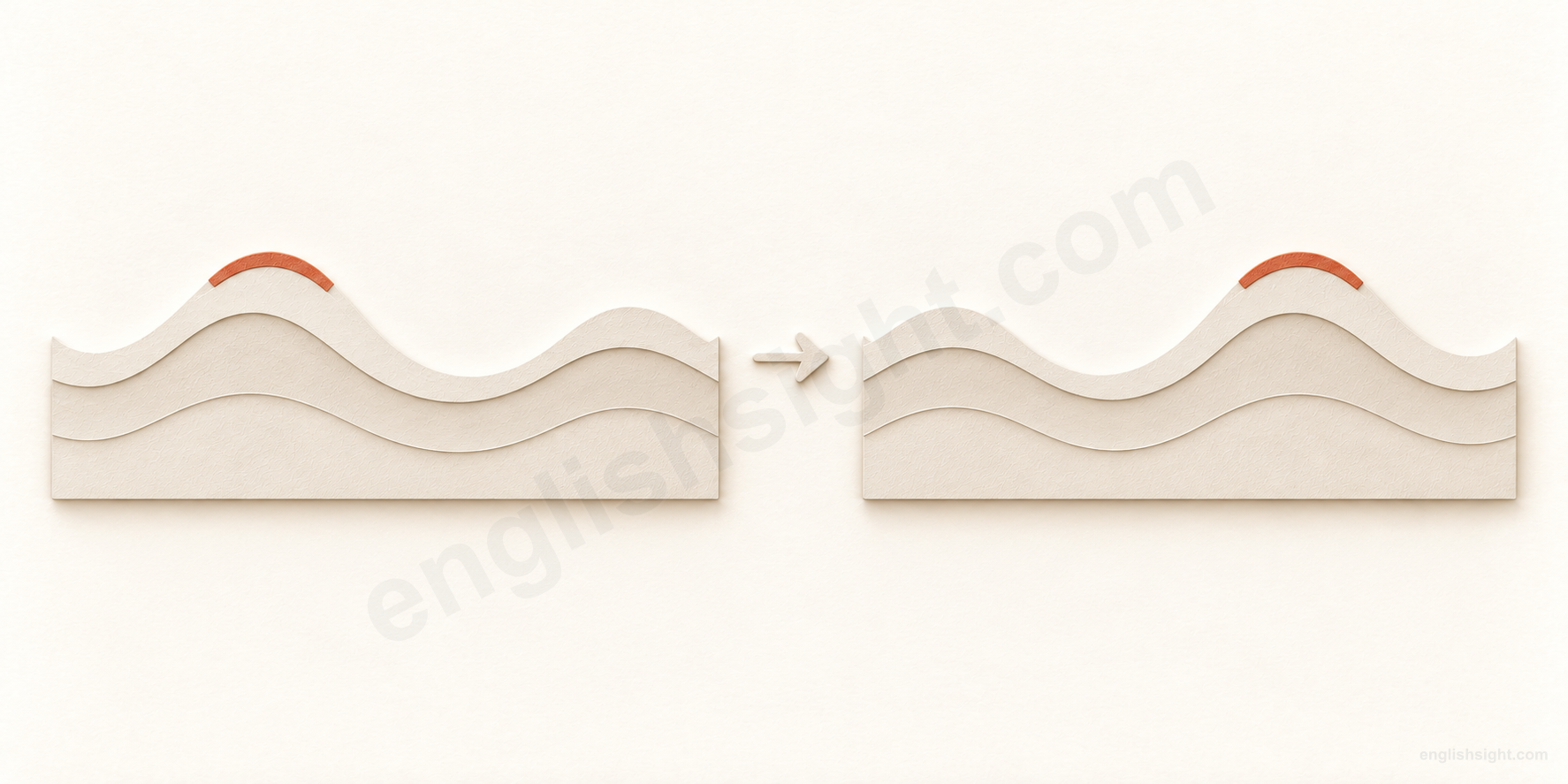
The orange-marked crest is in the left half of the first water section.
wave
The orange-marked crest is in the right half of the second water section.
The surface pattern advances to the right as time passes.
A wave’s surface pattern travels. The orange marks track the crest shape, not a particular parcel of water.
A wave can be a rise-and-fall disturbance that travels across a surface; repeated movement also helps connect the word with waving a hand or flag.
The water diagram models a traveling surface shape. Hair waves are curves; signaling and idioms need their own constructions and context. These are teaching connections, not a claim that all meanings have one literal mechanism.
Watch a ridge move across water, then watch a hand move from side to side. Wave serves both families. It can also describe a sudden surge of feeling or activity, but the surrounding construction decides the message.
The lesson uses a moving rise-and-fall pattern as a teaching connection, not as a rule that generates every sense or a picture shared by all native speakers. The hand-signal family is taught explicitly alongside it.
01
Water, energy, and curved shapes
Start with physical waves, then distinguish a traveling disturbance from a lasting curved shape.
01
a wave / waves + rise / break / lap; catch / ride a wave
a wave; waves break
a moving rise on a water surface
Situation / starting point
A ridge rises on the sea.
Action / resulting picture
The ridge approaches the shore and breaks.
The moving shape is a wave; breaking describes its collapse.
A wave is countable: one wave, two waves. Waves can rise, roll towards the beach, lap gently against a boat, or break into foam. A ripple is a small wave; wave itself does not require a huge wall of water.
In surfing, catch a wave means start moving with a suitable wave, and ride a wave means continue on it. Compare a tide: the tide is the broader rise and fall of sea level, not an individual moving crest. The diagram follows the surface shape; it is not a map of each water particle’s journey.
In a sentence
We watched a small wave break against the rocks.
Watch the difference Say The waves are high, not The wave are high. The adjective high describes their size, not the water’s temperature.
02
sound / light / radio waves; a shock wave; send shock waves through + group
sound waves; radio waves
a disturbance through which energy travels
Situation / starting point
A source produces a disturbance.
Action / resulting picture
The disturbance spreads away from the source.
Wave can describe transmission without a visible sea surface.
Sound waves and radio waves belong to science vocabulary used in everyday explanations of hearing and communication. The plural often describes a continuing signal, rather than several visible objects.
A shock wave is a sudden pressure disturbance, for example after an explosion. News can also send shock waves through an organization: people are strongly affected by it. The sea sketch is only an analogy; not every kind of wave has the same physical mechanism or a visible up-and-down shape.
In a sentence
The radio receives signals carried by radio waves.
Watch the difference Do not assume all waves require water, or that radio waves are sound traveling through the air.
03
a wave / waves in + hair; wavy hair; have + hair + waved
waves in her hair; have hair waved
gentle curves in hair, natural or styled
Situation / starting point
Hair may be straight or naturally curved.
Action / resulting picture
It has a series of loose curves.
Here wave names a shape, not a signal or a traveling object.
Her hair has a natural wave and There are waves in her hair describe curves. Wavy is the usual adjective: wavy hair. The curves need not be tightly curled.
The verb also exists: Her hair waves naturally. Have your hair waved means arrange for someone to give it waves; She had her hair waved describes a styling treatment. The passive form concerns shaping the hair, not someone waving it as a greeting.
In a sentence
She has soft waves in her hair.
Watch the difference A wave in someone’s hair is not an action performed by their hand. Learn wavy as a related adjective.
02
Hand movements, messages, and directions
Ask what moves, who receives the signal, and whether a following word gives a route, a stopping request, or an established meaning.
You raise and move your hand so the friend notices.
The person after at or to receives the signal.
You can simply wave, or wave at someone / wave to someone. Both prepositions are used for a greeting; at does not automatically mean hostility. Wave back means respond to another person’s wave.
Wave hello or wave goodbye names the greeting. You can wave goodbye to Mia or wave Mia goodbye. Mia is the person addressed, while goodbye names the message; wave Mia alone does not normally mean greet Mia.
In a sentence
I waved to Leo from the bus, and he waved back.
Watch the difference Use a preposition for a plain greeting: She waved at me, not She waved me. A following direction changes the construction.
05
give + person + a wave; return + someone’s wave; with a wave of + hand
give someone a wave
perform one greeting or signaling gesture
Situation / starting point
A neighbor is leaving.
Action / resulting picture
You acknowledge the neighbor with a hand gesture.
A wave is the countable gesture; wave is also the verb.
Give someone a wave and give a wave to someone use the noun with a. Return someone’s wave means acknowledge it with your own. A friendly wave and a dismissive wave can have very different intentions.
With a wave of her hand describes how someone communicates. The surrounding action tells you whether the gesture welcomes, refuses, or sends someone away. Wave does not always mean hello.
In a sentence
Nora gave us a quick wave before getting into the taxi.
Watch the difference Say give us a wave, not give us wave. The gesture is countable.
06
wave + object; wave + object + at + person; wave + object + around / about
wave a flag / your arms
move something visibly, often to signal
Situation / starting point
You hold a flag.
Action / resulting picture
You move it from side to side for others to see.
The direct object is what moves, not the person receiving the message.
Wave a flag, wave a hand, and wave your arms describe deliberate movement. The object can be a ticket, a piece of paper, or another thing held up for attention. In wave a ticket at the guard, the ticket is moved and the guard is addressed.
Around and about can describe motion without an exact destination: He was waving his arms around. These are movement descriptions, not a separate idiom for every object. The meaning may be celebration, urgency, or anger, depending on the context.
In a sentence
She waved her ticket at the conductor to show that she had paid.
Watch the difference Waving a ticket at someone does not mean handing the ticket over. The object can stay in your hand.
07
something + waves / is waving + in the wind / breeze
wave in the wind
move freely back and forth
Situation / starting point
A flag is attached to a pole.
Action / resulting picture
Its free edge moves in the breeze.
The subject moves; no human signaler is required.
The flag waved in the wind has no direct object. The breeze causes the motion, but the sentence presents what the flag does. Grass, reeds, or hanging cloth can also wave.
Compare She waved the flag: here she deliberately moves it, and the flag is an object. Was waving is natural for an action in progress. This verb sense connects with repeated or flowing movement, rather than the communication purpose of a greeting.
In a sentence
The curtains were waving in the breeze from the open window.
Watch the difference The flag waved is active and intransitive; it does not mean the same as The flag was waved by a person.
08
wave + person / vehicle + on / through / in / to + place; be waved through; wave towards / in the direction of + place
wave someone on / through / in
signal permission or direction with a hand
Situation / starting point
A driver waits for a signal.
Action / resulting picture
An official signals that the driver may continue.
The person or vehicle is directed; the following word gives the route.
Wave someone on tells them to continue. Wave someone through signals that they may pass a checkpoint; wave someone in signals entry. A host can wave a guest to a seat. These use wave plus an object and a direction, not a universal idiom meaning approve.
The signal does not physically push the person or guarantee that they obey. Passive wording is useful when permission matters: We were waved through. Compare She waved to us, which only identifies who received a wave, without specifying a route.
Wave can also indicate where something is, without directing anyone to move: Asked where the car was, I waved towards the garage. Here towards the garage identifies the indicated place; no person or vehicle is the direct object.
In a sentence
The guard checked our passes and waved us through.
Watch the difference Keep a pronoun before the direction: waved us through, not waved through us for this meaning.
09
wave + person + away; wave + person + out of + place
wave someone away
signal that someone should go away
Situation / starting point
Someone approaches you.
Action / resulting picture
You gesture for them to leave or keep their distance.
Away supplies the direction; wave supplies the signaling action.
Wave a person away can show irritation or simply indicate that their help is not needed. The person need not be touched. The situation determines whether the gesture is rude.
Compare wave to a person, an ordinary greeting, and wave an objection away, which dismisses an idea rather than directing a person. Keep the object before away when it is a pronoun: wave them away.
In a sentence
The worker waved us away from the wet paint.
Watch the difference Away does not by itself mean goodbye; here the gesture directs someone to move.
10
wave down + vehicle; wave + vehicle / driver + down; wave + pronoun + down
wave down a taxi
signal to a vehicle or its driver to stop
Situation / starting point
A taxi is approaching.
Action / resulting picture
You raise and move your hand to request a stop.
Down belongs to an established stopping expression.
Wave down a taxi and wave a taxi down mean signal for the taxi to stop. The object may name the vehicle or the driver. The expression does not describe lowering the taxi or waving toward the ground.
With a pronoun, say wave it down or wave him down. A passive is also possible: The driver was waved down. If you need to make clear that the signal failed, say I tried to wave down a taxi, but none stopped.
In a sentence
We tried to wave down a taxi outside the station.
Watch the difference Say wave it down, not wave down it. This differs from waving a driver on, which signals continuation.
11
wave + person + off; wave off + noun; wave + pronoun + off
wave someone off
wave goodbye as someone leaves
Situation / starting point
Your guests are ready to depart.
Action / resulting picture
You wave while they leave.
Off connects the farewell with departure.
Wave someone off focuses on a farewell at departure, often when someone leaves in a vehicle. You may remain at the station or doorway while the other person goes.
Wave our friends off and wave off our friends are possible; with a pronoun, use wave them off. Compare see them off, which means accompany them to their departure point and say goodbye, without requiring a hand wave.
In a sentence
We stood on the platform and waved our cousins off.
Watch the difference Do not confuse this departure use with wave someone away, which directs someone to leave or keep away.
A metaphorical dismissal need not include a visible hand movement.
Wave aside a suggestion or wave away an objection presents rejection without proper consideration. The object is an idea, request, or concern. You can also wave away thanks when you do not want someone to make a fuss.
Both object positions work with nouns: wave aside the objection / wave the objection aside. Put a pronoun between verb and particle: wave it aside. Passive wording highlights the rejected concern: Our objections were waved aside. Rejection does not prove that the concern was wrong.
In a sentence
The manager waved aside our concerns about the deadline.
Watch the difference Use wave it aside, not wave aside it. Do not confuse dismissing a concern with formally waiving a requirement.
03
Feelings, events, and groups
Wave can organize an experience as a surge, a burst, a sequence, or a shared movement. The surrounding nouns identify what is happening.
13
a wave of + feeling; a wave + washes / sweeps over + person; come in waves
a wave of relief; come in waves
a strong feeling that rises or returns in bursts
Situation / starting point
You are waiting for important news.
Action / resulting picture
The good news brings a sudden strong feeling.
The water pattern becomes a metaphor for changing intensity.
A wave of relief, fear, or excitement presents a feeling as a sudden surge. The feeling is not water. Verbs such as wash over or sweep over extend the same metaphor: relief washes over someone.
Come in waves means occur in successive bursts, often with gaps or changes in strength: The pain came in waves. A single wave of relief and repeated waves of pain differ in how the experience develops over time.
In a sentence
A wave of relief washed over me when the child answered.
Watch the difference Wave is countable even when the feeling noun is not: a wave of relief, not a relief wave in this ordinary phrasing.
14
a wave of + events / activity; a second / new wave; a crime wave
a wave of protests; a crime wave
a surge or connected series of events
Situation / starting point
Similar incidents begin occurring.
Action / resulting picture
Many occur during a noticeable period.
The events form a surge, rather than one literal moving object.
A wave of protests or a wave of complaints groups related events into a surge. A second wave names a later surge after an earlier one. A crime wave is a period with unusually high levels of crime.
This pattern is often used for problems, but is not inherently negative: a wave of enthusiasm or innovation can be welcome. The noun after of tells you what increases; wave alone does not explain its cause or exact duration.
In a sentence
The announcement brought a wave of complaints from customers.
Watch the difference A wave is a way of describing a surge or series, not a precise statistical measure.
15
a wave of + people / things; in waves; wave after wave of + plural noun
arrive in waves; wave after wave
arrive or act in successive groups
Situation / starting point
People are coming to an event.
Action / resulting picture
Groups arrive one after another.
In waves emphasizes groups or bursts rather than a steady stream.
A wave of visitors is a large arriving group. In waves describes repeated groups, while wave after wave emphasizes their continuation. The same form can describe aircraft passing overhead or repeated attacks.
Compare a crowd of visitors: crowd describes people together, while wave can emphasize arrival, sequence, or a sudden influx. The phrase need not suggest that people literally sway like water.
In a sentence
Visitors arrived in waves after each train reached the station.
Watch the difference In waves means in successive groups or bursts, not necessarily at regular intervals.
16
a heat wave / heatwave; during a heatwave; a cold wave
a heat wave / heatwave
a period of unusually hot weather
Situation / starting point
The weather becomes unusually hot.
Action / resulting picture
The high temperatures last for a period.
This compound names a weather spell, not a single pulse of heat.
A heat wave, also written heatwave, is an unusually hot spell. It can last for days. A cold wave is the corresponding expression for an unusually cold spell.
Compare heat waves as moving energy in a physical explanation. The spelling and context matter: a summer heatwave concerns weather. It is not defined simply by seeing a shimmering pattern above a hot road.
In a sentence
The heatwave lasted all week, so we worked early in the morning.
Watch the difference Do not use a wave of heat as an automatic substitute for the established weather term; it can describe a brief sensation instead.
17
do the wave (North American); do a Mexican wave (British)
do the wave; a Mexican wave
make a traveling pattern by standing and sitting in sequence
Situation / starting point
Fans are sitting around a stadium.
Action / resulting picture
Successive sections stand, raise their arms, and sit again.
The pattern travels; each spectator stays in the same seat area.
In North American English, fans do the wave. British English calls it a Mexican wave. This is a coordinated crowd action, not an individual waving hello.
The connection with water is the shape that seems to pass through the crowd. People rise and sit in sequence; they do not all have to run around the stadium for the wave to travel.
In a sentence
The fans did the wave during the break.
Watch the difference The wave in this sports expression is singular. Waves of fans arriving describes a different event.
18
a new wave of + people; new wave + films / music
a new wave of designers; new wave
a new group or movement bringing a different approach
Situation / starting point
A field already has familiar styles.
Action / resulting picture
A new group introduces other ways of working.
New wave can identify a cultural movement as well as a fresh influx.
A new wave of designers suggests a new generation or influx. The wider context tells you whether the emphasis is on numbers, shared ideas, or both.
New wave also names movements in art, cinema, or music with new styles and ideas. In new wave films it modifies films. Recognizing the expression does not require treating every group called a new wave as the same historical movement.
New wave also names a style of rock music associated with the 1970s: I like new wave. In that music sense it is uncountable, so no a is needed. This differs from a new wave of musicians, where a wave is a countable influx.
In a sentence
A new wave of filmmakers is experimenting with very short films.
Watch the difference A second wave counts a later surge; new wave in cultural discussion may label a particular movement.
04
Attention, success, loss, and support
Learn these expressions as complete combinations. The wave image can help memory, but does not determine their meaning on its own.
19
make waves; make waves in + field / organization
make waves
attract attention by disturbing or changing an established situation
Situation / starting point
An organization follows its usual routines.
Action / resulting picture
Someone challenges them and causes a reaction.
The idiom extends disturbance; the reaction may be unwelcome or useful.
Don’t make waves often warns someone not to cause trouble or challenge accepted arrangements. It is informal. There need not be any water or physical motion.
In a positive description, a newcomer making waves in a field attracts attention through a fresh or challenging approach. The speaker’s attitude matters: making waves can criticize disruption or welcome change. Compare make a wave in a pool, a literal description.
In a sentence
The young designer is making waves with her low-cost furniture.
Watch the difference Keep the plural in the idiom: make waves. It does not always mean behave badly.
20
ride a / the wave of + support / popularity / change
ride a / the wave of something
benefit from a developing situation or strong support
Situation / starting point
Interest in an activity is growing.
Action / resulting picture
Someone uses that favorable situation to progress.
Ride supplies the idea of being carried by the trend.
Ride a wave of popularity or ride the wave of renewed interest means benefit from that support or trend. The phrase may describe a company, artist, or organization, not just a person.
The wave can be a real opportunity, but it does not promise lasting success. Contrast ride a wave at the beach: that is literal surfing. The metaphor borrows the idea of moving with a force already developing.
In a sentence
The café is riding a wave of interest in local food.
Watch the difference Read the noun after of. The expression does not mean control or create the entire trend.
21
be on / ride the crest of a wave
on the crest of a wave
in a period of great success or happiness
Situation / starting point
An achievement brings success.
Action / resulting picture
The person or group is enjoying a high point.
The top of a wave becomes a metaphor for a high point.
Be on the crest of a wave describes enjoying a successful or happy period. Ride the crest of a wave is a related form. The success can be current without being permanent.
The crest is the high part of a wave. The idiom is stronger than saying things are merely acceptable. It does not predict that failure must immediately follow.
In a sentence
After winning the award, the team was on the crest of a wave.
Watch the difference Learn the whole expression with crest and wave; on a wave alone does not carry this exact idiomatic meaning.
The farewell is metaphorical; no hand gesture is necessary.
You can wave goodbye to your deposit means you should expect to lose it. The informal pattern often warns about a consequence. The object can be money, a chance, or a hoped-for result.
Wave something goodbye is another form. Compare wave goodbye to your brother: with a departing person, the expression is normally a real farewell. Context separates the greeting construction from the idiom of loss.
In a sentence
If we miss the deadline, we can wave goodbye to that discount.
Watch the difference The loss sense belongs to the full expression. Wave by itself does not mean lose.
23
wave the flag (for + cause / organization)
wave the flag for something
show and encourage support for a group or idea
Situation / starting point
A cause needs public support.
Action / resulting picture
Someone speaks or acts visibly in its favor.
The flag stands for a shared cause; a physical flag is optional.
Wave the flag can describe supporting your country, an organization, or an idea. With for, you can name the cause: wave the flag for local arts. The point is public encouragement, not necessarily moving cloth.
Compare wave a flag, an ordinary action with a held object. Another longer image, like waving a red flag in front of a bull, means likely to make someone angry; it is North American wording, with British a red rag to a bull. That provocation is a separate fixed comparison, not the meaning of every flag wave.
In a sentence
The festival continues to wave the flag for independent cinema.
Watch the difference A waving flag may just be moving in the wind. The support meaning requires the broader context or idiom.
Read the motion and the whole expression
Forms and sentence roles
Say /weɪv/. The verb forms are wave, waves, waved, waved, waving: drop the final e before -ing. In the main noun senses here, wave is countable and waves is its plural. The fixed music term new wave is uncountable. A person can wave, wave a flag, or wave someone through. The object’s role differs in each construction.
Particles and directions
Wave back is a return gesture. Wave someone through uses an object plus a direction. Wave an objection aside is an established dismissal expression. These should not all be treated as the same kind of phrasal verb. With a pronoun in the separable expressions taught here, use wave it down / aside and wave them off.
Wave and waive
Wave and waive sound the same. Wave concerns motion, signals, and the senses in this lesson. Waive means choose not to demand something you are officially entitled to demand: The hotel waived the cancellation fee. Write waived a fee, not waved a fee.
Where the model stops
A wave of emotion is figurative, hair waves are curves, and a hand wave communicates through context. This lesson covers common modern noun and verb uses and selected expressions. It does not teach wave equations, specialized fabric patterns, moth names, historical military acronyms, or the literary the waves meaning the sea.
Choose the intended wave
Use the object, the following words, and the situation to decide.
1. You greet a friend across the street. Which sentence fits?
2. You want a passing taxi to stop. Which pronoun position is natural?
3. The supervisor ignores your concern as unimportant. What happened?
4. Visitors arrive in separate groups after several trains. Which wording expresses this?
5. The hotel decides that you do not have to pay a cancellation fee. Which spelling fits?
6. Someone warns: “Miss that deadline and you can wave goodbye to the discount.” What do they mean?
Sources and teaching notes
Modern meanings and constructions were checked against Oxford and Collins publisher pages. Explanations and examples are original; the visual model is a teaching interpretation.
The diagram illustrates one useful connection; it does not represent a picture shared by every native speaker.