Meet wax as a substance, a treatment, and a separate verb for increase.
Warm, shape, cool
Warm, shape, cool
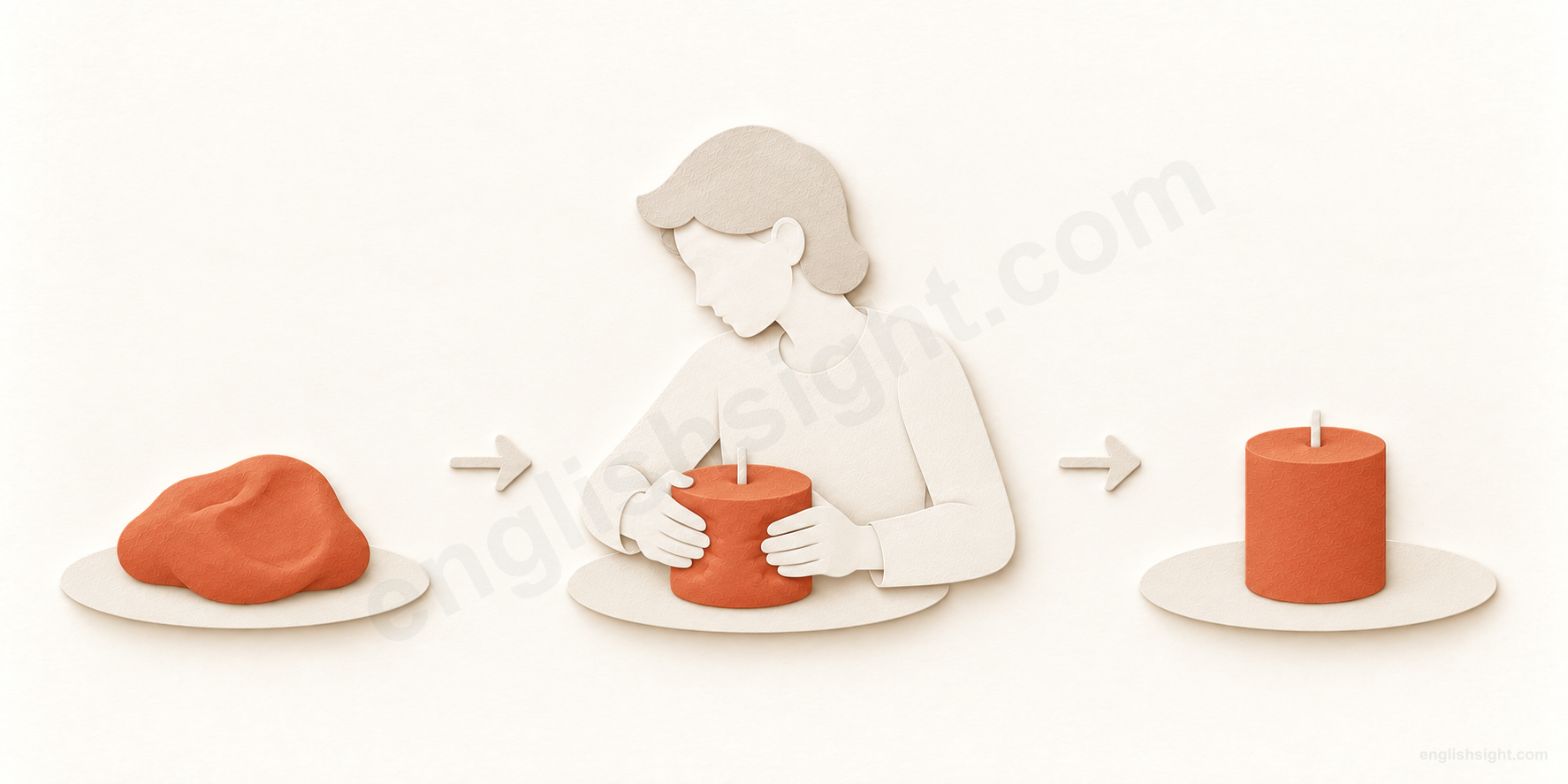
Warm, softened wax starts as an irregular lump.
wax
The cooled wax holds its shape as an unlit candle.
A craftsperson shapes the soft wax; it then cools.
Soft wax is shaped, then keeps its form after cooling. The candle illustrates the material use.
Wax is a material that softens with warmth, can be shaped or spread, and becomes firm again as it cools.
This material model connects objects made of wax with wax coatings. Earwax is a separate substance use. Moon phases, wax lyrical, and fixed idioms need their own explanations; they cannot be predicted from the picture.
Wax names a material used in candles, models, and surface treatments. Start with what the material can do, then use the sentence to tell whether wax is a noun or a verb.
There is also a separate wax meaning increase or become, as in a waxing moon and wax lyrical. A useful lesson keeps that branch distinct rather than inventing one physical story for every meaning.
01
A material and things made from it
Start with wax as a substance. Notice the difference between the material, an object made from it, and the substance in the ear.
01
some / a little wax; a piece / block of wax; a type of wax
some wax / a piece of wax
name the substance, rather than a finished object
Starting situation
A craft box contains a block of candle-making material.
Meaning in context
You take a small amount to use.
Wax is normally a mass noun when it names a material.
Wax can be softened or melted and used to make candles, models, or coatings. Candle wax names its use; beeswax names wax produced by bees; paraffin wax names another kind. Not all wax comes from bees.
Say some wax, a little wax, a piece of wax, or a block of wax. In a discussion of different kinds, waxes is possible: The supplier sells several natural waxes. That plural counts varieties, not ordinary pieces.
Hair wax or styling wax is a product used to shape hair. Put some wax in your hair describes adding a styling product; it does not mean removing your hair.
In a sentence
We need a little more wax for the last candle.
Watch the difference A candle is an object; wax is its material. Say two candles or two pieces of wax, not two waxes when you mean two candles.
02
be made of wax; wax + object noun
made of wax / a wax figure
identify what an object is made from
Starting situation
A museum displays a lifelike model of a person.
Meaning in context
You explain that the model is made from wax.
Wax before a noun can describe the material of the thing.
A wax figure or wax model is a figure or model made of wax. The head noun names the object: a figure, a model, or a candle. Wax tells you about its material.
Compare a wax figure with a waxed jacket. The figure is made from wax; the jacket is fabric treated with wax. The ending -ed matters: it points to an applied treatment, not the main material.
In a sentence
The museum has a wax figure of the singer.
Watch the difference Waxed and made of wax are not interchangeable. A waxed cotton jacket is not a jacket made entirely from wax.
03
earwax; wax in + possessive + ear(s); a build-up of wax
wax in your ears / earwax
name the natural waxy substance found in the ear
Starting situation
A conversation concerns a substance in someone’s ear.
Meaning in context
The context identifies the substance as earwax.
The same noun also names a bodily substance.
Wax in the ears means earwax, also written ear wax. It is not candle wax or a product someone has applied. The body location makes the intended noun sense clear.
This is also a mass use: some earwax or a build-up of wax. Read a sentence about wax in someone’s ear as a description of a substance, not as instructions to put wax there.
In a sentence
The note mentioned a build-up of wax in his left ear.
Watch the difference Do not assume that all substances called wax have the same source or use.
02
Putting wax to use
As a verb, wax can name a treatment of a surface or a method of removing hair. The object tells you which action is intended.
04
wax + surface; be waxed; waxed + noun
wax the floor / a waxed jacket
treat a surface with wax
Starting situation
A surface has not yet received its wax treatment.
Meaning in context
A layer of wax has been applied.
In wax something, the object is the surface being treated.
To wax a floor or a car is to apply wax, often as part of polishing or protecting the surface. Wash the car and wax the car are different actions: washing removes dirt; waxing adds a treatment. Polish describes making a surface shine and does not always involve wax.
The passive is natural: The floor was waxed yesterday. Waxed can describe the resulting coating, as in a waxed jacket or waxed paper. A wax coating names the layer itself.
You can say I am waxing the floor for an action in progress. Forms are wax, waxes, waxed, waxing; waxed is both the ordinary past tense and past participle.
In a sentence
They washed the car on Saturday and waxed it on Sunday.
Watch the difference Wax it uses an ordinary transitive verb, not a separable phrasal verb. The wax stays on the treated surface; this differs from a hair-removal treatment.
05
wax + body area; have / get + body area + waxed; book / get a wax
have your legs waxed / get a wax
remove unwanted body hair using a wax treatment
Starting situation
Someone wants hair removed from part of the body.
Meaning in context
A waxing treatment removes the hair.
With a body area as object, wax can mean remove hair from it.
She waxes her legs means she uses a wax treatment to remove the hair there. The treatment applies wax and then removes it with the hair. The aim is removal, unlike waxing a floor, where a coating remains.
I had my legs waxed usually means someone else provided the treatment. Have + object + past participle describes arranging the service; it does not say that the speaker performed it. I waxed my legs presents the speaker as doing the action.
A wax can also mean a hair-removal session: I booked a wax before the holiday. This countable service noun differs from uncountable wax, the substance. Waxing names the activity.
In a sentence
I had my legs waxed at the salon yesterday.
Watch the difference Hair wax is a styling product. Having your legs waxed is a hair-removal service; context and grammar separate the two.
03
A separate verb: increase or become
The moon waxes; interest waxes and wanes; someone waxes lyrical. These belong to a different historical verb, not to melting candle wax.
06
the moon waxes / is waxing; a waxing moon
the moon is waxing
the visible illuminated part of the moon is increasing
Starting situation
Only a small part of the moon’s lit face is visible.
Meaning in context
More of its lit face becomes visible as the full moon approaches.
Waxing describes a change of phase, not the moon growing physically.
The moon waxes between new moon and full moon; it wanes as the visible lit portion decreases after full moon. A waxing moon is therefore in the increasing part of its phase cycle.
This wax takes no object: The moon is waxing, not The moon is waxing something. Unlike wax the car, it has nothing to do with a surface treatment. Learn this as a separate verb meaning increase.
In a sentence
The moon is waxing and will be full in a few days.
Watch the difference Waxing does not mean the moon itself is getting bigger or that wax is being added to it.
07
interest / influence / enthusiasm + waxes and wanes
wax and wane
increase and decrease over time
Starting situation
Interest in a project rises.
Meaning in context
It later falls and may rise again.
The paired verbs describe changing strength, importance, or amount.
Interest, influence, or enthusiasm can wax and wane. The expression describes an increase followed by a decrease, often as part of a continuing fluctuation. It need not describe a perfectly regular cycle.
Wax supplies the increasing part; wane supplies the decreasing part. This literary expression is useful to recognize in reports and reflective writing. In ordinary conversation, Interest goes up and down is a plainer alternative.
The general increase sense can also occur alone in literary writing, but do not routinely replace grow with wax in everyday sentences. For a child’s physical growth, say The child is growing.
In a sentence
Our enthusiasm for the project waxed and waned as the months passed.
Watch the difference This pair is not a phrasal verb: and joins two verbs. Wax and wane describes fluctuation, not steady improvement.
speak or write with enthusiasm or expressive feeling
Starting situation
A topic prompts someone to talk enthusiastically.
Meaning in context
Their description becomes expressive or elaborate.
An adjective names the manner or quality the speaker develops.
If someone waxes lyrical about a meal, they describe it with enthusiasm and feeling. Wax poetic is a similar expression; wax eloquent emphasizes fluent, persuasive expression. These are established combinations, often formal or playfully elevated in tone.
About introduces the topic, not a direct object of wax: She waxed lyrical about the garden. The adjective lyrical describes the expressive quality. Do not change it to lyrically in this pattern.
The broader become sense also appears in combinations such as wax sentimental or wax indignant. The adjective determines the feeling, so the pattern does not always mean praise. These uses belong with the increase/become verb, not the material.
In a sentence
Maya waxed lyrical about the little café beside the station.
Watch the difference Wax lyrical does not require actual poetry, singing, or written lyrics. It describes how someone expresses themselves.
04
A fixed expression for everything
Learn the whole ball of wax as a unit, with its informal North American setting.
09
the whole ball of wax
the whole ball of wax
everything involved in a situation or package
Starting situation
A service could include several separate parts.
Meaning in context
You say that all of them are included.
The complete fixed expression means the entire thing.
The whole ball of wax is an informal expression associated especially with North American English. It can stand for all the arrangements, all the items, or the entire situation. It need not refer to a physical object.
In This price covers delivery, installation, and the whole ball of wax, the phrase includes the remaining relevant parts too. For neutral business wording, say everything or the complete package. Learn the idiom as a whole rather than trying to calculate its meaning from ball and wax.
In a sentence
The fee covers the room, the meals, the equipment—the whole ball of wax.
Watch the difference Keep the fixed wording. A whole wax ball would normally name a physical ball made from wax.
Keep the branches distinct
Two verbs with the same spelling
Wax a surface is a treatment verb connected to the material. Wax meaning increase or become comes from a different historical verb. The shared spelling does not prove a single underlying physical meaning.
A material, a service, or a type
Some wax names an amount of substance; a wax can name a hair-removal treatment; several waxes can name different types. Use the context rather than a blanket rule that wax is always uncountable.
Forms and boundaries
Wax is pronounced /wæks/. The verb has waxes /ˈwæksɪz/, waxed /wækst/, and waxing /ˈwæksɪŋ/. Surface and hair-removal verbs allow objects and passives; the moon and become uses do not take that kind of object. Historical recording uses, defeat slang, old anger expressions, and specialized technical senses are outside this introductory selection.
Choose the intended use
Use the object, the grammar, and the setting to identify the meaning.
1. You need a small amount of the substance to make a candle. Which request fits?
2. A salon worker removed hair from your legs. Which sentence reports the service?
3. What does The moon is waxing tell you?
4. A reviewer waxed lyrical about the bread. What did the reviewer do?
5. An informal offer includes the whole ball of wax. What is included?
Sources and teaching notes
The dictionary pages below support the recorded meanings and patterns. Lesson explanations and examples are original; the material diagram is a teaching aid.
The diagram illustrates the material branch; it is not a shared mental picture or a rule for every expression.