Follow way from physical routes to methods, habits, progress, and fixed everyday expressions.
A course from here toward an aim
A course from here toward an aim
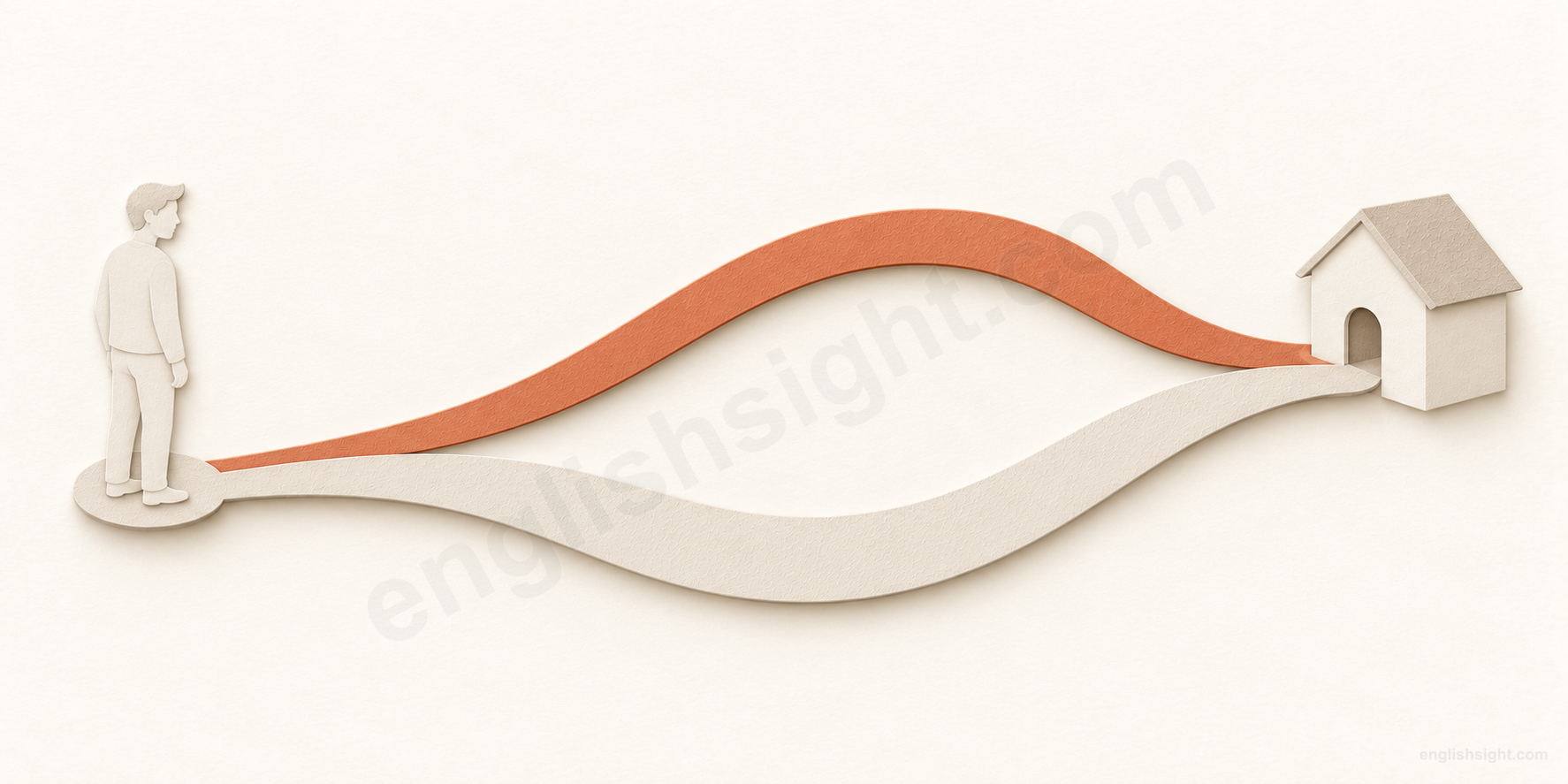
A traveler stands at the start, facing a building as the destination.
way
One possible course stands out; the traveler is still at the start.
Two routes lead toward the same building; the upper route is highlighted.
One highlighted route, another possible way to the same destination.
A way can be a route to follow or a manner of proceeding; the surrounding words specify the route, action, or aspect in question.
The route sketch connects spatial routes with possible approaches. It does not predict every idiom, and it does not imply that a way must succeed, be chosen freely, or involve movement.
Way is often a noun naming a route, direction, method, or manner. Ask which way to go when choosing a direction, or find a way to solve a problem when choosing an approach. The same practical question helps: what course or manner is involved?
This is a teaching connection, not a claim that every meaning developed in one simple line or that every speaker imagines the same picture. Fixed expressions such as by the way and informal adverbial way need their own explanations.
01
Routes, directions, and journeys
Start with where someone is going, which route is available, and what happens during the journey. These are the closest uses to the route sketch.
01
the way to + place; the way home / back / in / out
the way to the station
the route that takes you somewhere
Situation / starting point
You need to reach the station.
Meaning in context
Someone explains which streets to follow.
A way connects a starting place with a destination.
Way can identify the route through a place, not just one named street. Ask the way, know the way, or show someone the way when the route matters.
The way in or out can be an entrance or exit: Is this the only way out? A way out of a problem extends access into a possible solution. In a street name such as Willow Way, Way is part of the proper name.
Original example
Could you show me the way to the station?
Watch the difference Say the way home, without to. A road is a physical route for travel; a way to a place can involve several roads.
02
go / look / point + this / that / which / the other way
this way / which way?
a direction to move, look, or point
Situation / starting point
Two paths lead away from a junction.
Meaning in context
You ask which direction to take.
Direction need not specify a complete route.
This way can direct someone toward the speaker or a visible route. Look both ways asks you to check two directions. Every which way is an informal expression for many different directions.
The other way can mean the opposite direction. Direction also supports choices: Which way will you vote? asks about a decision, not physical travel.
Original example
Which way should we turn after the bridge?
Watch the difference Come this way needs no to or in; it does not mean come in this manner in a directions context.
03
the right / wrong way up; the other way round / around
the right way up / the other way round
how something is positioned, ordered, or related
Situation / starting point
A picture is upside down.
Meaning in context
You turn it into its intended position.
Way can identify an orientation rather than a journey.
The right way up puts the top where it belongs. The other way round, or around, reverses a position, direction, or order. Both round and around occur; round is particularly familiar in British English.
The reversal may be abstract: I teach her French, not the other way around means she does not teach me French. Here the relationship between the people is reversed.
Original example
The lid fits better the other way round.
Watch the difference The other way round can reverse an explanation as well as a physical object.
04
a long / short way from; all the way to / through
a long way / all the way
distance and the full extent of a journey or activity
Situation / starting point
The destination is far from the start.
Meaning in context
The journey covers the whole distance.
Length belongs to the route; all marks its full extent.
A long way describes a large distance; a little way describes a short one. A long way off can concern time: The holidays are still a long way off. Informal North American English also has a ways to go; neutral international usage is a way to go.
All the way through a book means from beginning to end. I support you all the way expresses complete support. These extensions use extent, not a literal road.
Original example
We walked all the way to the lake.
Watch the difference All the way means the whole distance or extent, not simply a very long distance.
05
be on one’s way to + place; on the way home / out / back
on my way / on the way
traveling, arriving, or during a journey
Situation / starting point
You leave home for work.
Meaning in context
You stop at a shop during the trip.
On places someone or something within an unfolding journey.
On my way home locates an event during my journey. The parcel is on its way says it is being sent or transported. I had better be on my way is a way of announcing departure.
One on the way can mean an expected baby: They have a daughter and another baby on the way. The surrounding nouns make this conventional family use clear.
Along the way can describe events during travel or during a longer process: We learned to work together along the way. Here it means as the project developed, without describing a physical journey.
Original example
I bought some bread on my way home.
Watch the difference I am on my way says I have started or am about to set off; it does not guarantee I am nearly there.
06
find / lose + my / your / her / their way
find / lose your way
navigate successfully or become lost
Situation / starting point
The streets are unfamiliar.
Meaning in context
You work out a route or lose track of it.
The possessive identifies the traveler whose route is at issue.
Find your way to a place means manage to get there; lose your way means become lost. Know your way around a town means be familiar enough to navigate it. It can also concern a subject: She knows her way around a spreadsheet.
A project that has lost its way has lost its purpose or direction. A photograph that found its way into a magazine ended up there, possibly unexpectedly. These are figurative developments, not proof of deliberate travel.
Original example
We lost our way when the path disappeared under the snow.
Watch the difference Use a possessive that matches the traveler: she lost her way, not she lost your way.
07
be out of one’s way; go out of one’s way to + verb
out of your way / go out of your way
a detour, or extra effort for someone
Situation / starting point
A shop is not on your planned route.
Meaning in context
Visiting it takes an extra trip or effort.
A route deviation and a considerate effort are related but distinct uses.
Is it out of your way? asks whether a place requires a detour. Go out of your way to do something usually praises an extra effort, whether or not travel happens.
She went out of her way to explain the form refers to effort and helpfulness. The to-infinitive states what that effort achieves or aims to do. It is not a separate geographical meaning of to.
Original example
The host went out of her way to help us find a late bus.
Watch the difference Out of my way can mean off my route; out of the way often means no longer obstructing.
08
round / down / over our way; across the way
round our way / across the way
a local area or the opposite side
Situation / starting point
You talk about the area near your home.
Meaning in context
You locate a person or building nearby.
Some spatial uses refer to a neighborhood or a place across from you.
Our way can mean the area where we live: There are few buses round our way. A place name can locate an approximate area too: somewhere over Bristol way.
Across the way usually places something across a street or comparable gap. It is a different expression from on the way, which locates something along a journey.
An out-of-the-way village is remote, far from a town or city. The hyphenated adjective before village differs from moving a chair out of the way, which clears an obstruction.
Original example
There is a small bakery across the way.
Watch the difference Round our way is informal and especially familiar in British usage; it is not a precise address.
02
Methods, manners, and viewpoints
A course can be an approach to a task rather than a line on a map. Distinguish the means of achieving something from the manner of doing it.
09
a way to + verb; a way of + -ing
a way to do / a way of doing
a possible method for achieving something
Situation / starting point
You want to save time.
Meaning in context
You consider a method that could help.
A method is like a course of action toward an aim.
A way to solve a problem and a way of solving it often name the same method. Way is a broad everyday word; method more strongly suggests an organized procedure.
There may be several ways, or no way at all. Ways and means is an established pairing for available methods and resources. Where there’s a will there’s a way is a saying about determination, not a guarantee that every goal is achievable.
That is no way to treat a guest criticizes the treatment as unacceptable. This is a judgment about the manner of acting, rather than a claim that treating the guest is impossible.
Original example
Is there a simpler way of sharing these files?
Watch the difference After of use sharing, not share. With to use the base verb: a way to share.
10
in a/an + adjective + way; do something this / that / someone’s way
in a friendly way / do it this way
the manner in which an action is performed
Situation / starting point
Two people can make the same request.
Meaning in context
One does so gently and the other abruptly.
Manner describes how an action happens, not only whether it reaches an aim.
An adjective such as calm describes the manner when it modifies way. Compare a quick way to get there, a method, with answering in a quick way, a manner of answering.
Do it this way and do it my way can function without in. The construction already presents the manner directly. In the same way as compares manners: Fold this corner in the same way as the first one.
Original example
She explained the delay in a calm way.
Watch the difference In a calm way can often become calmly; not every adjective has an equally natural adverb.
11
the way + clause; the way that / in which + clause
the way (that) she speaks
how something happens, or the fact that it happens that way
Situation / starting point
You hear a speaker interrupt repeatedly.
Meaning in context
You comment on that feature of her behavior.
The following clause identifies the manner or behavior being evaluated.
The way can introduce a clause with no that: The way she speaks is reassuring. The focus is how she speaks. In I hate the way he interrupts, the complaint can target the repeated behavior itself, not just its style.
The way things are describes the present situation. The way things are going comments on its development: The way things are going, we will finish early. No physical route needs to exist.
Original example
I like the way you explain difficult ideas.
Watch the difference Use the way you explain, the way that you explain, or the way in which you explain; avoid the way how you explain in standard English.
12
a way of looking at / thinking about + noun; to my way of thinking
a way of looking at it
an interpretation or viewpoint
Situation / starting point
People consider the same change.
Meaning in context
They understand its effects differently.
A viewpoint is one possible mental approach to a situation.
Way of thinking identifies a manner or framework of thought. To my way of thinking introduces an opinion and is a little more deliberate than I think.
See it my way means accept or understand my interpretation. Feel that way describes having a particular attitude or emotion: I did not know you felt that way about moving.
To put it another way introduces a restatement: The room is compact; to put it another way, there is little space for furniture. The speaker offers another formulation of the same point.
Original example
That is one way of looking at the problem.
Watch the difference One way of looking at it allows other interpretations; it need not imply agreement.
13
by way of + place / noun phrase
by way of London / by way of thanks
via a place, or serving as a kind of response
Situation / starting point
A journey can pass through an intermediate city.
Meaning in context
A gesture can serve as thanks.
By way of has both a route use and a conventional function use.
We traveled to the coast by way of the capital means via the capital. Here of is part of the expression, not a way-of-doing method pattern.
By way of introduction means as an introduction; by way of apology means as an apology. These uses can sound formal or literary. The route image may help memory, but the phrase’s function must be learned.
Original example
He sent us a drawing by way of thanks.
Watch the difference By the way introduces an aside. By way of thanks explains the function of an action.
14
a way out of + noun; take the easy way out; the way forward
a way out / the easy way out
a solution or an escape from difficulty
Situation / starting point
A problem needs a response.
Meaning in context
You find an escape or choose an easy avoidance.
An exit can be a metaphor for leaving a difficult situation.
A way out of debt is a means of escaping debt. The easy way out often avoids responsibility or chooses immediate ease over a better answer.
The way forward looks ahead instead: It is a promising plan for future action. A way into an industry is an opening that helps someone join it. These expressions link access with opportunities, without describing actual doors.
Original example
Blaming the software would be taking the easy way out.
Watch the difference The easy way out often criticizes avoidance; an easy way to solve something need not be critical.
03
Characteristic behavior and skill
Repeated behavior becomes someone’s ways. The constructions of, with, and a possessive make important differences.
15
a way of life; someone’s ways; change / mend one’s ways
a way of life / change your ways
customary living or behavior
Situation / starting point
A person has familiar daily habits.
Meaning in context
Those habits continue or change.
Repeated courses of behavior become characteristic ways.
A way of life includes everyday practices, values, and routines. Plural ways can mean habits or customs: I am getting used to their ways. It is not a count of roads.
Be set in your ways means be unwilling to change established habits or views. It is just her way explains behavior as typical of her. Neither expression proves that everyone in a group behaves alike.
Original example
Moving to the island changed our way of life.
Watch the difference Mend your ways implies correcting bad behavior; change your ways can be broader.
16
have a way of + -ing
have a way of doing something
a recurring tendency
Situation / starting point
Small problems are left unattended.
Meaning in context
They repeatedly become larger problems.
Have a way of presents a characteristic tendency rather than a chosen technique.
This pattern often comments on events that seem to happen repeatedly, sometimes despite our intentions. Things have a way of disappearing describes a tendency, not the things’ ability to choose a method.
A person can also have a distinctive way of speaking. Context tells you whether way names a manner, a recurring tendency, or an available method; the words have a way alone do not settle it.
Original example
Small delays have a way of turning into bigger ones.
Watch the difference Have a way of happening is not the same as have a way to make it happen.
17
have a way with + people / things
have a way with children / words
skill in dealing with people or things
Situation / starting point
A person makes nervous children feel comfortable.
Meaning in context
Others recognize that special ability.
With identifies what someone handles well.
Have a way with children concerns dealing successfully with them. Have a way with words concerns using language effectively. The positive ability belongs to the whole expression.
Compare She has a way of interrupting: that describes a tendency and may be negative. She has a way with people usually praises social skill.
Original example
Our guide has a way with nervous visitors.
Watch the difference With names the people or things handled skillfully; it is not interchangeable with of doing.
18
in one’s own way; go one’s own way
in your own way / go your own way
a distinctive style or independent course
Situation / starting point
Someone has an unusual working style.
Meaning in context
They continue according to their own preferences.
A personal way can be a style or a chosen independent course.
In your own way recognizes a person’s characteristic style, which others may find unusual. Go your own way means act independently, sometimes against advice.
The possessive contributes whose style or choice is involved. It does not always imply selfishness, and it does not mean that the result necessarily favors that person.
Original example
He shows affection in his own way.
Watch the difference In his own way describes manner; get his own way describes obtaining the result he wants.
04
Progress, effort, and support
Movement along a course offers a useful comparison for completing tasks, advancing, and meeting expenses. Read the verb and the destination together.
19
make one’s way to / towards / through + place
make your way to…
move toward a place or advance in life
Situation / starting point
People leave a crowded hall.
Meaning in context
They reach the garden.
The expression presents getting somewhere, sometimes with effort.
Make your way is often used when a journey is gradual or requires finding a route, but it does not always imply great difficulty. Can you make your own way there? asks whether you can get there without help or a lift.
Make your way in the world extends getting somewhere to establishing a life or career. The destination phrase and context supply the particular achievement.
Original example
We made our way through the hall to the garden.
Watch the difference Make way for someone removes an obstruction; make your way describes your own movement.
20
verb + possessive + way + through / into / out of / up…
push / pick / talk your way…
progress achieved through the action named by the verb
Situation / starting point
Someone needs to cross uneven ground or escape trouble.
Meaning in context
Their particular action enables progress.
The verb gives the means; the following phrase gives the course or outcome.
Push your way through a crowd names movement by pushing. Pick your way across rocks emphasizes careful foot placement. Feel your way along a wall means navigate by touch; figuratively, feel your way in a new job means proceed cautiously while learning.
Talk your way out of trouble means escape through explanations or persuasion; lie your way into a job means obtain it through lying. The action and result depend on both the verb and the directional phrase.
Original example
We picked our way across the wet rocks.
Watch the difference This is a noun construction, not a rule allowing any verb to combine with any particle.
21
work one’s way through + task / college; work one’s way up
work your way through / up
complete successive parts, advance, or earn support
Situation / starting point
A report contains many sections.
Meaning in context
You finish them one after another.
Work can describe orderly progress or paid work supporting a larger activity.
Work your way through a pile of forms emphasizes completion through sustained effort. Work your way up a company describes advancement through positions.
Work your way through college can mean do paid work while studying to cover costs. This is not simply a synonym for read your course books. The wider goal is supported by the work.
Original example
I worked my way through the report before lunch.
Watch the difference Work your way through college often means earn money to fund your studies; the object changes the reading.
22
have come a long way; have a long way to go; be well on the way to + noun / -ing
come a long way / have a long way to go
substantial progress or much progress still needed
Situation / starting point
A learner compares present ability with the starting point.
Meaning in context
They recognize achievement and remaining work.
Distance becomes a measure of development.
Have come a long way looks back at progress already made. Have a long way to go looks ahead at work still needed. Both can be true of the same learner.
Be well on the way to recovery or to reaching a target says progress is advanced and success is approaching. By contrast, We go back a long way means we have known each other for a long time, not that we have recently improved.
Original example
Your pronunciation has come a long way this year.
Watch the difference Well on the way to improving uses -ing because to is a preposition here.
23
something goes a long way; go a long way towards / toward + -ing
go a long way / go a long way towards…
last well or make a substantial contribution
Situation / starting point
You have a small budget or a useful improvement.
Meaning in context
It covers many needs or helps achieve a goal.
The full construction distinguishes lasting resources from contribution.
A little paint goes a long way means a small amount covers a large area. Money goes a long way when it buys a lot or lasts well.
A change that goes a long way towards improving safety helps significantly. Towards and toward are both standard. The goal is not a place, so the extension is about how much the contribution achieves.
Original example
This clearer guide will go a long way towards reducing mistakes.
Watch the difference Go a long way towards solving does not promise to solve the entire problem.
24
be under way / underway; be on the way out
under way / on the way out
already started, or approaching disappearance
Situation / starting point
A project has begun; an older system is being replaced.
Meaning in context
You locate each within its development.
These phrases mark different stages of an activity’s life.
Under way, also spelled underway, describes an activity that has begun: Preparations are under way. It need not be nearly finished.
On the way out can be literal in I saw her on the way out of the hall. Figuratively, Paper forms are on the way out means they are becoming obsolete or being replaced. Applied to a person, it may suggest impending departure from a role or, in a sensitive context, approaching death.
Original example
The repairs are already under way.
Watch the difference Under way means started; on the way means coming or traveling. They are not interchangeable.
25
pay one’s way; a business pays its way
pay your way / pay its way
meet your own expenses or cover operating costs
Situation / starting point
A traveler pays their own bills.
Meaning in context
A business earns enough to cover costs.
The established expression concerns financial support, not a fare for each step.
Pay your way means support yourself financially without relying on someone else’s money. It can refer to a trip, shared living, or life more generally.
A shop that pays its way makes enough to cover the cost of running it. The expression does not necessarily say it makes a large profit.
Original example
I saved enough to pay my own way during the trip.
Watch the difference Pay my way covers personal expenses; pay for my ticket names a particular purchase.
05
Obstacles, access, and replacement
A course can be blocked or cleared. Established give way expressions also describe yielding, collapse, and replacement; the subjects determine who or what changes.
26
be in the / someone’s way; get in the way of + noun / -ing
in the way / get in the way
block movement, vision, or an activity
Situation / starting point
A box blocks a doorway.
Meaning in context
People cannot pass until it moves.
An intended course is obstructed.
In my way says something obstructs my movement or view. Get in the way describes coming to obstruct an activity. Stand in someone’s way similarly means prevent them from doing what they intend.
The obstruction can be practical or emotional. Get in the way of learning has -ing after the preposition of. These extensions use a blocked-course metaphor rather than requiring a physical barrier.
Original example
Do not let a small disagreement get in the way of finishing the job.
Watch the difference In a way means partly; in the way means obstructing. The article changes the expression.
27
move out of the way; get something out of the way
out of the way / get it out of the way
not obstructing, or finished so you can move on
Situation / starting point
A box blocks the room; a form awaits completion.
Meaning in context
The box is moved or the form is completed.
Clearing an obstruction extends to dealing with a task.
Move out of the way asks someone to leave a space clear. Keep or stay out of someone’s way can also mean avoid meeting or bothering that person.
Once the exam is out of the way means once it has been dealt with. Out of harm’s way means safely away from danger. These phrases share a useful course-and-obstacle connection, but their conventional meanings still matter.
Original example
Let us get the paperwork out of the way before the guests arrive.
Watch the difference Get it out of the way can mean complete it; it does not always mean discard or hide it.
28
make way for + person / thing
make way for…
allow passage or make room for a replacement
Situation / starting point
A crowd fills a narrow passage.
Meaning in context
It moves aside to let someone through.
Make way clears access for another person or thing.
Make way can be an instruction to let someone pass. The person or thing after for gains passage or space.
Old offices were removed to make way for a park describes replacement, not moving offices aside momentarily. It is the same established expression used for a change in what occupies a place.
Original example
The crowd moved aside to make way for the paramedics.
Watch the difference Use make way for, without a possessive. Make your way describes your own progress.
29
clear / pave the way for + noun; lead / show the way
clear / pave / lead the way
enable later action or set an example
Situation / starting point
A new agreement removes a difficulty.
Meaning in context
Further cooperation becomes possible.
Opening a course differs from being the first to follow it.
Clear the way removes an obstacle; open the way makes something possible; pave the way prepares favorable conditions. For introduces the later person, action, or development.
Lead the way can mean go first so others can follow: Please lead the way to the hall. Figuratively, a team that leads the way in recycling sets an example. Show the way similarly demonstrates an approach others can follow.
Original example
The agreement paved the way for a joint research project.
Watch the difference Pave the way need not involve physical paving, and it does not guarantee the later event.
30
give way to + person / vehicle / pressure / emotion
give way (to traffic / pressure)
let others go first or stop resisting
Situation / starting point
A driver waits, or a committee faces pressure.
Meaning in context
Another vehicle goes first, or resistance ends.
Yielding allows another course or force to prevail.
In road language, give way means allow other traffic to go first. Have the right of way names priority in traffic; a public right of way can also mean permission or a path across land. These are language meanings, not a set of local traffic rules.
Give way to pressure means stop resisting it. Give way to despair means allow that feeling to take over. The to-phrase identifies what prevails; you do not separate give and way with an object.
Original example
The committee finally gave way to pressure from residents.
Watch the difference Give way to traffic is especially British usage; yield is the usual American road term.
31
support / structure / leg + give way
the shelf gave way
fail to support weight; collapse
Situation / starting point
A shelf carries too much weight.
Meaning in context
It fails and the books fall.
In this established sense, support fails.
A bridge, shelf, or floor can give way when it breaks or collapses. A person’s knees or legs can give way when they fail to support the body.
This is a fixed meaning of give way, not a productive meaning of the noun way by itself. The subject tells you what loses its supporting function; a to-phrase is not required.
Original example
The old shelf gave way under the weight of the books.
Watch the difference The shelf gave way does not mean it voluntarily let someone pass.
32
earlier state + give way to + later state
give way to sunshine / relief
be replaced by something different
Situation / starting point
The weather is cloudy; someone is anxious.
Meaning in context
Sunshine or relief replaces the earlier condition.
The subject is the earlier state; the to-phrase is the later one.
Give way to can describe succession: Darkness gave way to daylight. Unlike the traffic use, the subject need not be a person making a choice.
Compare She gave way to fear, where fear gains control over a person. In Fear gave way to relief, fear is the condition that ends. Similar words occur, but the subjects and relationships differ.
Original example
Our initial confusion gave way to relief.
Watch the difference The confusion is replaced by relief; reversing the nouns reverses the change.
06
Preferences, possibilities, and outcomes
Different ways can be alternative choices or courses in life. Notice whose preference is realized and whether an outcome favors someone.
33
get / have one’s (own) way; if I had my way
get / have your own way
obtain the arrangement or result you want
Situation / starting point
Two people want different plans.
Meaning in context
One person’s preference is accepted.
A preferred course becomes the actual arrangement.
Get your own way emphasizes obtaining your wish, often despite opposition. Have things your own way describes arrangements that favor your preferences. If I had my way introduces what you would choose if you controlled the decision.
Have it your way! can signal annoyed surrender in an argument. You cannot have it both ways criticizes wanting incompatible advantages, such as complete freedom together with a guarantee that someone else accepts all the risk.
Original example
We compromised, so neither of us got our own way completely.
Watch the difference Have a way with people praises skill; have your way concerns what you want.
34
either way; one way or the other
either way
regardless of which of two possibilities applies
Situation / starting point
There are two possible dates.
Meaning in context
Your conclusion holds for both.
Two possible courses lead to the same relevant conclusion.
Either way can mean whichever of two cases is true. One way or the other often works similarly: I do not mind one way or the other.
In physical contexts, a few centimeters either way means in either of two directions. The context decides whether ways are spatial directions or abstract alternatives.
Original example
The meeting may be online or in person; either way, we need an agenda.
Watch the difference Either way usually considers two alternatives; every way does not replace it in this expression.
35
one way or another + clause
one way or another
by some means, without specifying which
Situation / starting point
A task is difficult but necessary.
Meaning in context
You remain determined to achieve it.
Several methods may be possible even if none is yet selected.
This expression keeps the means open while presenting the outcome as the aim or expectation. It can suggest determination, uncertainty about how, or both.
It is not a literal instruction to travel in several directions. The method sense provides a helpful connection, but learn the whole expression as a normal way of saying somehow.
Original example
One way or another, we will get the equipment repaired.
Watch the difference One way or another emphasizes some means; either way commonly means regardless of two specified alternatives.
36
go one’s separate ways; part ways with + person / organization
go your separate ways / part ways
separate physically or end a shared relationship
Situation / starting point
People have traveled or worked together.
Meaning in context
They leave in different directions or stop working together.
Different courses can be physical paths or diverging lives.
After lunch we went our separate ways may simply mean each person left for a different destination. In a relationship or partnership, it often means the relationship ends.
A parting of the ways names the point of separation. Go your own way instead emphasizes independence; it does not necessarily describe two parties separating at the same time.
Original example
After ten years together, the band members went their separate ways.
Watch the difference The possessive normally matches the plural group: they went their separate ways.
37
opportunity + come one’s way; events + go one’s way
come your way / go your way
reach you unexpectedly, or turn out in your favor
Situation / starting point
An opportunity appears; a result favors someone.
Meaning in context
You receive a chance or benefit from events.
The possessive marks the person affected by the event.
A chance or interesting article that comes your way reaches you, often without being planned. Send it my way asks someone to pass something to you.
Nothing went our way says events failed to favor us. It does not mean we were geographically lost. Who or what is the subject helps distinguish this from traveling in someone’s direction.
Original example
Few opportunities came my way during that winter.
Watch the difference I am going your way can mean traveling in your direction; things are going your way means events favor you.
07
Conversation and fixed expressions
Learn these expressions as whole units. A route image alone does not tell you whether a speaker is changing the topic, refusing, praising, or reacting with surprise.
38
by the way, + clause; clause, by the way
by the way
introduce an aside or a change of topic
Situation / starting point
You are discussing travel.
Meaning in context
You remember an unrelated question.
This fixed conversational marker manages the topic.
The phrase can begin a question or comment that is not directly tied to the current topic. It can also appear later: Your scarf is here, by the way.
It is conversational; BTW is a familiar written abbreviation in messages. Its purpose is to manage the conversation, so a physical route does not predict its meaning.
Original example
By the way, did you leave your scarf at our house?
Watch the difference By the way does not mean during the trip; use on the way for that.
39
No way!; there is no way (that) + clause; no way + auxiliary + subject
No way! / There is no way…
strong refusal, impossibility, or surprised disbelief
Situation / starting point
Someone proposes something unacceptable or reports surprising news.
Meaning in context
You reject the proposal or react with disbelief.
The context and intonation distinguish refusal from surprise.
There is no way we can finish today states impossibility. No way am I paying that much is an emphatic refusal with auxiliary-before-subject order after initial no way.
As a standalone response, No way! can also express surprise or disbelief, especially in informal American English. It does not always accuse the other person of lying or refuse an invitation; listen to the situation and tone.
Original example
“They have already offered me the job.” “No way!”
Watch the difference No way! can sound blunt as a refusal. It is not a neutral polite no.
40
take something the wrong way; rub someone (up) the wrong way
take it the wrong way / rub someone the wrong way
be offended by a remark, or annoy someone
Situation / starting point
A comment is intended as helpful.
Meaning in context
The listener is offended or irritated.
Interpretation and irritation are conventional meanings of the full phrases.
Do not take this the wrong way can soften a remark expected to cause offense, but the wording does not make a hurtful remark harmless.
His tone rubs me the wrong way means his tone irritates me. British English also commonly has rubs me up the wrong way. Compare look the other way, which can mean deliberately ignore wrongdoing rather than misinterpret a remark.
Original example
Please do not take this the wrong way, but the music is rather loud.
Watch the difference Take the wrong way concerns the listener’s reaction; rub the wrong way concerns what irritates them.
41
Way to go!; learn / find out + the hard way
Way to go! / learn the hard way
praise success, or describe learning through mistakes
Situation / starting point
Someone succeeds, or learns from an unpleasant experience.
Meaning in context
You congratulate them or describe the lesson learned.
Two established expressions evaluate success and experience differently.
The exclamation celebrates an achievement. Like other praise, it may be sarcastic when someone has made a mistake; tone and context reveal that use.
I learned the hard way to keep a spare key means an unpleasant experience taught me that lesson. It does not necessarily mean the teaching method was academically difficult. Both phrases require more than the literal path image.
Original example
You fixed it yourself? Way to go!
Watch the difference Way to go! is informal praise, especially American; it is not asking which route to take.
42
what / much / little + in the way of + noun
in the way of equipment
the kind or amount available
Situation / starting point
You ask what a workshop provides.
Meaning in context
You describe its available equipment.
This construction classifies provision rather than describing an obstacle.
What do you have in the way of tools? asks what kinds of tools are available. The phrase is particularly familiar in questions and negatives, including little or not much.
The full structure and meaning of the following noun distinguish it from get in the way of working, which is about prevention. The same surface words can belong to different constructions.
Original example
The room has very little in the way of storage.
Watch the difference Little in the way of storage concerns provision; storage boxes in the way are obstructing something.
08
Aspects, emphasis, and counted parts
Way also helps qualify a statement, intensify a comparison, or describe shares and directions. Some of these are noun uses, while informal way too is adverbial.
43
in a way; in some / many / every way(s)
in a way / in some ways
partly true, or true in certain respects
Situation / starting point
A new job is both demanding and rewarding.
Meaning in context
You qualify your judgment rather than making it absolute.
Way can name an aspect from which a statement holds.
In a way softens or limits a judgment. In many ways names many relevant respects; in every way makes the claim comprehensive. In more ways than one can suggest that a statement has more than one relevant meaning.
In a big way and in a small way describe scale or degree of involvement: They expanded the service in a big way. They need not mean several different methods.
Original example
In some ways, the smaller office suits us better.
Watch the difference In a way can mean partly; in this way means by this method. Keep the determiner.
44
be in a bad way; the way things are / are going
in a bad way / the way things are
a poor condition, or the present state of affairs
Situation / starting point
A business has serious financial problems.
Meaning in context
You describe its difficult condition.
Some way expressions describe a state rather than a route or a method.
In a bad way can describe serious difficulty, poor health, or an injured state. The surrounding context identifies the kind of trouble. A business in a bad way may be struggling financially; an injured person in a bad way is in a poor physical condition.
The way things are means the current state of affairs: We cannot afford a bigger office, the way things are. This is a conventional state use. A physical route is not part of its meaning, even if the route sketch helps with other uses.
Original example
The business was in a bad way after losing its main customer.
Watch the difference In a bad way describes poor condition; in the wrong way describes doing something incorrectly.
45
in no way + verb phrase; in no way + auxiliary + subject; no two ways about it
in no way / no two ways about it
deny completely, or insist that a conclusion is certain
Situation / starting point
Someone suggests that you blame a colleague.
Meaning in context
You reject that interpretation completely.
These two negative expressions have different jobs.
In no way means not in any respect. It is stronger and more formal than not really. Compare There is no way we can leave, which says leaving is impossible.
There are no two ways about it insists that a conclusion admits no doubt: We need a backup; there are no two ways about it. It does not literally count the available methods.
In any way, shape or form is another emphatic formula, often with a negative: We do not support cheating in any way, shape or form. It stresses the completeness of the denial.
Original example
I am in no way blaming you for the delay.
Watch the difference Initial in no way takes inversion: In no way am I blaming you. Normal word order remains after I.
46
way + too / comparative / preposition / adverb; way back in + time
way too expensive / way ahead
far or much; an informal intensifier
Situation / starting point
A price exceeds your budget by a large amount.
Meaning in context
You emphasize the size of the difference.
Adverbial way increases distance or degree.
Way ahead, way above the limit, and way back in the corner emphasize a large separation. Way back in 2005 emphasizes a distant time. Way more useful means much more useful.
Way cool and way excited use way with a plain adjective, especially in informal North American speech. This is a marked conversational style, not a neutral replacement for very before every adjective. Here way is an adverb, not a countable noun.
The noun phrase by a long way also expresses a large margin: This is the best result by a long way. Compare the informal adverb in a way better result; both emphasize a difference, but their grammar differs.
Original example
This bag is way too heavy for the shelf.
Watch the difference Way too heavy is informal. Use much too heavy or far too heavy in more formal writing.
divide into shares, or describe directions and participants
Situation / starting point
Three friends share a bill.
Meaning in context
Each pays a share; directions or participants can also be counted.
Ways can count shares; hyphenated -way forms adjectives.
A three-way split has three parts; a three-way conversation has three participants. A one-way street permits travel in one direction; a one-way ticket covers travel to a destination without a return journey. In British English a one-way ticket is also called a single ticket.
Two-way traffic travels in both directions. Two-way communication involves exchange rather than just one side sending; a two-way radio both sends and receives. These compounds have established details, so the numeral alone is not a complete definition.
Original example
We split the taxi fare three ways.
Watch the difference Three ways follows the division verb; a three-way conversation uses a hyphenated adjective before a noun.
Read the whole construction
Grammar belongs to the phrase
The main modern word is a noun, with plural ways. A way, the way, and a possessive way can select different constructions. In find her way, her identifies the traveler; in give way, way is part of a fixed expression. These are not all separable phrasal verbs, and there is no ordinary modern verb way requiring a tense or passive paradigm in this lesson.
Keep the small words
In a way means partly; in the way means obstructing; on the way concerns a journey or arrival; by the way introduces an aside. A way of doing takes -ing, while a way to do takes the base verb. In on the way to recovering, to is a preposition and takes -ing.
A teaching connection has limits
The path model helps with routes, methods, and progress. It does not by itself explain every idiom, the tone of No way!, or informal adverbial way. The lesson selects useful modern senses and expressions; specialist nautical and machine-tool senses, archaic uses, and a full catalogue of proverbs are outside its scope.
Choose the way the sentence works
Use the subject, small words, and context to choose a meaning.
1. A chair blocks the doorway. Which sentence describes the obstruction?
2. Choose the standard method pattern.
3. You remember an unrelated question during a conversation. Which opening fits?
4. In Our anxiety gave way to relief, what changed?
5. You crossed the hall yourself. Which sentence describes your movement?
6. Choose the standard form for progress toward recovery.
7. A friend has won a surprising prize. You say No way! What can this mean?
8. The fee is way above our budget. What does way contribute?
9. Which sentence praises someone’s skill with language?
Sources and teaching notes
Modern meanings and constructions were checked against these publisher pages. The explanations and examples are original; connections to the route sketch are teaching interpretations.
The diagram presents a teaching connection, not a picture shared by every native speaker.