Describe the conditions outside, then explore weather as change, endurance, and idiom.
Conditions change around the same place
Conditions around a place, at a time
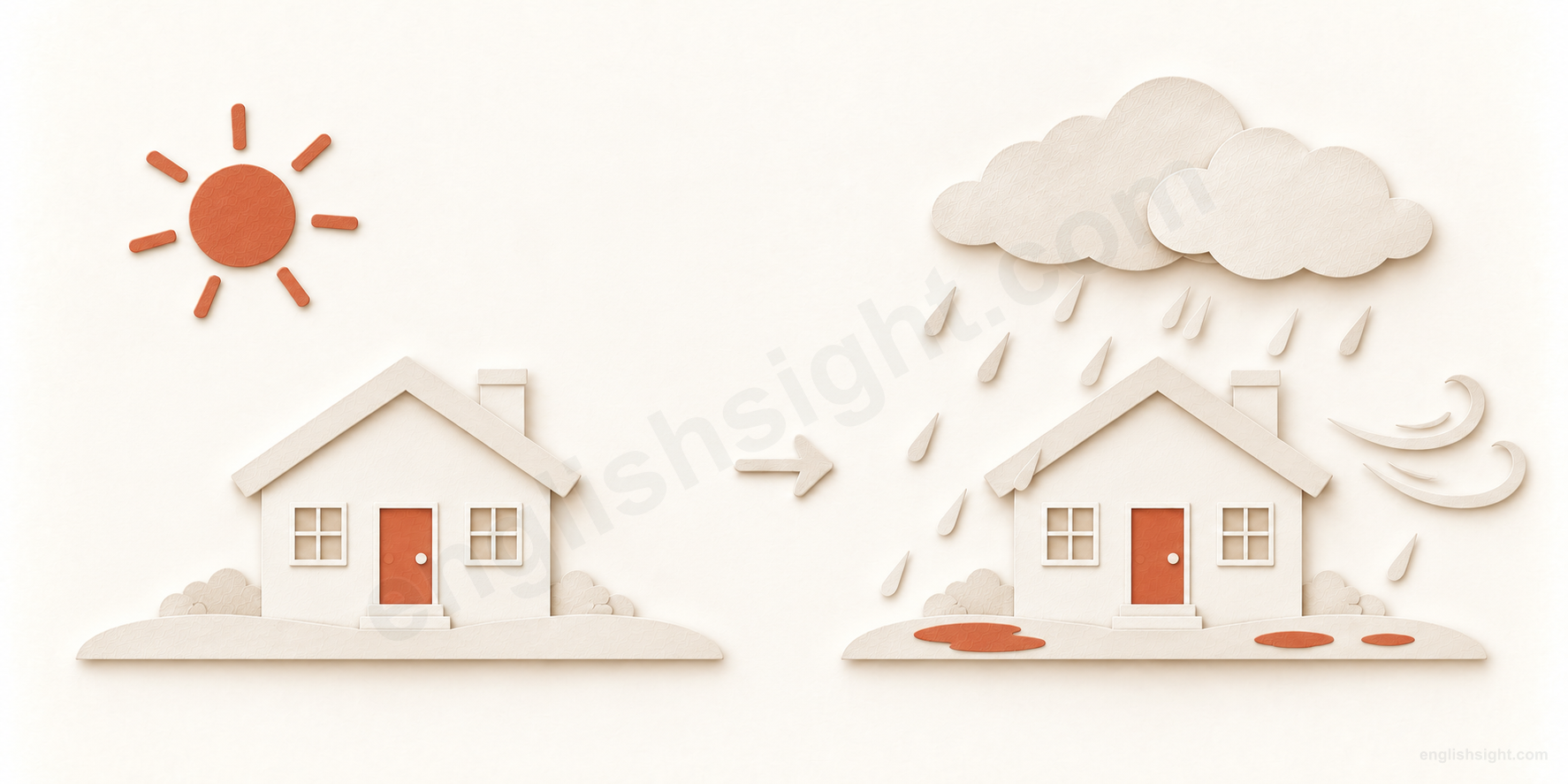
Sunshine above the house at one time.
weather
Cloud, rain, wind and puddles at another time.
The place stays the same; the conditions change.
Sunshine and wind-driven rain are both weather at the same place.
Weather is what the air and sky are like in a particular place at a particular time.
The two views keep the house and location the same while the conditions change. They illustrate the noun; they do not predict every verb use or idiom.
Weather brings together conditions such as heat, cold, wind, sunshine, and rain. A day can have beautiful weather without a drop of rain: weather does not mean bad weather by itself.
Start with the everyday noun. Then notice three different developments: the weather report, things changed by exposure, and people or organizations getting through difficulties. Fixed expressions need their own explanations.
01
Talk about the conditions outside
Ask, describe, check a forecast, or make a plan. These are noun uses, usually with uncountable weather.
01
adjective + weather; the weather + be + adjective; have + adjective + weather
warm weather / the weather is warm
describe the outdoor conditions
Situation / starting point
You step outside and feel warm air.
Meaning / outcome
You describe the conditions as warm.
Weather groups the conditions together; warm describes them.
Compare warm weather, wet weather, and windy weather. These describe different features, so warm does not imply dry. Good or bad weather evaluates the conditions for a purpose: rain may be good for a garden but bad for an outdoor concert.
Weather is normally uncountable. Say some lovely weather or a spell of lovely weather, not a lovely weather. Use the weather for the conditions relevant to this place or occasion; use bare weather in a general statement such as I prefer cool weather.
We had dry weather on the trip describes what we experienced. Weather conditions and weather patterns use weather before another noun; they are not plurals of weather.
In a sentence
We had warm, dry weather during our stay.
Watch the difference Say The weather is nice or It is nice, not It is a nice weather.
02
what + be + the weather + like?; how + be + the weather?
What’s the weather like?
ask someone to describe the conditions
Situation / starting point
A friend is in another town.
Meaning / outcome
You ask about conditions there.
Like asks for a description; it does not mean enjoy.
What is the weather like? invites a description such as cool and cloudy. How is the weather? is also natural. Add a time or place to make the question specific.
For a plan, ask What will the weather be like tomorrow? A natural reply is It will be windy. In It is raining, it is a grammatical subject used for weather; it does not refer to an object. The weather is rainy also works, but The weather is raining is not the ordinary pattern.
In a sentence
What’s the weather like where you are?
Watch the difference Do not confuse What is the weather like? with What weather do you like?, which asks about a preference.
03
the weather + turn + adjective; the weather + hold / break / close in
the weather turns cold / holds / breaks
describe a change or continuation in conditions
Situation / starting point
The morning is pleasant, and you watch for a change.
Meaning / outcome
You say whether the conditions continue or worsen.
The following verb supplies the kind of change.
The weather turned cold describes a change to cold conditions. The weather improved or cleared up describes improvement. These are ordinary combinations: turned and cleared up contribute their own meanings.
If the weather holds or holds out, the favorable conditions continue. If the weather breaks, a period of settled or pleasant weather ends, often with rain. The weather closed in describes worsening conditions such as approaching cloud, rain, or fog.
These expressions describe the conditions changing; they are different from The wood weathered, where exposure changes a material.
In a sentence
If the weather holds, we can finish painting the fence today.
Watch the difference The weather broke usually signals the end of a settled spell; it does not mean a weather instrument stopped working.
04
a weather forecast / report; check / watch / listen to + the weather
a weather forecast / check the weather
get information about expected conditions
Situation / starting point
You need to choose a day for a picnic.
Meaning / outcome
You consult a prediction or weather report.
The weather can also refer to the information being reported.
A weather forecast tells you what conditions are expected. A weather report is a report about weather. Informally, the weather can mean the report itself: watch the weather can mean watch that part of a broadcast. Check the weather may mean consult a forecast, rather than go outside and inspect the sky.
In a weather forecast, forecast is the countable head noun, so a is possible. Weather identifies the topic, as it does in weather map, weather station, and weather warning. A forecast is a prediction, not a guarantee.
In a sentence
Check the weather forecast before you choose a picnic spot.
Watch the difference A forecast is countable; the weather it predicts is normally uncountable.
The whole phrase means if the conditions allow it.
Weather permitting is a compact condition, often used when announcing arrangements. It can come before or after the main clause: Weather permitting, we will eat outside.
Weather is the subject of permitting within this small clause. It is not a person issuing a permit. What counts as suitable depends on the activity: a safe wind may matter for sailing, while dry ground may matter for a picnic.
In a sentence
We’ll hold the class in the garden, weather permitting.
Watch the difference The phrase makes the plan conditional; it does not promise good weather.
06
do something + in all weathers / in all weather; clause + whatever the weather
in all weathers / whatever the weather
do something despite different outdoor conditions
Situation / starting point
The days vary between sunny, wet, and cold.
Meaning / outcome
The activity continues in each kind of weather.
All and whatever remove weather as the deciding condition.
In all weathers emphasizes activity in good and bad conditions. In all weather and in all weather conditions are also used. Whatever the weather similarly says that the conditions do not decide whether the activity happens.
Weathers is an established plural in this expression. It does not make weather freely countable: two weathers is not the normal way to describe two kinds of weather. Contrast weather permitting, which does make the activity depend on suitable conditions.
In a sentence
The delivery team works in all weathers.
Watch the difference Both in all weathers and in all weather are established forms. The plural in this phrase does not make two weathers a normal way to describe two kinds of weather.
07
protect / shelter + someone or something + from the weather; brave the weather
protect something from the weather
shield something from outdoor conditions that can harm it
Situation / starting point
Your bicycle will remain outside overnight.
Meaning / outcome
A cover limits exposure to rain and other conditions.
Here the weather highlights exposure, often to unpleasant conditions.
Protect the bicycle from the weather treats outdoor conditions as a possible source of damage. Shelter from the weather and brave the weather also tend to foreground unpleasant conditions. Context gives this negative emphasis; the noun is not always negative.
Compare in wet weather, which places an activity within those conditions, with from the weather, which identifies what protection keeps away. Neither phrase uses weather as a verb.
In a sentence
We put a cover over the bicycle to protect it from the weather.
Watch the difference Weather includes more than rain, so protection from the weather need not mean waterproofing alone.
02
What exposure changes, and what survives
As a verb, weather can describe a material changing outdoors or someone getting through a hard experience. The subject and object help identify the meaning.
08
material + weather; conditions + weather + material; be weathered by + cause
wood weathers / weathered stone
change through exposure to sun, wind, rain, or cold
Situation / starting point
A wooden bench has a fresh surface.
Meaning / outcome
After exposure, its surface has become grey and worn.
The material changes; weather is now a verb.
The wood weathered uses the verb without an object: the wood itself changed. Sun and rain weathered the wood makes those conditions the subject and the wood the object. The wood was weathered by years of exposure is passive.
Weathered can describe an already changed appearance, as in a weathered wall or a weathered face. The change can involve color or texture; the object need not be broken or completely destroyed. Weathered to a pale grey states the resulting color.
In a sentence
Years of sun and rain have weathered the wooden bench.
Watch the difference It weathered means it changed through exposure; It was weathered adds a passive form, not a statement that it rained.
09
material + weather + well / badly
weather well / weather badly
show how a material copes with exposure
Situation / starting point
You compare materials for an outdoor structure.
Meaning / outcome
One remains usable, while another deteriorates.
Well and badly evaluate the result of exposure.
A material that weathers well endures outdoor conditions satisfactorily. It may change color attractively while remaining sound. A material that weathers badly deteriorates in an undesirable way.
This is an intransitive verb followed by an adverb, not an adjective describing today’s sky. Compare The weather is good, where weather is a noun and good describes the conditions.
In a sentence
This roofing material weathers well in coastal conditions.
Watch the difference Use weathers well to evaluate performance; good weather describes the conditions themselves.
10
someone / something + weather + a crisis / a difficult period / the storm
weather a crisis / weather the storm
get through difficulty and be able to continue
Situation / starting point
A small business faces months with few customers.
Meaning / outcome
It remains open after the difficult period.
The subject endures; the object is the challenge.
Weather a crisis or weather a difficult period places the person, group, or organization as the subject and the difficulty directly after the verb. The meaning centers on getting through, rather than making the problem disappear.
Weather a storm can describe actual survival at sea. In weather the storm, the storm often stands for trouble such as criticism or financial pressure: Our shop weathered the storm and stayed open. The metaphor connects to enduring exposure, but does not mean every difficulty is literally weather.
Compare The storm weathered the wall, where exposure changes the wall, with The shop weathered the storm, where the shop survives the difficulty. The storm is the cause of change in the first sentence but the challenge survived in the second.
In a sentence
The little shop weathered the crisis by keeping its costs low.
Watch the difference For this everyday transitive pattern, say weather the crisis, not weather from the crisis.
03
Expressions to learn as a whole
Illness, unnecessary difficulty, and watchfulness belong to established phrases. A picture of the sky is only a memory aid here.
11
be / feel + (a bit) + under the weather
be / feel under the weather
feel somewhat unwell
Situation / starting point
You feel ill and decide to rest.
Meaning / outcome
You explain why you are staying home.
This is an informal health expression, not a location.
I feel under the weather is a gentle, informal way to say you are not feeling well. A bit or a little can soften it further. It does not identify a particular illness or its cause.
Learn under the weather together, including the. It does not say that rain made you ill, and it does not normally just describe being outdoors. The scene of changing weather cannot calculate this idiomatic meaning.
In a sentence
I’m feeling a bit under the weather, so I’ll stay home today.
Watch the difference Keep the: under the weather, not under weather.
12
make heavy weather of + noun / -ing
make heavy weather of something
handle a task as though it were more difficult than necessary
Situation / starting point
A short form should be straightforward to complete.
Meaning / outcome
Someone struggles inefficiently and makes the task seem complicated.
The phrase evaluates the handling of a task.
This mainly British expression is usually critical: the speaker thinks the difficulty or effort is excessive. It need not mean the person deliberately pretends the task is hard.
Use of before the task, including an -ing form: make heavy weather of filling in a form. Heavy weather here is an established image of difficulty, not a report of rain or strong wind. A neutral alternative is find it difficult, which does not carry the same criticism.
In a sentence
He made heavy weather of filling in a simple application form.
Watch the difference This can sound dismissive of someone’s effort; it is not a neutral synonym for working hard.
13
keep a weather eye on + someone / something
keep a weather eye on someone or something
watch carefully so that you can respond to possible trouble
Situation / starting point
Supply delays could affect your work.
Meaning / outcome
You monitor deliveries and are ready to act.
Watchfulness, not literal eyesight or a forecast, is the point.
Keep a weather eye on something means remain alert to developments that may require action. The object may be prices, deliveries, a competitor, or a person; it need not be the sky.
The pattern is keep a weather eye on, with a before weather eye and on before the target. Keep an eye on is a simpler everyday alternative. The longer phrase emphasizes readiness for a potentially unwelcome change.
In a sentence
We’re keeping a weather eye on delivery times before the holiday rush.
Watch the difference It means monitor and stay alert; it does not promise that you can prevent trouble.
04
Weather inside a longer word
All-weather and fair-weather are compound adjectives. Their full meanings depend on what they describe.
14
all-weather + noun
an all-weather surface
describe something designed for use across different weather conditions
Situation / starting point
An ordinary playing area becomes unsuitable when wet.
Meaning / outcome
A specially designed surface supports use in varied conditions.
All-weather describes the suitability of the object.
All-weather is a compound adjective, usually before a noun: an all-weather track or all-weather clothing. It relates directly to varied conditions, unlike the illness idiom under the weather.
The article in an all-weather surface belongs to surface, a countable noun. It does not turn weather into a countable noun. Compare a team working in all weathers, which describes what the team does, rather than the design of equipment.
In a sentence
The school installed an all-weather playing surface.
Watch the difference Write the hyphen in this compound adjective; use the separate phrase in all weathers after an activity.
15
a fair-weather + friend; fair-weather + noun describing a person
a fair-weather friend
describe someone whose friendship disappears when things become difficult
Situation / starting point
Someone is friendly while life is easy.
Meaning / outcome
When help is needed, that person withdraws.
Fair conditions become a metaphor for pleasant circumstances.
A fair-weather friend is an unreliable friend who stays only while things are going well. Fair-weather can similarly describe participation that continues only while it is pleasant or convenient. The expression is disapproving.
Fair weather by itself describes pleasant weather. The compound fair-weather before friend transfers pleasant conditions to a relationship; it does not mean the friend simply enjoys sunny days. Keep the full expression rather than treating fair as a judgment that the friend is just or honest.
In a sentence
She stayed to help when I lost my job; she was no fair-weather friend.
Watch the difference A fair-weather friend is a criticism, even though fair weather itself sounds pleasant.
Read the grammar and the whole expression
Weather and climate
Weather describes conditions at a particular place and time. Climate describes the regular pattern of conditions in a place. A rainy afternoon is weather; a region’s usual pattern across the seasons belongs to its climate.
Weather and whether
Weather and whether sound the same in standard British and American pronunciation. Weather names conditions or works as a verb. Whether introduces alternatives or uncertainty: I don’t know whether we should go. The spelling changes the grammar, not just the meaning.
Verb forms and scope
The forms are weather, weathers, weathered, and weathering. The verb permits an ongoing process, as in The exposed wood is weathering. Passive weathered is useful for physical effects. There is no productive everyday family of particle verbs to memorize here; weather the crisis takes a direct object. Nautical windward weather, specialist building operations, and historical or uncommon senses are outside this lesson.
Choose the intended meaning
Check whether weather names conditions, reports information, acts as a verb, or belongs to a fixed expression.
1. You describe a pleasant day. Which sentence uses weather naturally?
2. The picnic will happen only if conditions are suitable. Which ending fits?
3. A company has got through a difficult period and remains in business. Which sentence fits?
4. Your friend says, “I’m feeling under the weather.” What does this usually mean?
5. A roofing material remains sound after outdoor exposure. Which sentence describes its performance?
6. Someone disappears whenever a friend needs help. Which description criticizes that behavior?
Sources and teaching notes
Dictionary entries support the usage distinctions below. Explanations, situations, examples, and the diagram are original teaching material; the visual model is a teaching choice.
The diagram is a teaching aid, not a claim that all native speakers share one mental picture.