Use week to organize dates, measure time, describe work, and build a routine.
One unit made from seven days
One unit made from seven days
Days in sequence
week
One week
Group seven consecutive days
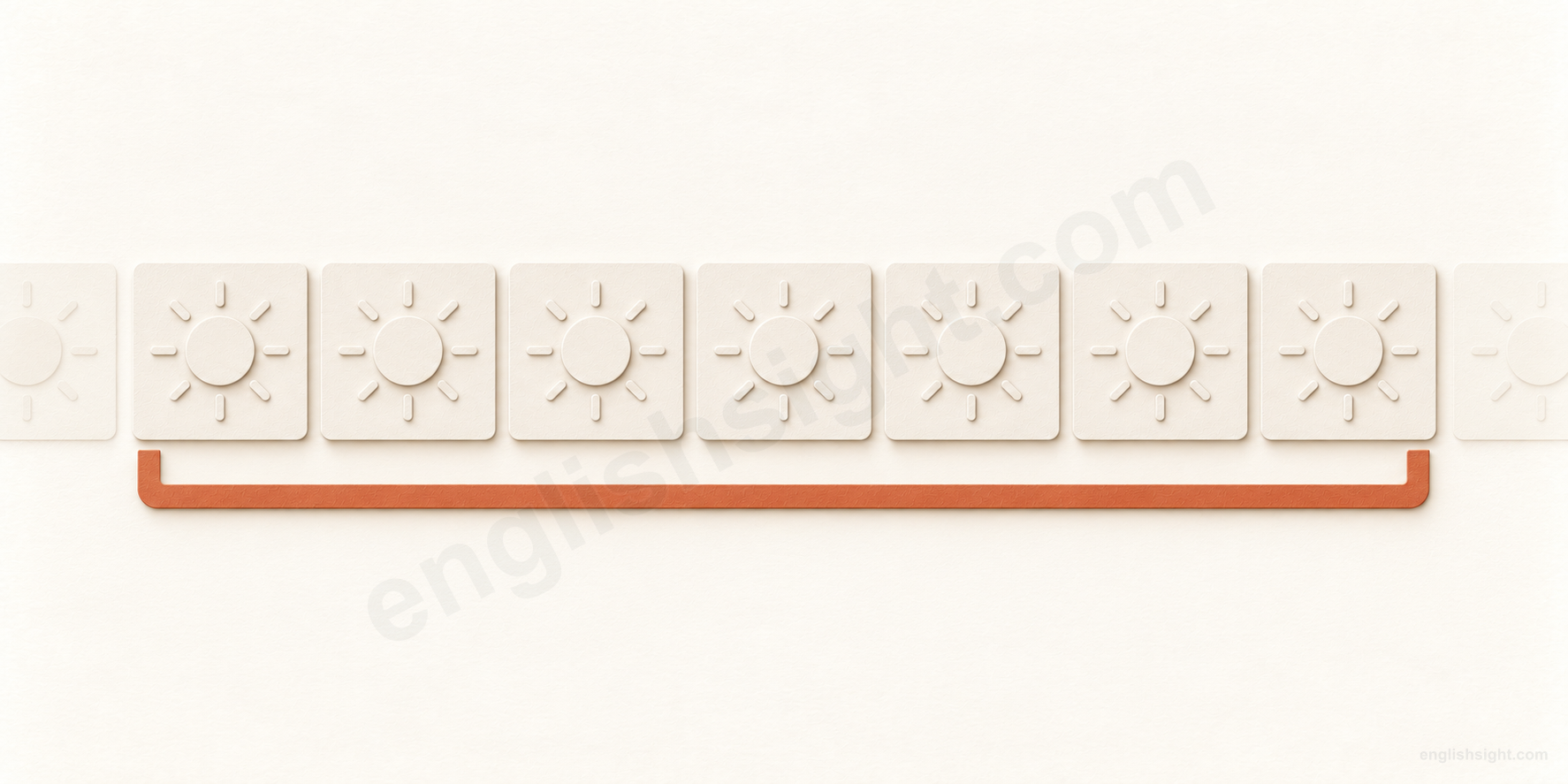
Seven consecutive days form one week. Sun symbols represent whole days; the grouping does not specify a first weekday.
A week groups seven consecutive days into one repeatable unit of time.
The seven-day model explains the full time unit. Weekday and work-schedule uses focus on part of it; fixed expressions add their own relationships.
A week groups seven consecutive days into one unit. You can place that unit on a calendar, measure it from any starting day, or repeat it when describing a routine.
Everyday English also uses week for the weekday part or the working part of that unit. The surrounding words tell you whether you mean a calendar block, a duration, a delay, a rate, or working time.
01
Seven days, a calendar block, or working time
Start with what is being counted. A full week contains seven days; everyday context can focus on the weekdays or on a person’s working hours.
01
a / one + week; number + weeks; day of the week
a week; the days of the week
one seven-day block in a calendar
Situation / reference
You are filling in a seven-day calendar row.
What the expression tells us
Every day belongs to the same calendar week.
A calendar week groups the days according to a shared calendar convention.
Week is a countable noun, pronounced /wiːk/, with the plural weeks. A calendar week contains seven named days. Calendars may start their rows on Monday or Sunday; week alone does not settle that convention.
What day of the week is it? asks for a day name. What week is it? asks which week. A busy week or a good week describes what happened in that period, rather than changing its length.
In a sentence
There are seven days in a week.
Watch the difference Use a week or one week when counting a single period; not one weeks. Week and weak sound alike, but weak means lacking strength.
02
for + a / number + week(s); take / last + a / number + week(s); spend a week + -ing
for a week; take a week
a period lasting seven days, starting on any day
Situation / reference
A guest arrives on Wednesday.
What the expression tells us
The guest leaves the following Wednesday.
The seven-day measure need not match a calendar row.
A week can measure a stay or a task from any starting day. We stayed for a week says how long the stay lasted. The repair took a week says how much time the task needed. The course lasts six weeks describes its duration.
Spend a week somewhere or doing something describes how a person uses that time: I spent a week helping my aunt. A week off is a week away from the usual work or duties. A week or so is approximate; a couple of weeks means about two in ordinary conversation.
In a sentence
We stayed by the lake for a week, from Wednesday to Wednesday.
Watch the difference For a week gives a duration. In a week can place a future event or describe time needed to complete something; it is not interchangeable with for.
03
during the week; in the week (especially British English)
during the week; in the week
the weekdays, especially when contrasted with the weekend
Situation / reference
Your usual routine changes between weekdays and weekends.
What the expression tells us
You explain the weekday part of your routine.
Context can narrow the week to the part outside the weekend.
In a weekday–weekend contrast, during the week usually refers to Monday through Friday. In the week is also used this way, especially in British English. The calendar week itself still has seven days.
Compare I read the report during the week of the conference: here the phrase identifies a particular period and need not exclude its weekend. During the week is not a promise that everyone works the same days.
In a sentence
I usually cook at home during the week and eat out at weekends.
Watch the difference Let the contrast decide the scope. Do not replace every use of during the week with Monday to Friday regardless of context.
04
a + number-hour / number-day + week; working week (BrE); workweek (NAmE)
a working week; a 35-hour week
the days or total hours allocated to work in one week
Situation / reference
A job description gives a weekly schedule.
What the expression tells us
You know the total work required, rather than the length of seven whole days.
The number modifies working time within the week.
A 35-hour week means 35 working hours in the weekly schedule. A four-day week means working on four days. Working week is usual in British English; workweek is the North American equivalent.
A short week may result from a public holiday. It does not mean that the calendar has lost a day. People’s schedules vary, so working week does not guarantee Monday to Friday or a particular number of hours.
In a sentence
My new job has a four-day week, with Fridays off.
Watch the difference A four-day week describes the work schedule. For four weeks describes a duration of about a month.
05
the first / second / last week of + period; the week of + date; week beginning / commencing + date
the week of…; week commencing…
identify a week by a date, position, or event
Situation / reference
Several weeks appear on a plan.
What the expression tells us
A date or an event identifies the intended block.
The following words select which week is meant.
The first week of July locates a week within a larger period. The week of 6 July identifies a week by an associated date; when the start matters, the week beginning 6 July or week commencing 6 July makes the start explicit. British schedules may abbreviate week commencing as w/c.
An event can identify the period too: exam week or Book Week. The label says what the week is associated with; it does not mean that every hour is spent on that event. Check the actual dates in a programme.
In a sentence
The workshops run in the week beginning 6 July.
Watch the difference A week beginning 6 July is a period. On 6 July identifies just one date; the two do not give the same information.
02
Place an event or measure its time
A calendar label, a delay, a duration, and a deadline answer different questions. Small surrounding words make these differences clear.
06
this / last / next + week; at / by the end of the week
this week; last week; next week
locate an event relative to the current calendar week
Situation / reference
Today falls in the current calendar week.
What the expression tells us
You place a meeting in the following calendar week.
Calendar labels select blocks rather than count exactly seven days from now.
This week is the current week, last week the preceding one, and next week the following one. Used as ordinary time expressions, they need no in, on, or at: We met last week; We meet next week.
If today is Friday, an event next week might be on Monday, only a few days away. In a week normally points about seven days ahead. By the end of the week gives a latest time at the current week’s end; at the end of the week locates something near that end.
In a sentence
We are moving next week, on Monday.
Watch the difference Say We meet next week, not We meet on next week. In the next week is possible with a different sense, such as within the coming seven days.
07
the previous / following week; the week before last / after next; the other week
the following week; the week before last; the other week
choose a past or future week using a clear reference
Situation / reference
You are telling a story about a trip in May.
What the expression tells us
The following week is linked to that trip, not automatically to today.
Identify whether the anchor is now, another event, or an imprecise recent time.
The following week and the previous week normally refer to a week already established in the story: We arrived in May and left the following week. The week before last skips last week and selects the calendar week before it. The week after next skips next week in the same way. Events in successive calendar weeks are not necessarily exactly seven days apart.
The other week is an informal way to say recently, in a past week that is not precisely identified. It does not mean every other week, and it does not require the immediately preceding week.
In a sentence
I sent the form the week before last, and the office called me last week.
Watch the difference The other week is vague. Use a date when the exact week matters, especially in bookings or deadlines.
08
a / number + week(s) + ago / later / away; weeks in advance
a week ago; a week later; weeks away
measure the distance between an event and a reference point
Situation / reference
An event has a reference date.
What the expression tells us
A number of weeks places another event before or after it.
Ago counts back from now; later counts forward from a stated or understood reference.
A week ago normally means about seven days before now. A week ago today specifies the corresponding day seven days earlier. A week later places something seven days after another event: The parcel left on Tuesday and arrived a week later.
The interview is two weeks away describes a remaining gap of two weeks. Book weeks in advance means book that far before the event. In these expressions week supplies the unit; ago, later, away, and in advance supply the time relationship.
In a sentence
The parcel was posted on Tuesday and arrived a week later.
Watch the difference Ago is normally anchored to now. To count back from a past event, use a week before or a week earlier.
09
in + a / number + week(s); in a week’s time; in two weeks’ time
in a week; in a week’s time
place a future event about seven days from the reference time
Situation / reference
You are discussing today’s plans.
What the expression tells us
The next meeting is about seven days from now.
In gives the gap before the event, not the event’s duration.
We’ll meet in a week and We’ll meet in a week’s time usually point to about seven days from now. A different reference point is possible when the surrounding story supplies it. The singular count noun needs a: in a week, not in week.
Compare We’ll stay for a week: the stay itself lasts seven days. We’ll leave in a week: the departure happens after that gap. Neither expression requires that the intervening days belong to the same calendar week.
In a sentence
I’ll call you in a week, after I have the results.
Watch the difference Next week selects the following calendar week. In a week measures a gap, so the two can indicate different dates.
10
complete / finish + something + in a week; within a week; by the end of the week
finish in a week; reply within a week
give completion time or the outer time limit
Situation / reference
Someone asks how long the repair needs or how soon a reply must arrive.
What the expression tells us
The answer either measures completion or sets a limit.
The verb and the preposition together determine what the week measures.
We built it in a week measures the time needed to reach completion. This is a different use of in from We’ll start in a week, which places the start in the future. Read the event described by the verb.
Reply within a week allows a reply sooner; it sets a limit of one week from the relevant starting point. By the end of the week instead uses a calendar endpoint, which may be fewer than seven days away. Check exact dates when the limit matters.
In a matter of weeks presents completion or change as taking only a small number of weeks: The team prepared the exhibition in a matter of weeks. It is an approximate time measure, not an exact deadline.
In a sentence
Please reply within a week of receiving this message.
Watch the difference Within a week does not tell you to wait seven days before replying. For a week would describe how long an activity continues.
11
all (this) week; the whole week; in / over the past / last week; not…for / in weeks; in recent / coming weeks; the first…in weeks
all week; in the past week; for weeks
describe a whole period or look back over an interval
Situation / reference
You summarize recent weather or a gap in contact.
What the expression tells us
Your wording shows whether the period is whole, recent, or indefinite.
All, past, for, and a negative sentence contribute different views of the interval.
All week and the whole week emphasize the whole relevant week: I’ve been busy all week may refer to the week so far. In the past week or over the last week commonly looks back over roughly seven days up to now. Last week instead selects the previous calendar block.
I haven’t heard from her for weeks describes an extended period with no contact. In weeks also occurs in this negative use: I haven’t heard from her in weeks. Weeks here is indefinite, not a precise number; the tense and context locate the period.
In recent weeks describes a recent period of several weeks without fixing its length: Sales have risen in recent weeks. In the coming weeks points ahead: We will share more details in the coming weeks. In weeks can also follow first or last: This is my first free evening in weeks means I have had no free evening for several weeks.
In a sentence
I haven’t heard from my cousin for weeks.
Watch the difference I’ll be away for weeks gives a future duration. I’ll leave in a few weeks gives a delay before departure. Do not generalize the negative in weeks pattern to every sentence.
03
Routines, rates, and successive weeks
A week can be the unit for counting visits, charging rent, describing a repeated experience, or following gradual change.
12
once / twice + a / per week; number + times + a / per week; number + days + a week
once a week; three times per week
count how often something happens in each week
Situation / reference
A routine repeats over successive weeks.
What the expression tells us
You count the occurrences in one weekly unit.
A and per introduce the unit used to state frequency.
Once a week means one time each week; twice a week means two times. Three times a week and three times per week give the same kind of frequency, with per common in schedules and more formal instructions.
Three days a week counts days, not necessarily three separate visits. A habit expressed as twice a week does not by itself specify which days or require perfectly equal gaps between visits.
In a sentence
I practise the piano four times a week.
Watch the difference Use twice a week or twice per week, not twice one week when you mean a regular weekly frequency.
13
money amount + a / per week; pay / rent + by the week
£120 a week; paid by the week
use the week as the unit for a price, income, or payment arrangement
Situation / reference
Two rooms have prices listed for different periods.
What the expression tells us
A weekly price lets you compare the same unit.
A money amount per week is a rate; by the week identifies the payment or rental unit.
The room costs £120 a week means the quoted cost is £120 for each week. Per week gives the same unit. She earns £500 a week similarly states a weekly amount; the words alone do not tell you the actual payday.
Paid by the week focuses on the weekly basis of payment, as distinct from by the hour or by the day. Rent a room by the week uses the week as the rental unit. The exact billing rules still depend on the agreement.
In a sentence
The room costs £120 per week, including electricity.
Watch the difference £120 a week is an amount for each week, not necessarily the total price of the whole stay.
14
every week; every other week; every two / three / few weeks
every week; every other week
repeat each week or leave one week between repetitions
Situation / reference
You choose between a weekly visit and an alternating schedule.
What the expression tells us
The visits happen either each week or in alternate weeks.
Other changes which weeks are included.
Every week includes each week in the relevant routine. Every other week includes alternate weeks: a visit, a week without a visit, then the next visit. Every two weeks is a useful equivalent for a regular two-week interval.
Keep week singular after every in every week and every other week. After a number, use the plural: every two weeks. The other week, without every, refers vaguely to a recent past week.
In a sentence
The recycling truck comes every other week.
Watch the difference Every other week is not twice a week. If dates matter, write down the actual collection dates.
15
week after week; week in, week out
week after week; week in, week out
emphasize repetition across many successive weeks
Situation / reference
The same delay happens over a series of weeks.
What the expression tells us
You emphasize how regularly it keeps happening.
The whole expression adds insistence beyond a simple weekly schedule.
Week after week presents repeated or continuing experience over many weeks. Week in, week out emphasizes the same weekly pattern continuing reliably or monotonously. Both are fixed time expressions, not phrasal verbs.
Collins highlights disapproval for week in week out; Oxford also gives a neutral example of a regular family visit. A complaint is common, but the expression can also stress steady commitment. The attitude comes from the full sentence and context.
In a sentence
Week after week, the lift broke down before Friday.
Watch the difference These expressions suggest a continuing series. They do not mean that an action necessarily happens at every moment of every day.
16
change / develop + week by week; follow / track + something + week by week
week by week
follow change or development as successive weeks pass
Situation / reference
A learner is improving over several weeks.
What the expression tells us
You observe a little more progress each week.
By presents the successive units through which change is followed.
Week by week is useful when comparing one week with the next: confidence grows, recovery continues, or a plan develops gradually. The phrase highlights the passage of time in weekly stages.
Compare We check it every week, which states a checking routine. It improves week by week focuses on the pattern of improvement. Week after week often foregrounds repeated experience instead.
In a sentence
Her confidence grew week by week as she practised speaking.
Watch the difference Week by week does not mean every other week. It follows the series of weeks rather than skipping alternate ones.
17
(for) weeks on end; for weeks and weeks
for weeks on end; weeks and weeks
emphasize a long, uninterrupted or very extended period
Situation / reference
A road stays closed for a long time.
What the expression tells us
You stress that the closure continues through successive weeks.
On end emphasizes continuity; repetition can emphasize how long the period feels.
For weeks on end describes a situation continuing for many weeks without a break. The on-end meaning belongs to the whole expression; it is not a physical end point or the upright meaning of on end.
Weeks and weeks is another way to emphasize a long period, often with impatience or surprise. A state such as a road closure can hold continuously even though no person is performing an action every second.
In a sentence
The footpath remained closed for weeks on end.
Watch the difference Week after week can describe separate repeated events. Weeks on end stresses the continuity or extended persistence of the situation.
04
Build descriptions and read date expressions
Learn the singular form in two-week, the apostrophes in a week’s and two weeks’, and the reference day in regional date expressions.
18
a + number-week + noun; a week-long + noun
a two-week course; a week-long visit
use a duration to describe a noun
Situation / reference
A course has a duration of two weeks.
What the expression tells us
The duration becomes a description before course.
The number–unit modifier uses singular week.
The course lasts two weeks can become a two-week course. In this compound modifier, week stays singular and the written words are joined with a hyphen. A six-week project follows the same pattern.
A week-long visit means a visit lasting one week. Compare a weekly class: weekly describes recurrence, not a single class lasting a whole week. A two-week course may meet on selected days; it need not run all day for fourteen days.
In a sentence
I’ve joined a two-week cooking course.
Watch the difference Write a two-week course, not a two-weeks course. In The course lasts two weeks, weeks is an ordinary plural noun.
19
a / one week’s + noun; number + weeks’ + noun; this / next week’s + noun; a week’s worth of + noun
a week’s pay; two weeks’ notice
relate a time measure to an amount, entitlement, or notice period
Situation / reference
An employer asks for a notice period measured in weeks.
What the expression tells us
The time measure is attached to notice with a genitive ending.
The apostrophe marks a grammatical relationship, not plural spelling by itself.
A week’s pay means pay corresponding to one week. Two weeks’ pay means pay for two weeks. The singular form takes ’s; the regular plural weeks takes an apostrophe after s. Two weeks’ notice similarly describes the amount of advance notice.
The same spelling appears in in a week’s time and in two weeks’ time. Compare this week’s timetable, which is the timetable associated with the current week, and the compound a two-week course, which uses a different construction.
A week’s worth of groceries is enough groceries for about one week. Here worth of links the time measure to a quantity; week itself does not mean money or value. Compare I bought a week’s worth of groceries with I spent a week shopping: the first describes the amount bought, the second the time spent shopping.
In a sentence
The job requires two weeks’ notice before you leave.
Watch the difference Distinguish two weeks (a plural duration), two weeks’ notice (a genitive measure), and a two-week course (a compound description).
20
a week (from) today; a week from + day; day + week / a week on + day (BrE); a week yesterday / last + weekday (especially BrE)
a week from today; Thursday week
count seven days before or after a named reference day
Situation / reference
You identify a specific reference day.
What the expression tells us
A seven-day gap places the event before or after that reference day.
The named day supplies the anchor; week supplies the seven-day distance.
A week from today is seven days after today. A week from Thursday is seven days after the Thursday being referred to. British English also uses Thursday week or a week on Thursday; tomorrow week means seven days after tomorrow. Specify a date if there is any doubt about which day is the anchor.
For recognition, British expressions such as a week last Monday count seven days back from the last Monday being referred to. A week yesterday means seven days before yesterday, so eight days ago. They are regional date expressions, not a verb use of week. A numeric date or an explicit phrase such as a week before last Monday is easier to interpret across varieties.
In a sentence
If today is Tuesday the 3rd, a week from today is Tuesday the 10th.
Watch the difference Thursday week does not mean every Thursday. Check the reference Thursday, especially when arranging travel.
Choose the time relationship before the phrase
Seven days and working days
A complete week is seven days. During the week can mean the weekdays in a weekend contrast, while a 35-hour week counts work. These are contextual focuses, not competing lengths for the calendar unit.
Calendar block, gap, duration, or limit
Next week selects a calendar block; in a week often places an event seven days ahead; for a week gives duration; within a week sets a time limit. In a completed task such as built it in a week, in instead measures time to completion.
Count noun and spelling
Use one week, two weeks, a two-week course, a week’s pay, and two weeks’ pay. Week /wiːk/ is a noun and sounds like weak. Its time expressions can function adverbially, but it has no everyday verb or phrasal-verb family to expand here.
A useful model with limits
Seven grouped day spaces are a teaching model, not a claim about a picture every English speaker sees. Fixed expressions, regional date conventions, and workplace schedules need their own context. Weekday, weekend, weekly, and fortnight are related vocabulary rather than additional senses taught as separate lessons here.
Choose what the week measures
Check the reference point, the preposition, and the form of week.
1. It is Friday. Your appointment is on Monday in the following calendar week. Which phrase fits?
2. You arrive on Wednesday and leave the following Wednesday. How do you describe the length of the stay?
3. A reply is welcome at any point before a seven-day limit. Which instruction fits?
4. The group meets, skips one week, then meets again. Which schedule describes this?
5. The course lasts three weeks. Which description has the correct noun form?
6. You want to emphasize steady improvement as successive weeks pass. Which phrase fits best?
Sources and teaching notes
The sources below support the meanings, constructions, and spelling notes. The lesson’s explanations and examples are original; the grouping diagram is a teaching interpretation.
The diagram groups seven days to explain the time unit; it does not represent a picture shared by every native speaker.