See how physical loads connect with importance, responsibility, and influence.
A load bears on a support
A load bears on a support
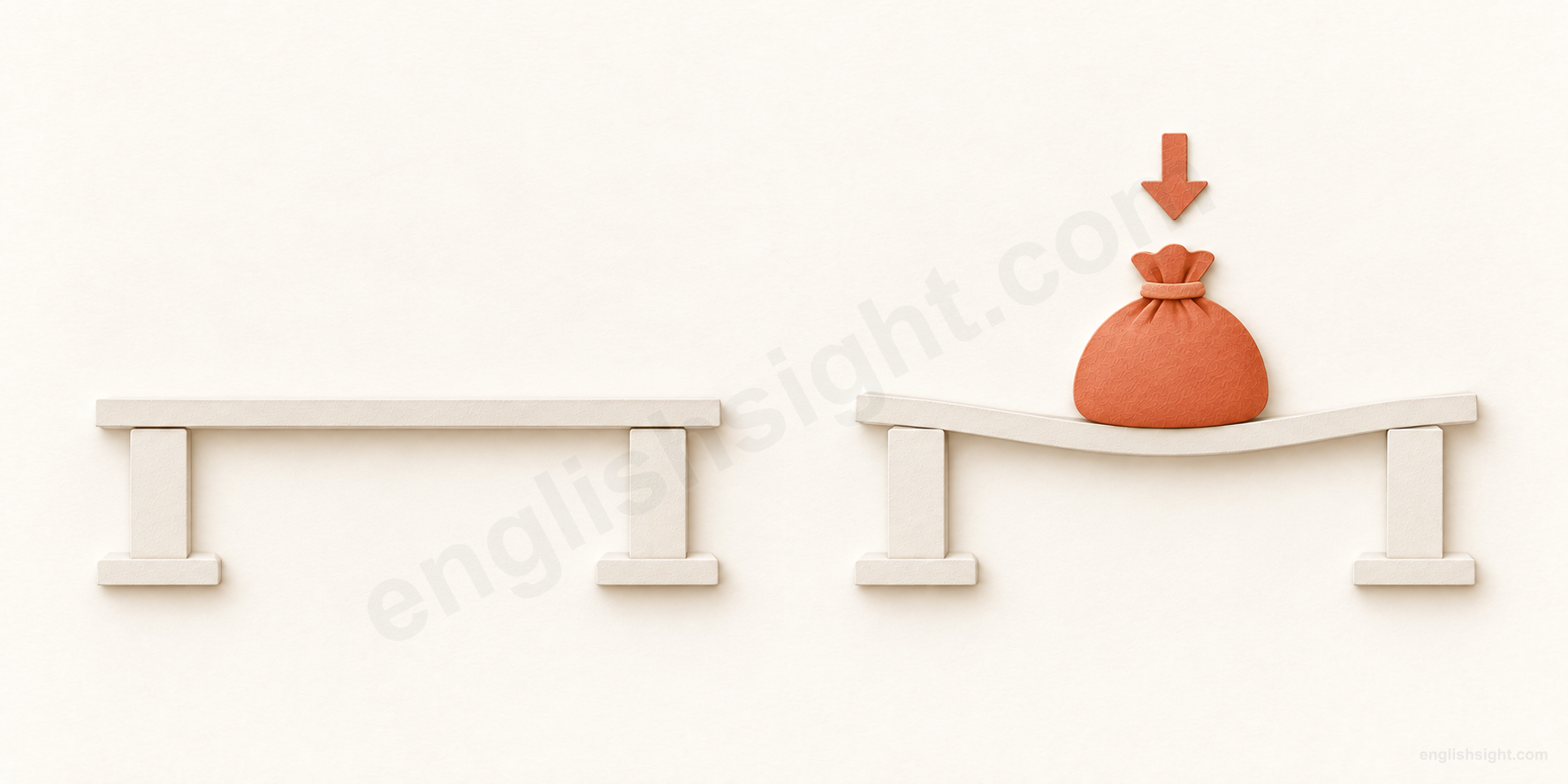
The empty plank rests level on two supports.
weight
The plank bears the sack and bends slightly at the center.
The sack's weight presses down on the same plank.
A load bears on a support; the slight bend makes its pressure visible.
Weight is how heavy something is and the load it places on a support. Figuratively, weight can be the pressure or importance something carries.
The comparison shows a physical load pressing on a support. It does not mean weight is always added or that every support bends; figurative uses and idioms require their own contexts.
Weight names how heavy something is, the load it puts on a support, or a heavy object used for a task. In established figurative uses, it can name importance, influence, or a burden.
The connection is useful for remembering these uses, but it cannot predict every idiom. The verb weight also needs its own patterns: adding heaviness and assigning relative importance.
01
Heaviness, measurement, and support
First identify whether weight is a measurable property, a load being supported, or a heavy object you can count.
01
the weight of + noun; a weight of + amount; amount + in weight
the weight of something
how heavy someone or something is
Starting situation
You need to check a parcel before posting it.
Meaning in context
You record its heaviness as an amount.
Weight names the measurement; weigh states it as a verb.
Ask What is the weight of the parcel? or How much does it weigh? An answer can be Its weight is two kilos or It weighs two kilos. The question is about heaviness, not the number of parcels.
Weight is often uncountable, but a weight of two kilos names a particular amount. Different packages can have different weights. In weight also introduces the measurement: It is two kilos in weight.
On a package, net weight excludes the container and packaging; gross weight includes them. A weight limit gives the maximum allowed amount. Body weight and birth weight specify whose weight or which moment is being measured.
Weights and measures refers to units and systems used to measure quantities, such as grams and metres. Here weights concerns measurement standards, not gym equipment.
Example in English
The parcel has a weight of just under two kilos.
Watch the difference For the ordinary measurement verb, use It weighs two kilos, not It weights two kilos.
02
sell / buy / charge + by weight; percentage + by weight
by weight
using heaviness as the basis of a price or comparison
Starting situation
A shop sells loose nuts.
Meaning in context
The price depends on how much the nuts weigh.
By identifies the basis for calculation.
Sold by weight contrasts with sold by number or sold by the bag. You pay for an amount measured on scales rather than a fixed count.
In a mixture, a percentage by weight compares the weights of ingredients. This is different from in weight, which simply states how heavy an item is.
Example in English
These nuts are sold by weight, so you can buy a small amount.
Watch the difference By weight does not mean beside a heavy object.
03
lose / gain / put on + weight; weight loss / gain; watch + possessive + weight
lose weight / gain weight / put on weight
become lighter or heavier in body weight
Starting situation
Two measurements are taken at different times.
Meaning in context
A person’s body weight has changed.
Weight is uncountable in these familiar combinations.
Lose weight means become less heavy; gain weight and put on weight mean become heavier. The expression itself does not tell you why the change happened or whether it was intended.
Weight loss and weight gain name the changes. Watch your weight means pay attention to it, often to avoid gaining weight; it does not mean keep looking at a scale all day.
Example in English
After his long trip, Ben noticed that he had lost some weight.
Watch the difference Say lose weight, not lose a weight, unless you mean misplace one heavy object.
04
support / bear / take + the weight of + noun; under the weight of + noun
take / bear / support the weight
hold a load without giving way
Starting situation
A bag rests on a shelf.
Meaning in context
The shelf holds the load pressing on it.
The object supporting the load is the subject of take, bear, or support.
The shelf takes the weight of the bag means it can hold that load. Under the weight of describes what is pressing on a support: a shelf may bend or break under the weight of books.
The diagram compares an unloaded support with a loaded one. The load does not have to move, and weight does not itself mean falling or breaking.
Groan under the weight of something can describe a strained support or exaggerate how much is on it: The table groaned under the weight of all the dishes. This is a more expressive, sometimes formal way to suggest a very large load or amount.
Example in English
This shelf can support the weight of all our dictionaries.
Watch the difference Carry weight also has a figurative influence meaning; read the object and context.
05
put your weight on + body part; shift your weight from … to …; take the weight off your feet
put / shift your weight
direct the pressure of your body onto a support
Starting situation
A person is standing on both feet.
Meaning in context
More of the load rests on one foot.
Shifting weight changes where the body is supported, not how heavy it is.
Put your weight on one leg means let that leg support your body. Shift your weight from one foot to the other describes changing that distribution.
Take the weight off your feet is an informal invitation to sit and rest. The body still has weight; your feet no longer have to support it in the same way.
Example in English
She shifted her weight onto her right foot before stepping forward.
Watch the difference Shift your weight does not mean gain or lose body weight.
06
a weight; a set of weights; lift weights; weight training
a weight / a set of weights
a heavy object, often used for holding, measuring, or exercise
Starting situation
A sheet needs holding still, or a balance needs a known amount.
Meaning in context
A heavy object performs the task.
Countable weight names an object rather than the property of heaviness.
A weight can hold something in place. Standard weights can be put on a balance to measure another object. At a gym, lift weights means exercise with heavy equipment; weight training names this activity.
Compare The weight is missing, about one object, with The weight is too high, about a measurement. Context decides which noun use is intended.
Example in English
We placed a small weight on each corner of the cloth.
Watch the difference Weights is a countable plural here; gaining weight does not mean collecting gym equipment.
07
summer-weight / winter-weight + garment; font weight; a heavier weight
summer-weight / font weight
relative heaviness of material, or thickness of printed strokes
Starting situation
You compare clothes or select text in a design tool.
Meaning in context
You choose a lighter fabric or heavier-looking lettering.
The field determines what kind of relative heaviness is meant.
A summer-weight jacket is made for warmer conditions. This use compares the material’s heaviness and suitability, rather than giving the complete jacket’s weight in kilos.
Font weight concerns the thickness of letter strokes: regular and bold are different weights. This is a design use; bold text is not being weighed on scales.
Example in English
Use a heavier font weight for the main heading.
Watch the difference A fabric’s weight and a font’s weight are separate specialist extensions, not body measurements.
02
Importance, evidence, and pressure
Physical heaviness provides a useful comparison for influence and burdens. These are established meanings, not quantities in kilograms.
08
opinion / advice + carry + weight + with + person
carry weight with someone
have influence on someone’s judgment
Starting situation
An experienced colleague gives an opinion.
Meaning in context
The listener takes the opinion seriously.
Weight describes influence, not the speaker’s body.
An opinion carries weight when it affects how seriously people consider an idea. With names the person or group being influenced.
The expression can be negative: My suggestion carries little weight with them. It says the suggestion has little influence, not that nobody heard it.
Example in English
Her advice carries a lot of weight with the committee.
Watch the difference Carry weight does not necessarily mean have official authority or win the decision.
09
give / attach weight to + factor; place / put weight on + factor
give / attach weight to; place / put weight on
treat a factor as important in a decision
Starting situation
You compare price, quality, and convenience.
Meaning in context
You decide how much each factor should matter.
The decision-maker assigns the importance.
Give weight to and attach weight to take to. Place weight on and put weight on take on in this evaluative use. The complement identifies the consideration being valued.
Due weight means the degree of importance something deserves. Equal weight means two considerations count equally. These are judgments, not necessarily numerical calculations.
Example in English
We gave more weight to reliability than to appearance.
Watch the difference Giving weight to advice describes how you value it; adding weight to an argument describes strengthening it.
10
evidence / fact + add / lend weight to + claim
add / lend weight to something
make an argument, view, or concern more convincing
Starting situation
A claim has been made.
Meaning in context
New information strengthens the claim.
Evidence contributes support to an existing position.
A new fact adds weight to an explanation if it makes that explanation more credible. Lend weight to has a similar meaning. Neither expression guarantees that the explanation is correct.
Compare We gave weight to the report, about our judgment, with The report added weight to the claim, about the report’s supporting effect.
Example in English
The second witness’s account added weight to her explanation.
Watch the difference Lend weight does not describe lending a metal object that must later be returned.
11
the weight of + evidence / opinion; by sheer weight of numbers
the weight of evidence / numbers
the combined strength of supporting information or people
Starting situation
Several independent observations point the same way.
Meaning in context
Their combined support is hard to ignore.
The whole body of support matters, rather than its physical heaviness.
The weight of evidence is the strength of the evidence considered together. Weight of numbers describes the collective force or influence of many people.
A large number of weak claims is not automatically strong evidence. These expressions describe how support bears on an issue, rather than a rule that numbers always decide truth.
Example in English
The weight of evidence supports keeping the old bridge closed.
Watch the difference Here evidence is uncountable: the weight of evidence, not the weight of evidences.
12
the weight of + responsibility / expectation / debt; a weight on someone’s shoulders
the weight of responsibility
pressure caused by duties, worry, or a large burden
Starting situation
Someone has difficult duties to manage.
Meaning in context
Those duties feel demanding and oppressive.
A difficult responsibility is compared to a load being carried.
The weight of responsibility and the weight of expectation describe psychological pressure. Under the weight of debt compares financial strain to a physical load.
Weight alone can name such a burden: a great weight on her shoulders. The comparison helps connect the meanings, but the words do not specify a medical condition or a physical object.
Carry the weight of the world on your shoulders is an exaggerated idiom for having many worries or responsibilities: She looked as if she were carrying the weight of the world on her shoulders. It describes a sense of burden, not responsibility for literally everything.
Example in English
He felt the weight of responsibility for the whole team.
Watch the difference A weight on someone’s mind or shoulders may be figurative; do not assume a literal load.
03
Work, power, relief, and value
Learn these expressions as complete combinations. Pull, throw, off, and gold each help form a conventional meaning.
13
be / take + a weight off + possessive + mind / shoulders
a weight off your mind / shoulders
relief because a worry or burden has gone
Starting situation
You have been worried about finding somewhere to stay.
Meaning in context
A booking is confirmed, and the worry eases.
Off presents the burden as removed.
That’s a weight off my mind is a familiar response to reassuring news. A weight off my shoulders uses a similar burden comparison. A weight was lifted from her shoulders also describes relief.
The relieved person supplies the possessive: It’s a weight off his mind means he feels relief. It need not mean every difficulty in his life has disappeared.
Example in English
Having the room booked was a weight off my mind.
Watch the difference Keep off: a weight on my mind describes a burden rather than relief.
14
person + pull + possessive + weight
pull your weight
do your fair share of the work
Starting situation
A group is preparing a shared event.
Meaning in context
Each person is expected to contribute fairly.
The expression concerns contribution, not lifting strength.
To pull your weight is to contribute your share of the effort in a group. Someone who does not pull their weight leaves others to do more of the work.
Your changes with the person: I pull my weight; they pull their weight. The exact tasks need not be identical for the contribution to be fair.
Example in English
Everyone must pull their weight while we prepare the hall.
Watch the difference Pulling someone else’s weight is not the standard form for telling that person to contribute.
15
person + throw + possessive + weight + around / about
throw your weight around / about
use power aggressively to make others do what you want
Starting situation
A manager wants special treatment.
Meaning in context
The manager pressures people by relying on status.
The phrase usually criticizes how influence is used.
Throw your weight around, also throw your weight about, is informal and disapproving. The weight is social or organizational power.
It differs from simply being firm. The expression suggests an unnecessary or unpleasant display of authority, so it can sound accusatory.
Example in English
The new supervisor started throwing his weight around on his first day.
Watch the difference Around and behind form different expressions: behind marks support, not bullying.
16
throw / put + possessive + weight behind + cause; lend + possessive + weight to + cause
throw / put your weight behind something
actively use influence or resources to support a cause
Starting situation
An organization has influence.
Meaning in context
It commits that influence to a campaign.
Behind identifies the cause receiving support.
Throw your weight behind a proposal means back it actively. Put your weight behind and lend your weight to can also express support.
The subject may be a person, government, or organization. Support does not mean the proposal has already succeeded, and behind does not describe a physical location here.
Example in English
The local businesses threw their weight behind the library campaign.
Watch the difference Compare throw your weight around, which describes an aggressive display of power.
17
person / thing + be worth + possessive + weight in gold
worth your / its weight in gold
extremely useful or valuable
Starting situation
One colleague solves a difficult problem.
Meaning in context
You express strong appreciation of their help.
Gold supplies an exaggerated comparison of value.
A person or thing can be worth their or its weight in gold. This praises practical value rather than giving a literal price.
Use the possessive matching the subject: You are worth your weight in gold; this guide is worth its weight in gold. The expression can apply to help, knowledge, or a useful tool.
Example in English
Our interpreter was worth her weight in gold during the visit.
Watch the difference Worth is followed directly by the phrase: worth her weight, not worth of her weight.
18
person / organization + punch above + possessive + weight
punch above your weight
achieve more influence or success than your size or resources suggest
Starting situation
A small organization has limited resources.
Meaning in context
It achieves results associated with much larger organizations.
The comparison comes from competitors grouped by body weight.
Outside boxing, punch above your weight describes success or influence beyond what might be expected from size, experience, or resources. It often appears in reporting and discussion of organizations or countries.
The phrase need not describe an actual fight. It compares expected capacity with performance; it does not measure someone’s personal body weight.
Example in English
Our tiny studio punches above its weight in international competitions.
Watch the difference Above your weight is part of the established expression; it does not mean gaining body weight.
19
be / become / carry + dead weight
dead weight
a heavy load that is hard to move; figuratively, a hindrance
Starting situation
A load is difficult to carry or an arrangement drains resources.
Meaning in context
It hinders movement or progress.
Dead suggests that the load gives no useful help.
Dead weight can describe a body or object that is very heavy and difficult to move. Figuratively, it is a person or thing that holds a group or plan back.
Calling a person dead weight is harsh and insulting. For a practical discussion, explain the task or contribution that is missing instead.
Example in English
The unused equipment had become dead weight on the expedition.
Watch the difference Dead weight can be figurative and does not necessarily mean that someone has died.
04
Weight as a verb
Weight can mean add heaviness or assign relative importance. Its spelling and grammar differ from the more familiar verb weigh.
20
weight + object + (down) + with + heavy material; be weighted (down) with
weight something (down) with something
add something heavy to hold an object in place or make it heavier
Starting situation
A light cover keeps lifting in the wind.
Meaning in context
Stones hold its edges down.
The object being made heavier is the direct object.
Weight the cover with stones names the cover as the object being weighted; with introduces the added material. The passive is natural: The cover was weighted with stones.
Weight down is separable: weight the cover down or weight down the cover. A pronoun goes in the middle: weight it down. Down emphasizes holding or keeping something down.
Figuratively, weight can mean burden or oppress: She felt weighted down with worries about the move. The worries are presented as a load, rather than as physical objects added to her body.
Example in English
We weighted the cover down with stones before the wind picked up.
Watch the difference Weigh the cover means measure its heaviness; weight the cover means add heaviness.
21
weight + scores / factors; be weighted + equally / according to …; weighted average
weight results / a weighted average
assign items relative influence in a calculation
Starting situation
An assessment has tasks of different importance.
Meaning in context
Some task scores contribute more to the final result.
Weight assigns relative contribution rather than physical heaviness.
In assessment or statistics, to weight items is to assign their relative contribution. The passive is common: The projects are weighted equally.
A weighted average allows some values to count more than others. Weighted does not by itself mean unfair: weighting may be an openly stated part of the method.
Example in English
The final project is weighted more heavily than the weekly quizzes.
Watch the difference A higher weight means greater contribution, not necessarily a higher raw score.
22
be weighted + in favour of / in favor of / against + group; be weighted toward(s) + group
be weighted in favour of / against someone
be arranged so one side has an advantage or disadvantage
Starting situation
Rules affect two groups differently.
Meaning in context
The arrangement favors one group.
The passive describes the direction of an advantage.
A system weighted in favour of larger companies gives those companies an advantage. Weighted against small companies describes the same imbalance from the disadvantaged side.
American English spells the noun favor. Weighted toward or towards a group can also indicate that the group receives more emphasis. Context determines whether this is deliberate bias or a stated design.
Example in English
The rules are weighted in favour of the larger clubs.
Watch the difference This is not the same as evidence weighing against a claim; weigh and weight have overlapping imagery but different forms.
Choose the noun, verb, and whole expression
Weight, weigh, and wait
Weight /weɪt/ is a noun and a transitive verb. Weigh /weɪ/ is the ordinary verb for measuring or stating heaviness: weigh the bag; it weighs five kilos. Weight and wait sound alike, but wait means remain until something happens. Verb forms here are weight, weights, weighted, weighting.
Countability depends on the meaning
Lose weight and carry weight use uncountable weight. A weight can be one object or one specified measurement; weights can be gym objects or different measured amounts. A weight off my mind is a fixed singular expression.
Everyday measurement and physics
Everyday English reports weight in kilos or pounds. In physics, weight is a gravitational force, measured in force units such as newtons; mass is a different quantity. The everyday wording in this lesson is not a physics definition.
Read the whole combination
Pull your weight and throw your weight around contain the noun weight, not the verb weight. Weight down is a verb-particle combination. Not every expression containing a preposition is a phrasal verb.
Choose the intended meaning
Check whether the situation concerns a measurement, a load, or a figurative use.
1. You want to find out how heavy your suitcase is. Which instruction fits?
2. A teammate does none of the shared work. What should they do?
3. A new fact makes an explanation more convincing. Which sentence describes that effect?
4. You add stones to hold a light cover down. Replace the cover with it.
5. Your travel booking is finally confirmed, and you stop worrying. Which response fits?
Sources and teaching notes
Dictionary entries support the meanings and patterns below. Explanations, examples, and the visual comparison were created for this lesson; the comparison is a teaching aid.
The diagram is a teaching comparison, not an image shared by every native speaker.