Read the grammar to distinguish quality, health, degree, conversation, and a source that wells up.
Execution measured against a purpose
Execution measured against a purpose
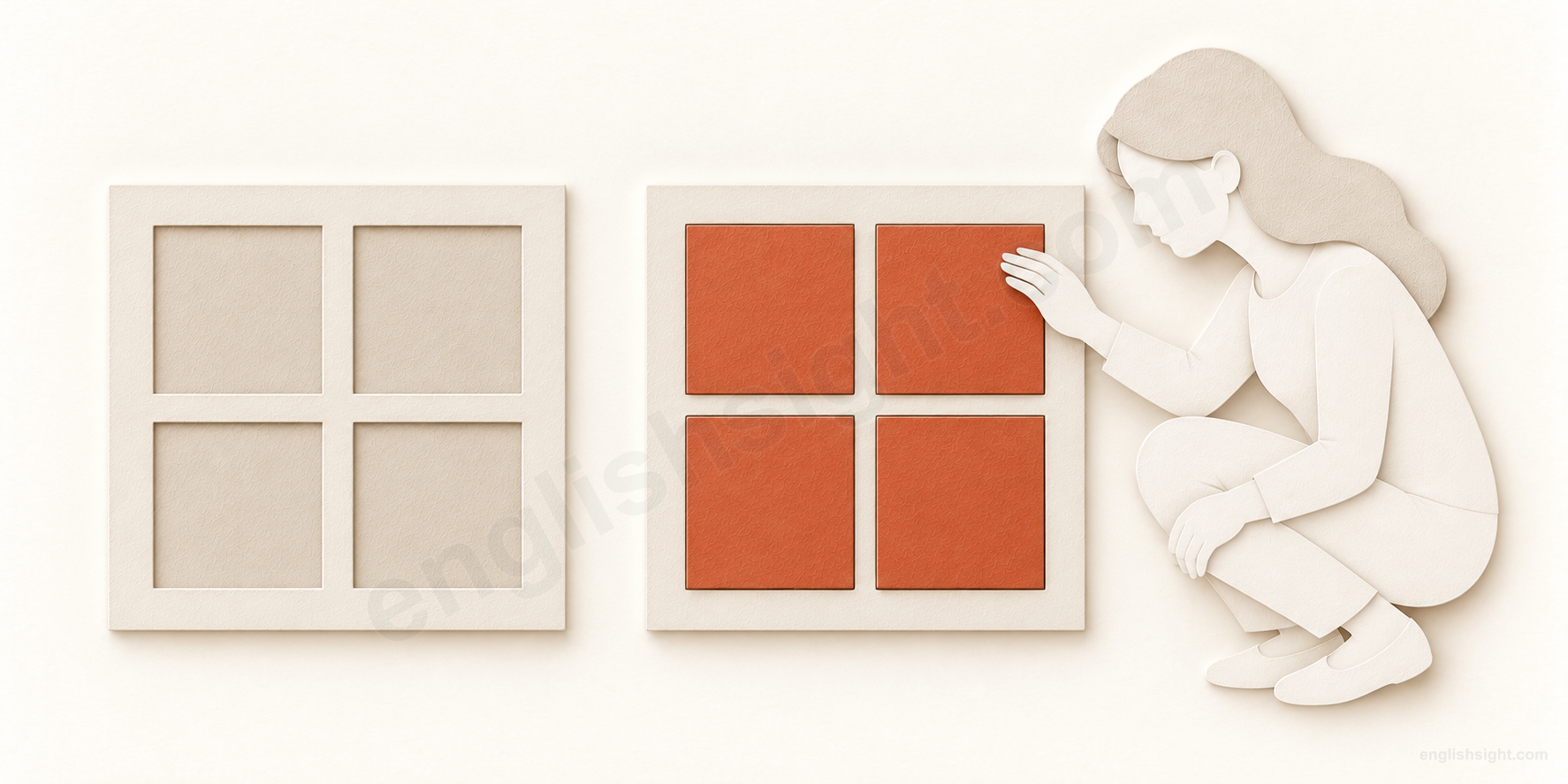
A template sets out four equal spaces.
well
Four tiles fit neatly in the matching panel.
The person checks the tiles against the required arrangement.
Doing the task well means carrying it out to a suitable standard; the template and fitted tiles illustrate that comparison.
An action is done well when the way it is carried out meets the task’s purpose or standard.
This is a teaching model for the evaluative adverb, not a universal origin for every use. Health, fixed expressions, conversation, and the independent noun/verb family need their own explanations.
In She plays well, well judges how an activity is done. What counts as good depends on the task: accuracy, effectiveness, thoroughness, or care. The diagram compares a standard with work that meets it.
Well also describes health, strengthens certain expressions, and manages conversation. The noun a well and the verb well up form a separate source-and-rising branch. One picture cannot predict all these uses.
01
How an action is done
Well can assess skill, effectiveness, care, knowledge, or treatment. The verb and the situation tell you what counts as good.
01
verb + (object) + well
do something well
perform an action skillfully or properly
Situation or starting point
You watch someone repair a chair.
Meaning in this context
The repair is careful and effective.
Well assesses the way the action is performed.
Ask what standard matters: accurate playing, clear speaking, or careful repair. Well evaluates the action against that standard. It need not mean perfectly; quite well and very well allow different judgments.
With an ordinary object, well generally follows it: She explained the rule well. In The rule was well explained, it evaluates the explaining inside a passive construction. Well itself is an adverb, not a verb that takes an object.
In a sentence
Mara repaired the chair well; it no longer wobbles.
Watch the difference Use She sings well for the action; She is a good singer describes the person.
02
something goes / works well; someone does well (in / at something); take something well; do well out of something
go well / work well / do well
have a satisfactory result or make good progress
Situation or starting point
You want to know how an interview went.
Meaning in this context
The experience was successful.
The whole event or performance is evaluated.
The interview went well evaluates how it developed. This key works well says it functions effectively. Jo did well in the interview evaluates Jo’s performance. These are related assessments, but the subjects differ.
Do well at school can refer to academic success. Do well for yourself often refers to becoming successful or prosperous. In The baby is doing well, context instead points to health and development; it is not a report about school marks.
Take bad news well means respond calmly or accept it without much outward distress: He took the cancellation well and made another plan. Do well out of something means gain money or another advantage from it: The owners did well out of the sale. In the first pattern, take supplies the reaction; in the second, out of identifies the source of the gain.
In a sentence
The interview went well, and Jo was offered the job.
Watch the difference Do well does not mean do good, which can mean help others.
03
mix / wash / dry something well; sleep / eat well
mix well / sleep well / eat well
do an activity to a suitable extent or in a beneficial way
Situation or starting point
A recipe needs evenly combined ingredients.
Meaning in this context
The mixture has no separate patches.
Well takes its practical standard from the activity.
With mixing, washing, or drying, well often asks for thorough work rather than impressive skill. Dry the bowl well means remove the moisture properly, not dry it quickly.
Sleep well wishes someone restful sleep. Eat well and live well evaluate food or living conditions; living well can suggest comfort and spending power. These combinations are best learned with their verbs rather than with a single replacement word.
In a sentence
Stir the sauce well before you serve it.
Watch the difference Eat well concerns good food or eating habits; eat a lot only concerns quantity.
04
know / remember / understand someone or something well
know someone well
have a substantial degree of knowledge or familiarity
Situation or starting point
You have worked with a colleague for years.
Meaning in this context
You understand their habits and preferences.
The degree of knowing is high.
Here well measures how much you know, remember, or understand. How well do you know this road? asks about familiarity, not whether your knowledge is morally good.
Very well increases the degree; not very well limits it. Know full well and know perfectly well strongly stress awareness, often when someone should not pretend otherwise: You know perfectly well that the gate is locked.
In a sentence
I know Bea well enough to recognize her voice on the phone.
Watch the difference Know her well means be familiar with her; know she is well means know she is healthy.
05
speak / think well of someone; treat someone well; wish someone well
speak well of / treat someone well
express approval or act kindly toward someone
Situation or starting point
A former colleague asks for your opinion.
Meaning in this context
You give a favorable account of someone’s work.
The verb distinguishes favorable words from favorable treatment.
Of introduces the person or thing being evaluated in speak well of and think well of. Treat a person well concerns what you do to them, such as showing care and fairness. Do well by someone is another established way to describe generous or fair treatment.
Wish someone well expresses goodwill about their future: We wish you well in your new job. These uses relate to a favorable attitude, but the grammar of each verb must be learned; do not insert of after every verb.
In a sentence
Her old manager speaks well of her.
Watch the difference Speak well of someone praises them; speak well describes your speaking ability.
06
someone means / meant well
mean well
have good intentions, possibly with an unhelpful result
Situation or starting point
Someone offers advice that causes a problem.
Meaning in this context
You acknowledge the kindness behind the mistake.
An intention can be good even when its effect is not.
Mean well often softens criticism: you give someone credit for wanting to help while still explaining the harm. The phrase does not promise that their action was wise or effective.
It is an established use of mean, not a statement that someone gives a correct dictionary meaning. Keep the distinction between intention and result when you respond to a mistake.
In a sentence
I know you meant well, but moving my notes made them harder to find.
Watch the difference Mean well is about intention; do well is usually about performance or success.
07
Well done!; well done on + noun / -ing; a well-done steak
Well done! / well-done food
praise an achievement, or describe food cooked thoroughly
Situation or starting point
A teammate finishes a difficult task.
Meaning in this context
You congratulate the teammate.
Praise and cooking are distinct uses of the same words.
Well done! is a short expression of praise. Well said! similarly approves what someone has said. Done and said supply the action being praised; well supplies the positive assessment.
In food orders, well done means cooked right through, especially of meat: I’d like my steak well done. Before a noun, write a well-done steak. The same spelling can describe a well-done repair, where the meaning is good workmanship; the noun and context decide.
In a sentence
Well done on finishing the report early!
Watch the difference A well-done steak describes its cooking level, not automatically its quality.
02
Health and a good state
After a linking verb, well can describe a person’s health or a satisfactory situation. These uses describe the subject rather than the manner of an action.
08
be / feel / look / keep well; get well; well enough to + verb
be / feel / get well
be healthy or recover from illness
Situation or starting point
A friend has been ill.
Meaning in this context
You ask about recovery.
Well describes the person’s health after a linking verb.
Well is an adjective in I am well and You look well: it tells you about the person. Get well describes becoming healthy again, and Get well soon! is a familiar recovery wish.
I’m better now compares my health with an earlier state. Well normally follows a linking verb rather than coming before a noun. A healthy child is the neutral choice for a noun phrase, though not a well man is an established exception.
In a sentence
I feel well enough to go back to work now.
Watch the difference Feel well concerns health; feel good can describe physical well-being as well as happiness or satisfaction.
09
all is well; all is not well; someone / something is alive and well
all is well / alive and well
be in a satisfactory state, or continue to exist successfully
Situation or starting point
You want reassurance about a situation.
Meaning in this context
You learn that things are satisfactory.
A good state can concern a person or a wider situation.
All is well offers broad reassurance. All is not well points to trouble without specifying its extent. All’s well that ends well is a saying that treats a happy ending as outweighing earlier difficulties.
Alive and well literally reassures us that a person or animal is living and unharmed. It also has a figurative use: The local music scene is alive and well means it remains active and successful, not that a music scene is a living creature.
In a sentence
The missing dog was found alive and well.
Watch the difference All is not well usually signals that something is wrong; it does not mean everything is wrong.
03
Extent, comparison, and modal patterns
Well can strengthen a degree or a margin. Larger constructions also express likelihood, reasonable behavior, and comparisons.
10
do it better / best; as well as + person / clause; not as well as
better / best / as well as
compare the quality or extent of actions
Situation or starting point
Two people attempt the same task.
Meaning in this context
You compare their performances.
Well has the irregular comparison better and best.
Better and best are the usual comparative and superlative forms of well: He played better today; Of the three, she played best. They also compare good and healthy, so the surrounding grammar identifies what is being compared.
As well as can frame equality in performance, and not as well as shows a lower standard. How well did it work? asks about effectiveness. This comparative pattern must be distinguished from the fixed addition phrase taught below.
In a sentence
Nina plays the piano as well as her brother does.
Watch the difference In this sentence as well as compares playing; in piano as well as guitar it adds an instrument.
11
verb + well enough (to + verb / for + noun)
well enough
to an adequate, sometimes only moderate, degree
Situation or starting point
You need a working solution rather than perfection.
Meaning in this context
The solution is adequate for its purpose.
Enough sets the required level.
Enough follows well. This is a judgment of adequacy in context, not necessarily strong praise: I like him well enough can suggest a reasonable but limited liking.
An infinitive can state what the level allows: She knows the route well enough to lead us. The source of sufficiency is the full construction well enough to, not well alone.
In a sentence
The old printer works well enough for occasional letters.
Watch the difference Well enough to travel can assess health; work well enough assesses function.
12
be well + participle; a well-prepared / well-known + noun
well prepared / well-known
done properly, thoroughly, or to a considerable degree
Situation or starting point
A team has trained for an emergency.
Meaning in this context
Its members are ready for the task.
Well modifies the following participle or compound adjective.
Well prepared, well organized, well paid, and well informed describe different results or degrees. A well-written letter is written skillfully; a well-known writer is familiar to many people. Let the second part define what is being assessed.
Compounds with well generally have a hyphen before a noun: a well-prepared team. After a verb, well prepared is normally unhyphenated. Better prepared and best prepared compare the preparation; do not use more well prepared as your default.
In a sentence
The volunteers were well prepared for the exercise.
Watch the difference Well-known means widely known; it does not necessarily mean admired.
13
well + before / after / above / below / over / within / into; well in advance
well before / well over / well into
by a considerable margin in time, distance, or amount
Situation or starting point
A meeting starts at noon.
Meaning in this context
You arrive much earlier than noon.
Well strengthens the gap or extent expressed by the following phrase.
Well before and well after widen a time gap. Well over the limit increases a numerical margin; well within the limit places something comfortably inside it. These do not evaluate moral goodness.
Well into the night means far into that period. Well in advance asks for substantial advance notice. The preposition determines the relationship, while well increases its extent; it supplies no exact number of minutes or units.
Be well on the way to recovery suggests recovery is far advanced and getting close. With an activity, to is a preposition here: We’re well on the way to finishing the roof. The pattern concerns progress toward a goal, not necessarily a physical journey.
In a sentence
Please send the agenda well before Friday.
Watch the difference Well over fifty means considerably more than fifty; it does not mean approximately fifty.
14
be well aware of / that…; be well worth + noun / -ing; be well able to + verb
well aware / well worth
strongly or fully, with particular adjectives
Situation or starting point
Someone asks whether a long journey was worthwhile.
Meaning in this context
You strongly affirm its value.
Only some adjective patterns naturally take this intensifier.
Well aware of the risk emphasizes full awareness. Well able to do something stresses sufficient capability. In well worth visiting, well strengthens the value judgment already expressed by worth.
Informal British well happy or well annoyed uses well much like very. This is marked conversational usage, not a general rule for neutral writing. Learn standard combinations such as well aware rather than inventing forms such as well beautiful.
In a sentence
The exhibition is well worth visiting.
Watch the difference Use worth visiting, not worth to visit; do not replace every very with well.
15
may / might / could well + base verb
may / might / could well
something is quite plausible or likely
Situation or starting point
You see dark clouds approaching.
Meaning in this context
You judge that rain is a serious possibility.
Well strengthens an assessment after a modal verb.
The modal keeps the statement short of certainty. Adding well often makes the possibility sound well supported or quite likely: She could well win. It sets no fixed probability.
Well can also mean with good reason: You may well ask why it took so long suggests that the question is justified, sometimes because the speaker is puzzled too. Read the whole sentence before deciding that every modal + well expresses likelihood.
In a sentence
The ferry may well be late in this wind.
Watch the difference May well be late predicts a possibility; might as well leave suggests a choice.
16
can / could well + verb; cannot / could not very well + verb
can well / cannot very well
be readily able to, or be unable to reasonably do something
Situation or starting point
Someone helped you, and now asks for a small favor.
Meaning in this context
Refusing would be awkward or unfair.
Ability and situational appropriateness differ.
In We can well afford a taxi, well can mean easily: the cost is comfortably within our means. This describes practical capacity, unlike could well be true, which expresses a plausible conclusion.
Cannot very well often means that an action would be improper, awkward, or unreasonable in the circumstances. It is an established pattern; removing very may still leave a formal reasonable-behavior reading, but the negative expression is especially useful to learn whole.
In a sentence
After all her help, I can’t very well refuse.
Watch the difference Can’t very well refuse concerns what is appropriate, not a physical inability to say no.
04
Addition, choices, and established expressions
Learn these as complete patterns. The words around well contribute meanings that the quality diagram cannot predict.
17
clause + as well
as well
also; in addition
Situation or starting point
You plan to bring a notebook.
Meaning in this context
You add a pen to what you will bring.
The full phrase adds an item or fact.
As well usually comes at the end of the clause and works like too. It does not say the action is done skillfully. If someone says I’m coming as well, they add themselves to the people coming.
Compare I write well, which evaluates writing, and I write as well, which in a suitable context adds writing to other activities. In ordinary negative addition, either is the natural choice; a phrase such as You can’t have dessert as well instead rejects an extra item.
In a sentence
I’ll bring a pen as well.
Watch the difference For a second negative fact, normally use either: I don’t have a pen either.
18
noun / phrase + as well as + noun / phrase; as well as + -ing
as well as
in addition to
Situation or starting point
A café serves sandwiches.
Meaning in this context
You mention that it also serves soup.
This established phrase adds another connected item.
The full phrase as well as adds information; well is not separately rating the soup. You can link nouns or other matching phrases: As well as serving lunch, they sell bread.
Compare She cooks as well as I do, which compares cooking skill. She cooks as well as teaching adds cooking to teaching. The words after the second as and the context distinguish comparison from addition. In careful writing, an added as well as phrase does not automatically make a singular subject plural: The manager, as well as two assistants, is attending.
In a sentence
The café sells soup as well as sandwiches.
Watch the difference At the start of a clause, use As well as serving soup, they sell bread. This does not ban a base verb in a parallel pattern such as They can bake bread as well as serve soup.
19
may / might (just) as well + base verb
may / might as well
choose a reasonable option when there is little reason not to
Situation or starting point
Your appointment has been delayed.
Meaning in this context
You decide to use the wait for a useful task.
The full expression evaluates a practical choice.
This often makes a modest or reluctant suggestion rather than an enthusiastic one. There is no strong reason to prefer another option, so the speaker proposes this one. No to follows the modal.
It can also stress equal futility: With no signal, this phone might as well be a brick. The phone is not literally a brick; for the present purpose it is no more useful. That rhetorical comparison is different from adding an extra action with as well.
In a sentence
We have half an hour, so we might as well get some lunch.
Watch the difference Might as well go suggests going; might well go says going is a plausible possibility.
20
it is / was just as well (that)…; it would be (just) as well to + verb
(it is) just as well
fortunate or advisable in the circumstances
Situation or starting point
You took an umbrella without expecting rain.
Meaning in this context
A storm shows that the choice was fortunate.
This expression judges a situation or possible action favorably.
It’s just as well (that) we left early comments on a fortunate circumstance. You can also respond That’s just as well when someone reports a useful or lucky fact.
It would be just as well to check the address recommends a sensible precaution. The first pattern evaluates a fact; the second evaluates a proposed action. Formal It would be well to check is possible too, but is less conversational.
In a sentence
It’s just as well we brought an umbrella; it’s pouring.
Watch the difference Just as well here means fortunate, not merely equally skillfully.
21
someone would do well to + base verb
would do well to
be wise to do something
Situation or starting point
A visitor is planning a journey in bad weather.
Meaning in this context
You recommend a sensible precaution.
The construction gives advice rather than predicting performance.
Would do well to is a fairly formal way to recommend an action. Depending on tone, it can sound like firm advice or a warning, not a casual invitation.
Past You did well to save a copy evaluates a decision as sensible. The to-infinitive identifies the recommended or wise action. It is not an object that can be moved around as if well to were a particle verb.
In a sentence
You would do well to check the last train before you leave.
Watch the difference Do well to check recommends checking; do well in a test describes success.
22
leave / let well alone; let well enough alone
leave well alone
avoid interfering when intervention may cause trouble
Situation or starting point
A repaired device is working again.
Meaning in this context
You decide not to adjust it further.
The complete idiom warns against unnecessary interference.
Leave well alone is common in British usage; let well enough alone is a familiar North American form. It can concern a satisfactory arrangement or a situation in which getting involved is likely to make matters worse.
The expression does not claim that doing nothing is always best. It expresses the speaker’s judgment that further interference is unwise here. Learn it as a fixed unit rather than treating well as the name of an object.
In a sentence
The radio is working now, so let’s leave well alone.
Watch the difference This is not leave someone alone, which asks for a person to be undisturbed.
23
that is all well and good, but…; it is all very well to…, but…
all well and good / all very well
acceptable in principle but insufficient in practice
Situation or starting point
Someone proposes a plan without funding it.
Meaning in this context
You acknowledge its appeal and raise an objection.
A positive acknowledgment leads into a reservation.
That’s all well and good commonly concedes a point before a but-clause identifies the missing practical issue. The criticism belongs to the whole conversational pattern.
It’s all very well for you to say “relax,” but I have a deadline suggests the other person’s advice does not account for your situation. Tone can be pointed or irritated. It differs from All is well, which normally reassures.
In a sentence
That’s all well and good, but who will pay for it?
Watch the difference These expressions often introduce criticism; they are not unqualified praise.
24
pretty well + phrase; well and truly + adjective / participle
pretty well / well and truly
almost completely, or completely
Situation or starting point
A day’s work is nearly finished.
Meaning in this context
You describe how close it is to completion.
Two fixed expressions mark different degrees.
Pretty well can mean almost or nearly: It rained pretty well all day. In other contexts, pretty simply moderates ordinary well: She played pretty well can be a positive but limited assessment of skill.
Well and truly is an informal emphatic expression meaning completely: By then we were well and truly lost. Unlike pretty well, it does not soften the degree. The following words and context decide which interpretation is intended.
In a sentence
We’ve pretty well finished the packing.
Watch the difference Pretty well finished means nearly finished; played pretty well often means played fairly well.
25
be well off; be better off (doing something / without something); be well off for something (British English)
well off / better off
financially comfortable, or in a more favorable position
Situation or starting point
You compare two living arrangements.
Meaning in this context
One leaves you with more money or fewer problems.
The established adjective describes circumstances, not movement away.
A well-off family has substantial money or comfortable financial circumstances. Better off can compare finances, but it can also compare general advantages: You’re better off waiting until the roads clear.
Before a noun, write a well-off family. After a linking verb, they are well off is usual. Off is part of this established adjective; it does not indicate leaving a place. The doing pattern after better off names the preferable option.
Well off can also describe a satisfactory situation without focusing on money. British well off for something means having plenty available: We’re well off for parks in this neighborhood. For names the resource; it does not name a person receiving money.
In a sentence
We would be better off taking the bus than paying for parking.
Watch the difference Better off need not mean richer: you can be better off without a stressful job.
26
something bodes well / does not bode well (for someone / something)
bode well for
be a promising sign for what will happen
Situation or starting point
Early results give clues about a project’s future.
Meaning in this context
You judge the prospects to be favorable.
The sign is favorable; the outcome has not happened yet.
Bode well for treats a present fact as a good sign for a later outcome. The subject is the sign or circumstance, while for introduces the person or thing whose prospects are being judged. It is common in formal reports and commentary.
Does not bode well warns of an unfavorable outlook. It does not establish certainty: early signs may mislead. Well supplies the positive evaluation, while bode supplies the predictive relationship.
In a sentence
Strong early sales bode well for the new shop.
Watch the difference Bodes well for predicts favorable prospects; went well reports how an event developed.
27
something sits / does not sit well with someone / something
sit well with
seem acceptable or compatible
Situation or starting point
You consider a proposal against your values or preferences.
Meaning in this context
You judge whether it feels right to you.
This established use concerns acceptance or fit, not a seated position.
An idea or decision that sits well with someone seems acceptable to them. A policy can also sit well with a set of principles when the two are compatible. The negative form is especially useful for expressing reservations.
Well contributes the favorable assessment, but sit well with is an established metaphor for acceptance or compatibility. It does not mean that the idea literally sits, and it differs from bode well for, which assesses future prospects.
In a sentence
The new rule doesn’t sit well with me.
Watch the difference Doesn’t sit well with me commonly signals unease or disapproval, not physical discomfort in a chair.
05
Managing a conversation
Spoken Well, … helps organize a response or show an attitude. Tone, punctuation, and the surrounding words matter.
28
Well, + clause
Well, …
begin, resume, shift, or close a conversational move
Situation or starting point
A pause has interrupted a discussion.
Meaning in this context
You resume or move the conversation forward.
Well signals how this utterance connects with the conversation.
Well can introduce your next contribution, return to a topic after a pause, or shift attention. Well, as I was saying returns to interrupted material; Well, what shall we do next? starts a new move.
Well, I’d better go can signal that a conversation is ending. These functions overlap, so context matters more than a rigid one-word translation. Written dialogue commonly separates Well with a comma; real speech uses a pause or intonation instead.
In a sentence
Well, we’ve checked the rooms; let’s look outside.
Watch the difference Sentence-opening Well does not describe the quality of the following action.
gain thinking time, soften disagreement, or correct a statement
Situation or starting point
A question invites a simple yes.
Meaning in this context
You give a qualified or hesitant answer.
Well prepares the listener for a response needing adjustment.
At the beginning of an answer, Well often signals that a plain yes or no would not be enough. It can give thinking time or soften a suggestion, criticism, or disagreement: Well, perhaps we should ask first.
Within a sentence it can introduce a self-correction: I waited an hour—well, forty minutes. The revised amount replaces the first one. That is a discourse function, not a claim that forty is a better-quality number.
In a sentence
“Was it free?” “Well, the talk was free, but lunch cost ten pounds.”
Watch the difference Well can soften disagreement, but tone can still make the response abrupt.
prompt a reply, accept a setback, or express an attitude
Situation or starting point
A person has not answered your question.
Meaning in this context
You prompt them to respond.
Short expressions rely strongly on tone and context.
Oh well often accepts something disappointing that cannot be changed: Oh well, we can try tomorrow. Very well can mean agreement, sometimes reluctant or formal: Very well, we’ll wait. This differs from She plays very well, where very increases a quality judgment.
Well, well! can express surprise or amused recognition. Well, really! can express disapproval, and Well, that’s a relief shows relief. Words and intonation carry the attitude; well alone does not encode a single emotion.
In a sentence
“Well?” she asked. “Have you decided?”
Watch the difference Well? can sound impatient; a rising question is different from a calm opening Well, ….
06
A separate branch: a well and welling up
A well supplies water or other material from below. The verb describes something rising or gathering. This family is separate from doing something well.
31
dig / sink a well; draw water from a well; wells
a well
a hole giving access to an underground water supply
Situation or starting point
A village needs water from below ground.
Meaning in this context
Water is drawn through a well.
This countable noun names a source-access structure.
Use an article or another determiner with the singular count noun: a well, the well, our well. Its plural is wells. A well may have a pump rather than a traditional rope and bucket.
This word belongs to a different historical family from the adverb well. A dry well has no usable water supply; dry describes its condition. Nothing in a well implies that the water is safe to drink or that the well is in good condition.
In a sentence
The village draws its drinking water from a deep well.
Watch the difference A well is not simply a bucket or a natural lake; the bucket may be used to draw its water.
32
drill an oil / gas well; a stairwell; a light well
an oil well / a stairwell
a drilled source or a deep enclosed space
Situation or starting point
Engineers drill to reach an underground resource.
Meaning in this context
A well provides access to that resource.
Related noun uses name a source or a shaft-like space.
Oil well and gas well extend the resource-access noun to other substances. A stairwell is a vertical space containing stairs; a light well allows light down into a building. These uses concern the shape or function of the space.
A well of information is a figurative source of plentiful information. It does not mean the information is necessarily good. Specialized nautical, legal, and machine-part senses are outside this introductory selection.
In a sentence
Workers drilled a new gas well outside the town.
Watch the difference A stairwell is the space containing stairs, not the individual steps.
33
tears well (up) in someone’s eyes; eyes well up (with tears)
tears well up
liquid rises or gathers at the surface
Situation or starting point
Someone is moved by a message.
Meaning in this context
Tears gather in their eyes.
The subject is the rising liquid, or eyes filling with it.
Here well is a verb: well, wells, welled, welling. Up can emphasize the rising or gathering. Without up, Tears welled in her eyes is also natural. Liquid may also well from a cut or another opening.
Her eyes welled up with tears puts the eyes in subject position and names the liquid after with. This is not the evaluative adverb in She writes well. The spelling is the same, but the grammar and meaning are different.
In a sentence
Tears welled up in his eyes as he read the letter.
Watch the difference Tears welled up describes their gathering; it does not necessarily mean they ran down his face.
Hope, anger, sadness, or gratitude can well up. The feeling is pictured as gathering or rising, just as tears do. The emotion need not be expressed aloud, even if it becomes hard to contain.
Learn this as an intransitive pattern: relief welled up, not I welled up relief. A person can also well up in an emotional context, meaning become tearful. This source-and-rising branch is useful, but it does not explain well in She plays well.
In a sentence
Relief welled up inside me when I saw her safe.
Watch the difference Well up means a feeling rises; it does not mean the feeling is pleasant.
Read well with its grammar and context
Good, well, and health
Good normally describes a noun or a subject’s quality; well usually describes how an action is done. Well can also be an adjective of health. Both I feel good and I feel well are standard for physical well-being; I feel good can also suggest good spirits. Feel is a linking verb here, so an adjective is appropriate.
Forms and construction types
The adverb compares as well, better, best; more well and weller are not the ordinary forms. The noun is countable: a well, two wells. The verb has wells, welled, welling. Verb + well combinations such as work well are not automatically phrasal verbs; well up in the rising-liquid or emotion branch is a particle-verb pattern.
A model with boundaries
The template-and-work diagram is a comparison, not a motion path or a guarantee of success. A person may do one task well and another badly. Fixed phrases such as as well, might as well, and Oh well have established functions that cannot be calculated from this sketch.
Choose the meaning that fits
Look at the whole construction and the speaker’s purpose.
1. Which sentence naturally assesses someone’s speaking skill?
2. A friend has recovered from flu. Which sentence directly concerns health?
3. You already packed a coat. What does “I packed a scarf as well” mean?
4. You have no other plans and suggest watching a film. Which fits?
5. Which is the normal construction for recommending a visit?
6. “Tears welled up in her eyes.” What does this describe?
Sources and teaching notes
The linked publisher entries support the usage distinctions and constructions. Explanations, situations, examples, and the compatibility sketch are original teaching material; the central visual model applies to the evaluative adverb.
The diagram compares a task’s standard with its execution. It illustrates one useful branch, not a picture shared by every English speaker.