Use west for direction, position, regions, and a few established expressions.
A fixed compass direction
West: a fixed compass direction
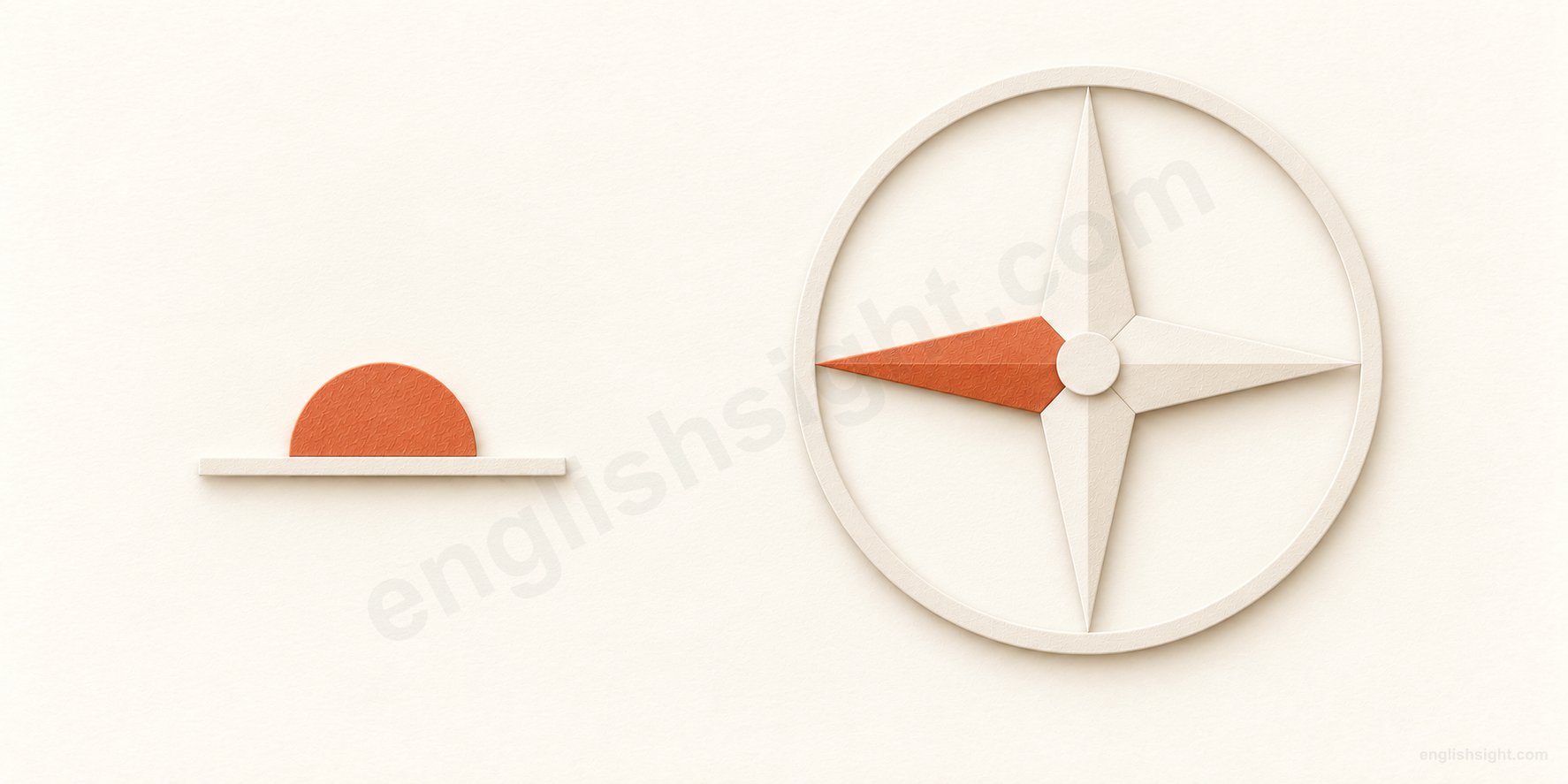
Read the compass with north at the top.
west
West lies opposite east.
The terracotta arm marks west.
West is left on this north-up compass. The low sun is a general sunset cue, not an exact daily bearing.
West is the compass direction opposite east; when you face north, west is on your left.
The sunset side is a memory cue, not an exact daily bearing. Grammar distinguishes movement, orientation, and location; wind names its source. Capitalized labels and idioms go beyond this sketch.
Imagine a compass with north at the top. West lies to the left, opposite east. You can head west, face west without moving, or locate a place west of another place.
The compass connection explains geographical uses. Cultural labels and idioms need their own context. This is a teaching model, not a claim that every native speaker sees the same mental picture.
01
Finding a direction
Identify west, travel towards it, face it, or specify an exact bearing. The verb tells you whether anything moves.
01
the west; from the west; from east to west
the west; east to west
name one of the four main compass directions
Situation / reference
You know which way north is.
What is identified?
You face north and identify west on your left.
West is opposite east; it is not always the viewer’s left.
West /west/ names a direction. It lies to your left when you face north, and is abbreviated W on a compass. Turning your body does not change where west is.
The noun often follows the: Clouds are approaching from the west. Direction pairs can omit it: from east to west. Which way is west? also needs no article.
Sunset is a useful general cue for west, not a promise of an exact bearing every evening. The sketch uses this association to help remember the direction.
In a sentence
The clouds moved from east to west.
Watch the difference Do not define west simply as left: it is left only when you are facing north.
02
head / go / drive + west; travel towards the west; westbound + noun
head west; go west
move in a westward direction
Situation / reference
You reach a road junction.
What is identified?
You choose the road leading towards the west.
West tells the direction; head, go, or drive supplies the movement.
In Head west, west is an adverb, so no preposition is needed. Go west and travel towards the west express a similar direction with different grammar. Go to west is not the normal form.
Westwards, especially in British English, and westward, especially in North American English, are alternative directional adverbs: We continued westwards. They do not specify a destination.
On transport signs, westbound describes vehicles or routes going that way: a westbound train or the westbound lanes. A train’s west side names a side of the vehicle, not its direction of travel.
In a sentence
Head west at the junction, then follow the signs for the lake.
Watch the difference A westbound bus may stop; westbound describes its service direction, not continuous movement.
03
person / room / window + face(s) west; a west-facing + noun
face west
have a front or view directed towards the west
Situation / reference
You compare two rooms.
What is identified?
You choose the room whose windows look west.
Facing a direction is an orientation, not a journey.
The subject can be a person, window, room, or building. This window faces west says which way it looks, even though the window stays still.
A west-facing window puts the same orientation before a noun. Compare a window on the west side: that locates it on a building, rather than directly stating the direction it faces.
In a sentence
Our bedroom faces west, so we keep the curtains closed on hot afternoons.
Watch the difference Face is the verb here. West does not itself mean turn, walk, or become.
04
go / lie + due west; distance + due west of + reference point
due west
specify exactly west
Situation / reference
You need a precise position.
What is identified?
You place the cabin directly west of the bridge.
Due makes the direction exact; it does not add distance.
Due west means directly west, without a northward or southward component. It can modify a route or a position: sail due west; lie due west of the village.
The distance is separate: two kilometres due west of the bridge. Due here is an adverb meaning exactly, not the due in a payment being due.
In a sentence
The cabin is two kilometres due west of the bridge.
Watch the difference West can describe a general direction; due west makes a more exact claim.
02
Locating a place or a source
Separate a direction relative to a reference point from the western part of a region. With wind, the direction names where it comes from.
05
be / lie + west of + place; be + to the west of + place
west of; to the west of
locate something on the western side of a reference point
Situation / reference
You know where the station is.
What is identified?
You use it to describe the clinic’s location.
The place after of is the reference point, not the thing being located.
In The clinic is west of the station, the clinic is the subject being located and the station is the reference. To the west of gives a similar relation. To in that phrase does not require movement.
You can add distance or degree: three kilometres west of town; just west of the station; farther west. West of a region does not mean its western part. A place west of the park may be outside it.
In a sentence
The clinic is just west of the station.
Watch the difference Do not reverse the reference: if the clinic is west of the station, the station is east of the clinic.
06
in the west of + country / region / city; in the west
in the west of
locate something within a region’s western part
Situation / reference
You divide a country into broad areas.
What is identified?
You identify the area containing someone’s home.
In the west of places the subject inside the named region.
The west of the country means its western part. In the west of the country locates something inside that area; in the west can stand alone when the country or region is already understood.
Compare She lives in the west of the city with She lives west of the city. The first places her home within the city’s western area; the second gives its position relative to the city, normally beyond it.
In a sentence
My aunt lives in the west of the city.
Watch the difference Keep in when you mean within: the west of the city is an area, not an adverbial direction.
07
west + side / coast / entrance / wing; on the west side of + noun
the west side; the west coast
identify the western side, edge, or part of something
Situation / reference
A building has several entrances.
What is identified?
You identify the entrance on its west side.
Before a noun, west selects a side or part.
West is an adjective in the west entrance, the west coast, and the west wing. It normally comes before the noun. For a full location statement, say The entrance is on the west side.
Western also describes location: western Spain, the western slopes. West and western overlap, but follow established names and combinations: West Africa is the regional name; Western art refers to a cultural tradition.
In Meet me at the west entrance, the identifies an entrance that can be recognized in the situation; west tells you which entrance.
In a sentence
Meet me at the west entrance of the museum.
Watch the difference Use faces west for orientation or is on the west side for location; The entrance is west alone is incomplete for this intended meaning.
08
a west wind; a wind from the west
a west wind
name a wind by the direction it comes from
Situation / reference
You check the weather before going out.
What is identified?
You learn that the wind comes from the west.
A west wind comes from the west and blows towards the east.
Weather descriptions name wind by its source direction. The west in a west wind therefore points to where the air comes from, not where it is going.
Compare a westbound train, which travels towards the west. The noun and the established combination matter; do not apply one arrow direction to every expression containing west.
In a sentence
A cold west wind blew across the campsite.
Watch the difference A west wind and a wind blowing towards the west describe opposite source directions.
03
Names, regions, and cultural labels
A capital W can signal an established name or a regional or cultural label. Context supplies the intended area.
09
West + established geographical name; lower-case west for a plain direction
West Africa; West Virginia
use west as part of an established geographical name
Situation / reference
You read a regional or place name.
What is identified?
You recognize that West belongs to that name.
Capitalization can mark a name rather than an ordinary compass direction.
Write West in established names such as West Africa and West Virginia. The capital belongs to the name. A west coast, by contrast, can simply be a descriptive coast on the western side.
Lower-case west is the usual choice for a plain direction: drive west. Capitals are also used for recognized regions, and regional naming conventions vary. Copy the established name rather than capitalizing every direction word.
West Virginia is a state name; it is not a way of saying the western part of Virginia. Names must be learned as names, not reconstructed from the compass alone.
In a sentence
She accepted a teaching job in West Africa.
Watch the difference Do not swap west and western freely inside names: West Africa and Western Europe have established forms.
10
the West; relations with the West; Western + cultural noun
the West
refer to a broad cultural or political grouping
Situation / reference
You read a discussion of art or international relations.
What is identified?
You identify a cultural or political label in context.
The West here labels a grouping, not a direction to travel.
The West commonly refers broadly to Europe and North America in cultural or political discussion. The exact intended grouping depends on the writer and context; it is not a complete geographical checklist.
In Cold War history, the West contrasts with the Communist East. Read the time period as well as the capital W. For the related adjective, Western art and the Western world are familiar forms.
In a sentence
The exhibition explores how Japanese prints influenced artists in the West.
Watch the difference The West does not mean every place lying west of the speaker, and it does not imply that all its people share one culture.
11
the American West; live / travel / move + out west
the American West; out west
refer to the western US or an understood western region
Situation / reference
A conversation is about a trip within the United States.
What is identified?
You understand a reference to its western region.
Regional West needs an understood country or context.
The American West names the western region of the United States. It can refer to modern places or to a historical region, depending on context. It does not automatically mean a frontier story.
Out west is a US informal expression for in or to a western part of a country or region. The verb distinguishes location from travel: live out west versus move out west. Out West is also a dictionary-listed capitalization.
In a sentence
My cousin lives out west, but she visits us in Boston every spring.
Watch the difference Out west is not a precise address or a universal name for one area everywhere in the world.
04
Historical labels and figurative expressions
These combinations have established meanings. A compass alone cannot explain them.
12
the Wild West; a Wild West + story / adventure / theme
the Wild West
recognize a historical label for the western US frontier
Situation / reference
You choose a film about the American frontier.
What is identified?
You recognize the setting suggested by its description.
Wild West is a historical and cultural label, not just west plus wild.
The Wild West refers to the western United States in its frontier period, especially as portrayed through rough life and weak law enforcement. It is a familiar setting for stories.
The phrase can modify a noun: a Wild West adventure. This conventional label is not a complete account of the region’s history or of everyone who lived there.
In a sentence
The children read an adventure set in the Wild West.
Watch the difference Use the American West for a regional description when you do not intend the frontier-period association.
13
a Wild West of + plural noun; describe something as a Wild West
a Wild West of…
describe an area of activity with little effective control
Situation / reference
An online marketplace has few checks on sellers.
What is identified?
Someone compares its lack of control to the Wild West.
The whole expression evokes weak regulation, not a geographical location.
A field of activity can be called a Wild West when it is chaotic or largely uncontrolled because oversight is weak. The historical label supplies the comparison.
Unlike the usual historical name the Wild West, a figurative description can use a: a Wild West of unverified claims. It is a vivid evaluation; explain the actual problem when precision matters.
In a sentence
The unmoderated forum became a Wild West of rumours and fake offers.
Watch the difference This phrase does not simply mean new, exciting, or physically far west; the lack of effective control is central.
14
something + go / went / has gone + west (informal idiom)
go west (idiom)
recognize an informal expression for loss, failure, or death
Situation / reference
A burst pipe ruins the equipment for an event.
What is identified?
Someone says the event plans have gone west.
This established idiom does not describe westward travel.
In the idiom go west, something can be lost, destroyed, or cease to work or exist. Plans going west can mean they have failed. Contrast We went west after lunch, which normally describes travel.
Collins labels the expression informal and its Easy Learning entry labels it old-fashioned. It also records the meaning die. Learn that meaning for recognition; plain failed, broke, or died is clearer in ordinary factual reporting, depending on what happened.
In a sentence
After the equipment was ruined, our plans for the concert went west.
Watch the difference Do not infer this idiom from every go west. A route, destination, or journey context usually supports the literal meaning.
Read the construction and the context
Direction does not mean movement
West is used as a noun, adjective, and adverb in this lesson. Drive supplies movement, face supplies orientation, and be or lie can describe position. These are not a family of separable phrasal verbs; there is no ordinary verb west being passivized or made causative here.
Source and destination differ
A westbound train travels towards the west. A west wind comes from the west. Identify what the expression describes before drawing a direction arrow.
Names are conventional
Use lower case for an ordinary direction and the established capitalization for names or recognized regions. The West and the Wild West require context; a compass cannot supply their cultural or historical meaning.
Scope of this lesson
The selection covers everyday geographical patterns and recognizable established expressions. Specialist bridge positions, church architecture, surnames, and a catalogue of place names are outside the lesson. Related words are introduced only where they help a practical choice.
Choose the direction and meaning
Use the reference point, the verb, and the whole expression.
1. A home is within the city’s western area. Which sentence says that directly?
2. A forecast mentions a west wind. Where does the air come from?
3. You face north, so west is on your left. You turn to face south. What changes?
4. A bedroom faces west. Must it be moving west?
5. Ruined equipment means an event cannot happen. Someone says, “Our plans went west.” What do they mean?
Sources and teaching notes
Dictionary sources support the meanings, constructions, and usage labels. The explanations, examples, comparisons, and visual model are original teaching material. The compass is a teaching aid, not evidence for every figurative expression.
The diagram is a teaching aid, not a mental picture shared by every speaker.