From wet clothes and rainy days to wetting a cloth and familiar idioms.
Liquid present, rather than dry
Liquid present, rather than dry
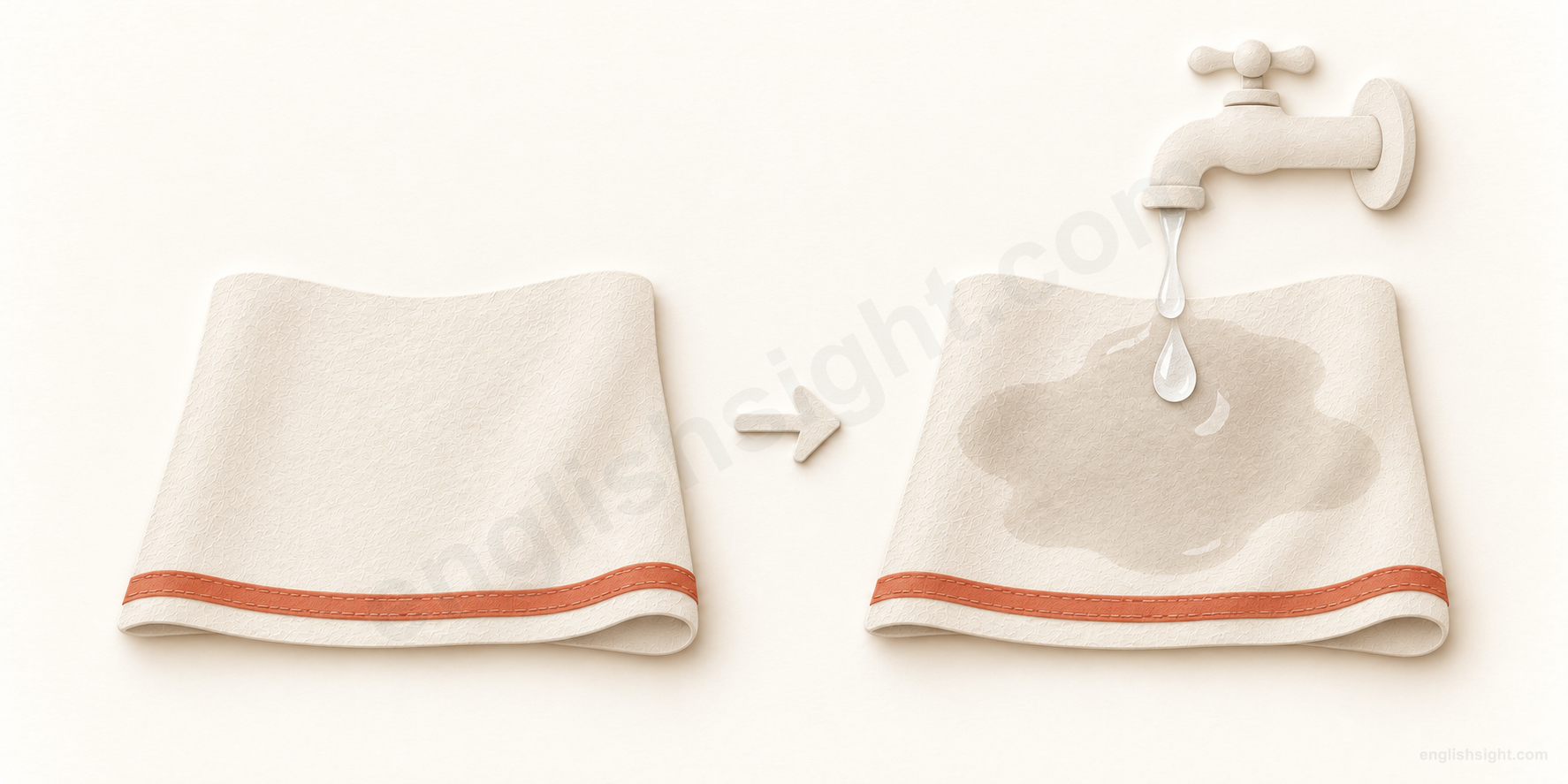
The cloth is dry.
wet
The cloth holds liquid in a visible damp patch.
Water from a tap reaches the cloth.
Water reaches a dry cloth and stays in it. Wet describes this condition; the cloth need not drip.
In its central physical use, wet describes something with liquid on its surface or held within it.
The sketch shows one possible change into the state. Wet alone does not require a change, dripping, complete saturation, or a particular liquid. Wet paint can simply retain liquid before drying; social and experience idioms have separate conventional meanings.
Wet most often describes a physical condition: liquid is on something or held inside it. The liquid may be rainwater, sweat, tears, or something else. Wet is the opposite of dry in this central use.
Start with that condition, then read the surrounding grammar. Get wet describes becoming wet; wet the cloth describes causing it. Rainy weather and paint that has not dried are related physical uses. Several familiar idioms need to be learned as whole expressions.
01
Liquid on or in something
Describe a condition, a change into that condition, its degree, and familiar objects that retain liquid.
01
wet + noun; be / feel / look wet; wet with + liquid
wet hair / wet with tears
have liquid on the surface or inside
Situation
A towel has not yet been dried after use.
Meaning in context
You describe its present condition.
Wet describes the thing containing or carrying liquid.
Wet is usually an adjective: in a wet towel, wet describes the noun towel; in the towel is wet, it describes the same condition after be. Feel wet and look wet describe how the condition is sensed or appears.
With can name the liquid: her cheeks were wet with tears; his shirt was wet with sweat. Water is especially common, but wet does not mean only covered in water. The liquid may be on a surface or absorbed into a material.
The diagram highlights liquid remaining on or in a cloth. It represents a physical condition, not dirtiness, coldness, or a fixed amount of water. A clean, warm towel can still be wet.
In a sentence
The towel is still wet, so I’ll hang it by the window.
Watch the difference Use an adjective after feel: the towel feels wet, not feels wetly.
02
get / stay wet; get / keep + object + wet
get wet / get your shoes wet / keep it wet
become wet, cause that condition, or maintain it
Situation
You cross grass after rain.
Meaning in context
Your previously dry shoes now carry water.
The surrounding verb tells us whether the state changes or continues.
In my shoes got wet, get introduces a change; wet supplies the resulting condition. My shoes are wet simply describes the condition. Stay wet means the condition continues.
In I got my shoes wet, my shoes is the object and wet describes its resulting state. Keep the cloth wet means maintain the condition. Neither get wet nor keep it wet is a phrasal verb: wet is an adjective, not a particle.
Compare I wetted the cloth: the verb wet itself expresses causing the physical condition. Do not treat every occurrence of wet as an action.
In a sentence
I got my shoes wet while crossing the grass.
Watch the difference In keep it wet, it goes before the adjective. Keep wet it is not the ordinary pattern.
03
soaking / dripping wet; be wet through; wetter / wettest
soaking wet / dripping wet / wet through
describe a very wet condition
Situation
Rain has soaked your jacket.
Meaning in context
Liquid has penetrated the fabric or is falling from it.
The extra words describe degree or a visible consequence.
Soaking wet emphasizes extreme wetness. Dripping wet pictures liquid actually dripping, though speakers may use it emphatically. Wet through says the wetness has reached through the material, not merely touched the outside.
For example, after a storm you might say My sleeves are wet through, but after a small splash they may just be a little wet. Wetter and wettest compare wetness: this sleeve is wetter than the other.
Wet is the broad word. Damp and moist generally suggest a smaller amount of moisture; damp often sounds unwanted, while moist often suits useful or pleasant moisture. These are tendencies, not a guarantee that every damp object is unpleasant. Soaked and drenched emphasize much more liquid.
In a sentence
After ten minutes in the storm, my jacket was wet through.
Watch the difference Soaking wet describes a state; it does not say the jacket is soaking another object.
04
wet + paint / ink / cement; be still wet
wet paint / still wet
not yet dry or set
Situation
You have just painted a shelf.
Meaning in context
The coating can still smear if touched.
Wet can describe a material before it has dried, without any added rain or water.
Fresh paint, ink, and cement can be wet because they have not yet dried or set. A freshly painted surface is not necessarily something that someone splashed with water.
Wet paint on a sign is a warning noun phrase: the paint has not dried. Still wet emphasizes that drying is incomplete. This is a close physical extension of liquid remaining in a material, not the rainy-weather sense.
Compare dry paint that later gets wet in a leak. That sentence describes new liquid reaching an already dry coating. The same adjective fits two different histories.
In a sentence
Don’t put the label on yet; the ink is still wet.
Watch the difference Wet paint does not mean paint mixed with extra water; the issue may simply be drying.
05
a wet wipe; a packet of wet wipes
a wet wipe
a small cleaning cloth supplied slightly wet
Situation
You need to clean a child’s sticky fingers away from a sink.
Meaning in context
A ready-moistened cloth is available.
Wet names a useful condition, not always an unwanted problem.
A wet wipe is a small disposable cleaning cloth already containing liquid. Here wipe is a countable noun, so ask for a wet wipe or some wet wipes.
This is a practical noun combination built around the literal state in the diagram. Compare a wet towel, which describes a towel’s current state and does not by itself name a disposable product.
Wet wipes illustrates why wet is not automatically negative. Whether moisture helps or causes trouble depends on the object and the task.
In a sentence
Do you have a wet wipe for these sticky fingers?
Watch the difference Use a plural ending when needed: two wet wipes, not two wet wipe.
02
Rain and wet surroundings
Move from an individual object to rainy conditions, and recognize the noun phrase the wet.
06
wet weather / day / season; it is wet outside
wet weather / a wet day / the wet season
describe rainy conditions or a rainy period
Situation
The forecast shows frequent rain this week.
Meaning in context
You plan an activity suited to that weather.
The noun after wet identifies the period or conditions affected by rain.
A wet day or wet weather involves rain; wet describes conditions across an area rather than only liquid on one object. It’s wet outside is a normal weather description, with it referring to the general conditions.
A wet season is the part of the year associated with much rain. This does not promise that rain falls without interruption every hour. A wetter month can mean a month with more rain.
Compare wet weather with humid air: humid focuses on moisture in the air, which need not mean it is raining. A wet road describes the surface and may remain wet after the rain stops.
In a sentence
We’ll visit the museum if the weather is wet tomorrow.
Watch the difference Wet does not automatically mean cold: a wet day can be warm.
07
in the wet; out of the wet; the wet + from / off something
in / out of the wet
refer to rain or wet conditions as a noun
Situation
You are sheltering while rain falls outside.
Meaning in context
You speak about exposure to those conditions.
Here wet is a noun referring to rain or moisture, used with the determiner the.
In the wet means in rainy or wet conditions; out of the wet means sheltered from them. Compare a wet afternoon, where wet is still an adjective modifying afternoon.
The noun can also refer to the moisture itself: The dog shook the wet off its fur. This use is useful to recognize, while water or moisture is often a more straightforward choice for a beginner.
This noun has a physical connection to the diagram, but you cannot freely replace water with a wet in every sentence. A wet has other restricted countable meanings, described separately below.
In a sentence
We waited under the arch to stay out of the wet.
Watch the difference For rainy conditions, use the wet, not a wet.
03
Making something wet and describing care
Distinguish the verb from the adjective. In care situations, the object and context identify a particular liquid.
08
wet + object; wet + object + with + liquid; be wetted
wet the cloth / wet your lips
cause liquid to be on or in something
Situation
A cleaning cloth is dry.
Meaning in context
You add a little water before using it.
The verb wet takes the affected thing as its object.
Wet the cloth tells someone to make it wet. Wet it with warm water names the liquid; slightly or thoroughly indicates how much. The action can be intentional or accidental: a leak can wet papers too.
Wet your lips means moisten them, for example with your tongue. It does not mean drink a whole glass. The object and context narrow down the action.
Forms are wet, wets, wetting, and past wet or wetted. A passive such as The cloth was wetted before use focuses on the treatment. The cloth was wet can simply be an adjective describing its state, so context matters.
In a sentence
She wetted the cloth with warm water before wiping the table.
Watch the difference Wet the cloth means add liquid; wash the cloth means clean it. Wetting alone need not remove dirt.
09
wet down + noun; wet + noun / pronoun + down
wet down the path / wet it down
put water on a surface
Situation
A dry path is dusty.
Meaning in context
Water is applied over its surface.
Down accompanies the physical wetting action; it does not introduce a new figurative sense.
Wet down the path means apply water to it, for example to reduce dust. Collins records down with wet in the ordinary physical sense.
You can put a noun object before or after down: wet the path down or wet down the path. With a pronoun, use wet it down. This is a particle construction, unlike get wet, where wet is an adjective.
Down does not require carrying the path downward. Read the combination as a way of treating its surface. For a small brush or cloth, plain wet is usually enough.
In a sentence
We wetted down the dusty path before the guests arrived.
Watch the difference Say wet it down, not wet down it.
10
a wet nappy / diaper; the baby is wet
a wet nappy / a wet diaper
describe a baby’s clothing after urination
Situation
A baby’s diaper has absorbed urine.
Meaning in context
A caregiver notices that it needs changing.
The care context identifies the liquid without wet naming it explicitly.
In baby care, a wet nappy or wet diaper normally contains urine. Nappy is the usual British word; diaper is the usual American word. The adjective still describes a physical condition.
The baby is wet can similarly refer to wet clothing or a wet diaper in a care context. Without that context, a wet baby might simply have just had a bath. Wet alone does not always specify urine.
Compare dirty in diaper care, which commonly indicates feces. Wet and dirty may both apply, but the words do not mean exactly the same thing.
In a sentence
His diaper is wet; I’ll change it before we leave.
Watch the difference Do not infer urine from every wet item: wet hair after a shower has an entirely ordinary water meaning.
11
wet the / one’s bed; wet oneself / one’s pants
wet the bed / wet yourself
accidentally pass urine in bed or in your clothes
Situation
A person cannot control urination while asleep.
Meaning in context
The bed or clothing becomes wet.
These established verb constructions specify urination, not just adding any liquid.
Wet the bed or wet your bed normally means urinate in bed by accident. Wet yourself or wet your pants means urinate in your clothes unintentionally. Use a reflexive pronoun matching the subject: she wet herself, they wet themselves.
The physical result connects with the diagram, but the particular cause belongs to these conventional expressions. Spilling a glass of water on a bed is better described explicitly as spilling water, to avoid the usual interpretation.
These are direct, sensitive descriptions. In a care conversation, use them calmly without blame. Do not use a passive such as He was wetted himself; the reflexive construction is active.
The urination meaning also occurs with other objects: The puppy wet the rug means it urinated on the rug. It need not always be an accident when describing an animal. Dictionaries also record wet without an object to mean urinate, especially of children or animals; for a beginner, an explicit phrase such as wet the bed or urinate is usually clearer.
In a sentence
The child wet the bed last night, so we changed the sheets.
Watch the difference Wet myself is about urination; get myself wet can simply mean cause water to get onto my body or clothes.
04
Expressions to learn as a whole
These familiar expressions describe experience, opinions, social behavior, or drinking. Their meanings cannot be calculated from liquid alone.
12
get + possessive + feet wet; get one’s feet wet in something / by doing something
get your feet wet
begin gaining experience in an unfamiliar activity
Situation
You have never helped run an event.
Meaning in context
You start by handling one small part.
The whole idiom means entering a new activity, not necessarily contacting water.
Get your feet wet means try something new and begin acquiring experience. It is informal and especially common in North American English. A small first task is a natural setting: you do not have to become an expert immediately.
The same words can be literal: I got my feet wet in a puddle. In an event-planning context without water, the experience meaning is the useful reading. This connection is a memory aid, not a rule for inventing new idioms.
Change your to match the person: she got her feet wet, we got our feet wet. In can introduce the activity or field; by doing can name the first step.
In a sentence
I got my feet wet in event planning by organizing a small workshop.
Watch the difference This is not a promise of deep expertise; it describes a beginning.
13
be / still be wet behind the ears
wet behind the ears
be inexperienced or naive
Situation
Someone has just entered a job or activity.
Meaning in context
Another person comments on their lack of experience.
This idiom describes experience, not the physical state of someone’s ears.
Be wet behind the ears describes someone who lacks experience, often someone young or new to a role. Still suggests that the speaker thinks the person has not yet gained enough experience.
It is informal and can sound dismissive. I was wet behind the ears can be humorous self-description; calling a colleague that may belittle them. New to the role is a neutral alternative.
Compare get your feet wet, which describes starting to gain experience. Wet behind the ears describes someone’s perceived inexperience; the two expressions serve different purposes.
In a sentence
I was wet behind the ears when I started my first office job.
Watch the difference Do not shorten it to He is wet if you mean inexperienced; that can suggest a different British criticism.
14
be a wet blanket; not want to be a wet blanket, but…
be a wet blanket
spoil other people’s enjoyment with a negative attitude
Situation
Friends are excited about an outing.
Meaning in context
One person keeps discouraging them.
The noun phrase labels someone’s effect on the group’s enjoyment.
A wet blanket is a person who dampens other people’s enjoyment through lack of enthusiasm or negative comments. It is an informal, disapproving label.
I don’t want to be a wet blanket, but… can introduce an unwelcome objection. The speaker may have a sensible concern; the expression acknowledges that the comment may reduce the group’s excitement.
A useful memory comparison is something damp suppressing warmth or excitement. That is a teaching comparison, not proof that the idiom has that exact historical origin. A literal wet blanket is simply a blanket containing liquid.
In a sentence
I don’t want to be a wet blanket, but the last train leaves at nine.
Watch the difference Use a wet blanket for one person: he is a wet blanket, not he is wet blanket.
15
be all wet; be all wet about something
be all wet
be completely mistaken
Situation
Someone gives an explanation that the evidence contradicts.
Meaning in context
You reject the explanation as wrong.
All wet has an established evaluative meaning in some informal American contexts.
In informal North American English, be all wet can mean be entirely wrong. It criticizes an opinion or a person’s claim; no physical liquid is required.
In a swimming context I’m all wet is usually literal. In a discussion of figures, You’re all wet about the price can be an idiomatic rejection. Context selects the reading.
This can sound blunt and is mainly useful for recognition. I think those figures are wrong is a clearer neutral way to disagree. Wet does not independently mean incorrect in any sentence.
In a sentence
If you think the tickets are free, you’re all wet.
Watch the difference Do not treat all wet as a universal synonym of wrong in every English-speaking region.
16
be wet; be so wet; be such a wet
Don’t be so wet.
criticize someone as weak or lacking resolve
Situation
Someone keeps backing away from a decision.
Meaning in context
Another person criticizes their lack of confidence.
British informal wet can judge character rather than describe moisture.
In informal British English, wet can criticize a person as weak or lacking confidence or determination. It is disapproving, so it is useful to recognize without adopting as a polite description.
The noun a wet can also label such a person. A noun needs an article here: Don’t be such a wet. By contrast, Don’t be so wet uses an adjective after be.
This evaluative branch is conventional; the cloth diagram does not predict it. It is different from wet behind the ears, which focuses on lack of experience, and from a wet blanket, which focuses on spoiling enjoyment.
In a sentence
“Don’t be so wet,” he said when I hesitated to complain.
Watch the difference A wet person after a shower is literal. The judgment about character depends on region and context.
17
wet + possessive + whistle
wet your whistle
have a drink, especially an alcoholic one
Situation
Someone pauses for a drink.
Meaning in context
They use a playful expression for drinking.
The whole phrase refers to drinking, not a musical instrument.
Wet your whistle means take a drink, especially an alcoholic drink. It is a colorful conversational expression; have a drink is the plain alternative.
Change the possessive with the subject: I’ll wet my whistle; they stopped to wet their whistles. Do not expect the literal sense of whistle to identify an object that needs water.
Write wet here. Whet, pronounced the same way, is a different verb in whet your appetite, meaning stimulate interest or desire. Keep the two fixed expressions separate.
In a sentence
He stopped at the pub to wet his whistle before heading home.
Watch the difference The spelling is wet your whistle, not whet your whistle.
Read the condition, the grammar, and the whole expression
State, change, and action
The cloth is wet describes a state; it gets wet describes a change; I wet it describes causing that condition. Wet is normally the adjective in get wet, even though the past participle of the verb may also be wet. Wetted makes a passive treatment easier to recognize.
Forms and comparisons
The adjective is wet, wetter, wettest. The verb is wet, wets, wetting, with wet or wetted for the past and past participle. Double the final t in wetter, wettest, wetting, and wetted. Wetness names the condition; wetly is an adverb, not the ordinary complement in feels wet.
The model has boundaries
Liquid can explain the physical family, including rainy conditions and materials not yet dry. It does not mechanically explain all wet, wet behind the ears, or a wet blanket. These are established expressions with their own meanings and tones.
Selection and register
This lesson covers ordinary physical uses, common care contexts, and useful expressions to recognize. Technical wet processes, alcohol-policy labels such as a wet county, the British political noun, regional tea-making senses, and separate compound headwords are not developed as everyday core meanings. The British fresh-fish expression wet fish is also outside the main course.
Choose the meaning that fits
Notice whether wet is an adjective, an action, or part of a fixed expression.
1. A towel already contains water. Which sentence simply describes its present state?
2. A sign says “Wet paint” beside a newly painted door. What does it warn you about?
3. You want someone to apply water over a dusty surface. Replace the surface with it.
4. You helped with one small project to begin learning a new field. Which expression describes that first experience?
5. A caregiver says that a child wet the bed. What is the usual meaning?
6. The rain has reached all the way through your coat. Which expression makes that clear?
Sources and teaching notes
Meanings and usage were checked against the dictionary pages below. The explanations and examples are original; the diagram is a teaching model of the central physical condition.
This diagram is a teaching aid, not a shared mental picture claimed for every speaker.