From turning wheels to moving, driving, and the machinery of everyday life.
A rim turning around a centre
Rotation around a centre
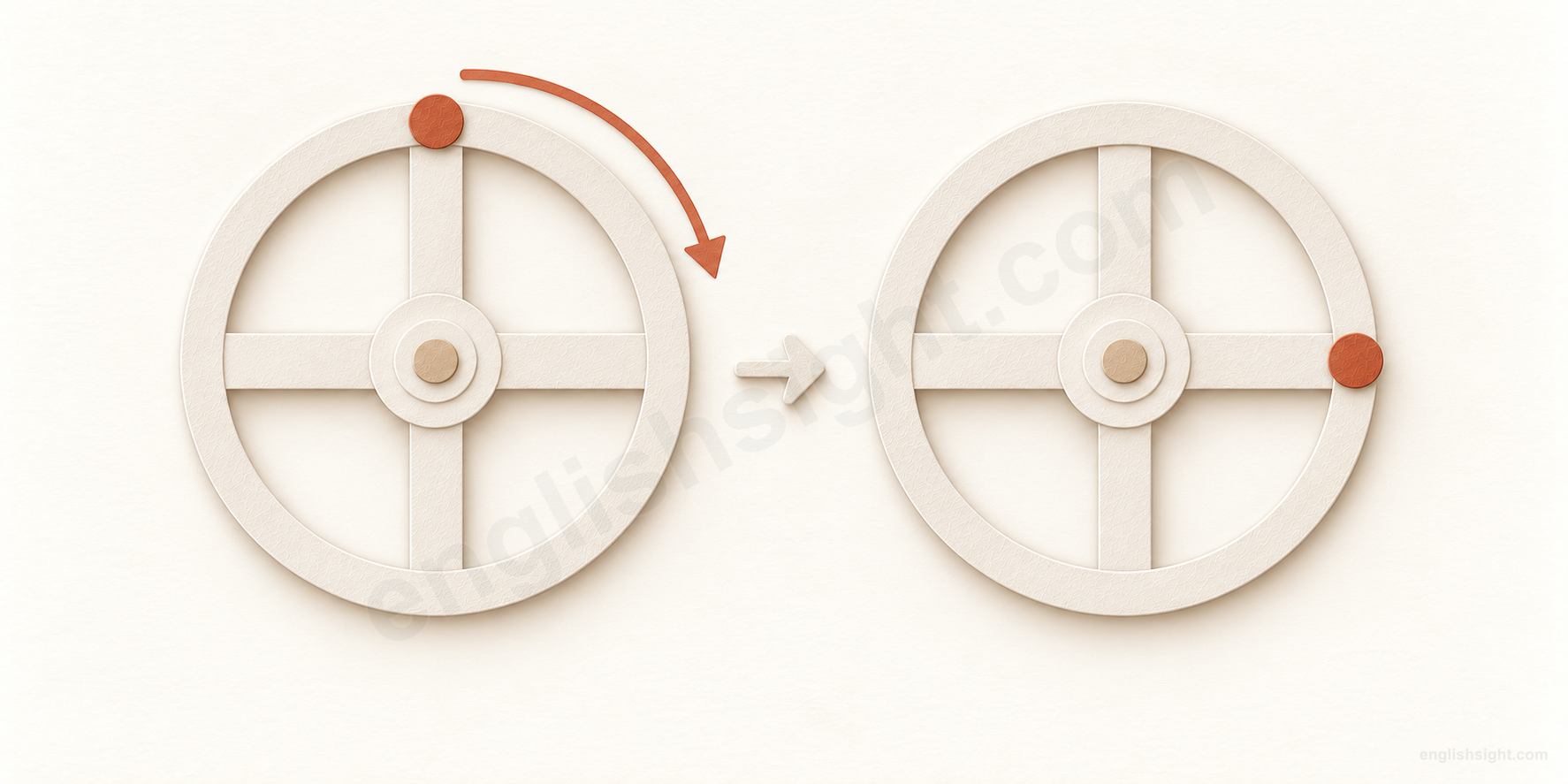
The rim marker is at the top of the wheel.
wheel
The same rim marker is now on the right.
The wheel turns clockwise about its centre.
The marked point moves around the hub. These are two rotational states, not a journey forward.
A wheel is a round part arranged to turn about its centre; that turning can support movement, transmit motion, or control direction.
The sketch isolates rotation. A wheel can turn while its centre stays in place. Travel, steering, circular flight, and established figurative expressions require their own context.
A wheel is most directly a round part that turns about its centre. It can carry a vehicle, transmit movement inside a machine, or serve as a steering control. Turning does not always mean travelling forward.
English extends these physical relationships in several ways: a person can wheel a suitcase, a bird can wheel above a harbour, and a team can set the wheels in motion. Fixed expressions need their own explanations; their full meanings do not follow automatically from the shape.
The diagram is a teaching aid for the physical relationship, not a claim about a picture shared by every English speaker.
01
Round parts, vehicles, and controls
Start with the physical object, then notice which wheel a situation refers to. A road wheel, a steering wheel, and a machine wheel have different jobs.
01
a / the + front / rear / spare + wheel; the wheels of + vehicle
a front / rear / spare wheel
a rotating part that supports a vehicle
Starting situation
You inspect a bicycle before a journey.
What changes or is understood
You find that one wheel needs attention.
The wheel turns about its centre; the tyre is its outer rubber covering.
Wheel is a countable noun: one wheel, two wheels. Front and rear locate the part; a spare wheel is an extra one kept for replacement.
A wheel can refer to the assembled rotating part in everyday repair talk. Tyre (British spelling), or tire (American spelling), specifically names the rubber ring around it. A flat tyre does not mean that the metal wheel has become flat.
In a sentence
The front wheel of my bicycle is bent.
Watch the difference Say a wheel or two wheels; bare singular wheel normally needs a determiner in a sentence.
02
noun + on wheels; be + on wheels
on wheels
supported by wheels so that it can be moved
Starting situation
A heavy case would be awkward to carry.
What changes or is understood
Its wheels let you pull it along.
On wheels describes support and mobility, not necessarily movement now.
A suitcase on wheels has wheels underneath it. The case may be standing still; on does not mean that somebody is currently driving it.
Furniture on wheels and a small shop on wheels use the same practical idea. In service names such as Meals on Wheels, the phrase points to delivery by vehicle rather than wheels attached to the meals.
In a sentence
We bought a storage box on wheels for the classroom.
Watch the difference Use on wheels, not in wheels. A wheel on a suitcase names the part instead of describing the whole suitcase.
03
a + machine name / function + wheel; a wheel in + machine
a wheel in a machine
a circular working part that rotates
Starting situation
You look inside a mechanical toy.
What changes or is understood
You see round parts transferring movement.
A wheel can rotate in a fixed place without travelling along a road.
A gearwheel passes movement between toothed parts; a water wheel receives moving water. The word before wheel identifies its particular design or job.
A potter’s wheel provides a rotating surface for shaping clay; a spinning wheel is equipment for making thread. These are established names, not claims that every circular tool is interchangeable.
In a sentence
A small wheel inside the toy turns when I pull the string.
Watch the difference Rotation alone does not imply forward progress. A stationary machine may contain many turning wheels.
04
a wheel of + cheese; wheels of + cheese
a wheel of cheese
a whole round block of cheese
Starting situation
The shop displays a large circular cheese.
What changes or is understood
The seller cuts a piece from the whole block.
Here the connection is round shape, not a working mechanism.
A wheel of cheese is named for its shape. It does not need an axle, spokes, or any ability to roll.
Of cheese names the material or food; it does not make cheese countable in every context. You can buy a slice of cheese cut from a wheel.
In a sentence
The seller cut a narrow slice from a wheel of cheese.
Watch the difference A wheel is the whole round block here, not an ordinary wedge or slice.
05
hold / turn / grip + the (steering) wheel
turn / hold the wheel
operate the steering control
Starting situation
A driver needs to change the vehicle’s direction.
What changes or is understood
The driver turns the circular control.
In a driving context, the wheel usually means the steering wheel.
The driver holds the steering wheel, not a road wheel. When the context is clear, the longer name is shortened to the wheel.
Keep both hands on the wheel describes hand position. Turn the wheel describes an action at the control; the expression does not itself tell you how far the car turns.
In a sentence
Nina turned the wheel as she guided the car into the parking space.
Watch the difference The wheel can mean different parts. Use steering wheel if a reader might confuse the control with a wheel under the car.
06
be + at / behind the wheel; get behind the wheel; take the wheel
at / behind the wheel; take the wheel
be the driver or begin driving
Starting situation
Two people are sharing a long drive.
What changes or is understood
They decide who will drive the next part.
The steering control stands for the driver’s role.
At the wheel and behind the wheel commonly identify the person driving. Get behind the wheel can describe taking the driving position or starting to drive, depending on context.
Take the wheel means take over driving: the object is the familiar control, but the intended action includes driving the vehicle. The phrase can also be extended figuratively to taking charge when the context supports that reading.
In a sentence
I drove until lunch, and then Maya took the wheel.
Watch the difference At and behind belong to established driving phrases. In the wheel does not mean driving.
07
have / get + (my / your / their) own wheels
my own wheels
a car, in informal speech
Starting situation
You usually depend on other people for lifts.
What changes or is understood
You now have a car available to you.
The plural part-name refers to a whole vehicle.
I’ve finally got my own wheels can announce having a car. This informal use names the vehicle through its wheels; it is not a count of spare parts.
Context still matters: I bought new wheels at a repair shop may refer to actual replacement wheels. In formal writing, name the vehicle directly.
In a sentence
Now that I have my own wheels, I can visit the coast more easily.
Watch the difference Keep the plural wheels for this informal car meaning; my own wheel normally names one actual wheel.
08
number + -wheeled + noun; a + number + -wheeler; four-wheel drive
a two-wheeled vehicle / a three-wheeler
describe or name something by its wheels
Starting situation
You compare vehicles with different wheel arrangements.
What changes or is understood
You choose an adjective or a noun to name the difference.
-Wheeled modifies a noun; -wheeler can be a noun itself.
A two-wheeled vehicle uses an adjective describing the vehicle. A three-wheeler is a vehicle named by its number of wheels. These forms do different grammatical jobs.
In four-wheel drive, four-wheel is part of the established name for a drive system. It refers to power reaching all four wheels, rather than merely counting how many the vehicle has. Four-wheel drive can also name a vehicle with that system: We hired a four-wheel drive for the trip.
In a sentence
The museum has a three-wheeler beside a two-wheeled motorbike.
Watch the difference Write a two-wheeled vehicle, not a two wheels vehicle. Do not confuse a wheel-count adjective with a drive-system name.
02
Moving something or changing direction
As a verb, wheel can describe transport on wheels or a curved or pivoting movement. The object and the direction phrase tell you which action is meant.
09
wheel + wheeled object + direction / place
wheel a bike / suitcase
move an object along on its wheels
Starting situation
You are walking beside a bicycle.
What changes or is understood
You guide it forward while its wheels turn.
The person causes the wheeled object to move; riding is not implied.
Wheel is transitive here: someone wheels something. You can wheel a bicycle across a courtyard while walking beside it, or wheel a suitcase to a taxi.
A direction phrase supplies the route or destination: across the road, into the garage, away. The physical action remains the same; these are not all separate idioms.
In a sentence
I wheeled my bicycle through the gate before getting on.
Watch the difference Wheel my bike is different from ride my bike. The first does not say that I am sitting on and cycling it.
10
wheel + person + direction; person + be wheeled + direction
wheel someone into a room
transport a person on a wheeled chair or bed
Starting situation
A person is seated in a wheelchair outside a room.
What changes or is understood
An assistant moves the chair and its occupant inside.
The person is the object of wheel, but the chair or bed supplies the wheels.
In wheel someone somewhere, the object may name the person being transported rather than the wheeled equipment. Context can make the chair, bed, or stretcher clear.
The passive is useful when the transported person matters most: He was wheeled into the room. It does not imply wheels attached to the person’s body.
In a sentence
The attendant wheeled me into the waiting room.
Watch the difference Wheel someone describes transport with wheeled equipment; it is not a general replacement for lead or carry someone.
11
wheel + around / round / about; wheel + object + around
wheel around / round / about
turn quickly to face another direction
Starting situation
You are walking away when somebody calls your name.
What changes or is understood
You turn sharply to face the caller.
A pivoting movement can be described with wheel even when there are no wheels.
The person turns as though pivoting around a centre. Around, round, or about adds the direction change; none requires a full circle.
Wheel can also take an object in this turning sense: wheel your body around. In ordinary conversation, turn around is a simpler neutral choice; wheel highlights a sharp, dramatic motion.
In a sentence
She wheeled around when she heard her name.
Watch the difference Do not assume that wheeled around means drove around. The subject and the scene determine whether this is a bodily turn.
12
birds + wheel + overhead; birds + wheel + above / around + place
birds wheeling overhead
birds moving along curved or circular paths
Starting situation
You look up at birds above the harbour.
What changes or is understood
They circle rather than follow a straight flight path.
Here the route curves around; no physical wheel is present.
Birds wheel when their flight traces a circling or sweeping course. Unlike wheel a suitcase, this use needs no object: the birds themselves move.
This use is especially at home in descriptive writing. Circle is a straightforward alternative when you simply want to report the flight path.
In a sentence
Gulls were wheeling above the harbour as we arrived.
Watch the difference Wheeling is not a general synonym for flying. The curved motion is the relevant connection.
13
wheel out + noun; wheel + noun / pronoun + out
wheel out the same old excuse
produce something familiar again for a purpose
Starting situation
Someone needs to explain another delay.
What changes or is understood
They repeat the excuse everybody has heard before.
The figurative expression presents an argument or person as something brought out for use.
Wheel out can mean bring forward a familiar excuse, argument, or even a person to serve a purpose. It is informal and often suggests impatience with something repeatedly used.
This phrasal verb is separable: wheel out the excuse or wheel the excuse out; with a pronoun, wheel it out. Compare wheel the trolley out: with an actual trolley, the same words can simply describe physical movement outside.
In a sentence
Whenever the work is late, he wheels out the same excuse about his computer.
Watch the difference Wheel it out is the pronoun order; not wheel out it. The figurative meaning does not require physical wheels.
03
Work, progress, and established expressions
English often treats a process as machinery. These expressions make different judgments about starting, helping, repeating, or failing; learn each full expression.
14
the wheels of + system; set the wheels in motion
the wheels of government; set the wheels in motion
a system’s operation; start a process
Starting situation
A decision has been made but nothing has begun.
What changes or is understood
An application starts the necessary sequence of actions.
The system is compared with machinery whose parts begin working together.
The wheels of government or bureaucracy refers to how a large system operates. The machinery comparison can make a process sound complicated or slow.
Set the wheels in motion means initiate the process, not complete it. In this expression, motion represents activity; later steps may still take time.
In a sentence
Submitting the form will set the wheels in motion, but approval may take a month.
Watch the difference Starting the process does not guarantee its success or speed. Keep plural wheels in the fixed expression.
15
oil / grease the wheels (of + process)
oil / grease the wheels
help a process work more smoothly
Starting situation
Two teams keep misunderstanding each other.
What changes or is understood
Clearer communication reduces delays between them.
The lubricant image represents making cooperation easier.
Oil the wheels is especially British; grease the wheels is the usual North American variant. What helps may be a useful introduction, clearer information, or practical assistance.
The phrase is about helping things run smoothly, not necessarily beginning them. In a context involving improper payments it can suggest bribery, but that is not required by every use.
In a sentence
A clear introduction can oil the wheels of a difficult meeting.
Watch the difference Compare set the wheels in motion: that highlights starting; oil the wheels highlights easing the process.
16
reinvent the wheel; no need to reinvent the wheel
reinvent the wheel
unnecessarily create something that already works
Starting situation
Your team needs a standard booking form.
What changes or is understood
Someone proposes rebuilding one although a suitable form already exists.
The idiom criticizes needless duplication, not useful improvement.
Reinvent the wheel treats a working solution as something already invented. It often recommends finding and adapting existing work before starting from nothing.
The expression is evaluative: the speaker considers the repeated effort unnecessary. Whether an existing solution actually fits is a separate practical question; the idiom does not prove that all new design is pointless.
In a sentence
Let’s adapt the existing checklist instead of reinventing the wheel.
Watch the difference Use the wheel, normally singular with the. Invent a wheel can be literal and lacks this established criticism.
17
spin + possessive + wheels
spin your wheels
spend effort without making useful progress
Starting situation
A team discusses the same question for hours.
What changes or is understood
There is still no decision or useful result.
The teaching image is turning wheels that fail to carry anything forward.
This informal expression, especially associated with American English, contrasts activity with progress. A person can be busy and still be spinning their wheels.
The possessive follows the subject: I’m spinning my wheels; we’re spinning our wheels. Literal wheels may spin too, so the surrounding task tells you whether the meaning is figurative.
In a sentence
Without the missing figures, we’re just spinning our wheels.
Watch the difference This does not simply mean relaxing or doing nothing. It often describes unsuccessful effort.
18
the wheels come off (something)
the wheels come off
a plan or performance begins to fail badly
Starting situation
A project seems under control.
What changes or is understood
A serious problem disrupts several parts of the work.
The vehicle image represents loss of effective functioning.
When the wheels come off, things go badly wrong, often quite suddenly. A match report, for example, may use it when a team’s performance collapses.
The subject is the wheels: The wheels came off after the break. In figurative use, the surrounding context supplies the team, plan, or operation that fails.
In a sentence
The launch went well, but the wheels came off when the booking system failed.
Watch the difference Come off here means fail as a whole expression. It does not mean that success has been achieved.
19
be + asleep at the wheel
asleep at the wheel
failing to pay attention to a responsibility
Starting situation
A supervisor should have noticed repeated errors.
What changes or is understood
The errors continue because the warning signs are ignored.
The driving image criticizes inattention by someone who should be in control.
Literally, asleep at the wheel describes a dangerously sleeping driver. Figuratively, it says that a responsible person or institution is not being alert enough.
The figurative criticism concerns neglect, not actual sleep or tiredness. It is stronger than simply saying that someone made one understandable mistake.
In a sentence
The inspectors were asleep at the wheel while the faults kept appearing.
Watch the difference A driving context may be literal. Check the subject and situation before assuming an idiom.
20
wheel and deal; be wheeling and dealing; wheeling and dealing
wheel and deal
negotiate and arrange complicated business or political deals
Starting situation
Someone is arranging a series of agreements behind the scenes.
What changes or is understood
They bargain with several people to get the result they want.
This is an established paired expression, not an action predicted by a round object.
Wheel and deal often has a disapproving tone, suggesting aggressive bargaining or questionable methods. Context determines whether actual dishonesty is alleged.
It commonly appears in progressive forms: They’re wheeling and dealing. Wheeling and dealing can also name the activity. Do not try to explain the whole idiom by assigning a separate physical wheel to each negotiation.
In a sentence
He was wheeling and dealing to secure support for the proposal.
Watch the difference This is not a neutral synonym for every ordinary purchase. Both words belong to the fixed expression.
21
there are wheels within wheels; wheels within wheels in + situation
wheels within wheels
complicated, interacting influences that are hard to see
Starting situation
A decision looks simple from outside.
What changes or is understood
You learn that several hidden interests influenced it.
The nested machinery image suggests complexity behind the visible result.
Wheels within wheels describes a situation shaped by connected motives, actions, or processes. It can suggest hidden dealings, without necessarily claiming a criminal conspiracy.
Use it when the obvious explanation leaves out important interactions. It is an established expression, not a technical description of a specific machine design.
In a sentence
The appointment looked routine, but there were wheels within wheels.
Watch the difference Keep within and the plural wheels. The idiom concerns complexity, not simply a large quantity of work.
22
the wheel of + fortune / history
the wheel of fortune / history
a literary image for changing or recurring circumstances
Starting situation
A once-successful group loses its influence.
What changes or is understood
Later events may reverse its situation again.
Turning provides an image of changing positions and recurring patterns.
The wheel of fortune presents luck or life’s circumstances as capable of turning. The wheel of history similarly treats historical change through the image of a turning wheel.
This is a rhetorical or literary use, not an everyday grammar rule for all change. Fortune can also appear in names of games or actual devices; the scene tells you which meaning is intended.
In a sentence
The novel follows a family caught in the turning wheel of fortune.
Watch the difference The image does not guarantee that history repeats exactly or that good luck must return.
23
the squeaky wheel gets the grease / oil
the squeaky wheel gets the grease
people who speak up are more likely to get attention or help
Starting situation
A problem remains unnoticed while nobody raises it.
What changes or is understood
Someone complains, and the issue receives attention.
The noisy-wheel image links making a problem heard with receiving a response.
This saying compares a complaint to a squeaking wheel that attracts attention and receives lubricant. It can encourage someone to speak up or criticize a system that rewards the loudest complaints.
The grease and the oil are both found in versions of the saying. This is an observation about who tends to receive attention, not a guarantee that complaining will solve a problem or that the loudest person deserves priority.
In a sentence
Ask them again about the repair—the squeaky wheel gets the grease.
Watch the difference Do not confuse this with grease the wheels, which means help a process run smoothly; the proverb focuses on attracting attention.
04
People and their place in a group
Several fixed expressions describe someone’s importance, contribution, or feeling of being unnecessary. Their social meaning is not supplied by the word wheel alone.
24
be / feel like + a third wheel / a fifth wheel
a third wheel / a fifth wheel
someone who feels unnecessary or out of place
Starting situation
Two friends concentrate entirely on each other.
What changes or is understood
The person who joined them feels left out.
The extra-wheel image concerns someone’s role, not their numerical order alone.
Calling yourself a third wheel can express feeling unnecessary, especially when accompanying a couple. A fifth wheel is a related expression for someone unwanted or without a useful role.
These are informal social judgments. Three people together do not automatically make one person a third wheel: the feeling of being excluded or superfluous is essential.
In a sentence
I left early because I felt like a third wheel on their date.
Watch the difference Calling another person a third wheel can hurt. This is not a neutral way to count guests.
25
a big wheel in + organization; ride / go on + the big wheel
a big wheel
an influential person; also a large fairground ride
Starting situation
Someone introduces an important figure in an organization.
What changes or is understood
You understand that the person has influence.
The person meaning is an informal label; context separates it from the ride.
In North American informal use, a big wheel is an important person in an organization. Big indicates importance within this established label, not the person’s body size.
In British English, the Big Wheel can instead name the large rotating fairground ride also called a Ferris wheel. We rode the big wheel is about the attraction; She’s a big wheel in the company is about status.
In a sentence
Her uncle is a big wheel in the local publishing business.
Watch the difference Do not assume every big wheel is a person. A literal large wheel or a fairground ride is also possible.
26
be / feel like + a cog in the machine / wheel
a cog in the machine / wheel
a small part of a larger organization
Starting situation
Your job contributes to a very large operation.
What changes or is understood
You feel that your individual influence is limited.
The person is compared with one small working component.
This informal expression places a person within a larger system. It often suggests limited influence or little individual recognition, even though the work may be necessary.
The machine is a more explicit image of the whole organization; wheel is an established alternative in the idiom. Neither means the person literally turns or that their work has no value.
In a sentence
In that huge company, I felt like a tiny cog in the machine.
Watch the difference Compare a big wheel: that highlights importance; a cog highlights being a small component.
27
put + possessive + shoulder(s) + to the wheel
put your shoulder to the wheel
apply yourself and work hard at a task
Starting situation
A shared task needs serious effort.
What changes or is understood
Everybody begins contributing more actively.
The pushing image represents effort rather than a literal driving position.
The expression encourages determined work. A person’s shoulder stands for bodily effort in the image, but the real task can be paperwork, planning, or another nonphysical job.
Change the possessive with the person: I put my shoulder to the wheel; we put our shoulders to the wheel. It is an idiomatic call for effort, not a casual instruction about posture.
In a sentence
We all put our shoulders to the wheel and finished the catalogue.
Watch the difference Use to the wheel, not on the wheel. Being at the wheel describes driving or control, not this promise of effort.
28
put a spoke in + possessive + wheel
put a spoke in someone’s wheel
obstruct someone’s plans
Starting situation
Someone has a plan ready to carry out.
What changes or is understood
Another person acts in a way that prevents it from proceeding.
The fixed expression judges an action as an obstacle to progress.
This British idiom means hinder someone’s plan. A spoke is actually part of a real wheel, but the obstructing meaning belongs to the whole expression; knowing the part-name alone will not reliably predict it.
The possessive identifies whose plan is obstructed: put a spoke in our wheel. It usually presents the interference negatively from that person’s viewpoint.
In a sentence
The rival’s objection put a spoke in our wheel just before the vote.
Watch the difference This idiom describes hindering, not helping to repair something. Learn the complete wording.
Read the part, the action, and the whole expression
Forms and grammar
Wheel is pronounced /wiːl/. The noun is countable (wheel, wheels), except that informal wheels meaning a car is used in the plural. Verb forms are wheel, wheels, wheeled, wheeled, wheeling. Ordinary physical actions allow progressive forms, and transitive transport uses allow a passive: The bed is being wheeled inside.
Wheel, tyre, roll, and turn
A tyre / tire is the rubber covering of a vehicle wheel. Roll can describe other round objects moving, such as a ball; wheel an object normally involves wheeled equipment. Turn is a broader verb: turning a page or turning on a light does not normally become wheeling it.
One relationship, several branches
The centre-and-rim sketch supports rotation. Shape explains a wheel of cheese; a part can stand for a car or its driver; movement can suggest a working system. These are learning connections, not a formula for translating every expression.
Scope and style
Start with the object, driving phrases, and moving wheeled things. Circling birds and the wheel of fortune are useful for reading descriptive prose. The idioms are included for understanding and appropriate use, not ranked by frequency. Historical torture, military formations, verse terminology, and specialist engineering uses are outside this lesson.
Choose the intended meaning
Use the whole sentence to decide which wheel or movement matters.
1. You walk beside your bicycle and guide it through a gate. Which sentence fits?
2. A team works hard for hours but makes no useful progress. Which expression fits?
3. Maya takes over driving after lunch. What does Maya took the wheel mean?
4. Replace the same old excuse with it: He keeps wheeling out the same old excuse.
5. A wheel turns inside a fixed machine. Which conclusion is justified?
6. You join two people on their date and feel left out. Which phrase describes that feeling?
Sources and teaching notes
The dictionary pages below were read to check meanings and constructions. The lesson’s explanations, examples, and visual teaching model are original; the diagram does not establish the meanings of fixed idioms.
The diagram is a teaching model of rotation, not a picture shared by every native speaker.