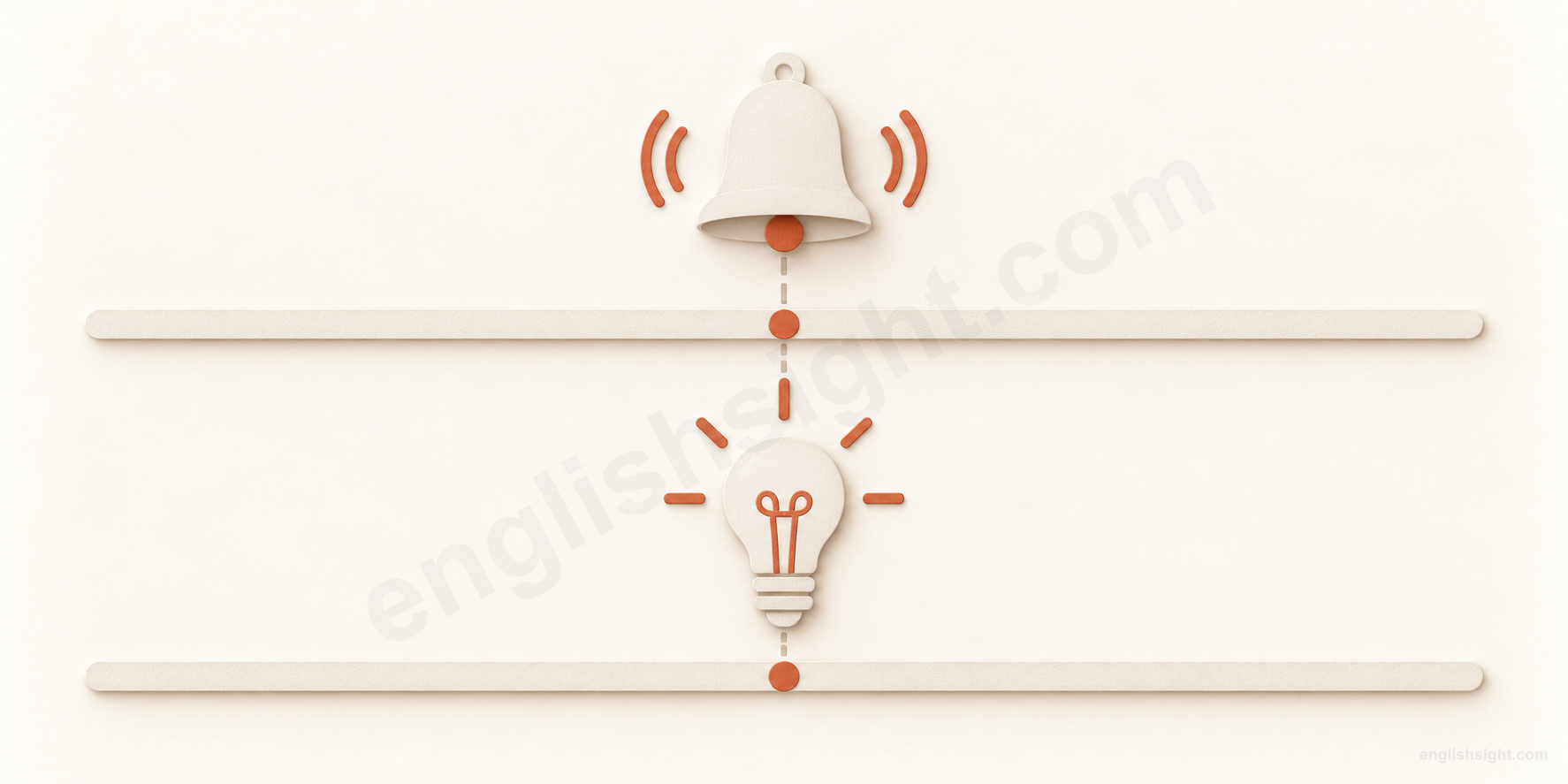
Use when to ask about time, anchor one event to another, and frame a situation.
One event supplies a time reference
One event supplies a time reference
The bell rings.
when
The light flashes at that time.
The ringing supplies a time reference.
The bell's ringing locates the flash in time.
When locates an event in time or relates it to the time supplied by another event or situation.
In The light flashed when the bell rang, the ringing anchors the flash in time. The sentence alone does not tell us whether the bell caused the flash. Other uses can cover longer periods or supply a reason or contrast.
When helps locate an event in time or relate it to the time supplied by another event or situation. A reference can be a moment, a period, or a repeated occasion; it need not be an hour on a clock.
This is a teaching model for the main temporal uses. The lesson also explains reason, contrast, and fixed expressions that need more than a timeline. It does not claim that all speakers share one mental picture.
01
Ask for and identify a time
Ask directly, embed a time question, or specify the time meant by a noun. When can refer to an occasion or suitable circumstances as well as a clock time.
01
when + auxiliary / be / modal + subject (+ verb)?
When does it start?
ask for a time or occasion
Situation / reference
You know a workshop is scheduled.
What is located or linked?
You ask for its starting time.
When leaves the time slot open for an answer.
When is the workshop? asks for its time. With an ordinary lexical verb, form the question with do, does, or did: When does it start? With be or a modal, invert that verb and the subject: When is it? When can we leave?
The answer can be a date, period, event, or circumstance. When should I use this setting? asks for a suitable occasion, not necessarily an hour. A surprised When? can ask someone to repeat the time.
In a sentence
When does the evening workshop start?
Watch the difference After does or did, use the base form: does it start, not does it starts. When asks for time; how long asks for duration.
I don’t know when the parcel will arrive contains the question What time will it arrive? inside a larger sentence. Keep the subject before the verb: when it will arrive, not when will it arrive.
Compare Tell me when it will arrive, requesting information about the arrival time, with Call me when it arrives, arranging a call at that time. Will is possible in the embedded question; the ordinary future time clause uses a present form.
In a sentence
Do you know when the parcel will arrive?
Watch the difference Do not ban will after every when. First decide whether the clause asks about a time or sets the time for another action.
03
know / decide / tell someone + when to + base verb
know when to stop
identify the right time for an action
Situation / reference
You must decide how long to keep working.
What is located or linked?
You judge the right point to stop.
When to do something names a timing decision.
When to stop compresses a question such as when you should stop. It follows expressions including know, decide, and tell someone: Tell me when to begin.
The understood person doing the infinitive comes from context: in Tell Maya when to begin, Maya is to begin. This is not the time-clause pattern When I stop, I will call you.
In a sentence
I haven’t decided when to book the tickets.
Watch the difference Use when to book, not when book or when to booking.
04
by / until / since + when + question; time expression, since when + clause
by when / until when / since when
ask for a deadline, endpoint, or starting point
Situation / reference
The time relation is known but its date is missing.
What is located or linked?
The question identifies that date.
The preposition specifies which boundary you want.
By when asks for the latest acceptable time: By when do you need the form? Until when asks for the endpoint of a continuing situation. Since when asks for the starting point of a situation continuing afterwards.
How long can you stay? is often a smoother way to ask about a stay’s duration; Until when can you stay? requests its endpoint. In We moved in June, since when we’ve had no problems, since when means since that time and sounds formal.
In a sentence
By when do you need my answer?
Watch the difference By Friday sets a deadline; until Friday describes continuation. The surprised challenge Since when? has a separate conversational use.
05
time / day / year + when + clause; that is when + clause
the day when…
specify or describe a time
Situation / reference
You mention a day.
What is located or linked?
The clause identifies what happened then.
When relates a clause to a time expression.
In the day when we met, when means on which day. Compare the place where we met. In ordinary contexts the day we met can omit when. But in the day that changed everything, that is the subject of changed; when cannot replace it.
We moved in April, when the streets were quiet adds information about an already identified period. That’s when I met Sam means that was the time I met Sam. In careful definitions, avoid using when as a vague substitute for in which after a non-time noun: a condition in which a person cannot sleep.
In a sentence
I still remember the afternoon when we first spoke.
Watch the difference Ask what the clause supplies: a time relation or a missing subject/object. I remember when we first spoke is also possible, without an expressed time noun.
02
Connect events through time
One clause supplies the time reference for another. Verb forms and context tell us whether events overlap, repeat, finish, or interrupt a plan.
06
when + subject + past verb, main clause
when I was a child
place something within a period or situation
Situation / reference
A past period is the reference.
What is located or linked?
You describe life during it.
When can cover a stretch of time, not only a moment.
When I was a child gives a period during which the main statement holds. It need not be a sudden event. While I was a child is possible in some contexts, but when is a natural way to frame a life stage.
The when-clause can come first or last: When I was a child, we lived near the sea / We lived near the sea when I was a child. A clause at the beginning normally takes a following comma.
In a sentence
When I was a child, we lived above a bakery.
Watch the difference When I was a child is a dependent clause; add a main clause unless it is a conversational answer.
07
main clause + when + event clause
when the bell rang
locate one event at another event’s time
Situation / reference
Two events need to be related in time.
What is located or linked?
The bell supplies the reference for the flash.
A time link does not by itself prove a cause.
The light flashed when the bell rang places the flash at the ringing. Another sentence, I smiled when I saw the message, may suggest a reaction. The verbs and context help us infer that reaction; when alone does not assert causation.
The relation need not be exactly simultaneous: We left when the show ended normally places leaving just after the ending. Use before or after if the ordering needs to be explicit.
In a sentence
The light flashed when the bell rang.
Watch the difference Do not translate every when as immediately after. It can mean at, during, or on the occasion of, depending on context.
08
will / imperative + when + present simple or present perfect
I’ll call when I arrive
set the time for a future action
Situation / reference
Arrival is expected later.
What is located or linked?
The call is planned for that time.
A present verb can point to future time in a time clause.
In I’ll call when I arrive, the main clause contains will, while the when-clause normally uses a present form. It treats arrival as the future time reference. It is not an instruction to use present tense for every kind of when-clause.
When you’ve finished the form, press Send uses the present perfect to highlight completion before the next action. When you finish is also natural. For an uncertain possibility, If I arrive before lunch, I’ll call you leaves open whether that condition will be met; when normally presents the event as expected.
In a sentence
I’ll send the photos when I get home.
Watch the difference For ordinary future timing, use when I get home, not when I will get home. Compare the information question I don’t know when I will get home.
09
when + present clause, present clause
when I’m tired
describe what happens on such occasions
Situation / reference
A situation occurs on different occasions.
What is located or linked?
A regular response follows.
When can connect a repeated circumstance and response.
I make mistakes when I’m tired describes a pattern, not one scheduled event. In this setting when is close to whenever or every time that, although a general statement need not promise an exceptionless rule.
When water freezes, it expands gives a general relationship. If can also introduce conditions in such statements. The difference between when and if is therefore not a universal contrast between certainty and uncertainty in every sentence.
In a sentence
When I’m tired, I read the same page twice.
Watch the difference Use the context to distinguish a habit from a single future event; the present form alone does not decide.
10
was / were + -ing or about to + verb + when + past event; had just / hardly… when…
was about to… when…
introduce a new event in a narrative
Situation / reference
Something is in progress or just about to happen.
What is located or linked?
A new event enters the story.
When can introduce the event that interrupts or changes the situation.
I was cooking when the alarm sounded places the alarm during cooking. I was about to leave when Jo called places the call just before my intended departure. The first clause sets the scene; the when-clause moves the story forward.
We had just sat down when the lights went out puts the second event immediately after the first. More formally, We had hardly sat down when the lights went out means almost no time had passed. With hardly first, invert: Hardly had we sat down when the lights went out. Before is also possible after hardly or scarcely in suitable contexts; when is the standard pairing illustrated here.
In a sentence
I was about to close the shop when a customer came in.
Watch the difference The new event may delay a plan, but when does not guarantee the plan was permanently abandoned. Standard pairs are hardly / scarcely… when and no sooner… than.
11
when + adjective / -ing form / past participle
when ready / when using…
shorten a time or circumstance clause
Situation / reference
An instruction repeats information that is clear.
What is located or linked?
A short when-clause keeps the relevant condition.
Recover the missing subject and verb from the sentence.
Press Start when ready normally means when you are ready. Add water when necessary means when it is necessary. When asked, Mina gave her name means when Mina was asked. These are reduced clauses, not when followed freely by any noun.
When using this app, keep a backup normally means when you are using it: the implied user matches the person addressed. Avoid When using the app, the screen froze if that makes the screen the supposed user; write The screen froze while I was using the app.
When compared with last year’s version, this model is faster means when this model is compared with it. The model is what is compared; the past participle has passive meaning. Use an explicit subject if the shortened clause could attach to the wrong thing.
In a sentence
When using this tool, wear safety glasses.
Watch the difference Keep the understood subject clear. When I’m ready and when ready work differently from the embedded question when to begin.
03
Use a situation as a reason or contrast
Some when-clauses invite us to consider a fact rather than find a date. These uses need their own explanation; a shared time marker cannot explain everything.
12
why / how + question + when + supporting fact
Why… when…?
give a fact that supports a judgment
Situation / reference
A free alternative is already available.
What is located or linked?
You question the need to pay.
The situation is a reason for the question, not an unknown date.
Why pay for parking when the museum has a free car park? asks why paying would make sense given an alternative. When is close to considering that here.
How can we finish when half the files are missing? similarly presents an obstacle. The clause may describe a simultaneous situation, but its communicative job is to explain the judgment.
In a sentence
Why buy another notebook when you already have three?
Watch the difference Answer the reasoning, not a time question. Because can state a cause directly, but it does not preserve every rhetorical when construction.
13
main clause + when + contrasting clause
when in fact…
contrast a claim or action with a conflicting fact
Situation / reference
Someone calls the room empty.
What is located or linked?
You point out that people are inside.
When can introduce a fact that makes the other statement surprising.
They called the room empty when in fact two people were inside sets a claim against reality. Here when is close to although or whereas; in fact makes the correction especially clear.
He drove when he could easily have walked similarly contrasts an action with an available alternative. Do not force these into an exact moment on a timeline.
In a sentence
They said the room was empty when in fact two people were inside.
Watch the difference This when is not a question word. The whole contrasting clause is needed to understand the point.
04
Familiar expressions and sayings
Learn the whole phrase and its tone. When still connects a time or circumstance, but the rest of an idiom supplies meanings such as disbelief, pressure, or postponement.
14
say when; say when to stop / start
Say when.
ask someone to signal the stopping point
Situation / reference
You are pouring a drink for someone.
What is located or linked?
They tell you when the amount is enough.
The fixed request asks for a practical signal.
Say when is an informal request to indicate the right point to stop, especially while pouring or serving. A reply such as That’s enough, thanks makes the signal clear.
It can also request a signal for beginning an action in an appropriate context. Learn the request as a whole: it does not require the listener to name a clock time.
In a sentence
“Say when,” I said as I poured the juice.
Watch the difference Do not confuse this request with Tell me when the train leaves, which can ask for schedule information.
15
since when + question; Since when?
Since when…?
express surprise or challenge an assumption
Situation / reference
A friend announces an unexpected rule.
What is located or linked?
You question whether that rule is established.
Tone can turn a starting-time question into a challenge.
Since when do we need tickets for this park? may express surprise or doubt about the new requirement. The speaker may want an explanation as much as a start date.
Since when have you lived here? can be a genuine question about a starting point. The standalone Since when? often sounds skeptical, so use it carefully with unfamiliar people.
In a sentence
Since when do we have to book a table for breakfast?
Watch the difference This can sound annoyed or confrontational. A neutral alternative is When did that rule change?
16
if and when / when and if + present clause, future main clause
if and when…
leave both occurrence and timing open
Situation / reference
A project may receive approval.
What is located or linked?
You plan what to do if approval eventually comes.
The phrase emphasizes uncertainty about the future event.
If and when the project is approved, we’ll hire a designer does not promise approval. If leaves open whether it happens; when draws attention to the occasion if it does.
When and if is also used. Either if or when is often enough; the combined wording adds emphasis and can sometimes suggest impatience in context.
In a sentence
If and when we get permission, we’ll open the garden to visitors.
Watch the difference Do not treat if and when as a guarantee. Use a present form for ordinary future conditions here.
17
as and when + clause; as and when
as and when…
act when the necessary occasion or information arises
Situation / reference
There is no complete update yet.
What is located or linked?
You pass on new details once available.
Action waits for an appropriate future circumstance.
As and when means that something will happen at the relevant time, often only when another development makes it possible. It does not commit the speaker to a fixed schedule.
I’ll explain more as and when can stand without an expressed following clause if the missing circumstances are understood. This is an established expression rather than two independent time links to translate separately.
In a sentence
We’ll share further details as and when they become available.
Watch the difference This wording can be too vague if the listener needs a firm deadline; provide a date when one is known.
18
when it comes (down) to + noun / -ing form
when it comes to…
introduce a topic or particular aspect
Situation / reference
You are comparing people’s skills.
What is located or linked?
You specify the area in which one person excels.
The expression sets a topic rather than a clock time.
When it comes to repairing bikes, Ana is the expert means as far as repairing bikes is concerned. It is a fixed topic expression, not a literal arrival.
After to use a noun or an -ing form: when it comes to money / choosing a route. When it comes down to can also introduce a particular aspect; the rest of the sentence determines the point being emphasized.
In a sentence
When it comes to choosing a route, I trust Ana.
Watch the difference To is a preposition here: choosing, not choose. Do not read comes as someone physically arriving.
19
when all is said and done, + overall statement
when all is said and done
state a final overall judgment
Situation / reference
Many arguments have been considered.
What is located or linked?
You say what ultimately matters.
The whole idiom introduces a conclusion after considering everything.
When all is said and done signals an overall judgment after the details have been weighed or the work completed. It need not mean everyone has literally finished speaking.
The expression can introduce a future assessment too: When all is said and done, we’ll be glad we tried. It organizes the speaker’s conclusion rather than giving a precise time.
In a sentence
When all is said and done, the repair is still cheaper than a replacement.
Watch the difference Keep is said and done in the established phrase. Its meaning belongs to the expression as a whole.
20
statement + when pigs fly; When pigs fly!
when pigs fly
say that something is extremely unlikely
Situation / reference
Someone makes a promise you do not believe.
What is located or linked?
You answer with humorous disbelief.
An impossible imagined time stands for never.
When pigs fly is an ironic saying, especially associated with North American English, that rejects the likelihood of something happening. British English also uses Pigs might fly.
It often appears as a short reply. The point comes from the impossible image of flying pigs; when by itself does not mean never.
In a sentence
“Will Max volunteer to wash every dish?” “When pigs fly!”
Watch the difference This can sound mocking. In a serious conversation, I don’t think that’s likely is safer.
21
when it rains, it pours
when it rains, it pours
comment on troubles arriving together
Situation / reference
One problem is followed by several others.
What is located or linked?
You comment on the cluster of bad luck.
A weather saying supplies the figurative meaning.
When it rains, it pours commonly describes one bad thing being followed quickly by others. It need not concern weather. The familiar British equivalent is It never rains but it pours.
The when-clause has the shape of a repeated relationship, but the whole saying supplies the observation about misfortunes. It is a comment, not a rule that every problem causes another.
In a sentence
The boiler broke, and then the car wouldn’t start—when it rains, it pours.
Watch the difference Check whether the context is literal weather or the established figurative saying.
22
when in Rome (do as the Romans do)
When in Rome…
suggest adapting to local customs
Situation / reference
You visit people whose routines differ from yours.
What is located or linked?
You decide to follow their custom.
The shortened saying means to follow local practices.
When in Rome is a shortened form of When in Rome, do as the Romans do. People use it beyond Rome to suggest behaving according to the customs of the group they are visiting.
The time/circumstance link is still visible: when you are there. The advice about adapting belongs to the full saying, not to when alone.
In a sentence
Everyone left their shoes at the door, so I did too—when in Rome!
Watch the difference It describes adapting to customs; it is not a universal instruction to agree with everything a group does.
23
when push comes to shove, + clause; when the chips are down, + clause
when push comes to shove / when the chips are down
describe a situation that tests decisions or support
Situation / reference
An easy arrangement may fail.
What is located or linked?
You consider what to do under real pressure.
The when-clause names a figurative test situation.
When push comes to shove is informal: when there is no other choice or other approaches have failed. It can introduce a fallback plan without referring to physical pushing.
When the chips are down is also informal, focusing on a difficult situation that forces people to show their priorities or courage: When the chips are down, she supports her team. The phrases overlap, but the first often highlights a last resort and the second a test under difficulty.
In a sentence
When push comes to shove, we can postpone the trip.
Watch the difference Learn these as whole expressions. Chips here does not mean a portion of food.
24
cross that bridge when + subject + come(s) to it
cross that bridge when we come to it
delay dealing with a possible problem until it arises
Situation / reference
Someone worries about a problem that may occur later.
What is located or linked?
You suggest handling it at the relevant time.
A bridge is a metaphor for a future difficulty.
We’ll cross that bridge when we come to it means we will address that problem if and when it becomes real, rather than worry about it now. The bridge and crossing supply the metaphor.
When keeps its normal time-linking job: it locates dealing with the problem at the encounter with it. Change the pronouns naturally: you’ll cross that bridge when you come to it.
In a sentence
If the room is unavailable, we’ll cross that bridge when we come to it.
Watch the difference This can sound dismissive if someone needs a contingency plan now. It expresses a conversational attitude, not proof that planning is unnecessary.
25
the when (and where) of + event
the when and where
treat timing as a detail to settle
Situation / reference
An event is agreed in principle.
What is located or linked?
You still need to arrange its timing and location.
When can be used as a noun naming the timing itself.
In the when and where of the meeting, when is a noun meaning its time. This is more compressed and stylistically marked than the time and place, but useful to recognize in planning or discussion.
The hows and whens similarly refers to practical details about method and timing. This noun use does not change the grammar of an ordinary question such as When is the meeting?
In a sentence
We agree on the visit; we still need to settle the when and where.
Watch the difference For a plain request, When and where shall we meet? is often clearer than treating when as a noun.
Choose the function before choosing the form
A time question is not a time clause
When will Jo arrive? and I wonder when Jo will arrive ask about an arrival time. I’ll leave when Jo arrives uses the arrival to time my leaving. Embedded questions keep subject–verb order; ordinary future time clauses normally use present forms.
When, while, if, and whenever
While often emphasizes duration or simultaneous activities; when can locate a point inside a longer activity as well as describe a period. Future when normally presents an event as expected; if leaves a condition open. In general rules and repeated situations, their uses may overlap. Whenever can emphasize any or every occasion.
Grammar, pronunciation, and scope
When is pronounced /wen/, with weaker pronunciation possible in connected speech. Dictionaries label its functions as adverb, conjunction, pronoun, and occasionally noun, with different divisions. It has no verb conjugation, passive, causative, or particle-verb family. This lesson covers modern everyday uses and selected recognizable idioms; it does not turn every saying containing when into a new meaning of the word.
Choose the function of when
Decide whether the sentence asks for time, uses time as an anchor, or expresses a viewpoint.
1. You promise to phone on reaching the station. Which sentence gives ordinary future timing?
2. You want to know the future arrival time. Which embedded question has the right word order?
3. You ask, “Why order more paper when we already have six boxes?” What does the when-clause do?
4. A colleague needs the latest acceptable date for your reply. Which question asks that?
5. The sentence says, “The light flashed when the bell rang.” What does when establish by itself?
6. Complete the topic expression: “When it comes to ___, Noor is very careful.”
Sources and teaching notes
Modern uses were checked against the linked publisher pages. Examples and explanations are original. Source divisions differ; the time-reference model is a teaching interpretation.
The diagram shows a time relationship. It is a learning aid, not a shared mental picture.