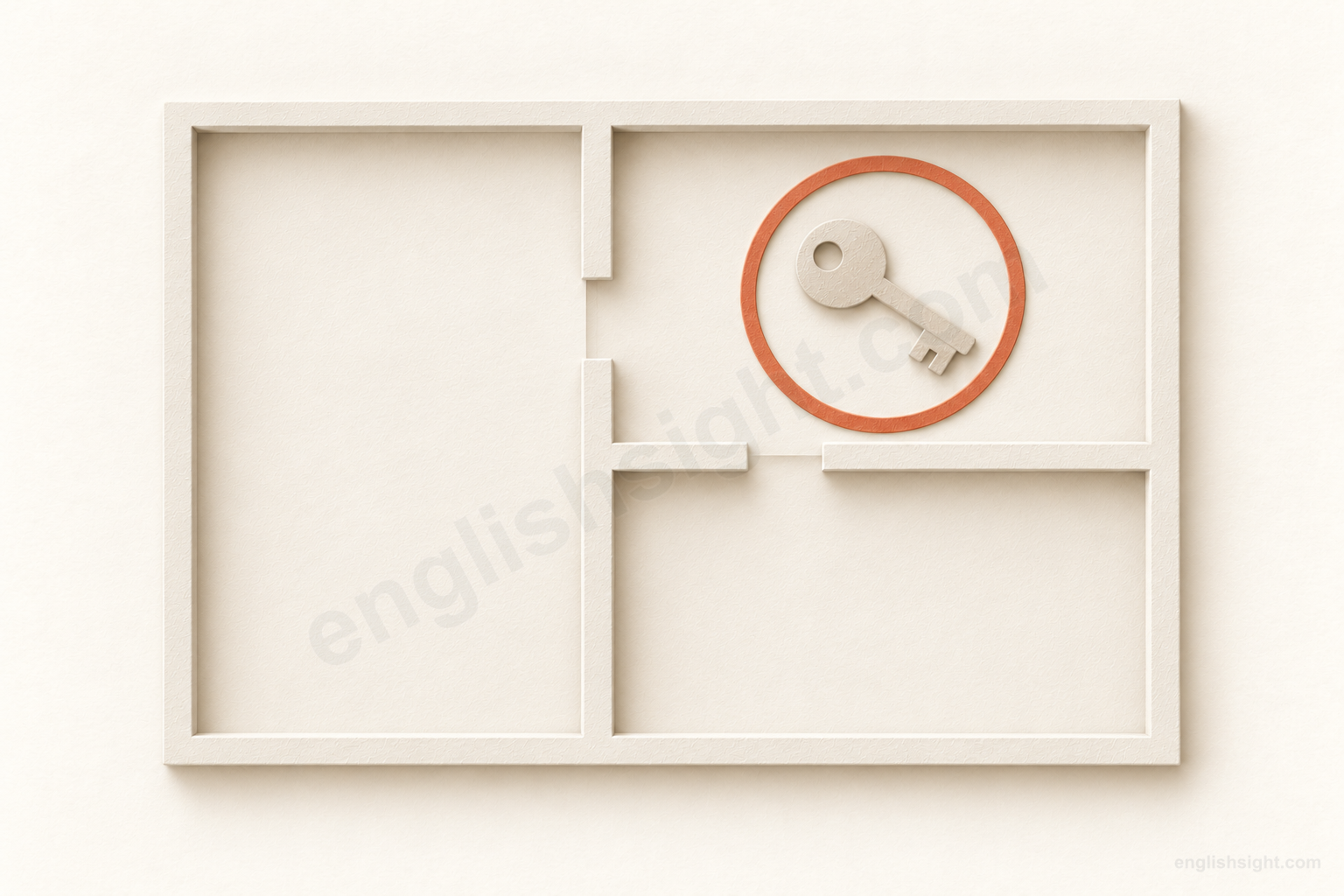
Use where to ask for a location and connect events, situations, and ideas to one.
Identify the relevant location
Identify the relevant location
The key's location is the information to identify.
where
The orange ring marks the key's position in the upper-right room.
Focus on the place occupied by the key, without moving it.
Where identifies the relevant location: here, the key is in the upper-right room.
Where asks for, or connects a clause to, a place or position relevant to the situation.
The location may be physical or an abstract point in a task or argument. The diagram illustrates the physical relation, not every expression.
Where helps identify a place: Where is the key? It can also connect a description with a place: the drawer where I keep it. The same locating idea extends to stages, circumstances, and viewpoints.
This lesson uses a location diagram as a teaching model. Fixed expressions need their own explanations; a map cannot predict all their meanings.
01
Ask for a place
Find a location, destination, or source. Direct questions and questions inside other sentences use different word order.
01
where + be + subject?; where + do/does/did + subject + base verb?
Where is…? / Where do…?
ask about location
Situation
You cannot find the spare key.
What the expression achieves
Someone identifies its location.
Where asks for a place; the answer supplies it.
Where is the spare key? can be answered with a short location such as In the top drawer. Where do you keep it? asks about a usual location. Use be before the subject, or do/does/did before the subject and base verb.
Where exactly…? asks for a more precise location. Where else…? asks for another place. Where? alone can ask someone to supply or repeat a location already under discussion.
In a sentence
Where do you keep the spare key?
Watch the difference Say Where does she live?, not Where does she lives?. Where is she? normally needs no final at.
02
where + movement question?; where to?
Where are you going?
ask about a destination
Situation
A friend is leaving.
What the expression achieves
You learn the intended destination.
The verb of movement makes the requested place a destination.
With go, travel, or take, where can ask about the end of a journey. It is the movement verb that supplies travel; where itself does not mean walk or arrive.
Where are you going? is neutral without to. Where to? is a natural short question, for example from a driver. A final to also occurs in conversation; it is not required in the full question.
In a sentence
Where are you taking these boxes?
Watch the difference Do not translate a destination as how: How are you going? normally asks about the method of travel.
03
where + be + person + from?; where + … + come from?
Where are you from? / Where does it come from?
ask about origin or source
Situation
You hear an unfamiliar sound.
What the expression achieves
You identify its source.
From marks the starting place or source.
Where are you from? asks about someone’s background or home place; the context determines how broad an answer is useful. Where have you come from? can instead ask about the place just visited.
A source need not be a country: Where did that information come from? asks for its source. In formal wording, From where did the sound come? is possible, but the final from is ordinary in conversation.
In a sentence
Where is that buzzing sound coming from?
Watch the difference Keep from when it is needed to identify the source: Where is she? and Where is she from? ask different questions.
Compare Where is the station? with Do you know where the station is? The outer question has question order; the clause after where does not invert its subject and verb.
The same clause order follows know, wonder, ask, and tell, or expressions such as not sure: I’m not sure where she works. Do not carry question-only do/does/did into the embedded clause.
In a sentence
Could you tell me where the station is?
Watch the difference Avoid Could you tell me where is the station? Use where the station is.
05
know / decide / show someone + where to + base verb
where to go / where to start
identify a place or starting point for an action
Situation
You must choose a place for a picture.
What the expression achieves
You ask for guidance about placement.
Where to + verb leaves the actor understood from context.
I don’t know where to put this picture means I don’t know where I should put it. After to, use the base verb. The person doing the action is supplied by the surrounding sentence or situation.
Where to start can refer to the first step in a task, not a location: With so many repairs, I don’t know where to start. Where should I start? is a full direct question; where to start is a shorter embedded construction.
In a sentence
Can you show me where to put this picture?
Watch the difference Say where to put it, not where to putting it. Do not add an explicit subject after where to.
06
where on earth + question?
Where on earth…?
emphasize surprise, frustration, or puzzlement
Situation
You have searched for your glasses.
What the expression achieves
You express strong puzzlement about their location.
On earth adds emotional emphasis to a location question.
Where on earth…? still asks where, but the speaker sounds surprised, annoyed, or unable to imagine the answer. Tone and context determine the emotion.
Where in the world…? is a similar emphatic question. Use a plain Where…? when you want a neutral request; strong emphasis can sound impatient.
In a sentence
Where on earth did I leave my glasses?
Watch the difference On earth here does not contrast Earth with another planet.
02
Connect an event to a place or case
A where-clause can describe a place, supply the place itself, or set the circumstances in which something applies.
07
place noun + where + subject + verb; named place, where + clause
the place where…
describe a place through what happens there
Situation
You are identifying a café.
What the expression achieves
The meeting there identifies which café you mean.
Where relates an event to the place noun before it.
The café where we met means the café at which we met. Where supplies the location relation inside the clause; do not add a second there for the same role.
Compare the café which we recommended: recommended takes the café as its object, so which fits. We met at the café, so where fits. A comma can add information about an already identified place: We stayed in York, where my aunt lives.
In a sentence
The café where we met has closed.
Watch the difference Avoid the café where we met there. Where cannot replace which whenever a noun happens to name a place.
08
stay / put / go + where-clause; this / that is where + clause
Stay where you are. / This is where…
supply a place without a preceding place noun
Situation
Someone is waiting at a suitable spot.
What the expression achieves
You ask them to remain at that spot.
The whole where-clause can supply the place itself.
Stay where you are means remain in your current place. There is no missing place noun that must be added before where. Put it where I can reach it specifies a suitable location through a condition.
This is where we leave our bikes identifies a place. Go where you like permits a choice of destination; in that context where has an any-place sense close to wherever.
In a sentence
Leave the parcel where I can see it.
Watch the difference Use a full clause after where here: where I can see it. Where the door alone is not that clause.
09
from / near + where + subject + verb
from where / near where
relate one place to a place described by a clause
Situation
You compare a bus stop with your workplace.
What the expression achieves
You describe their relative locations.
A preposition can take a whole where-clause as its complement.
From where we sat describes the viewpoint or starting position. Near where I work describes a nearby location. In each case the clause supplies the place, while the preceding preposition supplies a separate relation.
Compare Where do you work? with I live near where you work. The second does not ask a question, and the clause keeps ordinary subject–verb order.
In a sentence
The bus stops near where I work.
Watch the difference Do not insert a second where or question inversion: near where I work, not near where do I work.
10
where + clause; where necessary / possible / appropriate
Where necessary, … / where there is…
state the cases or circumstances in which something applies
Situation
Some parts of a document need examples.
What the expression achieves
You add examples in the cases that need them.
The place relation extends to a relevant case or circumstance.
Where necessary, add an example means add one in the cases in which it is necessary. Where possible and where appropriate work similarly. These shortened clauses are common in instructions and careful writing.
Use protective covers where there is a risk of damage can identify physical areas or relevant circumstances. When necessary is also possible, but emphasizes an occasion or condition rather than which case or part is involved.
In a sentence
Where necessary, add a short example.
Watch the difference Where does not replace if in every conditional sentence. For an ordinary future condition, If it rains, we’ll stay home is natural.
11
where + contrasting clause, main clause
Where others…, she…
contrast responses to comparable circumstances
Situation
Different people respond to the same difficulty.
What the expression achieves
You contrast one person’s response with the others’.
This established linking use is close to whereas.
Where others complain, she looks for a solution contrasts two reactions in the same kind of situation. It need not describe two physical locations.
Whereas is often clearer if a reader might mistake where for a place link. This contrast meaning belongs to the clause construction; it is not the meaning of a location question.
In a sentence
Where others complain, she looks for a solution.
Watch the difference Do not use this pattern as the default translation of every but. The comparison should be clear.
03
Locate a stage, issue, or position
English also treats a discussion, a process, or a viewpoint as something with positions. These uses do not require a physical map.
12
where + progress question?; stage / point / situation + where-clause
Where were we? / a stage where…
locate progress in a task or conversation
Situation
A discussion has been interrupted.
What the expression achieves
You recover the point reached before the interruption.
A process can have a position without occupying a physical place.
Where were we? can ask which point a conversation had reached. In a different context it can ask about an actual past location. Context supplies the kind of position.
We’ve reached a stage where we need advice describes circumstances at a point in a process. In which is an alternative after stage or situation, especially in formal prose.
In a sentence
Where were we before the phone rang?
Watch the difference Do not assume every where needs an address or map reference; the answer here may be a topic or step.
13
that / this is where + clause; where + … + go wrong / differ?
That’s where you’re wrong.
identify the part or respect in which something is true
Situation
Someone’s explanation contains one faulty step.
What the expression achieves
You identify that specific point of disagreement.
Where can pick out an aspect rather than a physical site.
That’s where you’re wrong points to the relevant part of an argument. Where did I go wrong? asks which step or choice caused a problem.
This is where the two plans differ locates a difference in their features. Where focuses on the point of difference; why asks for its reason. The words answer different questions.
In a sentence
You assumed the shop was open; that’s where you went wrong.
Watch the difference Where did it go wrong? asks about a point in the process; Why did it go wrong? asks for an explanation.
14
where + do/does + person + stand + on + topic?
Where do you stand on…?
ask about someone’s opinion or position
Situation
A group is discussing a proposal.
What the expression achieves
You ask which view another person holds.
Stand and the topic phrase turn position into a viewpoint.
Where do you stand on the proposal? asks what you think about it, often whether you support it. It does not normally ask where you are standing physically.
I know where I stand can mean I understand my position or how I am regarded. The full context and the verb supply this social or evaluative meaning.
In a sentence
Where do you stand on the new parking rules?
Watch the difference Use on to introduce the issue in this pattern. Where do you stand? without a topic can be literal or figurative.
15
where + do/does + person + go from here?
Where do we go from here?
ask what to do next
Situation
The original plan has failed.
What the expression achieves
The group considers its next action.
A next destination becomes a next step in dealing with a situation.
After a setback, Where do we go from here? usually asks how to proceed. Go and from here together present the current circumstances as a starting point.
At a street corner the same words may ask for a route. The figurative reading comes from the situation, not from a special change in the grammar of where.
In a sentence
The first plan failed. Where do we go from here?
Watch the difference The question does not always request travel directions. Check whether the subject is a journey or a problem.
04
Learn the whole expression
Some familiar expressions add meanings such as understanding a viewpoint, embarrassment, or determination. Their full wording matters.
16
see / understand + where + person + be coming from
I see where you’re coming from.
understand the thinking behind someone’s view
Situation
A colleague explains an objection.
What the expression achieves
You acknowledge the reasoning behind it.
The source is someone’s thinking, not their travel origin.
I see where you’re coming from acknowledges the beliefs, experience, or reasoning that led someone to say something. It is informal and can help a disagreement remain cooperative.
Understanding does not entail agreement: I see where you’re coming from, but I still prefer the earlier plan. Learn the whole expression rather than translating coming from only as travel.
In a sentence
I see where you’re coming from, but we still need a deadline.
Watch the difference Where are you from? normally asks about background or origin. It is not this acknowledgment of a viewpoint.
17
where + person + be + at; where … at on + topic
where someone is at
someone’s current situation, condition, or thinking
Situation
A coach checks a player’s recovery.
What the expression achieves
The coach assesses the player’s current condition.
The informal expression describes a present position in a broader sense.
Where she is at physically concerns her current physical condition. In a discussion, Where are you at on this proposal? can ask about someone’s current thinking.
This informal expression is established. In formal writing you can say her current condition or her current position on the proposal. It is useful to distinguish this figurative phrase from a plain location question, Where is she?
In a sentence
We need to understand where she is at physically before the next match.
Watch the difference Do not treat every final at as obligatory. Where is the key? is the neutral question about a physical location.
18
place / activity + be + where it’s at
where it’s at
a fashionable or popular place or activity
Situation
A new venue attracts crowds.
What the expression achieves
Someone calls it the place to be.
The whole informal expression evaluates popularity.
Where it’s at can describe the popular place, scene, or activity that people want to join. The pronoun it is part of the expression; the phrase does more than identify a location.
Compare where the concert is, which simply identifies its venue. Where it’s at adds an enthusiastic judgment and may sound like a slogan.
In a sentence
For live music this summer, the riverside club is where it’s at.
Watch the difference Popularity is the point here, not merely knowing where an object has been put.
19
no matter where + subject + verb, main clause
no matter where…
say that changing the place does not change the main statement
Situation
A friend may move to a different country.
What the expression achieves
Your promise of support stays the same.
No matter makes the choice of place irrelevant to the promise.
No matter where you live, I’ll keep in touch means the promise holds for any place you live. Wherever you live, I’ll keep in touch is an alternative.
No matter where does not ask a question: use you live, not do you live. Elsewhere, I don’t know where you live expresses missing information, not a promise that applies to all places.
In a sentence
No matter where you live, I’ll keep in touch.
Watch the difference To make regardless of place explicit, use no matter where or wherever. A bare where-clause can identify a particular place or, in some contexts, permit any place; context matters.
20
not know where to look
not know where to look
feel too embarrassed to know how to react
Situation
Someone makes an awkward public comment.
What the expression achieves
You feel embarrassed and unsure how to respond.
This fixed expression describes embarrassment, not a lost object.
I didn’t know where to look can describe intense embarrassment during an uncomfortable moment. The speaker is not literally asking for directions for their eyes.
The same words can be literal in another context: I couldn’t find the leak and didn’t know where to look. The awkward social setting selects the idiomatic reading.
In a sentence
When he read my private message aloud, I didn’t know where to look.
Watch the difference Do not confuse this with not know where to start, which usually expresses difficulty choosing a first step.
21
where there is + noun, there is + noun
Where there’s a will, there’s a way.
encourage determination in the face of difficulty
Situation
A difficult task seems impossible.
What the expression achieves
Someone encourages persistence and ingenuity.
Here where introduces a situation, while the proverb supplies the encouragement.
This saying encourages the belief that determination can help you find a method. Will is a noun meaning determination here, not the future auxiliary.
The saying is motivational, not a guarantee that every obstacle can be overcome. It should not be used to dismiss someone’s real constraints.
In a sentence
We’ll have to build our own equipment—where there’s a will, there’s a way.
Watch the difference Learn the whole proverb. Where alone does not mean determination or success.
Keep the relation and the grammar separate
One form, several grammatical jobs
Dictionaries label where as an adverb, conjunction, or relative word in different constructions. It does not inflect for tense or number. Tense, agreement, negation, and passive voice belong to the surrounding verbs; where has no causative or separable particle-verb family.
Where, which, and when
Use where for a location relation, which for a thing’s role such as an object, and when for a time relation. Compare the room where we slept, the room which we painted, and the night when we arrived. Abstract stage or situation can also take where.
At, to, and from
Where is it? and Where are you going? work without final at or to. Informal and regional speech may retain these prepositions; avoid treating them as mandatory or universally wrong. From adds source information and is fully standard in Where is it from?. Fixed where it’s at has its own meaning.
Small noun use and boundaries
In the when and where of the meeting, where functions as a noun meaning location; it is a compact way to discuss arrangements, not the normal way to ask a location question. The course does not teach archaic where meaning here or there, or treat the separate words wherever, whereabouts, and whereas as interchangeable spellings.
Choose the right location relation
Read the situation and decide what where contributes.
1. You politely ask for the station’s location. Which sentence uses standard embedded-question order?
2. You mean the café that was the location of your meeting. Which wording fits?
3. You want to know the source of some music, rather than its destination. Which question fits?
4. During a disagreement, someone says I see where you’re coming from. What do they normally mean?
5. A meeting is interrupted. The chair then asks Where were we? What answer fits the conversational meaning?
6. A document says Where necessary, add an example. What should you do?
Sources and teaching notes
Publisher entries were consulted for meanings and usage. Explanations and examples are original; the visual model is a teaching interpretation.
The location diagram is a teaching aid, not a claim about a picture shared by every native speaker.