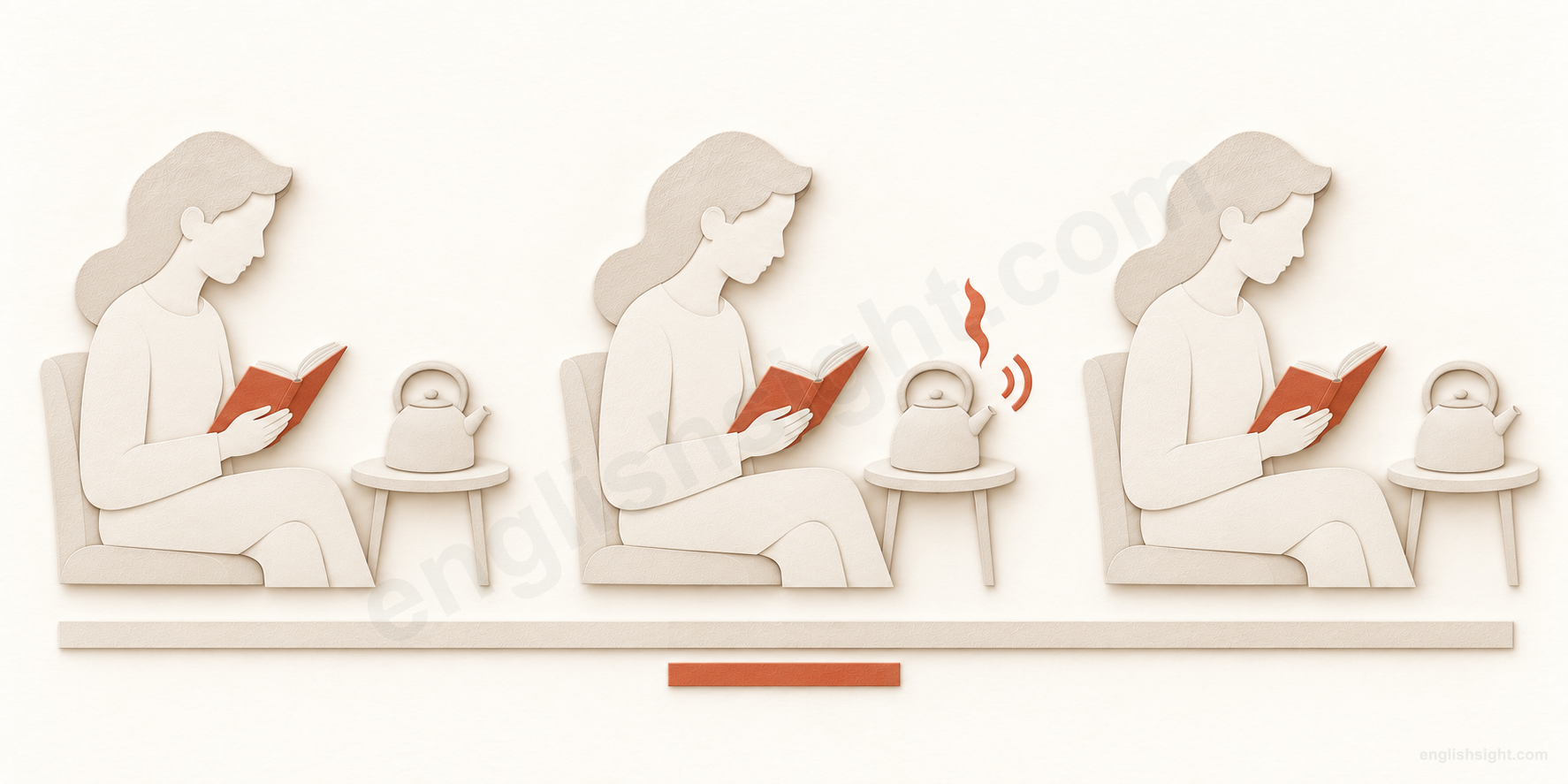
Use while for shared time, contrasting facts, and familiar expressions built around a period.
Put an event inside a time frame
Put an event inside a time frame
Reading is already in progress.
while
The whistle stops; reading continues.
The kettle briefly whistles while the reader keeps reading.
The brief whistle falls within the longer reading period.
While can locate an event within the time that another activity or state is in progress.
The same-time relation does not imply cause, equal duration, or identical start and finish. Contrast and concession are separate uses explained below.
While can connect an event to a surrounding interval: the kettle clicks off while you are reading. As a noun, a while names an unspecified stretch of time. These uses make time a helpful starting point.
While also introduces contrast or concession. Those uses connect facts in an argument and do not require a shared time. Established expressions add their own meanings, so one time picture cannot predict every use.
The diagram is a teaching model for the time relation, not a claim about a picture shared by every English speaker.
01
Actions within the same time
A while-clause supplies a time frame. Check whether the main event lasts alongside it, happens somewhere inside it, or uses a temporary opportunity.
01
main clause + while + subject + verb
while I was cooking
during another activity
Starting situation
Cooking is in progress.
What the expression adds
A second activity occupies some of the same time.
The two activities overlap; neither is said to cause the other.
While introduces a clause with its own subject and verb. In this example I cook and Lena sets the table during the cooking period. The people can be different; they need not start or finish together.
Continuous forms make ongoing activity explicit. They come from the verbs, not from a rule that while always requires -ing. In I cook while Lena sets the table, simple forms can describe a usual arrangement.
Original example
Lena was setting the table while I was cooking.
Watch the difference Do not read while as after: the actions overlap rather than form a sequence.
02
event + while + subject + state / ongoing activity
while we were away
at some point during a longer situation
Starting situation
We are away for several days.
What the expression adds
A delivery arrives during that absence.
The main event can be brief inside a longer time frame.
While does not make both clauses equally long. A parcel can arrive once during a week-long absence. The while-clause gives the surrounding situation, not the exact moment of arrival.
When is often possible here too. For a single moment that sets the time of another event, when is usually clearer: I was asleep when the alarm rang. While the alarm was ringing instead treats the ringing as an ongoing interval.
Original example
A parcel arrived while we were away.
Watch the difference Do not assume that while means throughout every second of the other event.
03
future main clause + while + present-tense clause
while you are here
during a present or future state
Starting situation
You plan to visit tomorrow.
What the expression adds
We plan a task within your visit.
A state can supply the interval without a continuous verb.
Be here is a state lasting for a period. While also works with states such as while you are young or while the shop is open; it does not require visible movement.
For an ordinary future time clause use a present form: I’ll show you while you are here tomorrow. The main clause can contain will, but the time clause normally does not use will simply to mark future time.
Original example
I’ll show you the new office while you are here tomorrow.
Watch the difference Use while you are here for this future time frame, rather than while you will be here.
04
while + -ing; while + adjective / prepositional phrase
while waiting / while in town
shorten a time clause when the subject is clear
Starting situation
I am waiting for the train.
What the expression adds
I read messages during the wait.
The understood subject of waiting is also the subject of the main clause.
While waiting means while I was waiting in this example. In the usual reduced construction, the omitted subject is the main-clause subject. If someone else is waiting, name that person in a full clause.
Other reductions omit a clear form of be: While in town, I visited the museum means while I was in town. An adjective also works: While still young, she moved abroad. Keep the full clause if shortening would leave the reader guessing who is involved.
Original example
While waiting for the train, I read my messages.
Watch the difference Avoid While waiting for the train, my phone rang if you mean that you, rather than your phone, were waiting.
05
request / suggestion + while + person + be + at it
while you’re at it
add a related task to something already being done
Starting situation
Someone is already cleaning the table.
What the expression adds
You ask them to wipe the chairs as well.
At it refers back to an activity; while places the extra task in that opportunity.
This informal expression asks for or suggests an additional related action. In Could you wipe the chairs while you’re at it?, it points to the task already mentioned.
The extra action need not happen literally at the exact same second. It is a convenient addition to the same job. While we’re on the subject similarly uses the current topic as an opportunity to add a related point.
Original example
You’re cleaning the table; could you wipe the chairs while you’re at it?
Watch the difference At it needs a recoverable activity. It is not a general replacement for at that place.
06
action + while + subject + can; while the going / getting is good
while you can / while the going is good
act during a limited opportunity
Starting situation
A favorable situation still exists.
What the expression adds
You act before it changes.
The time frame also limits when an action remains possible.
Buy the tickets while you can means buy during the remaining period of availability. The urgency comes from can and the situation: while alone does not mean hurry.
While the going is good is an established expression for doing something before conditions worsen or the opportunity disappears. While the getting is good is a North American variant. In Let’s leave while the going is good, leaving now is presented as wiser than waiting.
Original example
Let’s book the cheap tickets while we can.
Watch the difference This is a current window of opportunity, not a promise that conditions will remain favorable.
02
Contrasting facts and conceding a point
Here while links ideas. The facts need not occur at the same time; read the intended comparison rather than forcing a time-line interpretation.
07
clause A + while + contrasting clause B
while others prefer…
set two facts or preferences in contrast
Starting situation
Two groups have different preferences.
What the expression adds
You present that difference in one sentence.
While can mean whereas without making a claim about timing.
The example compares different preferences. It does not report what the groups are doing at one particular moment. Whereas makes this contrast especially explicit.
Compare I work while she sleeps, which can report simultaneous activity or contrast our routines depending on context. If the time reading would confuse the point, use whereas or two clear sentences.
While can also link parallel points rather than opposites: The guide gives beginners clear instructions, while experienced cooks can use it for fresh ideas. Both groups benefit. The context determines whether the connection emphasizes difference, parallel facts, or shared time.
Original example
Some guests prefer tea, while others prefer coffee.
Watch the difference Do not force during the time that into a sentence whose purpose is comparison.
08
while + conceded clause, main clause
While I agree, …
acknowledge one point before qualifying it
Starting situation
You accept part of an argument.
What the expression adds
You state a reservation that still matters.
The first clause concedes something; the main clause carries the qualification.
While means although here. The speaker accepts that the plan is useful, then explains why that does not settle the decision. The clauses are related by reasoning, not by duration.
A sentence-initial while-clause is followed by a comma in this pattern. Write While the plan is useful, it costs too much. Adding but before it is unnecessary in this standard construction.
Original example
While the plan is useful, it costs more than we can afford.
Watch the difference This does not mean that the plan costs too much only during the time it is useful.
03
A while: duration, delay, and distance in time
The noun names an unspecified period. For, in, after, and ago tell you how that period relates to the event.
09
verb + (for) a while; a short / little / long while
for a while
continue for an unspecified period
Starting situation
You start resting.
What the expression adds
The rest lasts for some time.
For measures duration; a while leaves the length unspecified.
A while is a noun phrase, with a as its article. For a while answers how long, not when. Stay a while is also possible without for.
A little while and a short while make the period sound brief. A long while and quite a while can be substantial. A while therefore does not always mean a few minutes; context supplies the scale.
Original example
We rested for a while before continuing the walk.
Watch the difference A while is not a fixed unit of time. Use a number of minutes when the duration matters.
10
something takes a while; it takes + person + a while + to-infinitive
take a while
require some time to finish or happen
Starting situation
The file upload has just started.
What the expression adds
Completion will not be immediate.
Take supplies the idea of time required; while supplies an imprecise duration.
This will take a while describes the duration a task needs. It often prepares someone to be patient. It took me a while to learn the route adds the person involved and the task.
Compare I waited for a while: that measures the waiting itself. It took a while to get a reply measures the delay before the reply, whether or not anyone waited actively.
Original example
Uploading these photos may take a while.
Watch the difference Say It took me a while to understand, not It took me a while for understand.
11
future event + in a (little) while
in a while
after some time from now
Starting situation
The speaker is not ready yet.
What the expression adds
They expect to be ready later.
In places an event after an interval measured from now.
I’ll call in a while promises a call later, after some time has passed. In a little while usually suggests a shorter wait. No exact deadline is supplied.
Compare I’ll talk for a while, which describes the length of the conversation. In and for contribute different relationships to the same noun phrase.
Original example
I’ll call you in a little while.
Watch the difference In a while does not mean for the whole duration of the call.
12
after a while, clause; a while later, clause
after a while
later than an earlier point in a story
Starting situation
At first the room is quiet.
What the expression adds
Some time passes before people start talking.
After locates a later development relative to an earlier situation.
After a while advances a story by an unspecified interval. The reference point usually comes from the narrative, so it need not be the present moment.
In We waited for a while, then left, for measures the wait. After a while, we left instead places the departure later. A while later is another useful way to move the story forward.
Original example
After a while, the guests began talking to each other.
Watch the difference Do not read after a while as all through the period; it points beyond that interval.
13
past-tense event + a while ago / back
a while ago / a while back
some time before now
Starting situation
An event happened before the present.
What the expression adds
You give a rough distance back to it.
Ago measures back from now rather than the duration of the event.
A while ago places an event in the past. A little while ago makes it sound relatively recent; a long while ago places it further back. A while back is a familiar alternative.
I sent it a while ago tells when I sent it, not how long sending took. In a past narrative, a while earlier can measure back from the earlier reference point instead of from now.
Original example
I sent the invitation a while ago.
Watch the difference Use two words before ago or back in careful standard writing: a while ago.
14
have not + past participle + in / for a while; first time in a while
not … in a while
no occurrence during a recent period
Starting situation
You last saw your neighbor some time ago.
What the expression adds
There have been no meetings since then.
Negation changes the reading of in from a future delay to a period without the event.
I haven’t seen her in a while looks back over a recent gap. I haven’t seen her for a while also works. Neither sentence schedules a future meeting.
The related This is the first time in a while that I’ve cooked describes a return after a gap. The meaning comes from in with negation or first, plus the period named by a while.
Original example
I haven’t seen our neighbor in a while.
Watch the difference Contrast I’ll see her in a while: with a future event, in points forward instead.
15
verb + awhile / a while; preposition + a while
wait awhile / wait a while
recognize the adverb and the noun phrase
Starting situation
You need a way to describe a brief wait.
What the expression adds
You choose a spelling that fits the construction.
Awhile is one adverb; a while is an article plus a noun.
Wait awhile and wait a while can both describe waiting for some time. The single word awhile can be understood as for a while; the two-word noun phrase also works as a duration expression.
For careful edited writing, use two words after a preposition: for a while, in a while, after a while. Also write a while ago and a while back. Real usage varies, so this is a useful writing convention rather than a claim that readers never encounter other spellings.
Original example
Please wait a while; I’m looking for the address.
Watch the difference Do not replace conjunction while with awhile: while I wait introduces a clause.
04
Frequency, continuing situations, and useful time
These established expressions describe occasional events, continuing facts, worthwhile effort, and ways of passing time. Learn what each complete expression contributes.
16
clause + (every) once in a while
(every) once in a while
occasionally
Starting situation
A walk by the river is not your daily routine.
What the expression adds
You do it on some occasions.
The whole expression describes frequency rather than the length of one event.
Once in a while means occasionally; it does not specify a regular timetable. Every once in a while has the same general meaning; every does not turn it into a daily habit.
Compare We walk for a while, which describes one walk’s duration. We walk once in a while describes how often walking happens. A walk can be long or short in either case.
Original example
We walk by the river once in a while.
Watch the difference Do not interpret once as only one time ever in this fixed expression.
17
clause + all the while; all the while, clause
all the while
throughout the time just described
Starting situation
You search several rooms for your keys.
What the expression adds
The keys remain in your pocket throughout the search.
All makes the time span continuous, often revealing a surprising background fact.
All the while refers to the whole relevant interval. It can follow a clause or come at the start: All the while, the keys were in my pocket.
The expression often introduces something the person did not notice, but surprise is not required. She kept humming all the while simply says the humming continued during the activity.
Original example
I searched the house, but the keys were in my pocket all the while.
Watch the difference A while means some period; all the while means throughout the period already in view.
18
it is worth + possessive + while + to-infinitive
worth your while
beneficial enough to justify the time or effort
Starting situation
You consider spending time checking some information.
What the expression adds
The likely benefit makes that effort sensible.
While refers to someone’s time and effort, not just a short wait.
It’s worth your while to check means checking offers enough value for you. The benefit may be learning, avoiding a mistake, enjoyment, or money; payment is not required.
The possessive identifies the person who benefits: my while, your while, their while. Worthwhile is a related one-word adjective, as in a worthwhile visit, but worth your while is a separate phrase.
Original example
It’s worth your while to compare the two prices.
Watch the difference Keep worth in the phrase: it is worth your while, not it is your while.
19
make + it + worth + possessive + while
make it worth someone’s while
offer a sufficient reward for doing something
Starting situation
You ask someone to work on a day off.
What the expression adds
You offer extra pay to make accepting attractive.
Make adds an inducement; the reward makes the time or effort worthwhile.
We’ll make it worth your while often promises a reward, commonly payment, for doing a requested job. It can sound like bargaining rather than simply praising the task.
Compare It’s worth your while to attend, which says attending is useful without necessarily offering payment. The make construction presents someone as arranging the benefit.
Original example
If you can work on Saturday, we’ll make it worth your while with extra pay.
Watch the difference The phrase alone may leave the reward vague; specify it when the agreement needs to be clear.
20
while away + time expression; while + time expression / pronoun + away
while away the time
pass time pleasantly or idly
Starting situation
You have time to fill before something else happens.
What the expression adds
You fill it with a relaxed activity.
While is a verb here; away belongs to an established particle-verb expression.
While away the time suggests letting time pass in a pleasant, unhurried way. The object is a period such as the afternoon, an hour, or the time; the activity can follow in an -ing phrase.
Both while away the afternoon and while the afternoon away are possible. A pronoun goes between the verb and particle: We had an hour, so we whiled it away with a puzzle. Forms are while, whiles, whiled, whiling.
This is not the conjunction in while we waited. Away helps form the conventional meaning of passing time; it does not describe physically moving the time somewhere.
Original example
We whiled away the afternoon doing a jigsaw puzzle.
Watch the difference Use the verb spelling whiled / whiling; do not confuse it with wild or wield.
21
strike while the iron is hot; make hay while the sun shines
strike while the iron is hot
use a favorable opportunity promptly
Starting situation
A customer shows interest in your idea.
What the expression adds
You suggest acting before that interest fades.
The saying supplies the figurative advice; while still identifies the favorable interval.
Strike while the iron is hot means act promptly when the opportunity is favorable. The literal picture involves working heated metal; the customer need not be angry or physically hot.
Make hay while the sun shines similarly advises using good conditions while they last. The first saying stresses timely action; the second stresses taking advantage of a favorable period. Both are established sayings, not meanings that while creates by itself.
Original example
The customer likes the idea, so let’s strike while the iron is hot and send a proposal today.
Watch the difference Do not translate only iron or hay and miss the whole saying’s advice about opportunity.
Read the construction before choosing the meaning
While, when, during, and until
For time, while normally introduces a clause or a clear reduction: while I work, while working. During takes a noun phrase: during the meeting. When can locate a single moment as well as a longer period. Until marks an endpoint: wait until noon. These words are not interchangeable in every sentence.
Clause order and punctuation
A time clause can come first or last: While I cooked, Lena set the table; Lena set the table while I cooked. A leading dependent clause normally takes a comma. A time clause still needs a main clause to form a complete ordinary sentence.
Whilst and word forms
While is pronounced /waɪl/. Whilst /waɪlst/ is a conjunction variant, especially in formal British English; it does not replace the noun in for a while or the verb in while away. The conjunction has no tense or passive form. The verb in while away can inflect, take progressive forms, and take a time object; there is no need to invent a larger family of everyday while phrasal verbs.
Scope of this lesson
This selection covers modern time, comparison, and concession uses, common noun phrases, and selected established expressions. Dialectal while meaning until and literary expressions such as between whiles are outside the active lesson. The examples are modern English and are not restricted to the historical Basic English 850-word list.
Choose the relation
Check time, grammar, and the whole expression.
1. A parcel arrived once during your week away. What does while we were away tell us?
2. Some guests prefer tea, while others prefer coffee. What is while doing here?
3. While the plan is useful, it costs too much. Which reading fits?
4. You promise to call later, after a short wait. Which expression fits?
5. You plan to show the office to a visitor tomorrow. Choose the ordinary future time clause.
6. Who is waiting in While waiting for the train, I read my messages?
7. You go to the river occasionally. Which expression describes that frequency?
8. You had an hour to fill pleasantly. Which sentence uses the pronoun in the usual position?
Sources and teaching notes
The linked dictionary and grammar pages support the usage inventory. Explanations and examples were written for this lesson; the diagram is a limited teaching model.
The diagram illustrates a time relation; it does not claim that every native speaker imagines the same picture.