Explore the flexible tool, sudden actions, cooking, and established expressions.
A sharp movement carries through
A sharp movement carries through
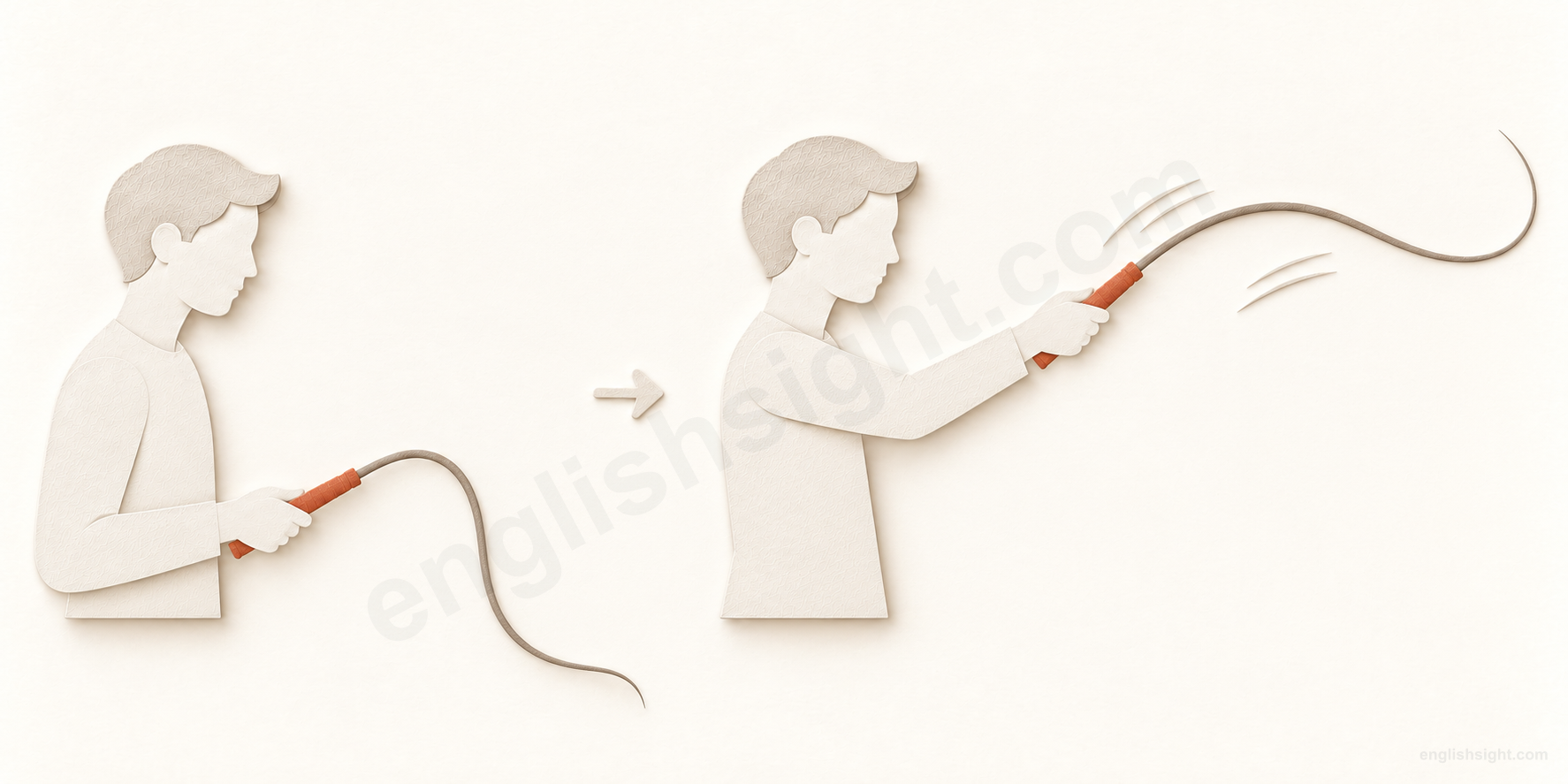
The flexible lash hangs from a low-held handle.
whip
The lash sweeps out toward the upper right.
The person sweeps the handle sharply upward and outward.
A sharp sweep sends the flexible lash moving. This memory link does not predict every cooking, political, or idiomatic use.
A quick sweep of a handle sends its flexible lash moving sharply. Several verb uses similarly highlight sudden movement or vigorous action.
Use this as a memory link. Whip up a meal, party whip, and fixed idioms have conventional meanings that the physical sketch cannot fully predict.
Whip can name a tool or present an action as sharp, fast, or forceful. A direction tells you where something moves; an object or result can shift the meaning toward food, feelings, performance, or politics.
The moving lash gives us a useful teaching connection, not a rule that produces every meaning. Political terms and idioms need to be learned in their own settings. No single picture is shared by all English speakers.
01
The tool, a blow, and a lashing movement
Start with the flexible tool and the sharp action. Weather descriptions can use the verb even when nobody holds a whip.
01
a / the + whip; crack + a whip
a whip; crack a whip
a handle with a long flexible striking part
Starting situation
You look at an old riding tool in a display.
Action or interpretation
You identify the handle and the flexible lash.
The countable noun names the tool, not every long rope.
A whip has a handle and a flexible length that can be swung to strike. A museum label might say a leather whip; several such tools are whips.
Crack a whip can literally mean make it produce a sudden sharp sound. A crack does not by itself tell you that the lash touched someone. The idiom crack the whip has a separate use below.
In a sentence
The guide showed us a whip with a wooden handle.
Watch the difference Keep the noun and the verb separate: a whip names an object; to whip describes an action.
02
whip + person / animal; be whipped
whip a person or an animal
strike with a whip or similar flexible object
Starting situation
A historical account describes a prisoner’s punishment.
Action or interpretation
The account reports that the prisoner was struck with a whip.
The direct object is the recipient of the blows.
In this literal use, whip takes the person or animal receiving the blows as its object. It can describe punishment or an attempt to make an animal move faster.
The passive keeps the same event but puts the recipient first: The prisoner was whipped. This is a report of violence; a whip is not a necessary part of the quick-movement or cooking uses.
In a sentence
The account says that the prisoner was whipped.
Watch the difference Whip is more specific than the general verb hit in this literal use.
The scarf lashes around rather than hanging still.
The moving thing can be the subject; the thing struck can be an object.
The scarf whipped in the wind describes the scarf moving sharply, often back and forth. The wind whipped the scarf around names the force as subject and the scarf as object.
Rain whipped our faces describes sharp impacts, not someone using a tool. Compare Rain fell on our faces, which does not highlight the force. These vivid descriptions are especially useful in narrative writing.
In a sentence
Her scarf whipped around in the gusts.
Watch the difference There is no direct object in Her scarf whipped around; do not assume every use means someone hits someone else.
02
Take, turn, or get through something quickly
The direction or particle tells you where something goes; whip adds a sudden, energetic quality to the action.
04
whip + object + out / off / away; whip out / off / away + noun
whip out / off / away
take or remove something with a quick sudden movement
Starting situation
A phone is inside her pocket.
Action or interpretation
She pulls it out in one quick action.
Whip supplies the manner; out, off, or away specifies the change of position.
Whip out a phone means produce it quickly, usually from a pocket or bag. Whip off a jacket means remove it quickly; whip a plate away means take it away abruptly.
With a noun, both whip out the phone and whip the phone out are possible. Put an unstressed object pronoun between verb and particle: whip it out, whip it off, whip it away. Out of her pocket adds the starting place.
In a sentence
She whipped her phone out of her pocket.
Watch the difference Say whip it out, not whip out it. Taking a coat off quickly does not mean striking it.
05
whip + direction / place phrase; whip round / around
whip past / into / round
move or turn very quickly
Starting situation
A cyclist comes toward the doorway.
Action or interpretation
The cyclist passes in a sudden rush.
The subject itself moves; an object is not required.
Whip past the gate describes quick movement past a location. Whip into a room likewise names rapid entry, with into supplying the destination. This use is more vivid and often more informal than go.
Whip round, especially in British English, or whip around can describe a sudden turn: Hearing her name, she whipped around. Compare have a whip-round, the noun for collecting money, which has a different meaning.
In a sentence
A cyclist whipped past the open door.
Watch the difference Whip is not a general replacement for go: I whip to work every day suggests an unusually quick, energetic trip.
06
whip through + task / process
whip through a task
complete or deal with something very quickly
Starting situation
You have a short list of routine questions.
Action or interpretation
You finish answering them rapidly.
Through treats the task as something you progress through.
Whip through a form, a list, or some routine work means deal with it quickly. This informal expression can suggest confidence or ease, but it does not guarantee that the work is accurate.
Through introduces what you get through: We whipped through it. It is not a movable particle here; do not copy the word order of whip it up. Whip through a doorway can instead be literal rapid movement through a place.
In a sentence
We whipped through the registration questions before lunch.
Watch the difference Say whipped through it, not whipped it through, for this meaning of completing a task quickly.
03
Beat air into food, or prepare it quickly
Whip cream describes a physical process. Whip up a meal describes speed of preparation, whatever cooking method you use.
beat a suitable liquid mixture so it becomes airy and thicker
Starting situation
Cream is still liquid in the bowl.
Action or interpretation
Beating incorporates air and changes its texture.
The object is food being beaten; a whip is not the kitchen tool you normally name.
In a recipe, whip the cream asks you to beat it rapidly, usually with a whisk or mixer. Whip the egg whites is another familiar instruction. Whisk names the tool as a noun and can name the action as a verb; whip emphasizes this vigorous beating process.
Whipped cream names the resulting food. Whipping cream is cream sold for whipping; the -ing name does not mean it is already whipped. Whip the cream until it forms soft peaks gives an endpoint, and whip it up can also describe beating it.
A fruit whip is a dessert made with an airy beaten mixture, such as cream or egg whites. That food noun is a separate established use; it does not mean a fruit-shaped striking tool.
In a sentence
Whip the chilled cream until it forms soft peaks.
Watch the difference Whip up lunch need not involve beating ingredients; whip cream specifies a cooking action.
08
whip up + something; whip + something + up
whip up a meal
make something quickly, especially food
Starting situation
Friends arrive and there is no meal ready.
Action or interpretation
You quickly prepare something for them to eat.
Speed of preparation matters; the method may involve no whisk at all.
Whip up a snack is an informal way to say prepare it quickly, often with an impression of ease. I can whip something up offers to make food without much delay.
You may also encounter whip up a sketch or a quick plan, extending the idea to producing something rapidly. In American informal usage, whip off a note or a song can mean write it hurriedly. That is distinct from whipping a coat off your body.
Up is a particle in this expression: whip up a meal or whip a meal up; with a pronoun, whip it up. For a neutral description without emphasis on speed, use make or prepare.
In a sentence
I can whip up a vegetable omelette while you set the table.
Watch the difference Whip up does not mean heat up: reheating existing food and quickly preparing food are different actions.
04
Stir things up and push toward a result
Read the object and the result carefully: dust, feelings, fitness, and a sporting defeat call for different interpretations.
09
whip up + emotion / people; whip + people + up
whip up enthusiasm / anger / a crowd
rouse people or encourage a strong feeling
Starting situation
People show little enthusiasm about a project.
Action or interpretation
A speaker tries to make them strongly interested.
The object can name the feeling or the people feeling it.
Whip up enthusiasm names the feeling being encouraged; whip up a crowd names the people being excited. The phrase often suggests active efforts to increase emotional intensity.
It can concern positive support or destructive hostility. The surrounding words decide: whip up support is different from whip up hatred. With a pronoun use whip them up, not whip up them.
In a sentence
The host tried to whip up enthusiasm for the charity race.
Watch the difference Tried to whip up reports an attempt without guaranteeing success. By contrast, His speech whipped up the crowd normally presents the arousal as having occurred.
10
wind / storm + whip up + dust / waves
whip up dust / waves
make loose material rise or water become rough
Starting situation
Dust lies on the dry road.
Action or interpretation
A gust lifts it into the air.
The subject is a physical force and the object is what it disturbs.
The wind whipped up dust describes material being lifted and stirred. A storm can whip up waves: water is agitated rather than literally carried above everything else.
Up contributes the sense of rising or increased activity. This physical meaning helps connect the expression with emotional agitation, but dust and public anger remain different objects and situations.
In a sentence
A sudden gust whipped up dust from the track.
Watch the difference Here whip up does not mean prepare a meal, and the wind is not a person using a tool.
11
whip + person / oneself + into + emotional state
whip someone into a frenzy
drive someone into an intense emotional state
Starting situation
A crowd is fairly calm.
Action or interpretation
Repeated announcements make the crowd extremely excited.
The object is affected, and into introduces the resulting state.
Whip the audience into a frenzy names a change in the audience’s emotions. Compare whip up excitement, where the object names a feeling rather than the people undergoing the change.
Whip oneself into a panic makes the same person both cause and experiencer. The construction is whip + object + into + state, not whip + person + to do. It is a vivid expression, often suggesting excessive agitation.
Up may also appear: whip the audience up into a frenzy. With a pronoun, use whip them up into a frenzy. The emotional result still comes after into.
In a sentence
The repeated countdowns whipped the audience into a frenzy.
Watch the difference Into is followed by a state such as a frenzy or a panic; it does not describe entry into a physical room here.
12
whip + person / thing + into shape; be whipped into shape
whip someone / something into shape
improve fitness, organization, or performance through determined effort
Starting situation
A team is disorganized before the season.
Action or interpretation
A coach works hard to make it ready.
Shape means a satisfactory condition, not necessarily a physical outline.
Whip a team into shape means get it working well through firm, energetic training or organization. Whip myself into shape can concern physical fitness; whip the accounts into shape can concern order and usability.
It is an idiom with a result complement. The passive is possible: The team was whipped into shape before the tournament. There is no claim that physical blows were used.
In a sentence
The new coach whipped the team into shape before the opening match.
Watch the difference Compare get into shape, which describes becoming fit or ready without naming someone who drives the improvement.
13
whip + opponent; get / be whipped
whip an opponent
defeat an opponent decisively
Starting situation
Two teams play a match.
Action or interpretation
One wins by a large margin.
The object is the losing opponent, not a recipient of literal blows.
In informal sporting talk, particularly North American English, whip a team means beat it very easily. The score or context makes the contest meaning clear.
We got whipped is an informal passive report of a heavy defeat. Whipped can therefore describe a lost match as well as beaten food or a literal punishment; read the context.
In a sentence
Our team got whipped in the final, losing by thirty points.
Watch the difference For neutral reporting, say defeated or beat. Do not assume whipped means injured in a sports result.
05
Political officials, instructions, and party status
These established institutional meanings occur in political news. The person, the voting instruction, and parliamentary party status are distinct.
14
a / the + party whip; chief whip; majority whip
a party whip; the chief whip
a party official who organizes attendance and voting
Starting situation
A party needs its legislators present for a vote.
Action or interpretation
An official contacts members and coordinates support.
A whip here is a person with a political role.
A party whip works to secure attendance and coordinated voting by the party’s legislators. Chief whip and majority whip name particular senior or institutional roles.
This noun occurs in British and American political reporting, although the institutions differ. The whips can mean several officials; it is not a reference to several physical tools.
In a sentence
The party whip contacted members before the debate.
Watch the difference A whip’s job involves party discipline; the word alone does not mean that the official makes the country’s laws single-handedly.
15
issue / impose + a three-line whip
a whip; a three-line whip
an instruction to party MPs about attendance and voting
Starting situation
Party leaders want MPs to attend a particular vote.
Action or interpretation
They issue a strongly worded voting instruction.
In this British political use, the noun refers to an instruction, not its issuer.
A whip can be a written party instruction about parliamentary business and voting. A three-line whip is a particularly strong instruction to attend and vote in the specified way.
The expression belongs to British parliamentary terminology. The number does not count officials or tools. Compare the chief whip, a person, with a three-line whip, an instruction.
In a sentence
The party issued a three-line whip for the vote.
Watch the difference This describes a party instruction, not a legal statement that every citizen must vote that way.
16
withdraw / restore + the whip; resign / lose + the whip
have the whip withdrawn; lose the whip
lose recognition as a member of a parliamentary party group
Starting situation
An MP sits as a member of a party’s parliamentary group.
Action or interpretation
The party removes that parliamentary affiliation.
The whip can refer to parliamentary party status and its associated rights and duties.
In British political news, have the whip withdrawn means lose the status of representing that party in Parliament. Resign the whip means give up that status oneself; restore the whip means give it back.
These expressions concern parliamentary party affiliation. They do not by themselves mean the MP loses a parliamentary seat or ceases to be an MP. The physical motion in the sketch cannot explain these institutional rules.
In a sentence
The MP had the whip withdrawn and continued to sit as an independent.
Watch the difference Keep parliamentary party status distinct from holding a seat; losing the whip does not automatically remove the seat.
17
whip + MPs + to-infinitive; MPs + be whipped + to-infinitive; whip the vote
be whipped to support a proposal
be instructed by one’s party how to vote
Starting situation
MPs are preparing to vote on a proposal.
Action or interpretation
Their party tells them to support it.
The passive has an MP as subject and an infinitive giving the required voting action.
Especially in British politics, whip MPs to vote a certain way means direct their votes through party discipline. MPs were whipped to support it puts the MPs first and reports the instruction.
Whip the vote uses the vote itself as object. This institutional use can create pressure, but an instruction is not proof that every MP obeyed it.
In a sentence
The MPs were whipped to support the proposal.
Watch the difference The infinitive belongs to this political use; whip someone to cook dinner is not a general everyday causative construction.
06
Control, opportunity, cleverness, and a collection
Learn these expressions as whole units. Their meanings cannot be recovered by replacing whip with hit.
18
crack the whip
crack the whip
use authority strictly to make people work harder
Starting situation
A supervisor thinks the work is moving too slowly.
Action or interpretation
The supervisor imposes strict demands and deadlines.
The idiom highlights strict control over other people’s effort.
Crack the whip can describe demanding discipline from workers or a team. It often gives a critical or forceful impression, though a speaker may use it jokingly.
Compare crack a whip in a demonstration, which can be a literal action with a tool. The idiomatic object is normally the whip, and no physical whip needs to be present.
In a sentence
With the deadline close, the supervisor started cracking the whip.
Watch the difference This is stronger than offer encouragement; it presents the person as a strict authority.
19
have / hold + the whip hand + over + someone
have / hold the whip hand
have the stronger controlling position
Starting situation
Two companies are negotiating.
Action or interpretation
One controls the only supply of a needed material.
The idiom describes an advantage in power, not a quick movement.
Have the whip hand over someone means have the power to control the situation involving that person. Hold the whip hand is another form; both occur in commentary about power and negotiations.
The phrase can suggest the leverage of someone directing others, but its established meaning concerns control. It does not identify which physical hand someone writes with.
In a sentence
The sole supplier held the whip hand in the negotiations.
Watch the difference Keep the whole expression; have a whip hand is not the normal form of this idiom.
20
give / get / have + a fair crack of the whip
a fair crack of the whip
a reasonable chance to show what one can do
Starting situation
A new player has barely had time on the field.
Action or interpretation
You ask the coach to give the player a proper chance.
The whole British informal expression means fair opportunity.
Give someone a fair crack of the whip means give them a reasonable opportunity to try or demonstrate ability. Get a fair crack of the whip presents the same opportunity from the recipient’s viewpoint.
Despite crack and whip, this is not a request to punish someone. It is also different from crack the whip, which describes strict pressure. For a widely understood neutral alternative, use a fair chance.
In a sentence
Give the new goalkeeper a fair crack of the whip before replacing her.
Watch the difference A fair chance can still end in failure; the expression does not promise equal results.
21
be + (as) smart as a whip
(as) smart as a whip
very clever or quick to understand
Starting situation
A child works out a difficult puzzle.
Action or interpretation
An adult praises the child’s intelligence.
This fixed comparison praises cleverness, not neat clothing.
Smart as a whip is a lively informal compliment about intelligence. The initial as can appear: She is as smart as a whip. The comparison is conventional, so it does not require imagining a tool that thinks.
Compare a smart jacket, where smart can concern appearance. In this expression, the intended meaning is clever.
In a sentence
My niece is smart as a whip and loves solving number puzzles.
Watch the difference Do not generalize the comparison to every meaning of smart; it does not mean painfully stinging here.
22
have / organize + a whip-round + for + purpose / person
have a whip-round
collect contributions from a group
Starting situation
Colleagues want to buy one shared present.
Action or interpretation
They each contribute money toward it.
The hyphenated noun names a collection of money.
In British informal English, have a whip-round means ask people in a group to contribute money for a shared purpose. Have a whip-round for a colleague can introduce a gift collection.
This is a countable noun: a whip-round, two whip-rounds. Compare She whipped round when she heard a noise, where round describes a quick turn and whip is a verb.
In a sentence
We had a whip-round to pay for our colleague’s farewell flowers.
Watch the difference For readers unfamiliar with British usage, a collection or collect contributions is clearer.
07
Recognize casual descriptions and slang
Whipped can describe exhaustion in casual speech. A car called a whip and a partner described as whipped have further, more restricted slang meanings.
23
be / feel + whipped
I’m whipped.
I am extremely tired.
Starting situation
You have spent the day moving heavy boxes.
Action or interpretation
You describe yourself as completely worn out.
Here whipped describes exhaustion, with no opponent or romantic partner required.
In casual American usage, I’m whipped can mean I am exhausted. The preceding activity makes that interpretation natural: a long shift, a difficult journey, or strenuous work.
This is an adjective describing a present condition. Compare We got whipped by the champions, which reports defeat, and the mocking relationship label in the relationship unit below. Context decides which meaning is intended.
In a sentence
After carrying boxes upstairs all afternoon, I’m whipped.
Watch the difference Use exhausted for a neutral, explicit description; I’m whipped without context can invite another interpretation.
24
a / my / your + whip
a new whip
a car, in slang
Starting situation
A friend shows off a recently bought car.
Action or interpretation
They call the car their new whip.
This noun is a slang label for a vehicle.
In some slang, a whip means a car, and whip can also mean drive a car. This is a recognition meaning for casual conversation, music, or social media, rather than a neutral transport term.
The literal tool in the diagram does not predict this meaning for a learner. Use car in ordinary travel information or formal writing unless the slang tone is deliberate.
In a sentence
“Is that your new whip?” he asked, pointing at the car.
Watch the difference Context is essential: a new whip in a riding equipment shop can still mean a physical tool.
25
person + be + whipped
be whipped
be regarded as too controlled by one’s romantic partner
Starting situation
Someone repeatedly follows their partner’s wishes.
Action or interpretation
Another person labels them whipped.
The slang label judges the relationship; it is not a neutral description.
In romantic-relationship slang, whipped suggests that someone lets their partner exercise excessive control over what they do. It is often mocking or disparaging. It is especially used about a man regarded as controlled by a female partner, so it can also carry a gendered sneer.
He is whipped in a relationship discussion is different from He was whipped in a historical punishment account or We got whipped after a match. To describe a relationship without mockery, state the behavior directly.
In a sentence
His friends called him whipped because he always let his partner make the plans.
Watch the difference The label reports a speaker’s judgment; it does not by itself establish that the relationship is abusive or unequal.
Read the object, construction, and register
Forms and pronunciation
The usual pronunciation is /wɪp/. Verb forms are whip, whips, whipped, whipping: double the p before -ed and -ing. Whipped ends in /pt/, not a separate added syllable. Progressive forms describe ongoing action, as in The flag is whipping in the wind.
Objects and passives
You can whip cream, whip an opponent, or whip a coat off, with an object. A flag can whip about without an object. Passives such as The cream was whipped and The coat was whipped away preserve their respective meanings; there is no single passive interpretation.
Particles and complements
Whip it up and whip it off place the pronoun before a separable particle. Whip through it puts it after through. In whip someone into shape, into introduces a result. Whip someone to vote is a political pattern, not a general substitute for make someone do something.
Limits of this lesson
British informal whip can also mean steal: Someone whipped my wallet describes theft. The course does not expand specialist rope-binding, sewing, fishing, hoisting, antenna, musical-instrument, horticultural, or hunting terminology. Related words such as whiplash and whipstitch need their own entries.
Choose the meaning that fits
Use the object, the small word, and the situation to identify the intended meaning.
1. You offer to make lunch quickly, without saying how you will cook it. Which expression fits?
2. A phone is in your bag. You pull it out quickly. Which word order is standard?
3. A presenter makes a calm audience intensely excited. Which sentence names that emotional result?
4. An MP has the whip withdrawn. What does this expression itself tell us?
5. You ask for a new employee to have a reasonable chance to prove herself. Which British informal expression fits?
6. You dealt with a routine checklist very quickly. Which sentence expresses that?
Sources and teaching notes
Definitions and usage were checked against the sources below. Explanations, example sentences, and the diagram were written for this lesson; the visual connection is a teaching interpretation.
The sketch is a teaching connection, not a picture shared by every native speaker.