Connect the sound, the action, and the device—then learn the fixed expressions.
From a high sound to an audible signal
Sound first; a signal when used to communicate
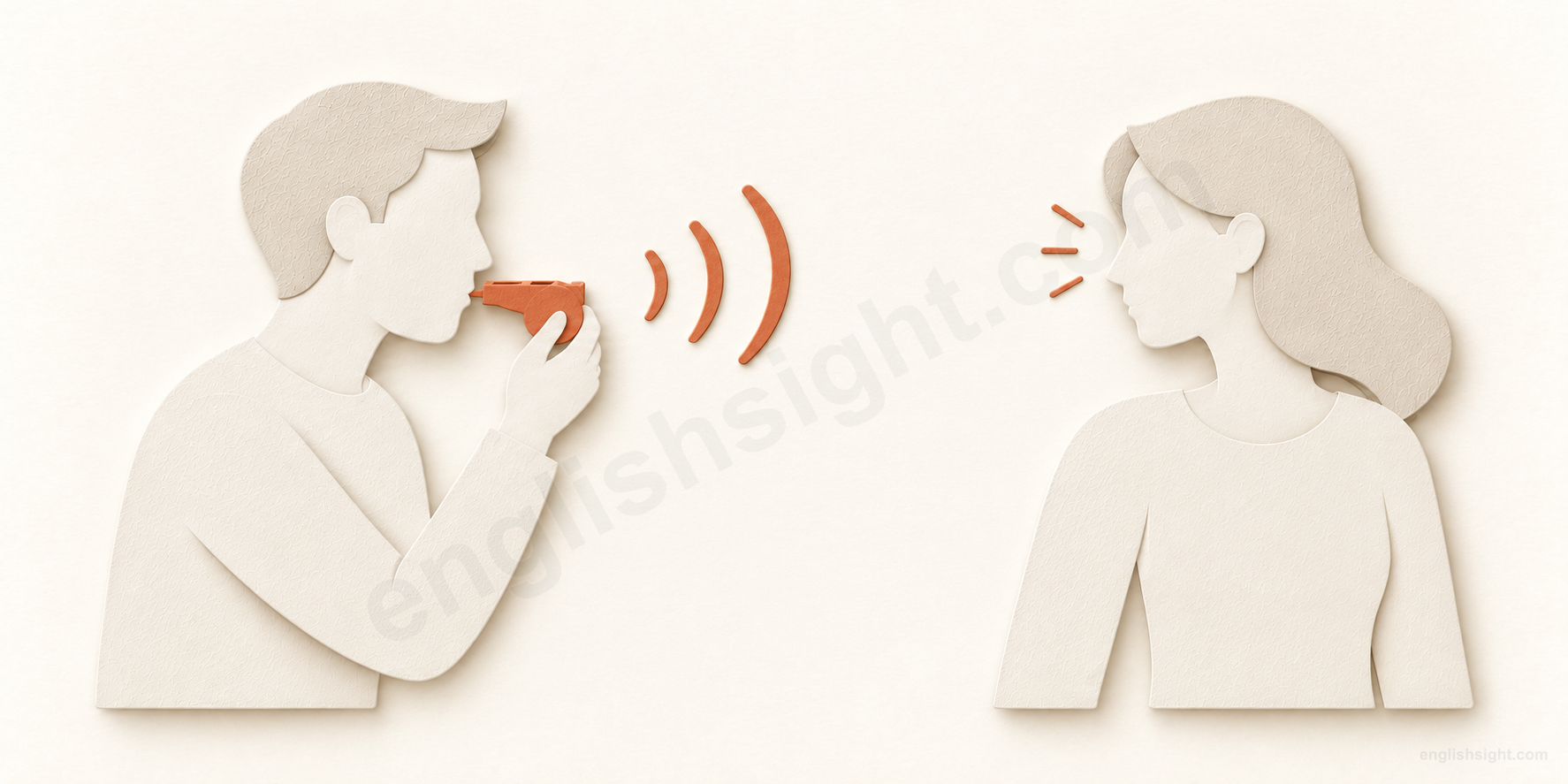
A person holds a small whistle to their lips.
whistle
The listener faces the sound's source and notices the signal.
Blowing into the device produces a clear, high sound.
The small device produces a sound that draws the listener's attention.
Whistle names a clear, high sound, the act of making it, or a device that produces it; people can use that sound to attract attention or signal.
The sketch shows one literal signal. Whistling can also be music or a reaction, and similar sounds can come from nonhuman sources. Idioms have established meanings beyond this model.
Whistle may name a sound, describe making that sound, or name a device used to produce it. People whistle tunes, call a dog, react to news, and use whistles to give signals.
Machines, wind, and birds can make similar sounds. Fixed expressions such as blow the whistle on and wet your whistle need their own explanations; they are not mechanical predictions from one picture.
01
A sound made with the mouth
Separate the action, a tune being produced, a call, and an emotional reaction.
01
whistle; whistle + adverb; whistle to oneself
whistle softly
make a clear, high sound with your mouth
Situation / source
You bring your lips close together and move your breath.
Sound / result
A thin, clear sound comes from your mouth.
The verb describes a way of producing sound; it does not require a separate instrument.
Whistle can stand alone when the action matters: Can you whistle? Adverbs describe its manner: whistle softly or loudly. Whistle to yourself means you do it for your own enjoyment, without addressing anyone.
Compare hum: humming uses your voice, often with closed lips. Singing uses your voice too; whistling does not require singing words. The sound need not be loud.
In a sentence
Maya whistled softly to herself while she folded the towels.
Watch the difference Say She whistled or She was whistling. Do not add a compulsory object such as a whistle when you mean the mouth action.
02
whistle + tune / melody / song
whistle a tune
produce a melody by whistling
Situation / source
A melody is familiar to you.
Sound / result
You reproduce its notes with a whistling sound.
The direct object names what is produced, not a person being called.
Whistle a tune or whistle a song means reproduce its melody this way. No instrument is implied. Compare play a tune on a whistle, where a separate musical instrument is involved.
The tune can be the subject of a passive: That melody can easily be whistled. This is possible because the active construction has a direct object.
In a sentence
Can you whistle the melody so I can recognize the song?
Watch the difference Whistle a song normally means its tune, not pronounce its lyrics while whistling.
03
whistle to + person / animal; whistle for + person / taxi; whistle + object + over
whistle to the dog / for a taxi
use whistling to attract attention or summon someone
Situation / source
Your dog is some distance away.
Sound / result
You give it an audible signal to return.
The sound is a means of calling; the following words identify the intended recipient or response.
Whistle to the dog directs a sound toward the dog. Whistle for a taxi means try to attract a taxi. These are verb-plus-preposition combinations; for does not always carry an idiomatic meaning.
Whistle the dog over uses the dog as an object and over as a direction: call it toward you by whistling. With a pronoun, whistle it over is natural. The verb describes the signal; it does not guarantee obedience.
In a sentence
Nina whistled to the dog to come back to the gate.
Watch the difference Keep literal whistle for a taxi separate from He can whistle for his money, which can express refusal.
04
give / let out a whistle of + feeling; whistle in + amazement; whistle at + person / thing
give a whistle of surprise
express a reaction with a whistling sound
Situation / source
You see an unexpectedly high price.
Sound / result
Your reaction comes out as a low whistle.
A whistle can express a feeling; the surrounding situation tells us which feeling.
Give or let out a whistle treats one sound as a countable noun. A whistle of surprise or admiration identifies its emotional meaning. Whistle in amazement describes the action instead. Whistling can also express disapproval, as in a crowd’s reaction; it is not automatically praise.
Whistle at someone can refer to an attention-getting or appearance-related reaction. The compound wolf-whistle specifically names a whistle expressing attraction to someone. It can be unwelcome; it is not a neutral substitute for greeting someone.
In a sentence
When Sam saw the repair bill, he let out a low whistle of surprise.
Watch the difference A low whistle may be quiet or low in pitch. Whistle does not always mean a loud alarm, and at does not itself mean admiration.
02
Devices, signals, and similar sounds
Whistle can name an object or its sound, describe another sound source, or combine sound with movement.
05
a / the / possessive + whistle; blow (into) a whistle; the whistle blows / sounds / goes
blow a whistle
use a small device that makes a high sound
Situation / source
A coach has a small whistle on a cord.
Sound / result
The coach blows into it to make a signal.
Here a whistle is a physical object, distinct from the sound it produces.
A coach can carry a whistle, lose it, or blow it. The countable noun names the device: one whistle, two whistles. Blow a whistle or blow into a whistle describes using breath to sound it.
Whistle can also name larger equipment, such as a train whistle or factory whistle. In The train whistle blew, blew describes sounding, not a device flying away. Context separates an object from its sound: I bought a whistle versus I heard a whistle.
In a sentence
The coach blew her whistle, and the team gathered around her.
Watch the difference She blew her whistle uses blow as the verb and whistle as the object. She whistled uses whistle as the verb.
06
at / before / after the final whistle; whistle for a foul; be whistled for + offence; whistle play dead
the final whistle / be whistled for a foul
use a whistle signal to mark a sporting decision
Situation / source
Players are still competing.
Sound / result
A referee’s signal stops play or marks a decision.
Whistle can name the signal, the act of giving it, or a decision communicated with it.
The opening whistle marks the start and the final whistle marks the end. In at the final whistle, the noun refers to the signal and the moment it marks. It does not mean a last physical whistle in a collection.
A referee can whistle for a foul. In sports reporting, especially American usage, a player can be whistled for an offence: The defender was whistled for holding. The referee penalizes the player by signalling; the player is not the source of the sound. A play can also be whistled dead, meaning stopped by a whistle signal.
In a sentence
Our team was still leading at the final whistle.
Watch the difference The referee whistled for a foul and The player was whistled for a foul assign different roles. Neither means whistle at a player in admiration.
07
kettle / train / bird + whistle; the whistle / whistling of + source; whistling + noun
the kettle whistles / a bird whistles
make a sound resembling a human whistle
Situation / source
Water boils in a whistling kettle.
Sound / result
A high sound comes from its spout.
The subject names the sound’s source; it need not be a human mouth.
A kettle or train can whistle, and a bird can whistle too. These uses connect through the sound. They do not mean that the kettle has lips or that a bird is using a referee’s device.
The noun can name the sound: the whistle of the kettle or a bird’s whistle. Whistling can name the ongoing sound or activity: the whistling of the kettle. A whistling kettle describes a kettle that produces such a sound.
In a sentence
The kettle started to whistle just as a bird whistled outside.
Watch the difference Whistle describes a particular sound quality. It is not a general replacement for ring, beep, or make a noise.
08
whistle + through / past / down + place or reference point
whistle through / past
move while making a high whistling sound
Situation / source
Air moves through a narrow gap in a window.
Sound / result
You hear a thin sound as it passes.
Whistle supplies sound; through or past supplies the path.
The wind whistled through a gap combines a sound with movement through an opening. An object can whistle past someone when it passes quickly with that kind of sound.
These are ordinary motion constructions, not a set of unrelated phrasal verbs to memorize for each direction. Compare The ball flew past me: flew presents movement without specifying the whistling sound.
In a sentence
All night, the wind whistled through the gap under the door.
Watch the difference The wind is the moving source. In whistle a tune, the object is a melody being produced, not a route.
09
play the (tin / penny) whistle; play + tune + on a tin whistle
play the tin whistle
play a small wind instrument
Situation / source
A musician holds a narrow pipe with finger holes.
Sound / result
Breath and finger movements produce a melody.
A musical whistle produces notes; a signal whistle usually serves a different purpose.
A tin whistle, also called a penny whistle, is a small pipe instrument played by blowing into it and using its holes. You can say play the tin whistle to name the musical skill.
Compare whistle the melody, made directly with the mouth, with play the melody on a tin whistle, made using an instrument. The noun’s musical meaning belongs to the same sound family, but the constructions differ.
In a sentence
Leah played a folk tune on her tin whistle.
Watch the difference A tin whistle is not simply any metal referee’s whistle. It is a musical instrument designed to play different notes.
03
Fixed expressions and their limits
Learn these meanings with their whole expressions. A sound or signal may suggest a connection, but does not predict the idiom.
10
blow the whistle (on + person / wrongdoing)
blow the whistle on something
report wrongdoing, especially to someone in authority
Situation / source
An employee discovers dishonest activity.
Sound / result
The employee tells someone who can investigate.
The whole idiom uses the idea of an alerting signal; no actual whistle is necessary.
Blow the whistle on a person or activity means expose wrongdoing. On introduces who or what is being reported. Blow the whistle can stand alone when the wrongdoing is already understood.
The person in the diagram makes a sound to attract attention. Reporting wrongdoing is a useful comparison with that signal, but the idiom has an established meaning that must be learned. Whistle-blower names the person who reports it.
In a sentence
An employee blew the whistle on the company’s false safety reports.
Watch the difference The idiom normally uses the whistle. Blow a whistle often describes making a physical sound; context still matters.
11
(as) clean as a whistle
as clean as a whistle
completely clean
Situation / source
A kitchen has been scrubbed.
Sound / result
No dirt remains on the surfaces.
This fixed comparison strengthens clean; it does not describe a sound.
The kitchen is as clean as a whistle means it is extremely clean. The first as can be omitted in informal use: clean as a whistle.
Treat this as an established comparison. The sound diagram does not prove why a particular kitchen is clean, and an actual whistle need not be present.
In a sentence
After we scrubbed it, the kitchen was as clean as a whistle.
Watch the difference Keep the adjective clean. Clearly and whistle clearly describe different things and cannot replace this idiom.
12
person / record + be + (as) clean as a whistle
a record as clean as a whistle
free from wrongdoing
Situation / source
Someone checks a person’s conduct.
Sound / result
They find no dishonest or illegal behaviour.
Clean can refer to conduct as well as physical dirt.
When a person or their record is as clean as a whistle, the expression can mean they have done nothing wrong. The subject and context select this interpretation.
Compare a kitchen as clean as a whistle, where clean is physical. A clean record does not refer to polishing paper or cleaning a musical recording. This extension belongs to the established idiom.
In a sentence
They checked every transaction; her record was as clean as a whistle.
Watch the difference This is a strong claim about conduct. It is not merely a comment that someone looks neat.
13
wet + possessive + whistle
wet your whistle
have a drink
Situation / source
Someone is ready for a drink.
Sound / result
They take something to drink.
This old-fashioned idiom concerns drinking, not wetting an instrument.
Wet your whistle is a playful, old-fashioned way to say have a drink. The possessive changes with the person: wet my whistle, wet her whistle, wet our whistles.
It need not describe preparing to whistle, and no device needs water. Learn it mainly for recognizing informal speech or writing; have a drink is the straightforward everyday choice.
In a sentence
“Let’s wet our whistles before the next song,” said the singer.
Watch the difference The spelling is wet, not whet. Whet means sharpen or stimulate, as in whet your appetite.
14
person + can whistle for + requested thing / it
you can whistle for it
you will not get what you are asking for
Situation / source
Someone asks for a favour you refuse to provide.
Sound / result
You dismiss the request rather than grant it.
Can introduces a dismissive refusal here, not a useful way of calling.
In British informal usage, You can whistle for it means you should not expect to receive it. The speaker may be unwilling or unable to give it. This can sound rude.
Contrast literal He whistled for a taxi: he used a sound to summon one. In If he wants another free ride, he can whistle for it, the point is that no free ride will be provided.
In a sentence
If Ben expects another free ride, he can whistle for it.
Watch the difference Do not use this as a polite offer or as advice to whistle more loudly.
15
whistle in the dark; be whistling in the dark
whistle in the dark
try to sound brave or hopeful despite fear or uncertainty
Situation / source
There is reason to worry about a plan.
Sound / result
Someone voices confidence to reassure themselves.
The idiom describes a stance toward worry; it does not require darkness or actual whistling.
Someone who is whistling in the dark may be trying to keep up their courage or convince themselves things will be all right. The speaker often doubts that the confidence is well supported.
The image of making a cheerful sound in a frightening place can help you remember it. That is a teaching comparison, not proof that every use involves a literal dark place.
In a sentence
“Everything will be fine,” I said, though I knew I was whistling in the dark.
Watch the difference It is not the same as deliberately keeping others uninformed or quietly practising a tune at night.
Choose the source and read the whole construction
Pronunciation and forms
The t in whistle is silent: /ˈwɪsl/. Forms are whistle, whistles, whistled, whistling; drop the final e before -ing. The plural noun is whistles.
Sound, device, and action
I heard a whistle refers to a sound; I bought a whistle refers to a device. She whistles describes an action. Use hum for a voiced closed-mouth tune, and whistle for a whistling sound.
Grammar depends on the object
A tune can be whistled because whistle a tune has a direct object. A kettle whistles without an object. Sports reporting also permits a player to be whistled for an offence. There is no general whistle someone to do something pattern meaning persuade or allow them; whistle to someone to come back gives a sound signal with a purpose.
Scope and register
The lesson covers modern noun and verb uses plus selected fixed expressions. Wet your whistle is old-fashioned; you can whistle for it is British informal and dismissive. Separate compounds such as dog whistle and whistle-stop have their own meanings and are not fully taught here.
Listen to the construction
Choose the sentence or interpretation that fits the situation.
1. A coach buys two small devices to use during practice. Which noun phrase names those objects?
2. You make a melody directly with your lips, using no instrument. Which sentence fits?
3. An accountant blew the whistle on false invoices. What happened?
4. A defender was whistled for holding. Who most likely made the whistle signal?
5. “If he wants another free ticket, he can whistle for it.” What does the speaker mean?
Sources and teaching notes
Usage was checked against the publisher pages below. The explanations and examples are original. The sound-to-signal connection is a teaching model, not a derivation of every idiom.
The diagram is a teaching aid; it does not represent one picture shared by every native speaker.