Follow width into range, reach, and familiar expressions.
Notice the span across
Notice the span across
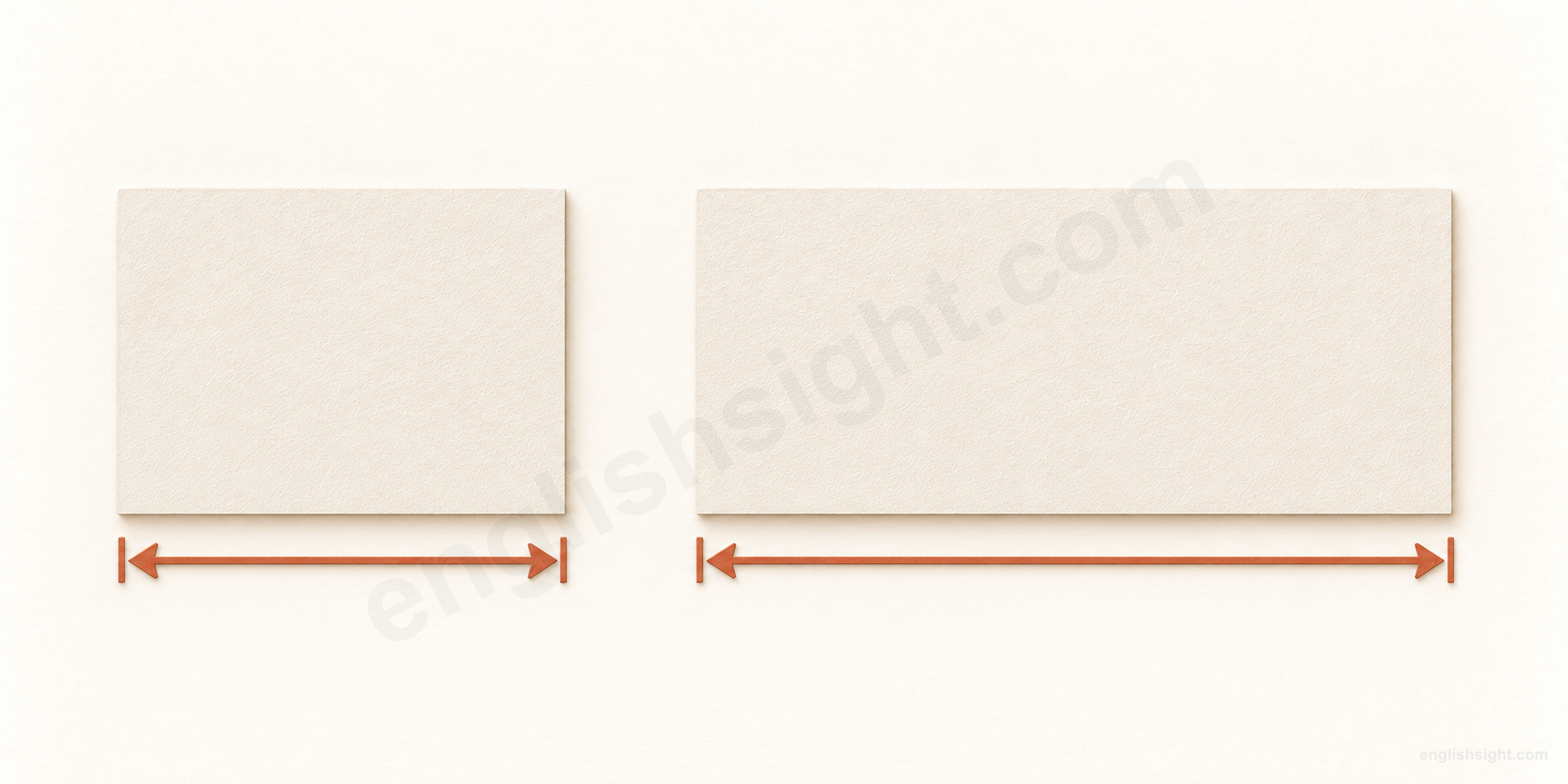
A narrower panel is shown on the left.
wide
The right-hand panel has a larger span at the same height.
Compare the distance from side to side.
The wider panel spans farther from side to side, without being taller.
Wide describes a large span from side to side; related uses extend the idea to a broad range or reach.
The diagram compares two widths; it does not show an object necessarily growing. Target-relative wide and fixed intensifiers need the separate explanations below.
Wide usually directs attention across something: a road’s sides, the limits of a range, or the distance between results. First identify what the span belongs to.
This lesson connects related uses without treating every expression as a width calculation. Wide awake and wide of the mark need their own established meanings.
01
Width, openings, and separation
Identify the relevant sides or edges. Wide can describe a dimension, an opening, or how far things are spread apart.
01
wide + noun; be / get + wide; wider than; the widest + noun
a wide road / wider than
have a large distance from side to side
Situation / comparison
You compare two roads.
What is described
One has more room across it.
Width runs across the road rather than along its length.
Wide describes the side-to-side dimension of a road, river, shelf, screen, or piece of clothing. It can come before a noun or after be, seem, become, or get: The path gets wide near the beach.
Use wider and widest to compare widths: This shelf is wider than that one. Narrow is the usual opposite. Broad overlaps with wide in combinations such as a broad river, but the two words do not replace each other in every fixed expression.
In a sentence
The new road is wider than the old one.
Watch the difference A long road covers a great distance along its route; a wide road has a large span across it.
02
how wide + be + subject?; number + unit + wide; as wide as
How wide? / two metres wide
ask for or state a width
Situation / comparison
You need to know whether a table will fit.
What is described
You learn its side-to-side measurement.
A measurement tells us the width even when the object is not especially broad.
How wide is the table? asks about its dimension; it does not assume the table is large. Put a measurement before wide after the noun or linking verb: The table is ninety centimetres wide.
Before a noun, a measurement compound uses a singular unit: a two-metre-wide opening. You can also compare with as wide as: The desk is as wide as the window. Wide names the dimension; width is the noun: What is its width?
In a sentence
The doorway is eighty centimetres wide.
Watch the difference Use wide after the measurement, not eighty centimetres width. In a compound before a noun, use a singular unit.
03
wide enough for + noun; wide enough (for someone) to + verb; too wide to + verb
wide enough for / to…
have sufficient width for a purpose
Situation / comparison
Two people need to walk next to each other.
What is described
The available width allows them to do so.
Enough sets a practical threshold rather than an absolute size.
Put enough after the adjective: wide enough. For can introduce the thing needing space, while a to-infinitive names the action the width allows.
The gap is too wide to jump across means its width prevents that action. Wide enough to pass through and too wide to step across assess different tasks, so neither expression by itself says whether the width is desirable.
In a sentence
The path is wide enough for two people to walk side by side.
Watch the difference Say wide enough, not enough wide. Check whether more width helps or obstructs the particular task.
04
a wide smile / grin; wide eyes; eyes wide with + emotion
a wide smile / wide eyes
describe a broad smile or fully opened eyes
Situation / comparison
Someone sees a welcome visitor.
What is described
Their smile spreads across their face.
The facial feature determines what kind of width is meant.
A wide smile or grin stretches across the face. Wide eyes are opened a lot; eyes wide with surprise links that opening to an emotion. Joy, fear, and surprise come from the context, not from wide alone.
A wide mouth can describe someone’s physical features even when the mouth is closed. A mouth wide open describes its current opening. Do not confuse a stable physical width with a temporary expression.
In a sentence
Maya greeted her sister with a wide smile.
Watch the difference Wide eyes do not mean widely known eyes. The former concerns opening; widely known concerns recognition.
05
open + object + wide; subject + be + wide open; leave / keep + object + wide open
open wide / wide open
open something to a large or full extent
Situation / comparison
A mouth or window is only slightly open.
What is described
It is opened much further.
Wide modifies the extent of opening, not how widely an action is distributed.
At the dentist, Open wide is a shortened instruction to open your mouth a lot. Open your mouth wide places wide after the object; keep the window wide open describes a continuing state.
In wide open, wide is an adverb intensifying open. The window is wide instead describes its width. A window can be narrow in shape and still be wide open.
Wide-open spaces are large, open areas without enclosing barriers or obstructions: After weeks in the city, we enjoyed the wide-open spaces of the countryside. Here the phrase describes the landscape, rather than a door being opened.
In a sentence
Please open your mouth wide so I can see your back teeth.
Watch the difference Use wide open for an opening at full extent; widely open is not the usual expression for this meaning.
Apart expresses separation; wide adds its large extent.
Spread your arms wide means extend them outward. Stand with your feet wide apart describes the large space between your feet, whether or not we see you moving into that position.
Wide is an adverb in these patterns. Spread gives the outward action; apart supplies separation when present. Wide does not turn the combination into a special phrasal verb.
In a sentence
She spread her arms wide to show how big the box was.
Watch the difference Wide apart is about separation, not necessarily a large size for either of the things being separated.
02
Variety, reach, and differences
The span can be an abstract range: the choices included, the people reached, or the distance between two results.
07
a wide range / variety / selection / choice of + noun
a wide range / variety / choice of
include many different options or types
Situation / comparison
You are comparing what shops offer.
What is described
One shop includes many kinds of tool.
The range stretches across different kinds, not just many copies of one item.
In a wide range of tools, wide modifies range, and of introduces what the range contains. Variety, selection, and choice work similarly. A wide range can include many prices, styles, or categories.
A wide vocabulary, wide experience, and wide interests also concern breadth of coverage. Wide-ranging describes something covering many topics or activities. None of these expressions means that an abstract idea has a measurable physical width.
In a sentence
The shop carries a wide range of tools for home repairs.
Watch the difference A thousand identical hammers are many tools, but do not by themselves form a wide variety.
08
wide + audience / appeal / support / publicity / area / circle of friends
a wide audience / wide support
reach or involve many people or a large area
Situation / comparison
A service begins with a small local audience.
What is described
People in many places become interested.
Reach concerns how far involvement extends, rather than how many options exist.
A wide audience or wide appeal means that something interests many people, often across different groups. Wide support and wide publicity concern the extent of support or attention. A wide area refers to geographical spread.
A wide circle of friends describes an extensive network of relationships. These combinations commonly put wide before the noun. When describing a verb, use forms such as widely supported or widely publicized.
In a sentence
The free concerts have wide appeal across the city.
Watch the difference Wide support describes breadth of support; it does not necessarily mean unanimous support.
09
a wide gap between A and B; wide variations in + noun; win by a wide margin
a wide gap / by a wide margin
describe a large difference between levels or results
Situation / comparison
Two teams finish with different scores.
What is described
The winning score is far ahead.
The span is between values, not between physical edges.
A wide gap between incomes is a large difference. Wide variations in prices mean that prices differ substantially. By a wide margin describes how much one result exceeds another.
A wide range of prices includes many values; a wide gap between two prices compares those two values. The noun and the surrounding construction tell you whether you are considering a whole range or a difference.
In a sentence
Our team won by a wide margin.
Watch the difference Margin means the size of the advantage here, not the blank space at the edge of a page.
10
the wider + context / issue / community; in its widest sense
the wider context / in its widest sense
consider a more general setting or interpretation
Situation / comparison
A discussion concentrates on one delay.
What is described
You consider the larger transport system.
Wider changes the scope of the discussion rather than the size of an object.
The wider context includes factors outside the immediate detail being discussed. The wider community means people beyond the smaller group currently in focus. In its widest sense gives an expression its most inclusive interpretation.
This general-scope use normally occurs as wider or widest: consider the wider issue. It is related to including more within a range, but it is not simply a measurement of width.
In a sentence
We need to discuss the delay in the wider context of public transport.
Watch the difference For this general-scope meaning, learn wider context rather than substituting wide context mechanically.
The first part names the area; -wide gives the extent.
Nationwide means throughout a country, and worldwide means throughout the world. They can describe a noun or modify an action: a nationwide campaign; The programme operates nationwide.
The pattern also appears in citywide and industry-wide. Spelling varies by established compound, so check the full word rather than adding or deleting hyphens by one universal rule. An area-wide service is not necessarily used by every individual in that area.
In a sentence
The reading programme is now available nationwide.
Watch the difference Write nationwide as one word. The combining form is not the free adjective in a phrase such as a wide road.
03
Established expressions and useful contrasts
Learn these combinations as expressions. The general idea of extent helps with some, but cannot supply every meaning by itself.
12
be / feel / stay + wide awake
wide awake
be completely awake or alert
Situation / comparison
You want to sleep after a late coffee.
What is described
You still feel fully alert.
This fixed intensifier does not measure an opening.
Wide awake means fully awake. A person can lie with their eyes closed and still be wide awake; the expression concerns wakefulness, not the visible width of their eyes.
Be, feel, and stay can introduce this state. Wide awake can also emphasize alert attention: You need to be wide awake when driving in heavy traffic. Learn the combination rather than using wide freely with every adjective; fully awake is an alternative for the sleep-related meaning.
In a sentence
I was still wide awake at two in the morning.
Watch the difference Do not change it to widely awake or use wide as a general replacement for very.
13
a race / election / competition + be + wide open
the race is wide open
say that several competitors could win
Situation / comparison
No team has established a clear lead.
What is described
The outcome remains undecided.
The opening is a metaphor for possible outcomes, not a physical gap.
If an election, race, or competition is wide open, there is no clear favourite or settled outcome. Several participants have a realistic chance of winning.
This is a separate use from a door being wide open. It also differs from an open competition meaning one that people are allowed to enter: wide open here concerns who might win.
In a sentence
With three teams level on points, the title race is wide open.
Watch the difference Wide open does not promise that every entrant has exactly the same chance.
14
subject + be + wide open to + criticism / attack; leave + person or thing + wide open to + criticism / attack
leave someone wide open to…
leave someone strongly exposed to criticism or attack
Situation / comparison
A proposal has no supporting evidence.
What is described
It becomes easy for others to challenge it.
To introduces the kind of threat, not the person receiving an invitation.
Leave someone or something wide open to criticism means make them especially vulnerable to it. Be wide open to attack describes the exposed state. Wide intensifies open, whose figurative meaning is vulnerable here.
Open to suggestions is usually positive willingness to listen. Wide open to criticism can instead warn about an avoidable weakness. Read the object of to and the context before choosing the interpretation.
In a sentence
The missing figures leave the report wide open to criticism.
Watch the difference This expression does not mean that the writer actively welcomes criticism.
15
a shot + go / fly + wide; be wide of + target
go wide / wide of the goal
miss a target to one side
Situation / comparison
A player aims at the goal.
What is described
The ball passes outside a side of it.
Wide concerns position relative to the intended target.
The shot went wide describes a miss to one side. The shot was wide of the goal names the reference point. Just wide indicates a small miss; well wide indicates a larger one.
Wide is an adverb after go in this use and an adjective after be. This is a distinct established target-relative use, not a statement that the ball itself is broad. A shot over the goal specifies a different direction.
In a sentence
His final shot went just wide of the goal.
Watch the difference Keep the preposition of when naming the target: wide of the goal, not wide from the goal.
16
a guess / estimate / claim + be + wide of the mark
wide of the mark
be substantially inaccurate
Situation / comparison
You estimate a cost without checking.
What is described
The actual price is very different.
The mark is a figurative target: a correct answer or assessment.
A guess, estimate, claim, or prediction can be wide of the mark. The expression treats accuracy as hitting a target, but no literal shot or physical mark is required.
It criticizes the result as inaccurate. It does not by itself accuse anyone of deliberately lying; an honest guess can also be wide of the mark.
In a sentence
My estimate of the repair cost was wide of the mark.
Watch the difference Learn the whole expression, including of the. A wide mark by itself describes the mark’s size.
17
give + person or thing + a wide berth
give someone / something a wide berth
keep well away from a person or thing
Situation / comparison
You notice a loose dog ahead.
What is described
You pass at a safe distance.
The large surrounding space expresses deliberate avoidance.
Give something a wide berth means keep well away from it. It can describe a physical route around an animal or obstacle, or avoidance of a person or troublesome situation.
Give the argument a wide berth means avoid becoming involved. This is an idiom built around distance; it is not a request to hand someone a physical object called a berth.
In a sentence
We gave the loose dog a wide berth.
Watch the difference The object follows give: give the dog a wide berth, not give a wide dog berth.
18
search / travel / spread + far and wide; come from far and wide
far and wide
over or from many places across a large area
Situation / comparison
You cannot find a particular spare part nearby.
What is described
Your search extends to distant places.
Far adds distance; wide adds spread in this established pair.
Search far and wide means search across many places, including distant ones. Come from far and wide focuses on the origins of people arriving; news that spreads far and wide reaches a large area.
The phrase can sound emphatic or descriptive; Collins labels this use written. It does not claim that every possible place has literally been searched or reached.
In a sentence
We searched far and wide for a replacement part.
Watch the difference Use from when describing origins: visitors came from far and wide.
19
cast + possessive + net + wide / wider
cast your net wide
consider many possibilities while searching
Situation / comparison
You have applied to only one employer.
What is described
You consider several industries and locations.
The search includes more possible sources or candidates.
Cast your net wide advises someone to consider many people, places, or opportunities in a search. A jobseeker might try different employers instead of depending on one vacancy.
The net is a conventional image for a search, not an instruction to use fishing equipment. A wider net compares the scope with an earlier or narrower search.
In a sentence
We cast our net wider and contacted firms outside the city.
Watch the difference The expression recommends breadth of search; it does not guarantee success.
20
wide open / wide awake; widely known / used; vary / differ widely
wide or widely?
choose the adverb that fits the intended meaning
Situation / comparison
You describe how familiar an expression is.
What is described
You say that many people know or use it.
Wide can itself be an adverb, while widely often concerns distribution or large differences.
Use widely known, widely used, and widely available for recognition, use, or availability across many people or places. Widely also works with differ or vary: Prices vary widely means they differ greatly.
Compare Open the gates wide with The news was widely reported. The first concerns extent of opening; the second concerns distribution of reporting. You do not add -ly automatically just because a word modifies a verb.
In a sentence
Prices vary widely between these shops.
Watch the difference Use widely known for known by many people; wide known is not the normal standard combination.
Choose the dimension and the construction
Width is relative to a context
A wide path may still be narrower than a narrow road. The noun, purpose, and comparison establish the relevant standard. A measurement such as ten centimetres wide can describe something quite small.
Word forms and word classes
The adjective and the adverb wide have comparative wider and superlative widest. Width is a noun; widen is a verb. This lesson does not treat wide as an ordinary verb, so passive and causative verb patterns do not apply.
Specialist and historical boundaries
In cricket, a wide is a delivery judged out of the batter’s reach; it is a specialized countable noun. Detailed cricket rules, technical phonetics, historical noun senses, and regional slang are outside this everyday lesson.
Combinations have their own conventions
Wide and broad overlap for some physical dimensions, but wide awake and wide of the mark are established combinations. Wide does not freely replace very, large, or broad in every phrase.
Choose the meaning and form
Identify the relevant dimension, context, or established expression.
1. You need the side-to-side measurement of a table. Which question asks for it?
2. A window is opened as far as it can go. Which sentence expresses that?
3. A shop has many different types of tea. Which expression highlights this variety?
4. You are lying in bed with your eyes shut, but you are fully awake. Which sentence fits?
5. Your prediction was very different from what happened. What can you say?
Sources and teaching notes
The sources below were consulted for meanings and constructions. The explanations, examples, and comparison diagram are original teaching material.
The diagram is a teaching comparison, not a claim about a picture shared by all English speakers.