Distinguish wind /wɪnd/ from wind /waɪnd/, then let the whole expression guide you.
Air in motion makes its force noticeable
Air in motion makes its force noticeable
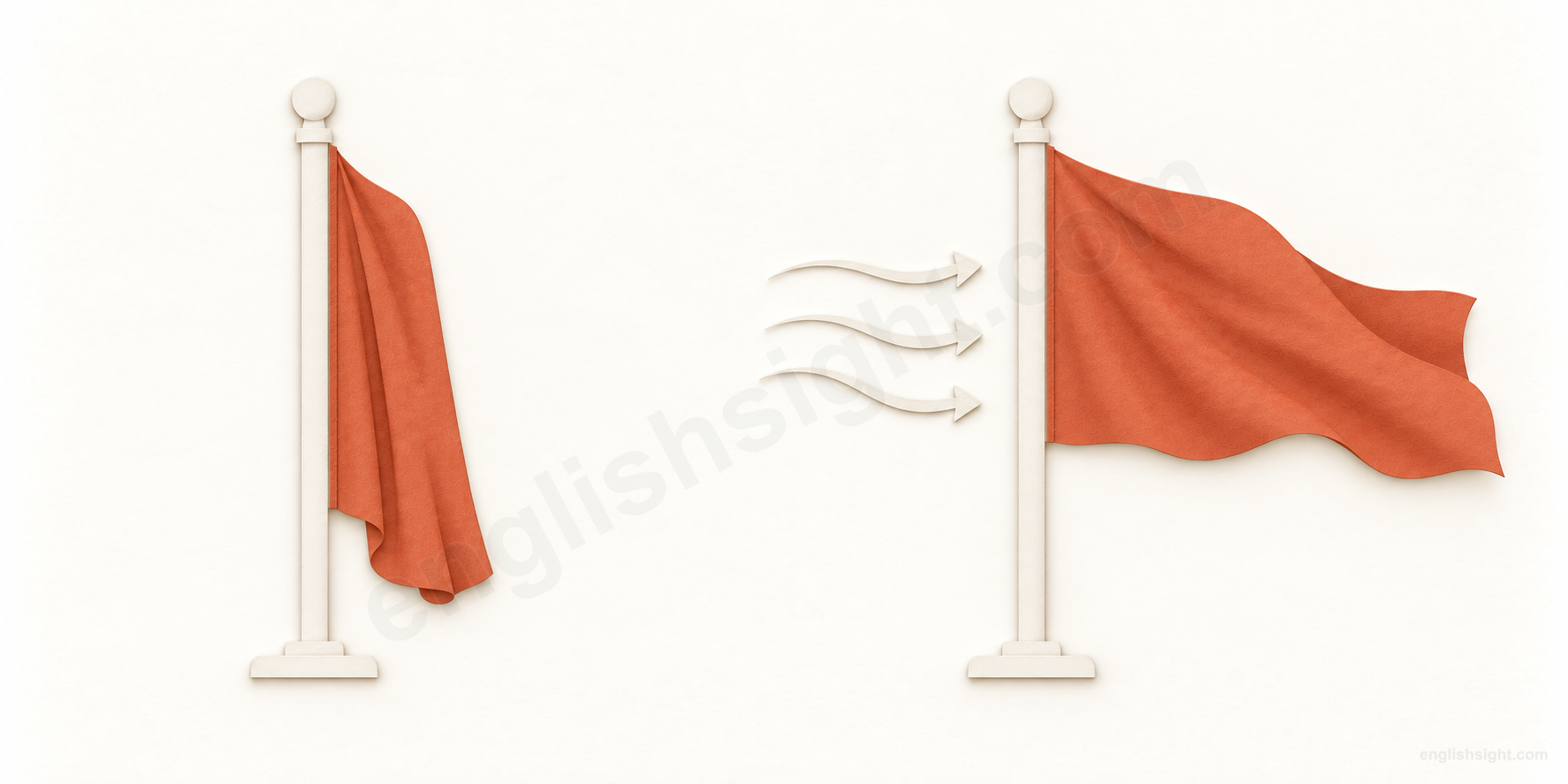
The cloth hangs down beside the pole.
wind
The same cloth spreads and streams to the right.
Moving air presses against the cloth.
The cloth makes moving air’s effect visible. Rightward flow is this example’s direction; the separate turning verb /waɪnd/ is outside this picture.
Wind /wɪnd/ is moving air: it can press against things, carry them, or make flexible material stream in its direction.
The picture illustrates the air family. The /waɪnd/ turning family is a separate branch, and fixed expressions must be learned in their own contexts.
A breeze, a flag streaming out, and air pressing against your face help you understand wind /wɪnd/: air in motion. Breath, music, and several familiar metaphors belong nearby, but each expression has its own use.
The same spelling also represents wind /waɪnd/, the verb for wrapping, turning, and following bends. Its past is wound /waʊnd/. Keep this family separate instead of forcing every meaning into the idea of weather.
This lesson offers a teaching model and a selection of common modern uses. It does not claim that all English speakers share one mental image or that every idiom can be predicted from a picture.
01
Moving air: /wɪnd/
Start with weather and direction. The air is moving; the things it touches let us notice its force.
01
a / the + adjective + wind; winds; a gust of wind; wind + noun
a strong wind; the wind blows
air moving with a noticeable force
Situation / starting point
A flag hangs beside its pole.
Meaning / outcome
Moving air makes the cloth stream out.
Wind is moving air; its effects can be visible even though the air itself is not.
Use wind as a noun for moving air. The wind is getting stronger identifies the weather around us; a cold wind describes a particular current or weather condition. Strong winds is natural in forecasts about several places or periods.
Say a strong wind, a light wind, or a gust of wind. A gust is a brief burst, not a synonym for every kind of wind. A breeze is usually a gentle wind. For the adjective, say It is windy, not It is wind.
The wind can blow, rise, or drop. These describe the air and changes in its strength. Wind power and wind energy use wind before another noun to identify the energy source; they do not refer to winding a machine.
In a sentence
A strong wind blew my notes across the garden.
Watch the difference Wind names the moving air; blow is the usual verb for what that air does. Do not use wind as a weather verb meaning blow.
02
a + direction + wind; wind from + place; into / in the wind; the wind at one’s back
a north wind; into the wind
describe where the wind comes from and how you move relative to it
Situation / starting point
Air comes from the north.
Meaning / outcome
A walker facing north feels it against their face.
A named wind comes from that direction; into the wind describes movement against it.
A north wind blows from the north, toward the south. The wind is blowing from the sea similarly identifies its source. Wind direction is about origin, so do not assume a north wind travels north.
Walk into the wind means face its force as you move. With the wind at your back, it blows in roughly your direction of travel. In the wind simply places something in moving air: The leaves shook in the wind.
In a sentence
We cycled into the wind on the way home.
Watch the difference In the wind can be literal here. Its idiomatic meaning about a coming event needs a different context.
02
Breath, the body, and music: /wɪnd/
These uses concern air in the body or air used to make sound. Learn the specific construction rather than replacing every occurrence with weather.
03
wind + person; be / feel / get winded; knock the wind out of + person; catch one’s wind
be winded; knock the wind out of someone
have difficulty catching your breath after effort or a blow
Situation / starting point
You run quickly up several flights of stairs.
Meaning / outcome
You pause, breathing hard.
Here wind concerns breath, and winded describes the person’s resulting condition.
Winded /ˈwɪndɪd/ means out of breath. Exercise can leave you winded; a blow can wind you. In The fall winded me, the fall is the cause and me is the person affected. I was winded by the fall is a passive form.
A fall knocked the wind out of me is a vivid established expression for suddenly losing your breath. Compare the figurative sails idiom later: that concerns confidence, not necessarily breathing.
Catch your wind means get your breath back: I stopped to catch my wind. It describes recovering ordinary breathing after effort; a second wind instead describes renewed energy after tiredness.
In a sentence
The steep climb left us winded.
Watch the difference This verb has winded as its past form. Wound /waʊnd/ belongs to the turning verb, not this breath meaning.
04
get / find + a second wind; get one’s second wind; give + person + a second wind
get a second wind
feel able to continue after tiredness
Situation / starting point
You feel too tired to finish preparing the room.
Meaning / outcome
New energy lets you carry on.
The whole phrase describes renewed energy, in physical or mental work.
A second wind is a return of energy after you have felt tired. It can help a runner, but it can also help someone studying, working, or staying awake.
Say get a second wind or get your second wind. The expression describes renewed capacity to continue; it does not promise that a short rest or any particular action will always produce it.
In a sentence
I got a second wind and finished setting up the room.
Watch the difference Second wind is one expression. It does not mean a second gust in this context.
05
have / suffer from wind; break / pass wind; wind + baby
have wind; break wind; wind a baby
talk about gas in the body or helping a baby bring up air
Situation / starting point
Someone feels uncomfortable after eating.
Meaning / outcome
They describe gas rather than the weather.
Wind can name digestive gas; the baby-care verb has a different action and object.
Have wind and trapped wind refer to gas in the digestive system, especially in British usage; gas is a common alternative, particularly in American English. Break wind or pass wind means release gas from the bowel and is a polite alternative to a blunter word.
In British English, wind a baby /wɪnd/ means help the baby bring up swallowed air after feeding; American English normally uses burp a baby. This transitive verb is not the same as break wind: a baby being winded is being helped to burp.
In a sentence
“Have you winded the baby?” means “Have you helped the baby burp?”
Watch the difference Use the regular past winded /ˈwɪndɪd/. Do not confuse this with wound a cord around a reel.
06
wind + instrument / section; the winds
a wind instrument; the wind section
make music using air, or refer to the players who do so
Situation / starting point
A player blows into a clarinet.
Meaning / outcome
The instrument sounds as part of the ensemble.
Wind identifies the role of air in producing sound, not outdoor weather.
A wind instrument is played by blowing air into it, as with a flute or trumpet. In wind instrument and wind section, wind modifies another noun; it is pronounced /wɪnd/.
The winds can collectively mean the wind instruments or their players in an orchestra. Context tells you whether a conductor means the people or their sound. This musical classification is broader than the word woodwind alone.
In a sentence
The wind section enters after the strings.
Watch the difference Do not pronounce this wind /waɪnd/: nobody is winding up the instruments.
03
News, influence, and established expressions: /wɪnd/
Air can carry things and affect their movement. That provides useful comparisons, but the full idiom supplies its conventional meaning.
07
run / ride / go + like the wind
run like the wind
move very fast
Situation / starting point
A runner notices the bus at the stop.
Meaning / outcome
She runs extremely quickly to reach it.
The wind supplies a comparison for speed, not a literal source of power.
Like the wind makes a vivid comparison meaning very quickly. It commonly follows movement verbs such as run, ride, or go.
She ran in the wind describes weather during the run. She ran like the wind describes speed, even on a still day. Like introduces the comparison; the whole phrase has become familiar.
In a sentence
Maya ran like the wind to catch the bus.
Watch the difference Keep like the wind. Like wind is not the normal form of this expression.
08
get wind of + noun / pronoun
get wind of something
learn about something, often before it is meant to be public
Situation / starting point
A team quietly plans to move offices.
Meaning / outcome
A reporter hears about the plan.
Information reaches someone; no actual air movement is required.
Get wind of a plan means hear about or discover it, especially when it is being kept quiet. It suggests information spreading, rather than an official announcement.
Of introduces what you learn about: get wind of the move, get wind of it. This is an idiom headed by get, not a phrasal verb made from wind.
In a sentence
A local reporter got wind of the planned move.
Watch the difference Keep of before the information: get wind of it, not get wind it.
09
change / something + be + in the wind
change is in the wind
suggest that something is likely to happen
Situation / starting point
Several signs point to a new manager arriving.
Meaning / outcome
People expect a change soon.
The situation suggests a coming development rather than a confirmed schedule.
If a change is in the wind, there are indications that it is coming. The phrase can sound more vivid or journalistic than A change is likely.
Compare A scarf is moving in the wind, which is literal. The subject and context select the interpretation; the preposition in does not itself mean likely.
In a sentence
With two directors leaving, a reorganization is in the wind.
Watch the difference This wording does not guarantee that the event will happen or give its exact date.
10
the winds of + change / a social or economic force
the winds of change
forces that bring changes to a situation
Situation / starting point
New attitudes and technology spread through an industry.
Meaning / outcome
The industry begins to change.
Moving air is a metaphor for influences acting on events.
The winds of change presents change as a force moving through a society or organization. The plural is conventional in this expression. Similar journalistic language can describe economic or political forces.
This is figurative noun use, not a statement about the weather. The metaphor helps organize the idea, but it cannot tell you what a particular change will be.
In a sentence
The winds of change are reaching even the oldest firms.
Watch the difference The plural winds takes are. The phrase is vivid commentary, not a precise explanation of causes.
11
see / know / wait to see + which way the wind is blowing
see which way the wind is blowing
judge how events or opinion are developing
Situation / starting point
A committee has not voted yet.
Meaning / outcome
You watch its discussions to judge the likely result.
Direction stands for the tendency of a situation or opinion.
See which way the wind is blowing means assess the direction things are taking, for example who is gaining support. How the wind is blowing is another established form.
Someone may wait to see the trend before acting, but the phrase does not always accuse them of being dishonest. It can simply describe paying attention to developments.
In a sentence
She waited to see which way the wind was blowing before proposing a vote.
Watch the difference Inside the embedded question, use which way the wind is blowing, not which way is the wind blowing.
12
take the wind out of + possessive + sails
take the wind out of someone’s sails
make someone suddenly less confident or enthusiastic
Situation / starting point
You confidently present what you think is a new idea.
Meaning / outcome
Someone shows it has already been tried, and your confidence drops.
The idiom compares lost confidence with a sail losing the force driving it.
The news took the wind out of my sails means it reduced my confidence, enthusiasm, or momentum. The subject can be a remark, fact, or event.
The sailing comparison helps you remember the expression, but the speaker need not sail. Unlike being physically winded, this effect is normally emotional.
In a sentence
Learning that the design had already failed took the wind out of my sails.
Watch the difference Use the possessive for the person affected: my sails, her sails, or the team’s sails.
13
throw caution to the wind + and + action
throw caution to the wind
stop being careful and take a risk
Situation / starting point
You hesitate because a choice could go badly.
Meaning / outcome
You act despite the risk.
Caution is treated as something discarded; the idiom describes the decision.
Throw caution to the wind describes acting without your usual careful restraint. It can suggest excitement, boldness, or recklessness, depending on the context.
The person is not literally throwing an object away. Learn caution and to the wind together; the expression does not promise that the risk will turn out well.
In a sentence
We threw caution to the wind and booked the trip that afternoon.
Watch the difference The past of throw is threw; wind stays a noun /wɪnd/ in this idiom.
14
sail + close / dangerously close + to the wind
sail close to the wind
behave in a way that risks trouble
Situation / starting point
A seller makes claims that nearly break advertising rules.
Meaning / outcome
People warn that the seller could get into trouble.
The whole expression concerns a risky limit, not necessarily a boat.
Sail close to the wind can describe conduct near the edge of what is allowed or acceptable. It often implies that the person may face criticism or penalties.
Compare throw caution to the wind, which emphasizes abandoning caution. Sail close to the wind emphasizes how close conduct comes to a dangerous limit; the person may be acting quite deliberately.
In a sentence
Those misleading advertisements are sailing close to the wind.
Watch the difference Close to belongs to the fixed expression. It does not mean that the wind is physically nearby.
15
put the wind up + person
put the wind up someone
frighten or worry someone
Situation / starting point
An unexpected warning arrives.
Meaning / outcome
The person who reads it becomes worried.
This British informal idiom names fear, not the winding of a mechanism.
That put the wind up me means that frightened or worried me. It is British and informal; frighten or worry is more neutral and more widely usable.
Here wind is the noun /wɪnd/, and put is the verb. Compare wind me up /waɪnd/, which can mean annoy or tease me. The similar-looking strings have different grammar and pronunciation.
In a sentence
The unexpected alarm put the wind up us.
Watch the difference Do not substitute the turning pronunciation /waɪnd/ in this noun idiom.
04
Wrapping and turning: /waɪnd/
This differently pronounced verb has its own family: coiling something, following bends, and operating mechanisms by turning.
16
wind + flexible object + around / round + support; wind + material + into a ball; wind up + cable; wind + cable / it + up
wind a cord around a reel
place something flexible in turns around something else
Situation / starting point
A long cord lies loose.
Meaning / outcome
The cord forms turns around a reel.
The flexible object takes a coiled course; this is wind /waɪnd/.
In wind a cord around a reel, the cord is what you arrange and the reel is what it goes around. Wind some wool into a ball instead names the resulting shape. Around and round are both possible in the wrapping construction.
This verb’s usual forms are wind /waɪnd/, wound /waʊnd/, wound. The cord was wound around the reel is a passive: it describes the cord’s arrangement or the action done to it. This family is separate from the air noun.
Wind up a cable can also mean coil it for storage: Please wind the cable up when you finish. With a pronoun, use wind it up. Here up belongs to the coiling expression; it does not mean that the cable moves upward or that you are powering a spring.
In a sentence
I wound the spare cord around a small reel.
Watch the difference Wound /waʊnd/ here is not wound /wuːnd/, the noun or verb concerning an injury.
17
road / river + wind + through / around + place; wind + one’s way + through + place
the road winds; wind your way through
follow a course with repeated bends
Situation / starting point
A route bends around several hills.
Meaning / outcome
Following it involves repeated changes of direction.
A road can have a winding shape without itself moving.
The road winds through the hills describes its shape and course. A river can wind too. Winding /ˈwaɪndɪŋ/ before road describes those bends.
We wound our way through the crowd describes people making progress along a twisting route. Way takes a possessive matching the travelers: I wound my way, they wound their way. Through supplies the area crossed; wind supplies the curving course.
In a sentence
We wound our way through the crowded market.
Watch the difference For a route use winds /waɪndz/. Windy /ˈwɪndi/ usually describes weather, so winding road is the clear choice for a road with bends.
18
wind + clock / watch; wind up + device; wind + device / it + up
wind a clock; wind it up
turn a mechanism to prepare it to run
Situation / starting point
A mechanical toy has stopped.
Meaning / outcome
After its key is turned, its spring can drive it.
Turning stores energy in a spring mechanism; it is not blowing air.
Wind a clock or wind up a toy means operate its winding key or knob so the spring mechanism can run. Up is optional in many such descriptions: wind the clock and wind up the clock can refer to the same task.
With a noun object, wind up the toy and wind the toy up are possible. With a pronoun, say wind it up. A wind-up toy is the related adjective construction. Electronic and battery-powered devices do not all require winding.
In a sentence
Grandpa wound up the toy and set it on the floor.
Watch the difference Say wound it up, not wound up it. The past is wound /waʊnd/.
19
wind + tape / film + back / forward
wind a tape forward or back
move recorded tape to a different position by turning it
Situation / starting point
A recording is at the wrong place.
Meaning / outcome
Turning the reels brings another part into position.
The recording medium is wound; the story itself need not move through space.
Wind the tape back or forward means move the tape toward an earlier or later recorded position. Back and forward specify the direction; they are not two unrelated meanings of wind.
This is especially useful for physical tape or film. Rewind names winding back. For a digital player, skip back or move the playhead may fit the actual interface better; winding is not a requirement of digital playback.
In a sentence
Could you wind the tape back to the start of the interview?
Watch the difference Winding to another position is different from playing or recording the material.
20
wind + window + up / down; wind up / down + window; wind it up / down
wind a window up or down
raise or lower a window by turning its handle
Situation / starting point
The car window is closed.
Meaning / outcome
Turning the handle lowers the glass.
The handle turns while the glass moves up or down.
Wind the window down and wind down the window refer to lowering it, traditionally with a crank handle. Wind it up raises it again. These expressions are particularly familiar in British English; roll the window down or up is a common alternative.
Up and down name the glass’s direction. These are physical uses of the same particles that appear in very different expressions about work or emotions. Put a pronoun between the verb and particle: wind it down.
In a sentence
Please wind the window down a little so I can hear you.
Watch the difference The window is the object. Wind down without an object usually needs a different interpretation, such as relax.
05
Finishing, outcomes, tension, and relaxation: /waɪnd/
Wind up and wind down have several established meanings. Identify the subject, any object, and the complement to select the right one.
21
wind up + activity; wind + activity / it + up; wind up with + final part; activity + wind up
wind up a meeting
bring an activity to an end
Situation / starting point
A discussion has covered its main points.
Meaning / outcome
The chair brings it to a close.
Wind up can concern completion without any physical turning.
Wind up a meeting or a speech means finish it. The object is the activity being concluded. Wind the meeting up and wind up the meeting are both possible; with it, use wind it up.
We wound up with a short discussion describes the final part of what we did. Compare wind down, which highlights a gradual reduction; wind up focuses on reaching the conclusion.
An activity can also be the subject: The meeting wound up at six means it ended at six. There is no object in that sentence. Compare The chair wound the meeting up, where the chair brings the activity to an end.
In a sentence
The chair wound up the meeting with a brief summary.
Watch the difference Finishing an activity and winding a clock up share a spelling and pronunciation, but the object selects different meanings.
22
wind up + company / business; company + be wound up
wind up a company
close a company and deal with its remaining affairs
Situation / starting point
The owners decide the company will stop operating.
Meaning / outcome
Its affairs are brought to an end.
The business meaning is permanent closure, not merely finishing today’s work.
Wind up a company refers to ending the organization and settling its remaining affairs. It is a business expression, and a company may be wound up describes the passive form.
Compare wind down operations: that highlights the gradual reduction of activity, often on the way to closure. Wind up the company concerns closing it; it does not merely mean work more slowly.
In a sentence
The owners decided to wind up the company after completing its final contracts.
Watch the difference This lesson explains the English expression; the exact legal procedure depends on the setting.
23
wind up + -ing / adjective; wind up in / at + place; wind up as + role
wind up in a place; wind up doing something
arrive at a final situation or result
Situation / starting point
Your plans change several times during the evening.
Meaning / outcome
You finally eat at home.
Wind up introduces the eventual outcome, often one that was not planned.
We wound up eating at home means that was the eventual result. You can also wind up in a place, as a particular kind of person, or unhappy. End up is a close everyday alternative.
Here wind up does not take an ordinary object to move between wind and up. In wind up doing, the -ing clause describes the eventual activity. Compare wind up the meeting, where the meeting is an object you bring to an end.
In a sentence
The restaurant was full, so we wound up cooking at home.
Watch the difference Use wind up cooking, not wind up to cook, for this result pattern.
24
wind + person / pronoun + up; wind up + noun phrase
wind someone up: annoy
make someone irritated or angry
Situation / starting point
A person keeps interrupting you.
Meaning / outcome
You become increasingly irritated.
With a person as object, the phrase can describe irritation.
That noise really winds me up means it irritates me. This use is informal and particularly British. In deliberate provocation, someone winds another person up on purpose; a repeated noise can also be the cause without any intention.
A person-object does not alone settle the meaning: a joke can wind someone up by teasing them instead. The surrounding situation tells us whether the emphasis is annoyance or a trick.
In a sentence
His constant interruptions really wound me up.
Watch the difference Put a pronoun in the middle: wind me up, not wind up me. Say /waɪnd/, not the air noun /wɪnd/.
25
wind + person + up; be winding + person + up; a wind-up
Are you winding me up?
ask whether someone is joking or trying to fool you
Situation / starting point
A friend tells you an unlikely story.
Meaning / outcome
You suspect it is a joke at your expense.
The phrase questions the speaker’s intention, not the weather.
Are you winding me up? can mean Are you joking or trying to make me believe something untrue? It is British and informal. The person speaking may be amused, doubtful, or annoyed.
A wind-up is the related noun for a joke or trick in British usage. The noun normally has a hyphen; the verb is two words. This teasing sense overlaps with annoyance but does not require the listener to be angry.
In a sentence
“The boss is sending us to the moon.” “You’re winding me up!”
Watch the difference Do not assume every wind me up means deceive me; context may simply mean annoy me.
26
be / get + (all) wound up; wound up about + issue
be all wound up
feel tense, agitated, or overexcited
Situation / starting point
Tomorrow’s performance occupies your thoughts.
Meaning / outcome
You are too tense or excited to settle.
The state resembles a tightly wound mechanism, as a teaching comparison.
I’m all wound up describes tension, agitation, or excitement. It need not mean another person deliberately teased you. About names the issue: wound up about the performance.
The spring comparison is useful for remembering tension, but a human emotion is not a literal mechanism. Here wound is /waʊnd/, the past participle of wind /waɪnd/; winded /ˈwɪndɪd/ instead concerns breath.
In a sentence
I was so wound up about the performance that I could not sleep.
Watch the difference Wound up and winded describe different states. Only the latter directly means out of breath.
27
person + wind down; wind down after + activity; wind down with + relaxing activity / thing
wind down after work
become calmer and more relaxed
Situation / starting point
You finish a busy, stressful shift.
Meaning / outcome
You gradually settle into a calmer state.
Wind down describes a person relaxing, with no ordinary direct object.
I need to wind down means I need time to become less tense or excited. After work identifies the earlier activity; with music can name what helps you relax.
Compare wind down the project, which has a project as object and concerns reducing work. In the relaxation use, do not insert yourself as a required object: I wind down is the natural simple form.
In a sentence
A quiet walk helps me wind down after work.
Watch the difference Use /waɪnd/. This expression does not mean that the weather becomes less windy.
28
wind down + activity; wind + activity / it + down; activity / mechanism + wind down
wind down operations; a party winds down
gradually reduce activity toward an end
Situation / starting point
A team is still handling several projects.
Meaning / outcome
It takes fewer new jobs and finishes its remaining work.
Down marks reduced activity; stopping may follow after a period of reduction.
Wind down operations means gradually reduce what is being done, usually before stopping. The organization can wind them down, or operations can wind down without an expressed agent.
A party winds down as people leave and activity lessens. A clockwork mechanism can also wind down as its stored energy runs out. Compare wind up a meeting, which brings it to a conclusion, and wind up a clock, which prepares it to run.
In a sentence
The team is winding down its operations before the office closes.
Watch the difference A gradual wind-down does not necessarily mean the activity has already stopped.
Listen to the vowel and read the whole construction
One spelling, two everyday sound families
Air and breath use /wɪnd/; winded is /ˈwɪndɪd/. Turning and wrapping use /waɪnd/; the usual past and participle are wound /waʊnd/, with winding /ˈwaɪndɪŋ/. The injury word wound /wuːnd/ is different again. Do not infer pronunciation from spelling alone.
Noun, verb, adjective, and particle are different jobs
Wind in the weather is a noun, while windy is the ordinary weather adjective. Wind power and wind instrument use wind before a noun. The turning verb takes objects in wind the cord or wind it up, but can have no object in the road winds and I wind down. Transitive uses allow passives such as The cord was wound around the reel; do not invent a passive for every intransitive pattern.
Some connections help memory; fixed phrases still need learning
A sail losing its driving force is a useful comparison for lost confidence. It does not let you invent new wind idioms. Wind up can mean prepare a mechanism, finish, reach an outcome, annoy, or tease; wind down can mean lower a window, relax, or reduce activity. The object and complement make the difference.
Coverage boundary
This lesson includes everyday air, body and musical uses, common figurative expressions, and the main modern turning constructions. It leaves specialist sailing angles, hunting scent, technical winding equipment, old horn-blowing verbs, literary empty-talk senses, and less central idioms for later reference. It is a useful selection, not an exhaustive dictionary or a frequency ranking.
Choose the sound, construction, and meaning
Use the situation to distinguish the two families and the different wind up / down patterns.
1. A cold wind is blowing from the sea. Which pronunciation fits wind?
2. Yesterday you coiled a cord around a reel. Which sentence uses the usual past form of the turning verb?
3. Your first two dinner plans failed. Finally you cooked at home. Which expresses the result?
4. You ask someone to lower a car window. Replace the window with it.
5. You are breathing hard after running, rather than tense about an event. Which sentence fits?
6. A team will close later, and it is gradually reducing its work now. Which phrase emphasizes the reduction?
Sources and teaching notes
Dictionary entries were consulted to check meanings, forms, constructions, and register. The explanations, examples, and visual model are original teaching material; the picture does not establish the history of every sense.
The sketch is a teaching aid, not a shared mental picture attributed to all native speakers.