Understand wine as a substance, a serving, a kind, and part of familiar expressions.
Juice, fermentation, and the drink
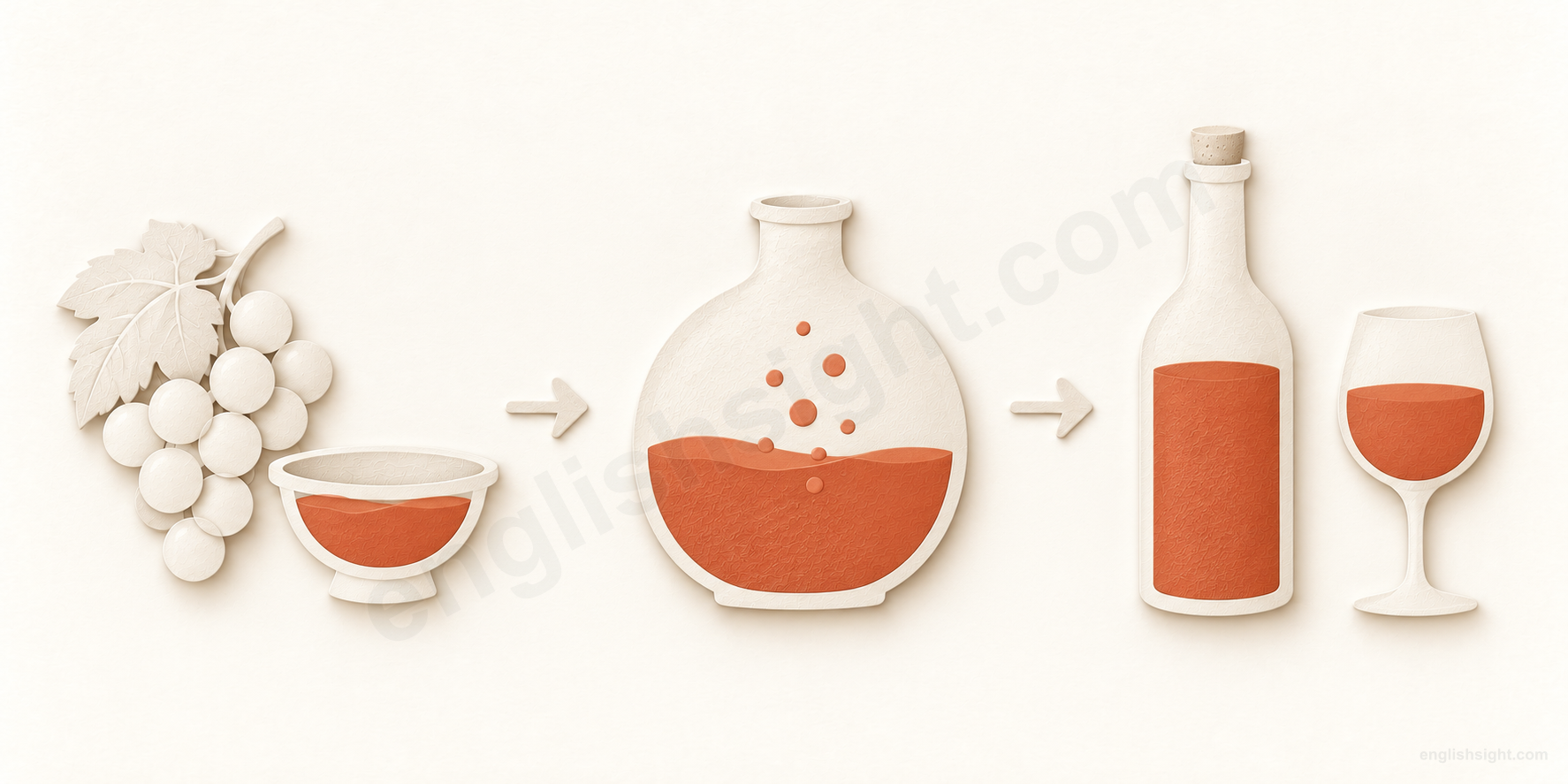
Juice ferments into an alcoholic drink
Grapes provide the juice.
wine
Wine is the finished alcoholic drink.
The juice ferments, producing alcohol.
Grapes → fermentation → wine. The middle bubbles mark fermentation, not a claim that all wine is sparkling.
Wine is an alcoholic drink produced by fermentation, usually of grape juice.
The sketch follows the usual grape case: source, fermentation, and finished drink. Some established wine names use other ingredients. Colour descriptions and wine and dine are separate extensions, not steps in this process.
Wine usually names an alcoholic drink made from fermented grape juice. Everyday grammar then lets us talk about some wine, a glass of wine, or different wines.
Other uses need their own context: wine can be a dark red colour, and wine and dine describes food, drink, and hospitality. The picture is a teaching connection, not a claim about an image shared by every speaker.
01
The drink, a portion, or a kind
Start with a substance. Then notice how a container, an order, or a variety changes what you count.
01
drink / have / serve + wine; some wine; the wine
drink wine
refer to the alcoholic drink as a substance
Situation
Someone asks what you usually drink with a meal.
What you mean
You name a category of drink, not a number of glasses.
Wine normally names a drink made by fermentation, usually from grapes.
Wine is usually a noun. In ordinary conversation it most often means the alcoholic grape drink. Grape juice and wine are different: fermentation produces alcohol. The picture follows that distinction, rather than identifying any liquid in a bottle as wine.
Use wine without an article for the drink in general: Do you drink wine? Use some wine for an unspecified amount and the wine for a particular supply already identified. “Would you like some wine?” can be answered with “No, thanks. Water, please.”
In a sentence
We served wine with dinner, but I had water.
Watch the difference Wine does not mean every alcoholic drink: beer and spirits have their own names.
02
a glass / bottle of wine; two glasses of wine; a wine / two wines (orders)
a glass of wine; two wines
specify an amount or order servings
Situation
Two people each want one glass.
What you mean
The order counts portions rather than types.
The container or the ordering situation provides the unit.
A glass of wine and a bottle of wine make the measure explicit. In two glasses of wine, glasses is plural; wine remains the substance being measured. A little wine refers to an amount, not a small variety.
In a bar or restaurant, a wine can mean one glass or serving: Two white wines, please. This is contextual shorthand. Outside that situation, two wines may instead mean two kinds; name the glasses or bottles when the distinction matters.
In a sentence
Could we have two glasses of red wine, please?
Watch the difference A wine is possible, but its meaning depends on context. It does not always mean a bottle.
03
a + adjective + wine; wines from + place; adjective + wines
a good wine; French wines
identify or compare kinds of wine
Situation
A shop has products from several regions.
What you mean
You compare wines as distinct kinds or products.
Countable wine can identify a variety rather than a portion.
A good wine describes one kind or product. French wines groups products by origin, while three different wines can count kinds chosen for comparison. The article or plural does not change the basic drink meaning.
Compare There is some wine left, about an amount, with There are several wines available, about choices. Fine wine means wine regarded as very good quality; fine describes an evaluation, not another substance.
In a sentence
The shop sells wines from several small producers.
Watch the difference Several wines does not tell you how many bottles the shop has.
04
fruit / ingredient name + wine
fruit wine; rice wine
recognize named drinks made from other ingredients
Situation
A label names a fruit or another ingredient before wine.
What you mean
You identify a named alcoholic drink beyond ordinary grape wine.
The modifier can specify a different source ingredient.
Wine on its own usually suggests grapes. A name such as elderberry wine identifies a fermented drink from another fruit; rice wine is also an established English name. Follow the whole name rather than assuming that every wine contains grapes.
This is a boundary to the central picture: it shows the usual grape case, not a universal recipe for every drink whose English name includes wine.
In a sentence
She brought a bottle of homemade elderberry wine.
Watch the difference Do not replace every local name for alcohol with wine; learn the established English name.
02
Choosing and describing wine
Colour, sweetness, bubbles, and a restaurant’s selection answer different questions. Read the describing word as well as wine.
05
red / white / rosé wine; a glass of + colour + wine
red wine; white wine; rosé
name broad colour categories of the drink
Situation
A server asks which kind of wine you would like.
What you mean
You choose a colour category.
Red, white, and rosé classify the drink without specifying its sweetness.
Red wine, white wine, and rosé are established categories. White wine is a name for the pale kind; it need not look literally white. Rosé refers to pink wine. You can say rosé wine or simply rosé when the drink is understood.
Colour alone does not say whether a wine is dry or sweet. Add a separate description when needed: a dry white wine. The later colour sense wine-coloured works differently: it describes an object resembling dark red wine.
In a sentence
Would you prefer red wine, white wine, or rosé?
Watch the difference White wine is a drink category, not a claim that the liquid is the colour of milk.
06
dry / sweet wine; the wine is dry / sweet
dry wine; sweet wine
describe sweetness rather than wetness
Situation
You want a wine that is not sweet.
What you mean
You ask for a dry wine.
With wine, dry means not sweet; the drink is still a liquid.
Dry wine contrasts with sweet wine. Dry is a conventional taste description here, so the ordinary dry-versus-wet contrast would mislead you. A dessert wine is a sweet wine served with or after dessert.
The adjective supplies the distinction: wine itself does not tell you the sweetness. In Is this wine dry?, wine is the subject and dry describes it; in a dry wine, the description comes before the noun.
In a sentence
I would like a dry white wine rather than a sweet one.
Watch the difference Dry wine does not mean alcohol-free wine or an empty glass.
07
sparkling / still wine
sparkling wine; still wine
distinguish drinks with and without bubbles
Situation
Two wines have the same colour but different textures.
What you mean
You specify whether you want bubbles.
Sparkling describes gas bubbles; still contrasts with it.
Sparkling wine contains bubbles. Still wine is the non-sparkling kind. This is a different distinction from red versus white and dry versus sweet; a wine description can combine more than one of these dimensions.
Read sparkling in its drink sense, not its shining-with-light sense. The bubbles in the middle of the teaching sketch mark fermentation; the sketch does not claim that every finished wine is sparkling.
In a sentence
For the meal, we chose a still white wine.
Watch the difference Still here does not mean the wine continues to exist, as it would in There is still some wine left.
08
the house wine; house red / white; wine by the glass / bottle
house wine; wine by the glass
ask about a restaurant’s regular selection and serving options
Situation
You want a straightforward choice without buying a whole bottle.
What you mean
You ask which house wines can be ordered by the glass.
House identifies the restaurant’s regular selection; by the glass names the selling unit.
House wine is a restaurant’s standard, usually inexpensive choice. House does not mean the wine was made inside that building. A restaurant may offer a house red and a house white.
Wine by the glass is sold in individual glasses, in contrast to by the bottle. These expressions answer different questions: which wine, and how it is sold. Table wine is an ordinary, fairly inexpensive wine suitable for meals; it is not necessarily the restaurant’s house wine.
In a sentence
Do you serve the house white by the glass?
Watch the difference House wine names a selection, not a serving size. Check by the glass or by the bottle separately.
03
At a restaurant and in the kitchen
Wine can name the drink in a meal or identify the purpose, contents, or source of something else.
09
the wine list; a list of wines
the wine list
ask for the restaurant’s wine choices
Situation
You have the food menu but need to see the drinks available.
What you mean
You ask for the wine list.
List is the head noun; wine tells you what the list contains.
A wine list lists the wines a restaurant offers. Asking Could we see the wine list? requests information rather than ordering a drink. Wine identifies the list’s subject, so it stays singular in the compound.
Compare a list of wines: the wines are now inside an of-phrase and can be plural. These two structures can describe the same information, but you do not form the ordinary compound by saying a wines list.
In a sentence
Could you bring us the wine list, please?
Watch the difference Asking for the wine list does not by itself order any wine.
10
a wine glass; two wine glasses; a glass of wine
a wine glass
name a glass intended for drinking wine
Situation
You need a suitable drinking vessel.
What you mean
You ask for an object that may still be empty.
A wine glass is a container; a glass of wine is a serving of the drink.
In wine glass, glass is the object and wine indicates its intended use. A wine glass can be empty, or it can contain water. In a glass of wine, the of-phrase states the contents.
Compare two wine glasses with two glasses of wine. The first counts vessels; the second normally describes two servings. This contrast helps you follow the word order instead of translating the two phrases as if they were identical.
In a sentence
Please put an empty wine glass at each place.
Watch the difference A wine glass does not promise that it contains wine.
11
wine tasting (activity); a wine tasting (event)
wine tasting; a wine tasting
describe comparing wines or a tasting event
Situation
People sample several wines to compare them.
What you mean
You name either the activity or an organized event.
Tasting supplies the activity or event; wine tells you what is sampled.
Wine tasting without an article can name the activity. A wine tasting is a particular event. At a tasting, people compare small samples rather than simply naming wine as their usual drink.
The countability belongs to the whole expression: We learned about wine tasting describes an activity; We booked a wine tasting refers to an event. This is not a new liquid sense of wine.
In a sentence
We booked a wine tasting for Saturday afternoon.
Watch the difference A wine tasting counts an event, not a glass or a kind of wine.
12
cook with wine; add wine to + dish; wine vinegar
cook with wine; wine vinegar
distinguish wine as an ingredient from a product made from it
Situation
A recipe calls for wine in a sauce.
What you mean
You add the named ingredient and distinguish it from vinegar.
With names an ingredient; wine before vinegar names its source.
Cook with wine and add wine to the sauce use the ordinary drink noun as a cooking ingredient. In a red-wine sauce, wine helps identify the sauce’s ingredient; the sauce itself is not a drink.
Wine vinegar is vinegar made from wine. The final noun matters: wine and wine vinegar are different ingredients. You cannot infer that a recipe asking for one is asking for the other merely because both names contain wine.
In a sentence
The recipe calls for white wine, not white wine vinegar.
Watch the difference Keep the whole ingredient name: white wine vinegar is vinegar, not white wine.
04
A colour and a social expression
The colour use draws on red wine. Wine and dine is an established expression about meals and hospitality.
13
wine-coloured / wine-colored + noun; wine-red + noun; in wine
wine-coloured; wine red
describe a dark red colour
Situation
You are describing a scarf, not a drink.
What you mean
You name its dark red shade by comparison with red wine.
The colour sense borrows the appearance of red wine.
Wine can name a dark red, often purplish shade. A wine-coloured scarf and a wine-red scarf describe colour, not material or contents. American English spells the first adjective wine-colored.
This is an established extension from the drink. It does not imply that all wine is red: the colour name refers to the red-wine association. A scarf in wine can also use wine as the name of a colour.
In a sentence
She chose a wine-coloured scarf to wear with her grey coat.
Watch the difference Wine-coloured does not mean stained with wine or made from wine.
14
wine and dine + somebody; be wined and dined
wine and dine somebody
entertain someone with good food and drink
Situation
A company invites visitors to an elaborate meal.
What you mean
It provides hospitality, perhaps to make a good impression.
The whole expression describes treating someone to food and drink.
In They wined and dined the visitors, the visitors are the people being entertained. A business purpose, a romantic intention, or a wish to impress can come from context; the expression does not by itself prove a hidden deal.
Wine and dine is an established paired expression, not a separable particle verb. Keep the person after both verbs: wine and dine them. The passive is natural: We were wined and dined. Forms include wined and dined and wining and dining.
In a sentence
The hosts wined and dined their guests after the conference.
Watch the difference Do not say wine them and dine as if and dine were a movable particle.
15
wine and dine; spend + time + wining and dining
wine and dine
go out and enjoy good meals and drinks
Situation
Travellers describe how they spent an evening.
What you mean
They talk about enjoying restaurant food and drink.
With no person as object, the subject enjoys the food and drink.
We spent the evening wining and dining describes the diners’ activity. Nobody needs to be named as the person receiving hospitality. Compare They wined and dined us, where us explicitly identifies the guests they entertained.
The expression suggests enjoyable, often rather elaborate eating and drinking. For an ordinary neutral report, We had dinner is simpler. Outside this expression, everyday English normally uses drink wine rather than the bare verb wine.
In a sentence
They spent their last evening in the city wining and dining.
Watch the difference Without an object, do not assume they were paying to entertain clients.
Keep the noun, the grammar, and the context together
Amounts, servings, and kinds
Wine is usually uncountable for the drink. A wine or wines can identify a kind, or a serving in an order. Use glasses or bottles to state the measure explicitly.
Listen to the last noun
A wine glass is an object, a wine list is information, and wine vinegar is vinegar. A glass of wine names the drink inside its container.
Forms and sound
Wine is pronounced /waɪn/ and sounds the same as whine, which can mean complain or make a high sound. The meanings differ. The verb forms wine, wines, wined, and wining are used here in wine and dine; wining has one n.
What this lesson leaves aside
This lesson covers everyday drink language, the colour, and wine and dine. It does not teach specialist wine classification, historical medicinal senses, literary images such as new wine in old bottles, or the separate Caribbean dance verb wine. Verb complement and particle-verb systems are not productive features of the main noun.
Choose what wine is doing
Use the situation, the article, and the whole expression to decide.
1. You need empty vessels for the table. What should you ask for?
2. A menu describes a dry white wine. What does dry tell you?
3. A shop advertises wines from six regions. What does wines most naturally count here?
4. The visitors were wined and dined by their hosts. What happened?
5. A shop sells a wine-coloured coat. What does the description specify?
Sources and teaching notes
Definitions and usage were checked against the sources below. Explanations, example sentences, and the diagram were written for this lesson; the visual connection is a teaching interpretation.
The diagram connects the usual drink to its source and production; speakers need not imagine the same picture.