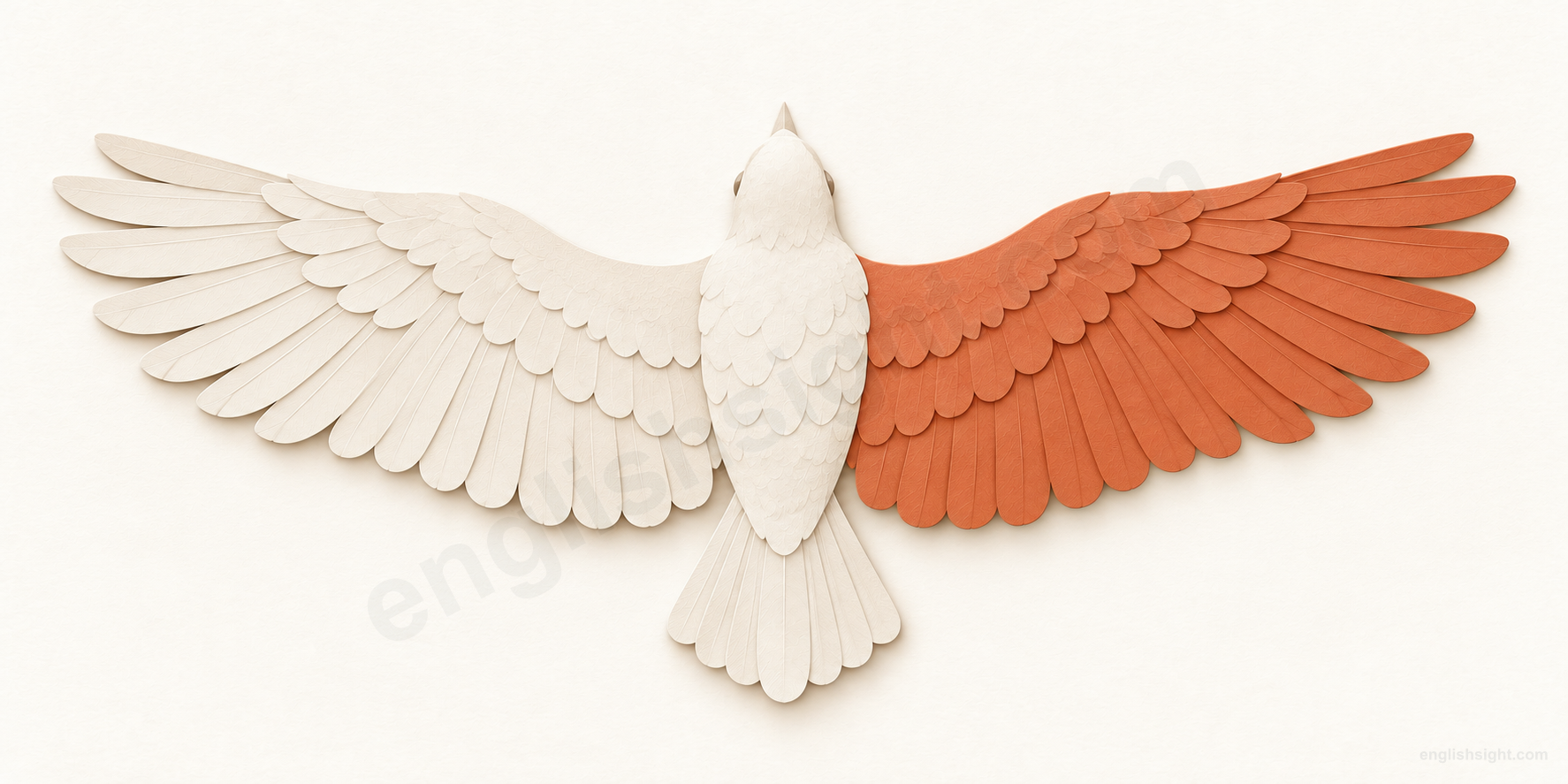
Follow wing from a physical part to side sections, freedom, support, and familiar expressions.
A side extension with a role in flight
A side extension with a role in flight
One central bird body.
wing
The spread wings provide broad surfaces for flight.
Two whole wings extend from its sides.
A whole wing extends from the side of the body and forms a broad surface for flight.
A wing extends from the side of a body; in flight, it helps support and move that body through the air.
Side-part meanings keep the relation to a larger whole. Several idioms draw on shelter or freedom; wing it must be learned separately. Not every animal with wings can fly.
A wing belongs to a body and extends from its side. Flight is central to many familiar uses, but a hospital wing, a theatre’s wings, and wing it require their own context.
The diagram offers a useful connection for learning. It does not claim that all English speakers imagine the same picture, or that one picture predicts every expression.
01
Wings on bodies, aircraft, and badges
Start with the physical part. Food and pilot qualifications keep recognizable connections to a real wing.
01
a / the / possessive + wing(s); flap / spread / fold + wings
a bird’s wings
the side limbs or surfaces associated with flight
Starting situation
A duck rests with its wings folded.
What the expression tells us
It opens and flaps them to leave the water.
A wing is a whole body part; a feather is one of its coverings.
Use a wing for one and wings for more than one: a damaged wing, both wings. Birds have two wings; bats have skin-covered wings, and insects have wings too. Do not assume that every insect has just two.
Flap its wings describes repeated up-and-down movement; spread its wings describes opening them out. Wing names the part, while flap and spread supply the action. Some birds, including penguins and ostriches, have wings but do not fly.
In a sentence
The duck spread its wings and rose from the pond.
Watch the difference A feather is not a whole wing. Two wings takes a plural verb: its wings are wet.
02
chicken wings; an order / a plate of wings
chicken wings
wings prepared or served as food
Starting situation
You choose a dish from a menu.
What the expression tells us
A plate of cooked wing pieces arrives.
The body-part name also names a serving of that part.
Chicken wings are a food item, not a different kind of flying surface. Chicken identifies the animal and stays singular before the plural head noun wings: six chicken wings.
On a food menu, wings can stand alone when chicken is understood. This is a context-dependent shortened expression. A restaurant may serve whole wings or separate pieces, so the word alone does not guarantee a whole anatomical wing in each portion.
In a sentence
We shared a plate of chicken wings with a spicy sauce.
Watch the difference For several pieces, say chicken wings, not chickens wing.
03
a plane’s wing; the wing of an aircraft; on / under the wing
the wing of a plane
a broad aircraft surface that produces lift
Starting situation
You look out from a window seat.
What the expression tells us
A broad fixed surface extends beside the aircraft.
An aircraft wing supports flight without needing to flap.
A plane’s wing is named by a similarity of function and position to an animal’s wing. It extends from the body and helps keep the aircraft in the air. It need not move like a bird’s wing.
Use on for a mark or object on the wing’s surface and under for a position below it: ice on the wing, an engine under the wing. The wing tip is its outer end. These prepositions describe ordinary spatial relations.
In a sentence
From my seat I could see ice on the plane’s wing.
Watch the difference A wing is not the entire aircraft; flying in a plane and ice on its wing describe different relations.
04
get / earn + possessive + wings
get / earn your wings
qualify as a pilot
Starting situation
A trainee completes the required flying training.
What the expression tells us
The trainee receives recognition as a qualified pilot.
Plural wings can stand for a flying qualification and its badge.
Get your wings or earn your wings refers to qualifying to fly. The plural also names a badge shaped like spread wings. It does not mean that the person grows a pair of body parts.
The possessive follows the person: she earned her wings; they earned their wings. Getting wings has a specific aviation association here. It is not an ordinary replacement for passing any examination.
In a sentence
After months of training, Lena finally earned her wings.
Watch the difference Keep the conventional plural wings in this qualification expression.
02
Side parts, positions, and groups
A wing can be a part beside a larger center. Context tells you whether it is a building section, a sports role, or a group of people.
05
the + direction / function + wing; a wing of + building; in a wing
the east wing of the hospital
a distinct section extending from a main building
Starting situation
You enter the hospital’s main reception area.
What the expression tells us
You follow signs to one section of the building.
A wing belongs to the larger building while forming a distinct part.
A building wing is a section attached to or extending from the main part. A direction can locate it, as in the east wing, or a function can identify it, as in the maternity wing.
People and rooms are in a wing. A hospital may build a new wing without replacing the whole building. This use preserves a center-and-side relationship; the section does not need to look like a feathered bird wing.
In a sentence
The children’s clinic is in the hospital’s east wing.
Watch the difference For a room’s location, use in the wing, not on the wing.
06
front / rear wing; a dent in a wing; wing mirror (British)
a dent in the front wing
the car body panel above a wheel, in British English
Starting situation
A car scrapes a post near a front wheel.
What the expression tells us
The panel above that wheel has a dent.
British wing corresponds to North American fender in this car-body sense.
This wing is a vehicle panel, not a device that makes a normal car fly. In British usage, the front wing can be damaged or repaired. In North America, fender is the usual word for this part.
British wing mirror is a separate compound for an exterior mirror used to see behind the vehicle; North American English commonly calls it a side-view mirror. It is not a mirror shaped like a bird’s wing. A racing car’s aerodynamic wing is another use: it produces a downward force that helps hold the car on the road, rather than lifting it into the air. It is distinct from the wheel panel.
In a sentence
The garage repaired a dent in the left front wing.
Watch the difference Do not replace wing with fender when talking about an aircraft’s lifting surface.
07
the + identifying noun / adjective + wing of + organization
the youth wing of an organization
a section within a larger organization
Starting situation
A larger association has members of different ages.
What the expression tells us
Its younger members organize activities through their own section.
The wing remains part of a larger organized body.
An organization’s wing can be distinguished by the work it does or the people it represents. Youth wing identifies a group associated with young members. A military wing identifies a group responsible for military activity.
The members do not need to sit on the same physical side of a room. The connection to a wing is a distinct part of a larger whole. A wing is not necessarily an independent organization or a separate building.
In a sentence
The association’s youth wing organized a weekend clean-up.
Watch the difference Read the identifying word: a hospital’s new wing may be a building section, while a party’s youth wing is a group.
08
the left / right wing of + party; on the left / right wing; left-wing / right-wing + noun
the left wing / right wing
a political grouping defined by its views
Starting situation
Members of a party disagree over policy.
What the expression tells us
A recognizable group supports a particular political direction.
Political left and right describe views, not room positions.
The left wing of a party generally favours greater social change, while its right wing is more conservative and more inclined to preserve existing arrangements. These are relative labels: specific policies depend on the country, party, and period. Left-wing and right-wing are the corresponding adjectives: left-wing policies, a right-wing newspaper.
This is a specialization of the organization sense. A speaker can be on the left wing of a party without standing anywhere in particular. In sport, the same words instead refer to field positions or players; the surrounding topic decides.
In a sentence
The proposal divided the party’s left wing and right wing.
Watch the difference In the adjective before a noun, use the usual hyphenated form: right-wing views. The noun is right wing.
09
play on the left / right wing; a left / right wing; winger
play on the wing
play in a wide attacking position; also, a player in that role
Starting situation
A team needs someone near one side of the playing area.
What the expression tells us
A player takes the wide position.
Wing may name the location, the role, or the player.
In football and hockey, on the left wing or on the right wing places play near a side of the field or rink. The direction is understood from the team’s attacking orientation, not from whichever way a spectator faces.
A wing can also be a player: Our new right wing is very fast. Winger is another word for the player. In plays on the wing, on belongs to the position expression; it does not mean the person is physically sitting on an animal’s wing.
In a sentence
Kai usually plays on the right wing.
Watch the difference Use on the wing for the sports position, but in the wing for a room in a building.
10
in / from / into the wings
in / from the wings
in the hidden spaces beside a stage
Starting situation
An actor is beside the stage but out of the audience’s view.
What the expression tells us
The actor can watch or prepare to enter.
Theatre wings are offstage side areas, usually named in the plural.
The wings are the concealed areas to the sides of the acting space. Waiting in the wings can describe an actor literally waiting there, and watching from the wings gives the hidden side area as the viewpoint.
The image of a part beside the center helps with this use, but a theatre’s wings are not simply the building’s east and west wings. The stage and audience’s sightline matter. Backstage is a broader word for areas behind the public performance.
In a sentence
I watched the final scene from the wings.
Watch the difference For this theatre expression, keep the plural and article: the wings.
03
Protection, independence, and readiness
Learn these expressions as complete patterns. Some draw on flight; waiting in the wings draws on the theatre.
11
take + person + under + possessive + wing; be under someone’s wing
take someone under your wing
help and guide someone with less experience
Starting situation
A new colleague is unsure how the workplace operates.
What the expression tells us
An experienced colleague guides and supports them.
The whole expression turns shelter under a wing into personal guidance.
The person doing the helping is the subject of take; the learner is its object. The possessive belongs to the helper: Maya took Ben under her wing. Under supplies the shelter relationship in this conventional image.
The help may include advice, introductions, or protection from avoidable problems. It does not require legal responsibility or literal physical shelter. Be under someone’s wing describes the supported situation rather than the start of the relationship.
In a sentence
Rosa took the new volunteer under her wing and showed him how everything worked.
Watch the difference Match the possessive to the helper: he took me under his wing. Do not use my wing in that sentence.
12
spread + possessive + wings
spread your wings
become more independent and try unfamiliar activities
Starting situation
Someone stays within a familiar routine.
What the expression tells us
They try new things and gain experience.
Opening wings becomes a conventional image for wider independent action.
Literally, a bird spreads its wings by opening them. With a person, spread your wings usually concerns independence, confidence, or experience. The new activity need not involve travel.
The person’s own possessive is normal: I spread my wings; she spreads her wings. This expression does not simply mean stretching your arms, and it does not guarantee success in every new activity.
In a sentence
Joining a different project gave me a chance to spread my wings.
Watch the difference Spread has the same past form: Last year I spread my wings, not spreaded.
Restricting action is compared with reducing a bird’s ability to fly.
The subject is the person, rule, or circumstance that imposes the limit. The possessive names the person affected: The board clipped the manager’s wings. The person is not literally injured.
Unlike spread your wings, this expression emphasizes a constraint. It can also appear in the passive: His wings were clipped by the new rules. Learning the whole phrase is necessary; clip alone has several other meanings.
In a sentence
The new spending rules clipped the director’s wings.
Watch the difference The plural wings belongs to the fixed expression, even when only one person is affected.
14
wait / be waiting in the wings; be in the wings
wait in the wings
be ready to step in when needed
Starting situation
The current leader is still in charge.
What the expression tells us
A possible replacement is ready but has not taken over.
This figurative expression comes from the offstage waiting position.
A person waiting in the wings is available to take a role when the opportunity comes. A plan or product can also be in the wings, ready to be used or introduced.
Unlike merely waiting, the expression suggests readiness near the action. Unlike the literal theatre use, it need not involve a stage. There is no promise that the waiting person or plan will actually be chosen.
In a sentence
A second team is waiting in the wings if we need extra help.
Watch the difference Keep in the wings. On the wing instead concerns flight or, in sport, a playing position.
15
be / do something on the wing; take wing; took wing
on the wing / take wing
be flying / start flying away
Starting situation
A bird lifts from a branch and continues across the sky.
What the expression tells us
Its departure and its ongoing flight can be described separately.
Take wing highlights departure; on the wing describes flight already happening.
These are literary expressions. The birds took wing describes the start of flying away. Birds on the wing are in flight; an activity done on the wing happens while flying. Ordinary conversation can simply use flew away or while flying.
Take wing can also be figurative, especially with imagination or ideas: Her imagination took wing. That presents a sudden free development of thought. It is not a general substitute for every use of leave or begin.
In a sentence
The swallows caught insects on the wing.
Watch the difference On the wing and take wing have no plural -s here. Compare actual body parts: its wings.
16
do / manage / run something + on a wing and a prayer
on a wing and a prayer
with very little hope of success, often because support or resources are inadequate
Starting situation
A group lacks enough money or preparation.
What the expression tells us
It attempts the project while hoping things work out.
The fixed phrase signals a precarious attempt, not assured success.
This idiom presents an attempt as having very little hope of working out. It can describe getting through a difficulty or launching a project with barely enough resources. The aircraft image is a memory aid; the whole phrase supplies the conventional meaning.
It does not require actual flying or a religious prayer. Compare wing it, which specifically focuses on performing without preparation. A project can run on a wing and a prayer because it lacks money even when its workers are well prepared.
In a sentence
With almost no funding, the group launched the festival on a wing and a prayer.
Watch the difference Keep both articles: on a wing and a prayer. The expression does not guarantee that the attempt succeeds.
04
Flying, sending, and improvising
Wing is also a verb. Notice the subject, the object, and the fixed expression wing it.
17
wing + direction; wing + possessive + way + to / across / towards…
wing your way somewhere
travel by flying, or as if flying
Starting situation
A flock leaves the coast.
What the expression tells us
It travels quickly toward a destination.
The subject moves; its way introduces the path of travel.
Wing can mean fly in literary description: The birds winged south. Wing their way south adds the noun way and a matching possessive. The destination or direction completes the movement description.
People may also be described as winging their way somewhere when traveling by plane. This can sound vivid or playful. Fly or travel is usually a simpler neutral choice; wing does not mean that a person moves their own arms to fly.
In a sentence
By dawn, the geese were winging their way north.
Watch the difference Match the possessive to the subject: we winged our way, not we winged its way.
18
thing + be winging its way + to + recipient / destination
be winging its way to you
be on the way to someone, presented as a quick dispatch
Starting situation
A sender dispatches a small parcel.
What the expression tells us
The parcel is on its way to the recipient.
Here the thing sent is the subject of an active verb phrase.
Your parcel is winging its way to you is a lively way to say it is being sent or is traveling to you. The phrase does not state that the parcel has literal wings or must be carried by air.
In is winging, is helps form an active progressive verb, not a passive. Compare has been sent, which is passive. To names the destination or recipient, while its way supplies the journey construction.
In a sentence
Your invitation is winging its way to you now.
Watch the difference Winging its way is a vivid description, not a precise delivery-time promise.
19
wing it; be winging it; winged it
wing it
perform without preparing fully
Starting situation
You are unexpectedly asked to introduce a guest.
What the expression tells us
You speak without a prepared introduction.
Wing it is a fixed informal expression for improvising.
In I had to wing it, it refers broadly to the task or performance. The focus is coping without adequate planning, rehearsal, or knowledge. Someone may wing it successfully or do badly; the phrase does not settle the result.
This is not a phrasal verb with a particle: it is a pronoun, not a word like up or out. Keep wing it as a useful complete chunk. The literal bird diagram cannot predict this meaning by itself.
In a sentence
I had no notes for the introduction, so I winged it.
Watch the difference Use winged as the past form. Do not read wing it as a promise to fly or as meaning work carefully from a plan.
20
wing + person / bird; be winged + by + shot / bullet
be winged by a shot
be wounded by a shot, especially in a wing or arm
Starting situation
A shot strikes a person’s arm.
What the expression tells us
The report describes a wound without saying the person was killed.
This is a separate shooting-related verb sense.
In fiction or a news report, a bullet may wing a bird or person. With a bird, the wing itself may be hit; with a person, it can mean wounding an arm or causing a nonfatal wound elsewhere. It does not mean giving the person wings.
Was winged is an ordinary passive: the person receives the action. This use deserves recognition, but neutral everyday reporting can say was wounded. It is unrelated to wing it meaning improvise, despite having the same past form.
In a sentence
In the story, the guard was winged by a stray bullet.
Watch the difference Do not assume winged always describes flight. Check whether a shot or bullet is involved.
Keep the context and the whole expression
Forms and word class
The noun is countable: one wing, two wings. Some expressions conventionally use a singular wing or plural wings. The verb forms are wing, wings, winged, winging. Wing it and wing your way are different patterns, not one general particle-verb family.
Related forms are not new verb senses
Wing can modify another noun, as in wing feathers. In black-winged birds, -winged describes the wings the birds have. This descriptive adjective differs from was winged by a bullet. Do not assume every -winged form is passive.
Boundaries of the picture
The physical diagram helps with side extensions and flight associations. It does not prove the meanings of political labels, theatre expressions, or improvisation. Technical plant structures, military formations, wing chairs, and specialist aviation compounds are outside the detailed lesson.
Read the relation, then choose
Use the setting and the full expression to decide what wing means.
1. You are describing the location of a clinic inside a hospital. Which sentence fits?
2. An experienced colleague helps a newcomer learn the job. Which expression fits?
3. You are asked to speak without any prepared notes. Which expression emphasizes improvisation?
4. Another team is ready to help if needed, but is not involved yet. Which expression fits?
5. You want several pieces of a familiar chicken dish. Which wording is natural?
Sources and teaching notes
The sources below support the meanings and usage distinctions. The explanations, examples, and diagram are original teaching material. The visual connection is a teaching model.
This diagram helps explain a connection; it is not a picture shared by every native speaker.