Winter: the cold season between autumn and spring.
Talk about seasonal time, winter conditions, and spending the season somewhere.
A cold-season interval in the yearly cycle
A cold-season interval in the yearly cycle
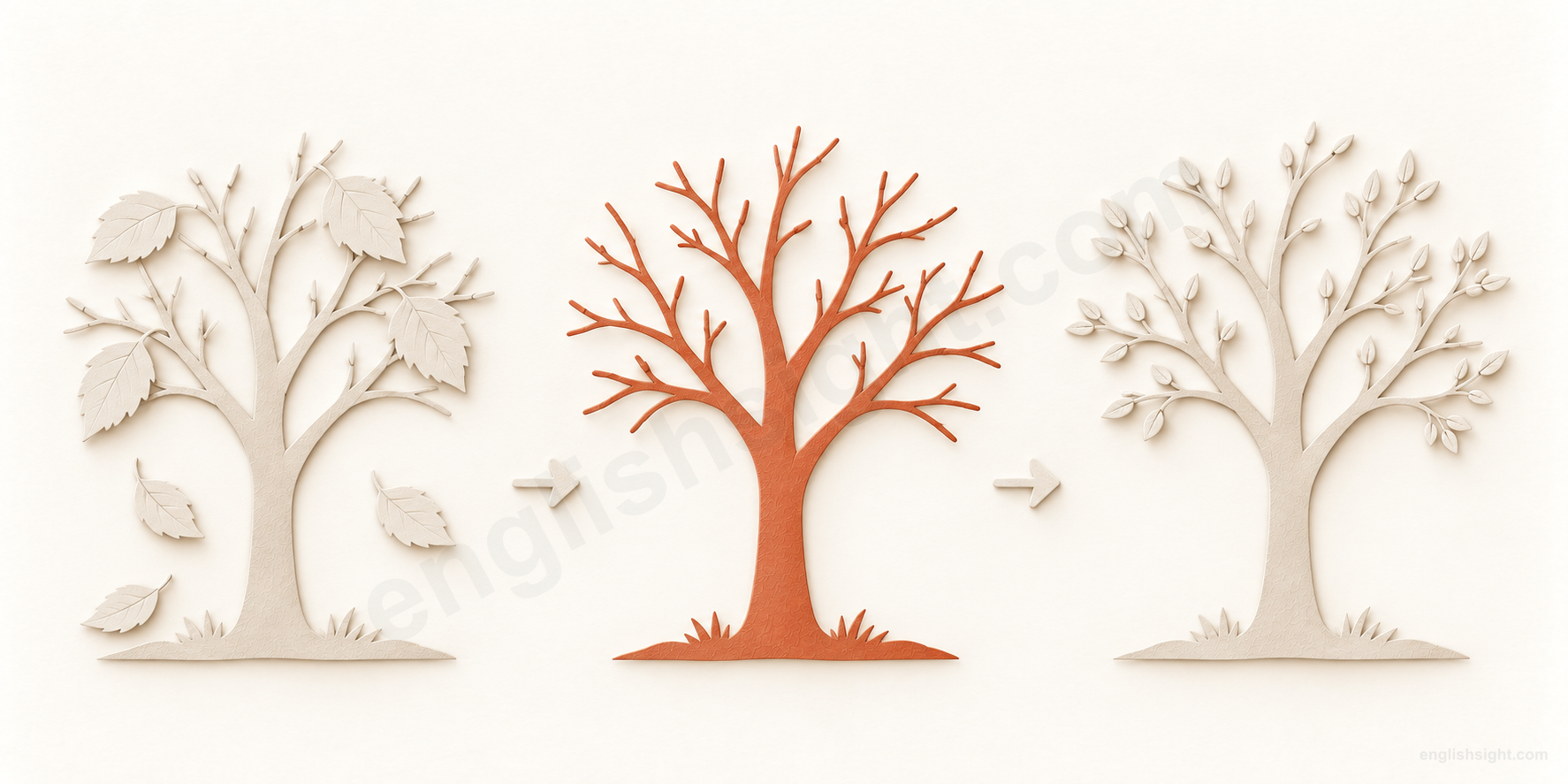
Autumn: mature leaves fall from the tree.
winter
Spring: small new leaves appear on the branches.
Winter: the bare tree marks the middle season.
Winter lies between autumn and spring. The bare branches show one temperate-climate example; winter need not bring snow.
Winter is the usually cold season between autumn and spring; other uses connect things, activities, or comparisons with that seasonal period.
The tree sequence is a teaching model drawn from a temperate climate. It shows seasonal order, not a universal landscape or a claim that every English speaker pictures winter this way.
Winter names a recurring season, usually associated with colder weather. Start with its position in the year, then notice how grammar lets you name a particular winter, connect things with it, or use winter as a verb.
The season is the shared reference point; the whole phrase determines the message. A winter coat, the winter blues, and birds wintering somewhere have different structures and cannot be understood by assigning every expression a single translation.
01
A season and a time in the year
Name the season, place an event within it, or identify one particular winter. Articles and time words make different choices.
01
winter + verb; the beginning / end of winter
winter
the usually cold season between autumn and spring
Situation / reference
Autumn is ending in a place with four familiar seasons.
Meaning in context
Spring comes after the winter period.
Winter names a recurring part of the year, rather than any cold day.
Winter is a noun for the season. It can be the subject of a sentence: Winter begins soon. Autumn comes before it and spring after it. The ordinary season name is lowercase unless it begins a sentence or belongs to a proper name.
The tree sequence uses a temperate climate to show the relationship. Local conditions differ: a winter can be mild, rainy, or snowless. Northern and Southern Hemisphere winters occur at opposite times of year, and calendar conventions for their boundaries differ. A snowflake alone would not explain the seasonal relationship.
Winter can also refer to the cold weather associated with the season, rather than a strict calendar interval. There was a touch of winter in the air this morning suggests winter-like cold; it can be said before the winter season has officially begun. This weather-related use does not change the calendar date.
In a sentence
Winter is usually rainy here, but spring is much drier.
Watch the difference Cold describes a temperature or condition. In its main use, winter names a season: a cold day in summer is still a summer day. Expressions such as a touch of winter can instead evoke winter-like weather.
02
in (the) winter; during the winter; for winter; by winter
in winter / in the winter
place events within the winter season
Situation / reference
You are explaining a seasonal routine.
Meaning in context
The listener knows when that routine applies.
In gives a time setting; it does not turn winter into an action.
In winter and in the winter are both ordinary ways to say when something happens. The article does not create a different season: We walk less in winter and We walk less in the winter can describe the same habit. Context determines whether a general season or a particular winter is intended.
During the winter also places an event within that period. It does not guarantee that the event lasted for the entire season. For winter can express preparation or intended use: We buy extra fuel for winter. By winter sets a deadline: The roof must be repaired by winter. These meanings come from the prepositions.
In a sentence
We keep extra blankets upstairs in winter.
Watch the difference For a simple seasonal time setting, use in winter, not on winter or at winter. On a winter morning refers to a day-related occasion instead.
03
last / this / next winter; in the winter of + year; early / late this winter
last winter / this winter / next winter
identify a winter relative to the present
Situation / reference
The conversation has a current point in time.
Meaning in context
The listener identifies a past, current or approaching, or following winter.
Last, this, and next normally make the whole phrase work as a time expression.
We met last winter places the meeting in the previous winter. We are moving next winter points to the next relevant winter. This winter can refer to the one now in progress or the approaching one, depending on when you speak.
These time phrases usually stand without in or the: I will visit this winter. Compare in the winter of 2022, which identifies a season by a year. Early winter and late winter divide the season itself: in early winter, but early this winter. Last winter’s storms uses the possessive to connect the storms with that season.
In a sentence
We moved here last winter, and our cousins will visit next winter.
Watch the difference For the ordinary time expression, say next winter, not in next winter or the next winter. The next winter can be natural in a past narrative: We arrived in 2020; the next winter was very wet.
04
a + adjective + winter; number + winters; number + winters ago
a mild winter / two cold winters
describe or count particular winter seasons
Situation / reference
You compare weather over one or more years.
Meaning in context
Each winter can be treated as a separate occurrence.
A and plural winters count seasons, while adjectives describe their conditions.
Winter can be uncountable when naming the season in general, or countable when you pick out one occurrence: We had a mild winter. Two harsh winters refers to two separate seasonal periods. A mild winter is less cold than usual; a harsh or hard winter brings severe conditions.
A long winter emphasizes duration, and a snowy winter emphasizes snow. These are useful combinations, not separate meanings of the noun. Two winters ago counts backward by seasonal occurrences. It does not mean a period lasting exactly twenty-four months.
In a sentence
After two harsh winters, we finally had a mild winter.
Watch the difference Use the plural after two: two winters. Do not say two winter when winter is the head noun; winter coats is different because coats is the head noun.
05
all winter; over the winter; through the winter; get through the winter
all winter / through the winter
describe a duration across the season
Situation / reference
An activity or condition starts before winter is over.
Meaning in context
You specify how much of the season it covers.
All and through contribute duration; winter supplies the seasonal period.
All winter explicitly means throughout that winter: The cabin stayed empty all winter. Over the winter can describe a change or an event during the winter interval: We repaired the cabin over the winter. That sentence need not mean that repair work occupied every day.
Through the winter presents the season as a period extending toward its end: The road stayed open through the winter. Get through the winter means manage to reach the end of the season, often despite difficulties. The endurance idea comes from get through, not from a special verb meaning of winter.
In a sentence
The village shop stayed open all winter.
Watch the difference All winter explicitly covers the full seasonal span. During the winter can locate an event within it without saying that the event lasted the whole season. All winter long also emphasizes the full duration.
02
Things and expressions associated with winter
Use winter before another noun, or learn a familiar expression as a whole. The second word contributes much of the meaning.
Winter specifies the relevant season, purpose, or setting.
The following noun tells us the kind of thing; winter narrows its association.
A winter coat is a coat suitable for winter use; winter sports are activities associated with winter conditions, such as skiing. Winter holidays are holidays in that season. Winter weather and the winter months refer to conditions and months belonging to the season. The relationship changes with the head noun.
Some dictionaries label winter here as an adjective; others describe the noun used as a modifier. For learning purposes, keep winter before the head noun and normally singular: two winter coats. Compare a wintry morning, which emphasizes cold or other winter-like qualities, even if it is not actually winter. A winter morning locates the morning in the season.
In a sentence
I packed a winter coat for our winter holiday.
Watch the difference To describe how the weather feels, say It is wintry or It feels like winter. It is winter names the season; It is very winter is not the normal adjective pattern.
07
in the dead of winter
in the dead of winter
in the deepest, typically coldest part of the season
Situation / reference
A speaker emphasizes a difficult seasonal setting.
Meaning in context
The event is placed deep within winter.
The dead of winter is an established expression, not a statement that the season has died.
In the dead of winter evokes the deep, cold, quiet part of the season. Collins marks the expression as literary; it is useful for vivid storytelling rather than neutral scheduling. You might use it when describing a journey or a house without heating.
Learn the whole phrase, including the: in the dead of winter. It does not specify an exact date, and it does not mean the end of winter. The noun dead contributes the idea of greatest quiet or least activity; winter still supplies the season.
In a sentence
Our heating stopped working in the dead of winter.
Watch the difference Do not confuse the dead of winter with the end of winter. The expression places you deep inside the season, not at its finish.
08
have / get / shake off + the winter blues
the winter blues
feelings of unhappiness associated with winter
Situation / reference
Someone describes feeling low in the cold, dark season.
Meaning in context
The phrase names that seasonal mood.
Blues supplies the unhappiness meaning; winter supplies the association.
The winter blues is an informal expression for low spirits associated with winter’s cold or darkness. In I get the winter blues, get means experience or develop those feelings. The expression is about mood, not the colour blue.
Learn the usual plural form blues as part of the expression. People may say have, get, or shake off the winter blues. The phrase is an informal mood description; by itself it does not establish a medical diagnosis or mean that everyone dislikes winter.
In a sentence
I sometimes get the winter blues when the evenings are dark.
Watch the difference For this established expression, use blues, not a winter blue. Winter alone does not mean sadness.
03
Spending winter somewhere and figurative uses
The verb turns the season into a period spent or managed in a place. Figurative winter compares a difficult or inactive period with the season.
09
someone / something + winter(s) + place expression; spend the winter + place expression
birds winter in the south
spend the winter in a place
Situation / reference
You describe where animals remain for the season.
Meaning in context
Their winter location is identified.
As an intransitive verb, winter means pass the season somewhere.
Birds winter in the south means they spend the winter there. In introduces the location; it is not a particle carrying an idiomatic meaning. The place may be warmer than their summer home. Wintering there does not mean producing cold weather or sleeping all season.
The verb also applies to people: My grandparents winter by the coast. Collins marks this human use as formal; spend the winter by the coast is a straightforward everyday alternative. Forms are winter, winters, wintered, wintering: The birds are wintering here describes a temporary seasonal stay.
In a sentence
These birds breed near the lake but winter farther south.
Watch the difference Winter does not mean hibernate. Animals can remain active in the place where they winter.
10
winter + plants / animals + place expression; be wintered + place expression
winter plants indoors
keep or care for something during winter
Situation / reference
Plants or animals need a place and care for the season.
Meaning in context
Someone keeps them there through winter.
With a direct object, winter describes managing that object through the season.
A gardener can winter tender plants indoors: the gardener keeps and cares for them there during winter. The subject is the person doing the managing, and plants is the direct object. A farmer can also winter cattle in a sheltered field.
Compare The plants winter indoors, where the plants are the subject, with We winter the plants indoors, where we manage their seasonal stay. The passive The plants are wintered indoors describes the same care arrangement without naming the gardener. This transitive use is especially relevant in gardening and farming.
In a sentence
The nursery winters these young plants in a greenhouse.
Watch the difference Winter the plants means manage them through winter, not make the plants cold. It does not guarantee that every plant survives.
11
a winter of + abstract noun; winter as a figurative noun
a winter of uncertainty
a period described as bleak, inactive, or declining
Situation / reference
A writer describes a difficult period in life or public affairs.
Meaning in context
Winter evokes coldness or reduced activity without naming literal weather.
This is a figurative comparison with selected features of the season.
A winter of uncertainty can portray a period as bleak and difficult, even when the calendar season is summer. The of-phrase identifies the trouble being emphasized. This use is more literary than ordinary weather conversation.
Writers may also use winter for a late stage of life or a period of decline. Context tells you which comparison is intended; winter does not itself mean unemployment, old age, or hopelessness in every sentence. The tree’s later spring can help you remember the seasonal sequence, but a figurative winter does not promise that recovery will follow.
In a sentence
After the factory closed, the town entered a winter of uncertainty.
Watch the difference Keep figurative and literal readings separate. In We had a mild winter, winter is still the calendar season, even if the speaker had personal difficulties.
Keep the season and the construction distinct
Season and weather are related, not identical
Winter can be unusually warm, and another season can have a wintry day. Do not define winter as snow or assume that the same calendar months apply everywhere.
Read the head noun
Winter clothes are clothes for winter; winter weather is weather of the season. Wintry describes winter-like qualities. Dictionaries differ over whether winter before a noun is called an adjective or a noun modifier.
Recognize specialized and literary boundaries
Winter wheat is a crop sown in autumn for harvest the following spring or summer; the expression does not mean wheat harvested in winter. The specialized feeding pattern winter on + food appears in The cattle winter on hay. Poetic winters can count years. These recognition notes are outside the main everyday practice; they are not general rules for new phrasal verbs.
Forms and scope
Noun: winter, winters. Verb: winter, winters, wintered, wintering. The intransitive verb names a seasonal stay; the transitive verb can take an object and become passive. Winter blues and the dead of winter are established expressions. The lesson covers useful modern patterns, not every compound, title, proverb, or literary use.
Choose the seasonal meaning
Use the time words, the head noun, and the subject–object relationship to decide.
1. You want to say when you will visit, using next winter. Which ordinary time expression fits?
2. It is autumn, but the morning feels unusually cold and winter-like. Which sentence describes that quality?
3. The birds remain active but spend the winter near the coast. What does winter mean here?
4. A gardener says, “We winter these plants indoors.” Who manages the plants through winter?
5. A story takes place in the dead of winter. What seasonal setting does that phrase suggest?
6. You want to count two separate cold-season periods. Which wording fits?
Sources and teaching notes
The dictionary pages below support the meanings and usage distinctions. Explanations, examples, and the seasonal visual model were written for this lesson; compositional time patterns are identified separately from dictionary senses.
The seasonal sequence is a teaching aid, not a picture shared by every native speaker.