Follow wire from a useful material to connections, communication, and familiar expressions.
A strand with a practical job
A strand with a practical job
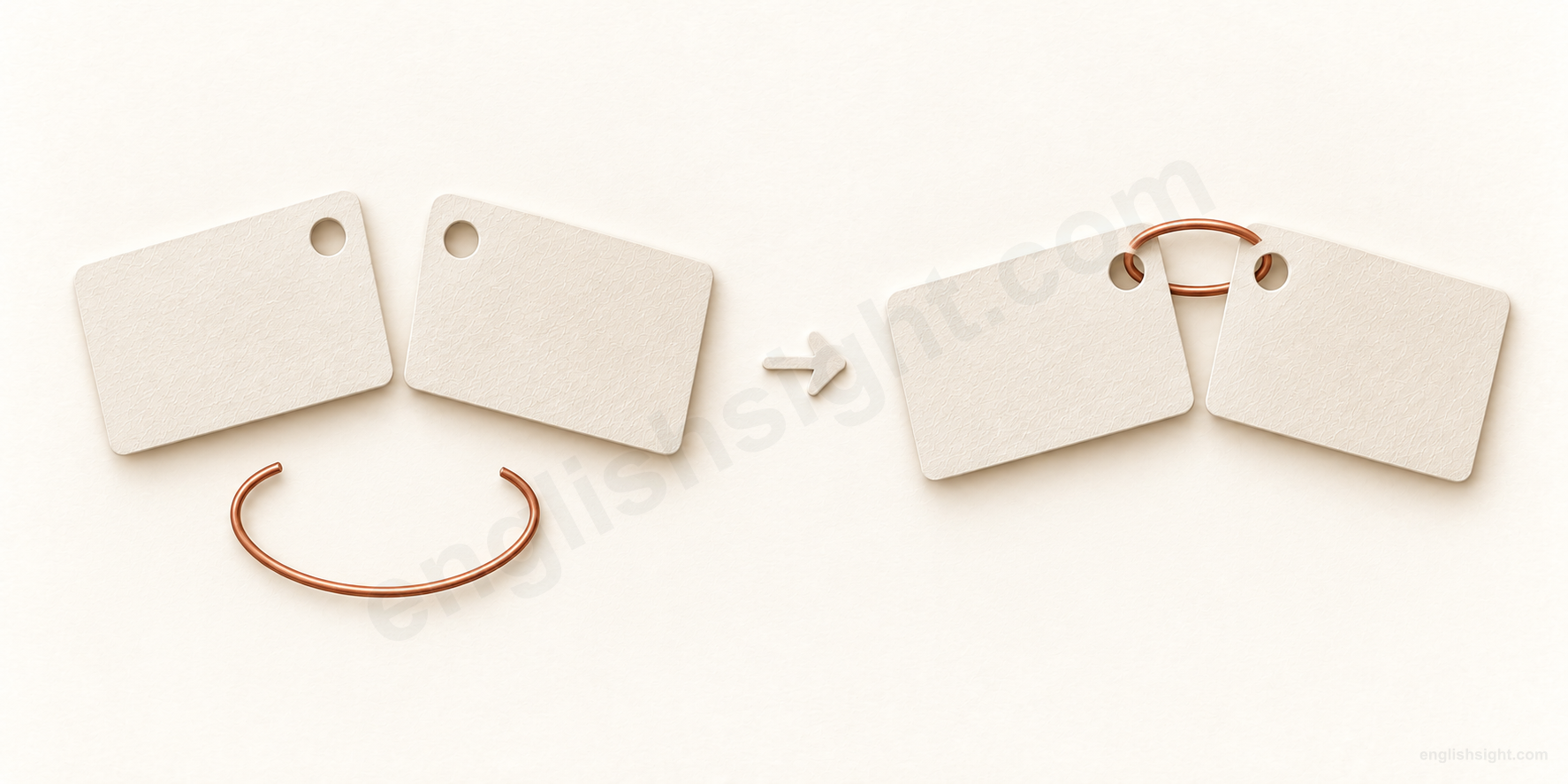
Two punched cards and an open length of copper wire are separate.
wire
The wire ring links the two cards.
The wire bends into a ring and passes through both holes.
A thin metal strand bends to connect two cards.
A wire is a long, thin metal strand that can be bent to hold things or used as an electrical connection.
The sketch shows the fastening use of a continuous strand. Electrical connections are another practical use; banking and idioms require their own explanations. This is a teaching model, not a universal mental picture.
Wire begins with a material: metal made into a long, thin strand. We can bend it around objects or use it to carry electricity and signals. The verb often names work done with this material.
Some uses have become names for messages, transfers, devices, or fixed expressions. Learn those meanings with their full patterns rather than expecting one picture to explain them all.
01
Metal strands and useful objects
Start with the material, a measured piece, and objects made from it. Wire need not carry electricity.
01
some wire; a piece / length / coil of wire; a wire / wires
some wire / a piece of wire
metal made into a long, thin strand
Situation
You need material for a model.
Meaning in this context
You measure out a length to use.
Wire names both material and an individual strand.
Use uncountable wire for the material: some wire, copper wire, or a metre of wire. A wire or two wires counts individual strands or lengths.
Thin metal can bend, wrap, or hold a shape; it is not necessarily soft thread. A piece of wire specifies one portion without changing the material meaning.
Example
We need two metres of thin wire for the model.
Watch the difference Do not add a plural merely because the length is large: ten metres of wire.
02
wire + noun; barbed wire; the wire
a wire fence / wire mesh
an object made from strands of metal
Situation
A garden needs a light barrier.
Meaning in this context
Metal strands form the barrier.
Wire before a noun often tells us what the object is made of.
A wire fence is a fence made with wire. Wire mesh or wire netting is an open network of strands; a wire rack supports things on spaced metal strands.
Barbed wire has sharp points along it. These are compound expressions, not phrasal verbs. In a prison or military story, the wire can mean the surrounding wire fence.
Example
A wire fence separates the vegetable garden from the path.
Watch the difference Wire is normally singular when it modifies another noun: a wire basket, not a wires basket.
03
an electrical wire; bare / live / overhead wires
an electrical wire
a conductor that carries electricity or a signal
Situation
A small lamp has a loose connection.
Meaning in this context
An electrician identifies the disconnected conductor.
An electrical wire connects parts, often inside a protective covering.
In electrical contexts, wire can refer to a conductor with insulation around it. Bare wire has exposed metal; a live wire is connected to an electrical supply and is not safely de-energized. Live here is not pronounced like the verb live: it rhymes with five.
Cable often names a covered assembly containing several conductors, though everyday wire and cable overlap. Thread and string do not name metal conductors.
Example
The electrician found a loose wire inside the lamp.
Watch the difference Not every wire is electrical, and an insulated wire can still be live.
02
Make a physical connection
The verb names work done with wire. The object and the following words show whether something is fastened, supplied with wiring, or connected to equipment.
04
wire + building / equipment; be wired for + service
wire a house / be wired for…
install electrical or signal wiring
Situation
An old workshop has no lighting system.
Meaning in this context
An electrician installs the connections needed for lighting.
The building receives a system of wires.
Wire takes the building or equipment as its object. The progressive names work in progress: They are wiring the workshop. In the passive, The workshop is being wired focuses on the building.
Be wired for lighting or cable television says what service the installed system supports. For names the purpose or service; it does not name the electrician.
Example
The workshop is being wired for new lighting.
Watch the difference Wire the house means install wiring; it does not mean send the house somewhere.
05
wire something up; wire it up to / into something; be wired up to a monitor
wire something up to…
connect equipment or a person to a device
Situation
A sensor is separate from a recording unit.
Meaning in this context
A technician connects it to the unit.
To identifies the device at the other end of the connection.
You can wire up the sensor or wire the sensor up. With a pronoun, put it between the verb and up: wire it up. Wire it up to the recorder identifies the equipment it connects to.
A patient wired up to a monitor has monitoring connections attached; the person is not being fastened shut. Wire something to a device also works without up. This use of up does not mean upward movement.
Example
The technician wired the sensor up to the recorder.
Watch the difference Use wire it up, not wire up it. Distinguish connecting equipment from merely switching it on.
06
wire + objects + together; wire + object + shut
wire things together
join or secure things with wire
Situation
Two sections of a decorative frame are separate.
Meaning in this context
Wire holds them together.
The wire acts as a fastener rather than an electrical connection.
Wire the sections together means use wire to join them. The noun supplies the material behind the verb; together supplies the relationship between the objects.
A result can follow the object: Her jaw was wired shut describes a medical procedure that held it closed. Shut names the resulting state; it is not the recipient of a signal.
Example
She wired the two sections of the frame together.
Watch the difference The object and context matter: wiring two wooden sections together need not involve electricity.
03
Money, messages, and listening
Some uses name services or devices associated with electrical communication. They are established meanings, not instructions to follow a visible metal strand.
07
wire + person + money; wire + money + to someone / into an account
wire someone money
send money electronically between banks
Situation
A relative needs funds in another city.
Meaning in this context
You arrange a bank transfer.
Money is transferred; a metal strand is not sent to the recipient.
Wire someone an amount and wire an amount to someone identify the same recipient in different grammatical positions. The money can also be wired into an account.
Wire transfer is the corresponding banking term. This use grew out of electrical communication, but a modern transfer does not require a telegram or a visible wire running between the people.
Example
I wired my sister the money for her ticket.
Watch the difference Wire me $200 requests money; wire me alone in an older story can instead request a telegram.
08
send + someone + a wire; wire + someone + news; wire + news + to someone
send a wire / wire someone
a telegram, or sending a telegram
Situation
A character in an older story needs to send urgent news.
Meaning in this context
The recipient receives a telegram.
The message takes its name from the communication system.
A wire can mean a telegram; wire as a verb can mean send one. Wire the news to her and wire her the news differ in the position of the recipient, not in the message.
This wording is especially associated with North American usage and older communication. For a message sent with a phone today, say text me or send me a message rather than treating wire me as the normal modern equivalent.
Example
In the novel, she wires her brother the date of her arrival.
Watch the difference A wire in this sense is a message, not a length of metal or automatically a money transfer.
09
wear a wire; wire + a room + for sound
wear a wire / wire a room
use a concealed listening device
Situation
Investigators want a recording of a conversation.
Meaning in this context
A device records or transmits the conversation.
Wire can name a hidden listening device or the act of installing one.
Someone wearing a wire carries a concealed microphone or recording device. This established noun sense does not simply mean wearing ordinary electrical cable.
To wire a room for sound can mean install hidden listening equipment. Context is essential: a studio wired for sound may simply have ordinary audio connections, with no secret recording.
Example
In the crime drama, the witness agrees to wear a wire.
Watch the difference Do not infer secrecy every time wired for sound appears; read the surrounding situation.
10
a wire service; a wire report
a wire service / a wire report
an agency supplying news to other media
Situation
A local paper needs reports from abroad.
Meaning in this context
A news agency supplies a report.
Wire identifies a news-distribution service, not the report’s material.
A wire service supplies news to newspapers and broadcasters. A wire report is a report supplied through such an agency, rather than necessarily written by the newspaper’s own reporter.
The name remains useful even when delivery is digital. It belongs to the communication family, but knowing the material meaning alone would not tell you which organization produced a report.
Example
The local paper published a wire report about the election.
Watch the difference A wire service is not an electrician’s business in this expression.
04
Wired equipment and people
Wired can describe a physical connection, a tense feeling, a tendency presented as built into someone, or close involvement in a network. Keep those readings separate.
11
wired + device / connection; wired versus wireless
a wired connection
connected through physical wires
Situation
You compare two types of headphones.
Meaning in this context
One uses a cable and the other uses a wireless link.
Wired describes the connection method.
Wired headphones and a wired internet connection use physical connections. Here wired is an adjective describing the equipment or link, not a report that somebody is excited.
Contrast wireless headphones. Wired is also the past form of wire: The technician wired the room yesterday describes an action; a wired connection describes a type of connection.
Example
I use wired headphones with this computer.
Watch the difference A wired device still needs a suitable connection; wired does not mean that every function is already working.
12
be / feel wired
feel wired
feel unusually alert, tense, or excited
Situation
You have had too much coffee late in the day.
Meaning in this context
You feel too alert to settle down.
The adjective describes a person’s state, not attached cables.
In informal English, I’m wired can mean I feel keyed up or nervous and cannot relax. The reason may be excitement, stress, or a stimulant such as caffeine; the adjective alone does not specify the cause.
Compare a live wire, which describes an energetic person. Feeling wired often highlights a current uncomfortable state, while a live wire can describe someone’s usual lively personality.
Example
I feel too wired to sleep after all that coffee.
Watch the difference Do not assume wired always means happy or always means drug use.
13
be wired to + verb; be wired for + tendency
be wired to do something
be disposed to respond in a particular way
Situation
You discuss a familiar automatic reaction.
Meaning in this context
You describe that reaction as built into people.
A system’s internal connections provide a metaphor for a tendency.
People are wired to notice danger presents a tendency as part of their underlying makeup. No actual electrical installation is being described.
The construction explains the way the speaker frames the behavior; it does not prove that a particular psychological claim is true, universal, or unchangeable. This is distinct from being wired up to equipment.
The related noun wiring can also describe the connections of the brain or nervous system: the brain’s internal wiring. It shares the connections metaphor; the word alone does not tell us whether a pattern is inherited or shaped by experience.
Example
The article argues that people are wired to seek social contact.
Watch the difference An infinitive names a response: wired to notice. To a monitor names connected equipment instead.
14
be wired into + network / group / organization
be wired into a network
have close connections within a group or organization
Situation
A reporter has contacts throughout local politics.
Meaning in this context
Those contacts give her access to people and information.
The connection is social or organizational rather than an electrical cable.
In informal descriptions, being wired into a group or network means being closely connected or involved with it. The connection metaphor extends from linked equipment to people and organizations.
The words after into identify the network: wired into political circles describes contacts and involvement, while a sensor wired into an alarm system describes a physical connection. Unlike wired to seek contact, this pattern does not describe an innate tendency.
Example
The reporter is wired into local political circles.
Watch the difference This informal metaphor does not mean that a person is wearing a hidden listening device.
05
Read the whole expression
Crossed wires, a final wire, and a live wire provide memorable associations. The full expressions have conventional meanings that the material alone cannot predict.
15
get / have + possessive + wires crossed
get our wires crossed
misunderstand one another’s message or plan
Situation
You expect a meeting online; your friend expects it in person.
Meaning in this context
You discover that you understood the arrangement differently.
The idiom presents communication as a connection that went wrong.
We got our wires crossed acknowledges a misunderstanding. It can soften a correction because it presents the confusion as a shared communication problem rather than directly blaming the other person.
The possessive follows the people involved: I got my wires crossed; we got our wires crossed. These are figurative wires, and an actual electrical fault is not required.
Example
We got our wires crossed: I thought we were meeting online.
Watch the difference Keep plural wires and crossed; a crossed wire by itself may describe a literal physical connection.
16
go / come down to the wire; take something down to the wire
go down to the wire
remain undecided until the very end
Situation
Two teams are close throughout a game.
Meaning in this context
The final moments decide the winner.
The wire marks the decisive end, not an electrical route.
A game or negotiation that goes down to the wire stays unresolved until its last stage. The wire has a finish-line sense, which helps explain the connection.
Taking something down to the wire can emphasize leaving very little time to finish. Neither wording guarantees success or says who will win.
Example
The match went down to the wire, with the winner decided in the final seconds.
Watch the difference This emphasizes a late decision or finish; it does not mean leading throughout the event.
17
get in / arrive / finish + under the wire
get in under the wire
manage something just before the cutoff
Situation
Registration is about to close.
Meaning in this context
Your registration arrives in time.
The expression focuses on narrowly meeting a limit.
Under the wire is informal and especially North American. It commonly means just in time before a deadline or before an opportunity ends.
The deadline context separates it from literal under the wire, meaning physically below a wire or fence. Compare down to the wire: that emphasizes the final stage, while getting in under it emphasizes meeting the cutoff.
Example
I submitted my registration just under the wire.
Watch the difference Under the wire does not normally mean too late for the stated deadline.
18
be + a live wire
a live wire
a lively, energetic person
Situation
A new teammate brings enthusiasm to a quiet group.
Meaning in this context
You describe her energetic personality.
The expression transfers the energy association to a person.
Calling someone a live wire is an informal description of a person full of energy. It does not mean the person is literally connected to electricity.
Compare a live electrical wire and I feel wired. The noun phrase a live wire can describe someone’s personality; wired can describe a temporary tense or overstimulated state.
Example
Our new teammate is a live wire who gets everyone involved.
Watch the difference Use the article for one person: She is a live wire, not She is live wire.
19
pull wires; pull wires for + person
pull wires for someone
use influence to obtain an advantage
Situation
Someone wants access to an opportunity.
Meaning in this context
A well-connected friend intervenes on their behalf.
The wires are a metaphor for hidden influence.
Pull wires is an informal expression, especially North American; pull strings is another familiar form. The phrase can suggest using personal connections rather than the usual open process.
Pull wires for someone identifies the beneficiary. It does not refer to installing cables, and it does not automatically say the influence succeeded.
Example
He offered to pull wires to get his cousin an interview.
Watch the difference The expression concerns influence, not simply working hard or making an ordinary application.
20
lead + (from) wire to wire; a wire-to-wire victory
lead from wire to wire
lead throughout a race or contest
Situation
A runner takes the lead at the start.
Meaning in this context
She keeps the lead until the finish.
The expression spans the whole contest.
Wire to wire or from wire to wire means from start to finish, often in sports reporting. With lead, it says the competitor remains ahead throughout.
A wire-to-wire victory uses hyphens before the noun. Contrast a race that goes down to the wire: that remains undecided until the end and need not have the same leader throughout.
Example
She led the race from wire to wire.
Watch the difference Do not replace wire to wire with down to the wire if you mean throughout.
Read the material, the object, and the whole phrase
Forms and grammar
The verb forms are wire, wires, wired, wiring: drop the final e before -ing. Most modern uses take an object. Active actions can be progressive or passive: They are wiring the room; the money was wired yesterday. The older telegram verb can also stand alone.
The object changes the interpretation
Wire a frame joins it with metal; wire a building installs connections; wire someone money sends funds. There is no general wire someone to do pattern meaning persuade them. In older telegram language, wire him to come can report a message asking him to come.
Wiring and related words
Wiring names the wires and connections of an electrical system, or the work of installing them. Wired has several adjective meanings. This lesson includes the useful everyday branches, not every technical compound or regional expression.
Choose what wire means here
Use the objects and the complete construction, not just the isolated word.
1. You need material for a model, measured by length. Which request fits?
2. A sensor must connect to a recorder. Which pronoun position is standard?
3. A relative asks, “Can you wire me the ticket money?” What are they requesting?
4. Your form arrives one minute before registration closes. Which expression highlights that timing?
5. You expected Tuesday; your friend meant Thursday. Which explanation fits?
Sources and teaching notes
Dictionary uses were checked against the publisher pages below. The explanations, examples, and teaching diagram are original; the visual model does not replace the separate meanings of fixed expressions.
The diagram is a teaching aid, not a mental picture shared by every English speaker.